Red Oak Tree Identification: Leaves, Bark & Acorns
Red oaks are among the most common hardwoods in eastern North America, and once you know what to look for, red oak tree identification is one of the more satisfying skills to pick up in the field. You’ll find this species from Nova Scotia down to northern Georgia and west into Kansas, in forests, city parks, and suburban yards alike.
Quercus rubra grows large, often reaching 75 feet tall with a crown nearly as wide. It earned its common name from the vivid red that sweeps through its foliage every October, one of the most reliable fall color events in the eastern woodlands.
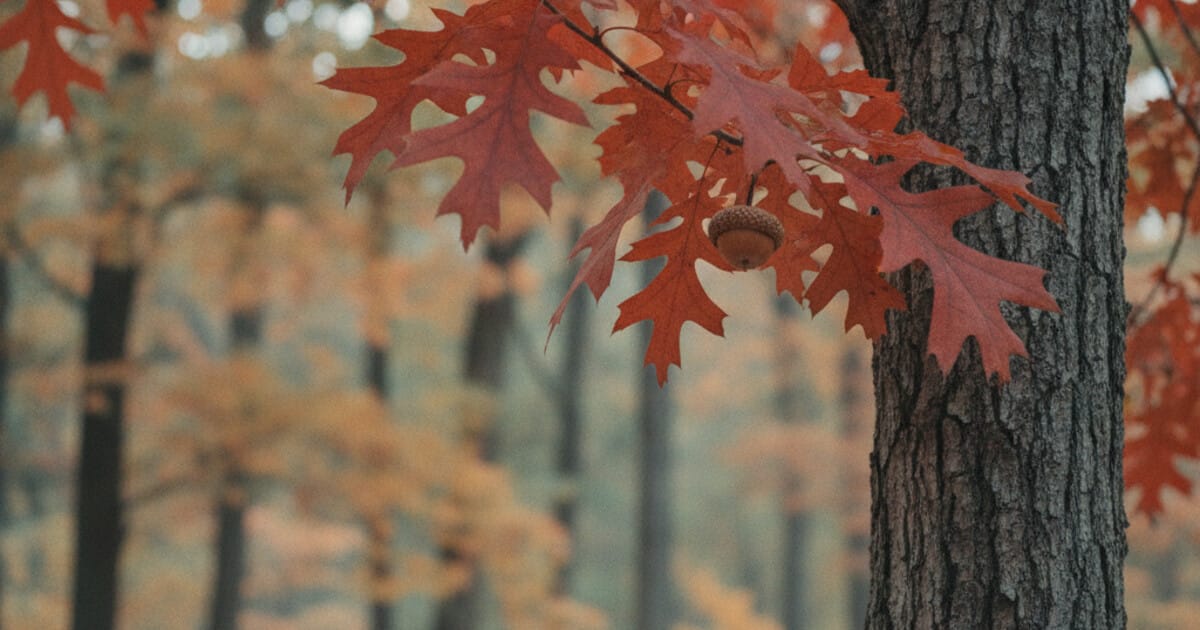
To identify a northern red oak, look for leaves with 7-11 lobes tipped with sharp bristles and sinuses that don’t cut halfway to the midrib. The bark has flat-topped ridges with a reddish inner layer when scratched, and the acorns are large with a shallow cap covering only about 1/4 of the nut.
What Does a Red Oak Tree Look Like?
A mature northern red oak is one of the larger hardwoods in eastern North America, typically reaching 65-90 feet tall with a broad, rounded crown spreading 45-60 feet wide. The trunk is straight and cylindrical, growing 2-4 feet in diameter at chest height on old trees. Open-grown specimens build a full dome-shaped canopy from a short trunk; trees in a dense forest grow taller and narrower, with a clear trunk before the first major limb.
The bark tells a two-part story. Upper branches and younger sections stay smooth and grayish-green, sometimes with a distinctly silvery sheen. The lower trunk shifts to broad, flat-topped ridges with shallow furrows running between them. Scratch a ridged section and the inner bark reveals a reddish-brown layer, which is where the common name comes from.
Fall brings the most striking visual. Red oak foliage shifts to vivid red to deep russet in late October, coloring 2-3 weeks after red maples peak. Young trees often hold their dried brown leaves well into December. That pattern of ridged bark below, smooth silver limbs above, and a late-season red canopy makes red oak one of the more recognizable hardwoods once you know what you’re looking at.
For a complete overview of all major oak species and how they compare, the oak tree identification guide covers the full family.
Sign 1: Red Oak Leaf Shape and Bristle Tips
Red oak leaves have 7-11 lobes, and every lobe tip ends in a pointed bristle rather than a rounded bump. That single detail separates the entire red oak group (section Lobatae) from the white oak group, where all lobe tips are smooth and rounded.
A mature leaf runs 5-9 inches long and about as wide. The lobes are broad and taper toward those bristle tips. Sinuses between lobes are moderately deep but don’t cut more than halfway to the central vein; compare that to scarlet oak, where sinuses go almost to the midrib and give the leaf a nearly skeletal look.
Red oak leaves have 7-11 lobes with bristle-tipped ends, a feature shared by all species in the red oak group (section Lobatae). Each leaf runs 5-9 inches long, with sinuses that cut less than halfway to the central midrib, which separates northern red oak from the more deeply lobed scarlet oak. The upper surface is dark green and slightly glossy through summer; the underside is paler with small axillary tufts of hair where major veins branch off. Leaves attach to the twig alternately rather than in facing pairs. In fall, red oak foliage turns vivid red to deep russet, typically coloring 2-3 weeks after red maples reach peak. Because several species in the red oak group, including pin oak, black oak, and scarlet oak, share the same bristle-tipped lobed leaf pattern, the leaves narrow your identification to the red oak group, but confirming the species requires checking bark and acorn features too.
For a broader overview of how lobe shape and leaf arrangement work as identification tools, the tree identification by leaf shape guide covers the full range of deciduous leaf types.
Sign 2: Bark With a Reddish Inner Layer
Young red oaks have smooth, grayish bark. As the tree matures, that bark develops broad, flat-topped ridges separated by relatively shallow furrows. The ridge tops stay somewhat shiny, unlike black oak bark, which forms deeper, blockier furrows with a rougher texture.
The most reliable bark feature is what’s underneath. Scratch a section of outer bark with your thumbnail and you’ll see a reddish-brown inner layer. White oak inner bark is cream or nearly white. Black oak inner bark skews more yellow-orange. Red oak inner bark is consistently reddish-brown, which matches the common name.
On upper branches, red oak bark stays smooth and grayish-green much longer than on the lower trunk, sometimes remaining silvery on the limbs into full maturity. That two-tone pattern, smooth limbs above and ridged trunk below, is a useful field marker in combination with other signs.
Sign 3: Acorns: Large Nuts With a Flat, Shallow Cap
Red oak acorns are large, running 3/4 to 1 inch long and nearly as wide. They’re almost hemispherical: short, fat, and rounded rather than elongated. The cap is shallow and flat, covering only about 1/4 of the acorn, like a beret rather than a deep bowl.
This shallow cap detail separates red oak quickly from white oak (whose cap covers roughly half the nut) and bur oak (whose fringed cap covers more than half). Red oak acorns also take two years to mature, so in mid-summer you’ll often see small green first-year acorns alongside the swelling second-year nuts on the same branch.
A mature red oak can produce tens of thousands of acorns in a mast year. Deer, wild turkeys, squirrels, and blue jays rely heavily on them through fall and winter.
Sign 4: Clustered Terminal Buds
At the end of each twig, red oak produces a tight cluster of 3-5 brown, sharply pointed buds grouped together at the branch tip. Each bud has multiple overlapping scales with slightly hairy or fringed edges (easy to spot with a hand lens).
This clustered terminal bud arrangement is a reliable winter field mark when no leaves are present. White oak buds look similar in shape but tend to be rounder and less tightly clustered at the tip. Pin oak buds are comparable in size, but pin oak’s lower branches droop noticeably, while red oak’s spread horizontally or angle upward.
Sign 5: Branch Structure and Crown Shape
Red oak develops a broad, rounded crown with branches that spread horizontally or angle upward. The lower branches don’t droop. That single feature separates red oak from pin oak faster than any other sign when you’re standing in a parking lot or park.
Open-grown trees spread 45-60 feet wide at maturity. Forest trees grow taller and narrower with a clear trunk before the crown begins. The trunk is typically straight and cylindrical, without the twisted or irregular form common on post oak or bur oak.
Sign 6: Fall Color and Winter Leaf Retention
Red oak turns vivid red to deep russet in late October to early November, and the color holds for 2-3 weeks before the leaves drop. Some individuals lean toward burgundy or orange-red rather than pure scarlet, depending on the year and growing conditions.
After the leaves drop, young red oaks hold their dried brown leaves into winter, sometimes through December or beyond. This marcescent leaf retention combined with the flat-ridged trunk patterns makes winter identification reliable even without a leaf in hand.
Sign 7: How Red Oak Compares to Similar Species
Four species cause most of the red oak confusion in the field: white oak, scarlet oak, pin oak, and black oak.
Red oak vs. white oak: White oak has smooth, rounded lobe tips with no bristles, where red oak lobe tips are pointed and bristled. White oak inner bark is cream or nearly white; red oak’s is reddish-brown. White oak acorn caps cover roughly half the nut versus red oak’s shallow quarter-coverage cap. These three features separate them reliably in any season.
Red oak vs. scarlet oak: Scarlet oak’s sinuses cut nearly to the midrib, producing a much more deeply lobed, almost skeletal leaf. Scarlet oak acorn caps are deeper. Red oak leaves look broader and more substantial by comparison.
Red oak vs. pin oak: Pin oak’s lower branches droop distinctly; red oak’s spread horizontally or angle upward. Pin oak leaves have narrower, more deeply cut lobes. Red oak grows considerably larger overall.
Red oak vs. black oak: These two are the hardest pair to separate. Black oak bark tends to be darker and more deeply furrowed with blockier ridges. Black oak inner bark is yellow-orange rather than reddish-brown. Black oak leaves often have more deeply cut sinuses. Their ranges overlap across much of the East, and natural hybrids exist, so some individuals will be genuinely ambiguous in the field.
How Tree Identifier Helps
When you want a fast confirmation in the field, Tree Identifier handles the analysis from your phone. Take a photo of the leaf, bark, or acorn and the app returns a species identification with a confidence score. It works from multiple input types: leaves, bark, fruit, and the whole tree silhouette.
For separating red oak from black oak, uploading both a bark photo and a leaf photo together gives you the strongest result. The app cross-references both features against its species database, which covers thousands of tree species including all major oak variants.
Tree Identifier works offline, so it functions in remote woodland areas without cell service. It’s free to start with 2 daily identifications. Download it on iOS or Android at treeidentifier.app.
Frequently Asked Questions
How do I tell red oak from white oak? Red oak leaf lobes end in sharp bristle tips; white oak lobe tips are smooth and rounded with no bristles. Red oak inner bark is reddish-brown; white oak inner bark is cream or nearly white. Red oak acorn caps are very shallow, covering about 1/4 of the nut, while white oak caps cover closer to half.
Do red oaks always have red fall color? Most do, but the intensity varies by tree and year. Some individuals turn more of a dull russet or burgundy-red than a vivid scarlet. Soil conditions, temperature swings, and individual genetics all affect the result. Scarlet oak and pin oak tend to produce more consistently vivid fall color than red oak.
How fast does red oak grow? Red oak is one of the faster-growing oaks, adding 2 feet or more per year when young and in good conditions. Mature trees typically reach 65-90 feet tall with trunk diameters of 2-4 feet. Exceptionally old specimens can exceed 100 feet, and the crown spreads 45-60 feet wide at maturity.
Where does red oak grow naturally? Northern red oak ranges from Nova Scotia and New Brunswick south to northern Georgia and Alabama, and west to eastern Kansas and Nebraska. It grows in a wide range of upland soils but does best in moist, well-drained acidic sites. It’s commonly planted as a street and park tree across its native range and in parts of Europe.
Are red oak acorns edible? Red oak acorns are edible after processing. Raw, they’re bitter from high tannin content. Leaching the tannins by soaking or repeatedly boiling and rinsing the acorns makes them palatable. Red oak acorns have more tannins than white oak acorns, so the process takes longer. Wildlife, including deer, squirrels, wild turkeys, and blue jays, eat them heavily without any processing.
Identify a tree from your photo — free
Upload a leaf, bark, or whole-tree photo and get the species in seconds. No signup.
Confidence:
Unlock the full species profile
Free in the app — with unlimited identifications.


AI result for guidance — the app gives full species details and works offline.
Want unlimited identifications?
Get the full species profile, photos and details — free in the app, with unlimited scans.
- Unlimited identifications
- Full species profiles & details
- Works offline, anywhere
- Save and revisit your finds
Elena Torres
Tree Identifier Team