Scarlet Oak Tree Identification: 7 Reliable Signs
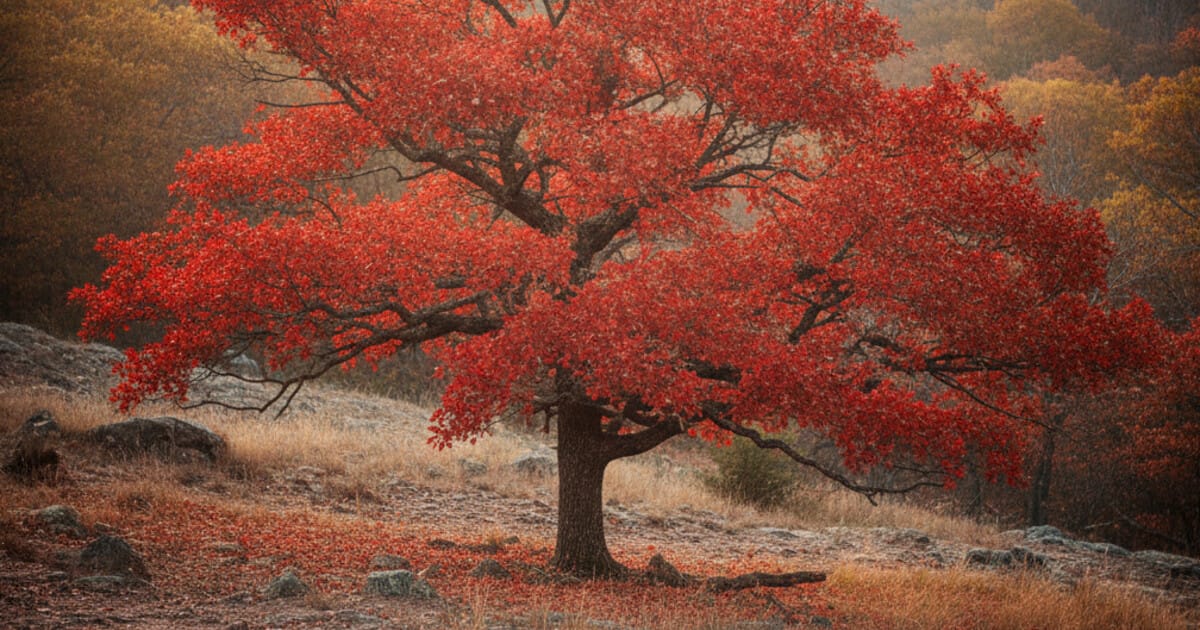
Scarlet oak (Quercus coccinea) earns its name every October when the foliage shifts to a deep, burning red that stands out from every other oak on the hillside. But six months before fall arrives, it’s a harder tree to pin down. The leaf shape is close to pin oak and black oak, the bark darkens with age, and the acorns take two years to mature, so summer identification relies on subtler clues. This guide covers 7 reliable signs that separate scarlet oak from its look-alikes, from the skeleton-like leaf silhouette to the deep-cupped acorns and the dry-slope habitat that tells you where to look in the first place.
Scarlet oak (Quercus coccinea) is identified by deeply lobed leaves with narrow sinuses cut nearly to the midrib, acorns with a deep cup covering roughly half the nut, dark furrowed bark, and ascending lower branches. It prefers dry, sandy, well-drained upland slopes and ridgetops, and turns the most intense scarlet of any eastern oak each fall.
How to Identify Scarlet Oak by Its Leaves
Scarlet oak leaves are 3 to 9 inches long with 7 to 9 narrow lobes ending in sharp, bristle-tipped points. The sinuses between lobes cut 60 to 80 percent of the way to the midrib, close to the same depth as pin oak but with slightly wider individual lobes. When you hold a scarlet oak leaf up to light, those open sinuses give it a skeleton-like look, with more airspace between the lobes than most red oak relatives.
Scarlet oak leaves are 3 to 9 inches long with 7 to 9 narrow, bristle-tipped lobes. The sinuses cut 60 to 80 percent of the way to the midrib, creating a distinctively open, skeleton-like leaf outline. The upper surface is bright glossy green in summer; the underside is pale green with small hair tufts at the vein axils. Fall color is the species’ most recognizable trait: a clear, burning scarlet that develops in late October, often with simultaneous yellow and red zones in the same leaf as color peaks. Individual trees vary somewhat, but scarlet oak’s fall color is consistently more vivid than pin oak, northern red oak, or black oak on the same site. Leaf drop comes fast, typically 2 to 3 weeks after color peaks. The leaves don’t hold through winter like pin oak’s marcescent leaves.
The lobe width is the most practical way to separate scarlet oak from pin oak on a fresh leaf. Scarlet oak lobes are noticeably wider, giving the leaf a fuller look. Pin oak lobes are narrower with a crisper cross-shaped silhouette. Both have about the same sinus depth, so sinus depth alone won’t help you.
If you find leaves on the ground, check the upper surface for gloss. Both scarlet and pin oak have shiny upper surfaces, but the gloss fades after a few days on the ground. Check attached leaves for the most reliable result.
Scarlet Oak’s Fall Color: Why the Name Fits
No eastern oak turns redder. Coccinea is Latin for scarlet or crimson, and the name fits precisely. Scarlet oak typically reaches peak color in late October, about a week or two after maples fade and just before most oaks have started turning.
The color is a clear, saturated red without much orange or bronze. On a sunny October day, a mature scarlet oak looks almost backlit. A row of upland oaks blazing that clean red on a dry hillside in late October is almost certainly scarlet oak. Northern red oak peaks slightly earlier and leans orange-red. Black oak is a darker, more muted red-brown. Pin oak tends to red-bronze and holds its dead leaves through winter.
Consistency varies from tree to tree. Some individuals run more orange-red in warm autumns, and young trees often show weaker color than mature ones. But across a stand, scarlet oak color is reliable enough to make fall the easiest identification season by a wide margin.
Scarlet Oak Acorns: Deep Cup, Half-Covered
Scarlet oak acorns are about 1/2 to 1 inch long and roughly ovoid. The cap is the diagnostic feature: it’s deep, covering 40 to 50 percent of the acorn, with scales pressed flat and slightly fringed margins. The cup looks like a tight bowl snugged around the lower half of the nut.
Compare that to pin oak, which has small, nearly round acorns with a very shallow cap covering only the top quarter. Northern red oak has very large, wide acorns (up to 1 inch wide) with a flat, saucer-like cap sitting under the nut. Scarlet oak’s cup is deeper than both.
Like all red oak group members, scarlet oak takes 2 years to mature its acorns. You’ll often see both small green current-year acorns and larger maturing second-year acorns on the same branch in late summer. Mature acorns drop in September and October and are a key food source for white-tailed deer, wild turkeys, squirrels, and blue jays.
A practical note: on the ground, scarlet oak acorns can be hard to separate from black oak acorns, which are similar in size and cup depth. Habitat and leaf shape are more reliable at that point.
Scarlet Oak Bark and Crown Shape
Bark: Scarlet oak bark is dark gray-brown to nearly black with deep furrows and flat-topped interlacing ridges. The overall impression is rough and dark, distinctly darker than pin oak’s lighter gray bark and rougher than younger red oaks. On older trees the bark can look almost black in wet weather. The inner bark, visible on a fresh cut, is pale yellow to pinkish, which is one of the few reliable distinctions from black oak. Black oak inner bark is yellow-orange and mucilaginous. Scarlet oak’s is pale yellow.
Crown: Scarlet oak has an open, somewhat irregular crown with ascending or horizontal lower branches. There’s no clean pyramid shape and no sharply drooping lower branches. Compared to pin oak’s tidy three-zone silhouette, scarlet oak looks scruffier from a distance, especially in winter when the bare canopy shows the irregular branching clearly. The crown becomes more rounded and spreading with age.
Size: Typical mature trees reach 60 to 80 feet tall, occasionally to 100 feet on good sites. Trunk diameter runs 1 to 2 feet at maturity. Growth rate is moderate, roughly 1 to 1.5 feet per year in good conditions on appropriate soils.
For bark comparison across oaks and other hardwoods, the tree bark identification guide covers the key features to distinguish red oak, white oak, black oak, and related species at a glance.
Scarlet Oak Habitat and Range
Scarlet oak is a dry-slope specialist. It grows on well-drained, sandy or rocky soils with low fertility and high acidity. Find it on ridgetops, south-facing slopes, sandy plains, and scrubby upland woods where other oaks can’t compete as well.
The native range runs from Maine south through the Appalachians to Georgia and Alabama, west through Tennessee, Kentucky, and Indiana. It’s most abundant in the mid-Atlantic and southern Appalachian states, where dry ridges with sandy or rocky soils are common. You’ll rarely find scarlet oak in bottomlands, river valleys, or anywhere with consistently moist soil.
That habitat preference is one of the most useful ID clues available. If you’re standing on a dry, sunny ridgetop with sandy soil and see a deeply lobed oak with dark bark, scarlet oak is the first hypothesis to test. If you’re in a river bottomland or suburban neighborhood with heavy clay soils, check pin oak, red oak, or white oak first.
Scarlet oak tolerates poor, acidic soils well, which makes it a component of the dry oak-heath forests that cover much of the Appalachian ridge system. It’s planted occasionally as a landscape tree for its fall color, though less commonly than pin oak or red oak.
The oak tree identification guide covers the full oak family, including the features that separate the red oak and white oak groups, which is useful context when working out which oak you’re looking at on any given site.
How Scarlet Oak Compares to Similar Species
Scarlet oak shares the red oak group with several look-alikes. Here’s where to focus:
Scarlet oak vs. pin oak (Quercus palustris): Both have deeply lobed leaves with bristle tips. Pin oak’s lower branches droop sharply; scarlet oak’s angle upward. Pin oak acorns are small with a shallow cap covering only the top quarter; scarlet oak acorns have a deep cup covering about half. Habitat is the strongest clue: wet bottomlands and suburban streets = pin oak; dry ridgetops and sandy slopes = scarlet oak. The pin oak identification guide has a full breakdown of every feature that separates the two.
Scarlet oak vs. black oak (Quercus velutina): The hardest pair in the red oak group. Both grow on dry upland sites with similar bark, leaf shape, and acorn cup depth. The most reliable distinction is inner bark color: slice into a small branch. Black oak inner bark is yellow-orange and somewhat bitter; scarlet oak’s is pale yellow to pinkish. Black oak leaves often have slightly shallower sinuses and fewer lobes, but the overlap is large enough that leaf shape alone is unreliable.
Scarlet oak vs. northern red oak (Quercus rubra): Northern red oak has broader leaves with shallower sinuses, much larger acorns with a flat saucer cap, and generally grows larger across a wider range of soil types. Red oak bark is also darker and more furrowed on old trees, though both bark types can look similar on young specimens.
For detailed leaf shape comparisons across the red oak group, the trees with lobed leaves guide covers the diagnostic features side by side.
How Tree Identifier Helps with Scarlet Oak ID
Scarlet oak identification is straightforward in October when the color is at its peak. The rest of the year, especially in summer when every red oak group member looks similar, it gets harder fast. The combination of leaf shape, acorn cup depth, bark color, and habitat all need to align, and in mixed oak forests you’re often working with incomplete information.
The Tree Identifier app accepts photos of leaves, bark, acorns, or the full tree silhouette. For scarlet oak specifically, a clear photo of the upper leaf surface in good light gives the AI the most to work with. The deeply cut sinuses and wider lobes are distinctive, and the app compares your photo against thousands of North American tree species including all the major red oak group members.
Offline mode lets you run identifications without cell service, which matters on the dry ridges and backcountry slopes where scarlet oak grows. You start with 2 free daily identifications. Download the app at treeidentifier.app and bring it on your next ridge walk.
Frequently Asked Questions
How do I tell a scarlet oak from a pin oak? The most reliable signs are branch angle, acorn cup depth, and habitat. Scarlet oak’s lower branches angle upward; pin oak’s droop sharply. Scarlet oak acorns have a deep cup covering about half the nut; pin oak acorns have a shallow cap covering only the top quarter. Habitat is a strong clue: dry ridgetops favor scarlet oak; wet bottomlands and suburban streets favor pin oak.
How do I tell a scarlet oak from a black oak? They’re the hardest pair in the red oak group. The most reliable distinction is inner bark color: slice into a small branch and check. Black oak inner bark is yellow-orange and mucilaginous; scarlet oak inner bark is pale yellow to pinkish. Black oak leaves often have slightly shallower sinuses, but the overlap is considerable. Both prefer dry, upland sites, so habitat won’t separate them.
When does scarlet oak change color in fall? Scarlet oak typically peaks in late October in the mid-Atlantic and New England states, about one to two weeks after maples and slightly later than northern red oak. The color is a clear, saturated red, consistently more vivid than most other eastern oaks on the same site. Leaf drop comes fast once color peaks, usually within two to three weeks.
What does the name coccinea mean? Coccinea is Latin for scarlet or crimson, referring directly to the species’ fall leaf color. The name dates to Carl Linnaeus’ original classification of the species. The common name “scarlet oak” is a direct translation.
Does scarlet oak grow in wet or dry soil? Dry. Scarlet oak is a dry-slope specialist that grows on sandy, rocky, well-drained, acidic soils with low fertility. It’s common on ridgetops, south-facing slopes, and sandy plains across the eastern US. It doesn’t tolerate wet or compacted soils the way pin oak does.
Identify a tree from your photo — free
Upload a leaf, bark, or whole-tree photo and get the species in seconds. No signup.
Confidence:
Unlock the full species profile
Free in the app — with unlimited identifications.


AI result for guidance — the app gives full species details and works offline.
Want unlimited identifications?
Get the full species profile, photos and details — free in the app, with unlimited scans.
- Unlimited identifications
- Full species profiles & details
- Works offline, anywhere
- Save and revisit your finds
Elena Torres
Tree Identifier Team