River Birch Tree Identification: 7 Reliable Signs
River birch turns up along creek banks, pond margins, and landscaped yards across the eastern United States. Its peeling, multicolored bark makes it one of the more recognizable native trees once you know what to look for. But if you’ve spotted one for the first time and want to confirm the ID, a handful of specific features will get you there fast.
This guide covers the 7 most reliable signs of river birch identification: from the cinnamon bark that peels in papery strips to the doubly serrated leaves and the riparian habitat that gives this species its name. You’ll also find a quick comparison to the birches and waterside trees most likely to cause confusion.
River birch (Betula nigra) is identified by its peeling cinnamon-to-cream bark, rhombic leaves with doubly serrated margins in alternate arrangement, and preference for moist soils near waterways. It grows 40 to 70 feet tall, often in multi-stemmed clumps, across the eastern and central US. The warm-toned peeling bark is the most reliable field marker.
What River Birch Looks Like
River birch grows 40 to 70 feet tall at maturity, with an irregular, open crown and branches that sweep slightly upward near the tips. The overall silhouette is airy rather than dense.
Multi-stemmed growth is typical. Many river birches send up 2 to 4 trunks from the same base, giving the tree a vase-like form from a distance. You can find single-stemmed specimens, but the clustered trunk habit is common enough that it’s a useful first clue.
River birch (Betula nigra) is the only birch species native to the southeastern United States, and it stands apart from the rest of the North American birches in several ways. Where paper birch (B. papyrifera) prefers cool northern climates and handles drought poorly, river birch thrives across USDA hardiness zones 4 through 9, tolerating both southern heat and periodic flooding with ease. Mature trees reach 40 to 70 feet with an open, irregular crown. The bark moves through distinct stages: young trees show exfoliating sheets of cinnamon, salmon, and cream, while older trunks develop thick gray-brown, scaly, deeply furrowed plates that look nothing like the upper bark on the same tree. This age-related bark change is why mature river birch confuses people who’ve only seen younger specimens. The species grows naturally along riverbanks, floodplains, pond margins, and stream corridors across the eastern US, tolerating wetter soils than any other native birch.
The species ranges from southern New England south to Florida and west into Kansas and Nebraska, with its densest populations in the Southeast and Midwest. It handles periodic flooding better than any other native birch, which is why it colonizes low-lying stream corridors and pond edges where other birches can’t survive.
In landscaping, river birch is popular for wet spots and rain gardens. The peeling bark looks striking year-round, and the clear yellow fall color adds a reliable seasonal display.
River Birch Bark: The Most Reliable Feature
The bark is what most people notice first, and it’s the most dependable feature for river birch identification.
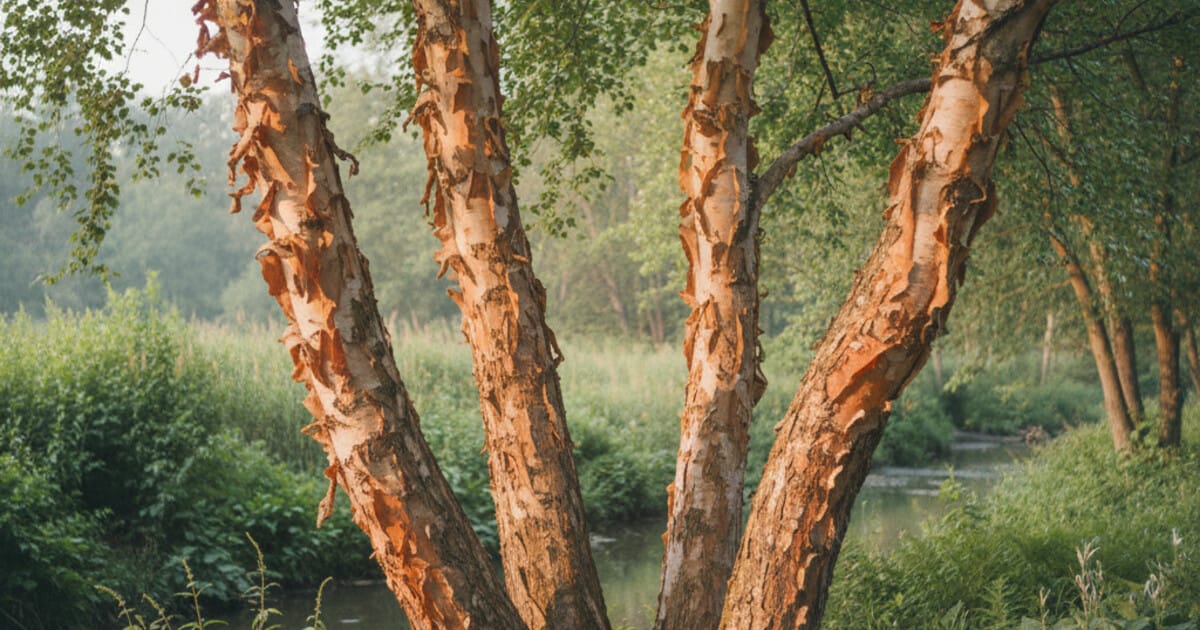
On young trees and upper branches, the bark peels in thin, curling sheets with a papery texture. The color ranges from cinnamon-brown to salmon-pink and cream, sometimes all three tones showing on the same trunk simultaneously. The strips curl back and hang loosely, giving the bark a layered, tattered look that catches light well in summer shade.
As the tree ages, the lower trunk bark transforms entirely. Older trunks grow thick, gray-brown, deeply furrowed plates that bear no resemblance to the peeling bark above. This two-texture pattern (peeling cinnamon in the crown, rough gray at the base) is a consistent signature of mature river birch.
Paper birch causes the most confusion because it also peels. The key difference: paper birch bark is distinctly white, not cinnamon or salmon. Paper birch is also a northern species (Canada and the upper US) that struggles south of Zone 4. If you’re in the Southeast or Midwest looking at peeling bark with warm brown tones, river birch is almost certainly what you’re looking at. Our guide to trees with peeling bark covers other species that share this trait.
River Birch Leaf Identification
The leaves confirm what the bark suggests.
River birch leaves are rhombic to ovate, roughly diamond-shaped with a slightly wider middle and a tapered tip. They run 1.5 to 3.5 inches long. The margins are doubly serrated: large teeth with smaller teeth between them. That two-tiered tooth pattern is consistent and easy to see with a close look at the leaf edge.
Leaves attach alternately along the stem, one per node, not in opposite pairs. They’re medium green on the upper surface and lighter green below, with small hair tufts in the vein axils on the underside (the small angles where the lateral veins branch off the midrib). Fall color is a clean, clear yellow before the leaves drop, with no orange or red tones.
The petiole (leaf stalk) is short, typically under half an inch. The overall leaf texture is thin and somewhat papery. Compared to other peeling-bark trees like sycamore or yellow birch, the river birch leaf is narrower and more sharply toothed.
7 Signs for River Birch Identification
1. Peeling Bark in Cinnamon, Salmon, and Cream Tones
This is the single most reliable feature. The bark on young trunks and upper branches exfoliates in papery, curling sheets with reddish-brown to cream coloration. The warm tones set river birch apart from white-barked paper birch immediately.
2. Gray-Brown Furrowed Bark on Mature Lower Trunks
Older river birch trunks develop thick, plated bark near the base that looks nothing like the peeling bark above. Seeing both textures on the same tree is a strong confirmation. The contrast is most visible on trees over 20 years old.
3. Rhombic Leaves With Doubly Serrated Margins
The leaf edges carry two sizes of teeth: large teeth with smaller teeth between them. That double-toothed margin is consistent across the species. Combined with the rhombic (diamond-like) leaf shape, it quickly rules out most similar trees.
4. Alternate Leaf Arrangement
Leaves attach one per node along the stem, alternating sides as they go up the branch. This rules out maples, ashes, and dogwoods, which all have opposite leaf arrangement. A 5-second check of any branch confirms it.
5. Multi-Stemmed Base
Many river birches grow 2 to 4 trunks from the same root system. Single-stemmed individuals exist, but the clustered, vase-shaped form is common enough that it’s a useful field marker, especially from a distance before you can see the bark detail.
6. Moist to Wet Riparian Habitat
River birch grows almost exclusively in moist to wet soil: creek banks, river floodplains, pond margins, lake shores, and low spots prone to periodic flooding. Finding a peeling-bark birch at the edge of a stream is strong circumstantial evidence on its own.
7. Small Cone-Like Seed Structures (Strobiles)
In late spring and early summer, river birch produces small cylindrical seed clusters called strobiles, about 1 to 1.5 inches long. They disintegrate to release tiny winged seeds and leave behind a bare central stalk. Scattered winged seeds and spent strobiles on the ground below the tree in June are reliable evidence of the species.
River Birch vs. Similar Trees
Paper birch (Betula papyrifera): The most common mixup because it also has peeling bark. Paper birch bark is white, not cinnamon. Paper birch is strictly a northern species (Canada and the northern US), rare south of Zone 4. If you’re in the South or Midwest, you’re almost certainly looking at river birch.
Yellow birch (Betula alleghaniensis): Has golden-yellow to bronze peeling bark, closer in tone to river birch. But yellow birch grows in cool, moist upland forests, not lowland floodplains. The bark on yellow birch is more metallic-looking, and the strips are smaller and tighter. Yellow birch twigs smell faintly of wintergreen when scratched.
Sycamore (Platanus occidentalis): Also peels and also grows near water, which causes regular confusion. Sycamore bark comes off in large irregular patches revealing smooth white-to-green sections, not thin curling strips. Sycamore leaves are large and maple-like with 3 to 5 lobes, nothing like the small serrated leaves of river birch.
American hornbeam (Carpinus caroliniana): Often grows in the same riparian understory as river birch. Hornbeam stays small (rarely over 30 feet) with smooth, gray, muscle-like bark that looks sinuous and twisted, nothing like peeling birch bark. The two are frequently neighbors, so learning to tell them apart pays off.
Alder (Alnus spp.): Riparian like river birch but with gray-brown bark that doesn’t peel. Alder leaves are rounder with wavy or finely toothed margins, noticeably different from river birch’s sharply doubly-serrated edge.
When you’re unsure, checking bark texture, leaf margin, and habitat type together resolves most cases quickly.
How Tree Identifier Can Help in the Field
River birch is usually one of the easier trees to photograph: the peeling cinnamon bark is distinctive enough that a clear trunk photo often returns a confident match right away.
The Tree Identifier app works from photos of bark, leaves, or the whole tree, pulling from a database of thousands of species. For river birch, a close-up of the peeling bark with some of the color visible usually does it. For younger trees where the bark is less developed, photographing a leaf cluster that shows the doubly serrated margins helps narrow the ID.
The app also surfaces detailed species information with each match: native range, habitat, distinguishing features, and similar species to compare. That cross-check matters in zones where multiple birch species could theoretically overlap.
Tree Identifier works offline too. Download the species data before a hike and you’ll have the full database available along creek banks and river trails with no cell signal. It’s free to start with 2 daily identifications. Download it at treeidentifier.app and bring it on your next walk.
Frequently Asked Questions
How do I identify river birch?
Look for peeling bark in cinnamon, salmon, and cream tones on the upper trunk and branches, rhombic leaves 1.5 to 3.5 inches long with doubly serrated margins, and moist or riparian habitat. Multi-stemmed growth from a common base is also typical. The warm-toned peeling bark is the fastest and most reliable field marker.
Is river birch the same as paper birch?
They’re related but different species. Paper birch (Betula papyrifera) has distinctly white peeling bark and grows in cool northern climates. River birch (Betula nigra) has cinnamon-to-cream peeling bark and grows across the eastern and central US, including the South. Their natural ranges barely overlap, so habitat and bark color together separate them in the field.
Where does river birch grow naturally?
River birch is native to the eastern and central United States, from southern New England south to Florida and west to Kansas and Nebraska. It grows primarily along rivers, streams, ponds, and lake margins in moist to seasonally flooded soil. It’s also widely planted in landscaping for its ornamental bark and tolerance of wet spots.
What does the bark of an old river birch look like?
On mature river birches, the lower trunk loses its peeling character and develops thick, gray-brown, deeply furrowed plated bark. The upper trunk and branches still peel in warm cinnamon tones. Seeing both bark types on the same tree is a reliable confirmation, since the contrast is distinct and consistent.
Does river birch change color in fall?
Yes. River birch turns a clean, clear yellow before the leaves drop, typically in October. It doesn’t produce orange or red fall color. The yellow foliage against the peeling bark makes the tree easy to spot along a creek in autumn.
Elena Torres
Tree Identifier Team