Trees With Peeling Bark: 8 Species Identified
You spot a tree with bark curling away in papery sheets or peeling off in shaggy strips and your first thought is: is it dying? Almost always, no. Peeling bark is a natural growth trait in dozens of tree species, and once you know the species, those curling sheets and ragged plates are one of the most reliable ways to make a confident ID.
Trees with peeling bark show up across North America in forests, parks, and backyards. Paper birch peels in thin white horizontal strips. Sycamore drops large irregular patches to reveal a patchwork of pale green, tan, and white. Shagbark hickory curls back in long woody plates that hang off the trunk like loose shingles. Each pattern is genetically fixed, which makes peeling bark useful year-round — even in winter when leaves are gone.
This guide covers 8 trees with peeling bark you’re most likely to encounter, with key features for each.
Trees with peeling bark include paper birch, river birch, sycamore, London plane, shagbark hickory, paperbark maple, crape myrtle, and Pacific madrone. Paper birch peels in thin white strips. Sycamore drops large patches revealing pale green and white inner bark. Shagbark hickory curls back in long ragged gray-brown plates. Peeling is a normal growth process, not a sign of disease.
Why Some Trees Have Peeling Bark
All trees shed bark to some degree as they grow. In peeling-bark species, the outer bark separates in sheets or strips rather than building up into thick ridges.
The outer bark layer (the rhytidome) can’t expand as the inner layers push outward from the cambium. In most trees, this pressure creates furrowed, rough bark. But in birch, sycamore, and a handful of others, the outer bark is thin enough that it separates cleanly in sheets instead.
The peeling process works like this: as new cells push outward from the cambium beneath the bark, the old outer bark can’t stretch to keep up. In most trees, this creates furrowed ridges or a rough texture. But in species like birch and sycamore, the outer bark is thin and flexible, so it separates cleanly in sheets instead. The color you see after peeling (the cream of birch, the mottled green and white of sycamore, or the bright cinnamon of paperbark maple) is fresh inner bark called phloem, temporarily exposed before it hardens and peels in turn. This cycle repeats throughout the tree’s life. The pattern, color, and peel texture are genetically fixed, making bark a reliable identification feature. A paper birch always peels in papery white sheets. A shagbark hickory always curls in long gray-brown strips. That consistency is what makes peeling bark so useful in the field, especially for species you’ll encounter repeatedly.
If your sycamore or river birch is dropping bark in early summer, that’s completely normal. In these species, it’s a sign of healthy growth.
Paper Birch and River Birch
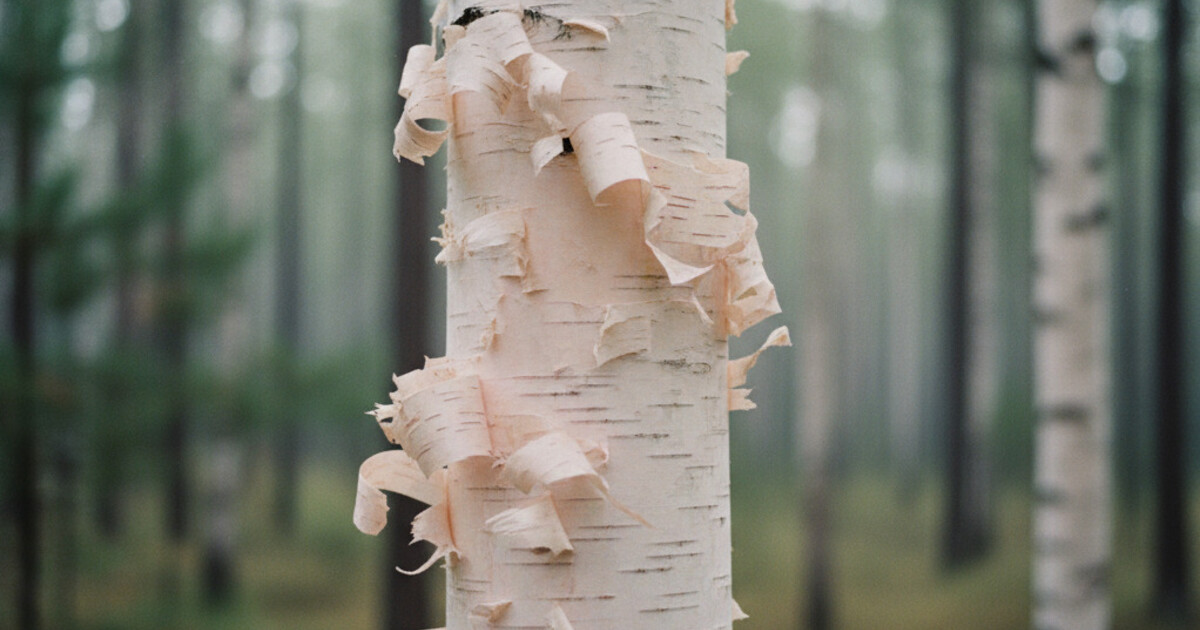
Paper birch (Betula papyrifera) is what most people picture when they think of peeling bark. Bark starts gray-brown on young trees, then shifts to bright white with horizontal dark lines called lenticels. It peels in thin papery strips that tear off in horizontal bands, revealing a pinkish-cream inner surface.
Paper birch is a cold-climate species. It grows across Canada and the northern United States, preferring cool, well-drained soils. You’ll often find it in groves on hillsides or open forest edges.
River birch (Betula nigra) is different in texture and color. The bark peels in curly papery flakes, cycling through shades of cinnamon, salmon, and tan. It tolerates heat and wet soils much better than paper birch, and it’s common along stream banks and moist areas throughout the eastern and central US.
Both species, along with silver birch and yellow birch, are covered in our birch tree varieties guide.
Quick ID: Paper birch = white bark with dark horizontal lines, northern forests. River birch = cinnamon and salmon flakes, wet areas.
Sycamore and London Plane
American sycamore (Platanus occidentalis) has some of the most eye-catching bark in North America. The outer bark peels off in large irregular plates, leaving behind a mottled patchwork of cream, tan, khaki, and pale green. From a distance, the upper trunk looks almost painted. That camouflage pattern is nearly impossible to confuse with any other species.
Sycamore grows large, often near rivers and flood plains. The leaves are broad and maple-like, and the round, spiky seed balls — detailed in our trees with spiky seed balls guide — are another strong ID clue.
London plane tree (Platanus × acerifolia) is a hybrid of sycamore and Oriental plane tree. It has the same mottled peeling bark but handles urban conditions better: pollution, compacted soil, heat. If you’re seeing a sycamore-like tree on a city street or in a park, it’s likely a London plane.
Our sycamore tree identification guide walks through the full comparison between these two.
Quick ID: Mottled green, tan, and cream patchwork bark = sycamore or London plane.
Shagbark Hickory
Shagbark hickory (Carya ovata) looks like someone started stripping the bark and walked away. Long gray-brown strips curl away from the trunk at both ends, giving the tree a permanently ragged silhouette. The strips are thick and woody, not papery.
On older trees, the plates can hang 1 to 2 feet long. In winter, when you can see the trunk clearly, shagbark hickory is one of the easiest trees to identify from 50 feet away.
It grows throughout the eastern United States in rich, well-drained upland soils, often alongside oaks and maples. The compound leaves have 5 leaflets (sometimes 7), and the nuts have thick husks that split into 4 sections at maturity.
See our hickory tree identification guide for how to distinguish shagbark from shellbark, pignut, and bitternut hickories.
Quick ID: Long, shaggy, woody strips curling at both ends = shagbark hickory.
Paperbark Maple
Paperbark maple (Acer griseum) is a small ornamental tree with genuinely striking bark. The outer layer peels back in thin curling sheets to reveal cinnamon and reddish-orange inner bark. It’s one of the most distinctive-looking small trees you’ll encounter in a garden setting.
Originally from central China, paperbark maple is widely planted in North American parks and residential landscapes. The tree stays small, usually 20 to 30 feet tall. The leaves are compound with 3 leaflets — different from most maples — and turn brilliant red-orange in fall.
If you see a small ornamental tree with cinnamon peeling bark and trifoliate leaves, paperbark maple is the likely answer.
Quick ID: Small tree, cinnamon-red curling bark, trifoliate leaves.
Crape Myrtle and Pacific Madrone
Crape myrtle (Lagerstroemia indica) is one of the most common flowering trees across the American South. In late summer and fall, smooth outer bark sheds in thin flakes, leaving behind a patchwork of gray, tan, and warm cinnamon. The inner bark is smooth and almost polished-looking.
You’ll typically find crape myrtle as a multi-stemmed small tree or large shrub. In summer it’s covered in clusters of pink, red, purple, or white flowers. If you’re in the Southeast and you see smooth, peeling mottled bark on a multi-stemmed flowering tree, crape myrtle is the first species to consider.
Pacific madrone (Arbutus menziesii) grows along the Pacific Coast from British Columbia down through California. It’s one of the most visually striking trees in the Pacific Northwest. The outer bark peels away in papery strips and curls to reveal bright orange-red inner bark underneath. That red-orange inner surface is unmistakable.
Our Pacific Northwest trees guide covers madrone alongside Douglas fir, western red cedar, and bigleaf maple.
Quick ID: Smooth peeling mottled bark in Southeast = crape myrtle. Bright red-orange inner bark in Pacific Northwest = Pacific madrone.
How Tree Identifier Helps With Peeling Bark IDs
Peeling bark often narrows a tree down to a short list, but distinguishing paper birch from river birch, or sycamore from London plane, takes the full picture.
Tree Identifier’s AI reads bark texture, color, and peel pattern from your photo. Take a close-up shot of the peeling section, and the app returns a species ID with a confidence score plus the key features that clinched the match. If you also photograph a leaf, a twig, or a seed — it factors all of that in.
The app works offline, so it’s useful on remote trails where cell service is spotty. It’s free to start with 2 daily identifications, and it’s available on iOS and Android.
Download Tree Identifier at treeidentifier.app to start putting peeling bark to work as an ID feature in the field.
Frequently Asked Questions
Is peeling bark a sign of a sick tree?
In most cases, no. For paper birch, river birch, sycamore, shagbark hickory, and the other species on this list, shedding bark is normal growth. These trees peel as part of their natural cycle. If your tree isn’t one of these species and the bark is peeling, or if you see dead branches, cankers, or weeping sap alongside it, consult a certified arborist.
What tree has white bark that peels?
Paper birch (Betula papyrifera) is the most common tree with white peeling bark. It peels in thin horizontal strips with a pinkish-cream inner layer. Sycamore also shows patches of pale white in its mottled bark, but it peels in large irregular plates rather than neat horizontal strips.
What is the tree with the shaggy bark?
Shagbark hickory (Carya ovata) has the most distinctive shaggy bark of any common North American tree. Long gray-brown strips curl away from the trunk at both ends, giving it a ragged, easy-to-spot silhouette even in winter.
Can you identify a tree just from its bark?
Many trees can be narrowed down by bark alone, especially species with distinctive features like paper birch (white papery strips), shagbark hickory (long shaggy plates), or Pacific madrone (red-orange inner bark). Combining bark with leaf shape, fruit type, and overall form gives more reliable results for species that are trickier to separate.
Which peeling bark trees work well in a yard?
Paperbark maple, river birch, and crape myrtle are popular choices for their ornamental bark. All three provide year-round interest, especially in winter when the bark stands out without leaves covering it.
Conclusion
Peeling bark is one of the most consistent ID features in the tree world. Paper birch gives you white horizontal strips. Sycamore gives you that mottled camouflage patchwork. Shagbark hickory gives you those unmistakable shaggy plates. Pacific madrone gives you a flash of red-orange that you won’t mistake for anything else.
For on-the-spot IDs, Tree Identifier reads bark texture and color from a photo and returns species results in seconds — useful when you’re standing in front of a tree and need a confident answer.
Identify a tree from your photo — free
Upload a leaf, bark, or whole-tree photo and get the species in seconds. No signup.
Confidence:
Unlock the full species profile
Free in the app — with unlimited identifications.


AI result for guidance — the app gives full species details and works offline.
Want unlimited identifications?
Get the full species profile, photos and details — free in the app, with unlimited scans.
- Unlimited identifications
- Full species profiles & details
- Works offline, anywhere
- Save and revisit your finds
Elena Torres
Tree Identifier Team