Sand Hickory Tree Identification: 7 Reliable Signs
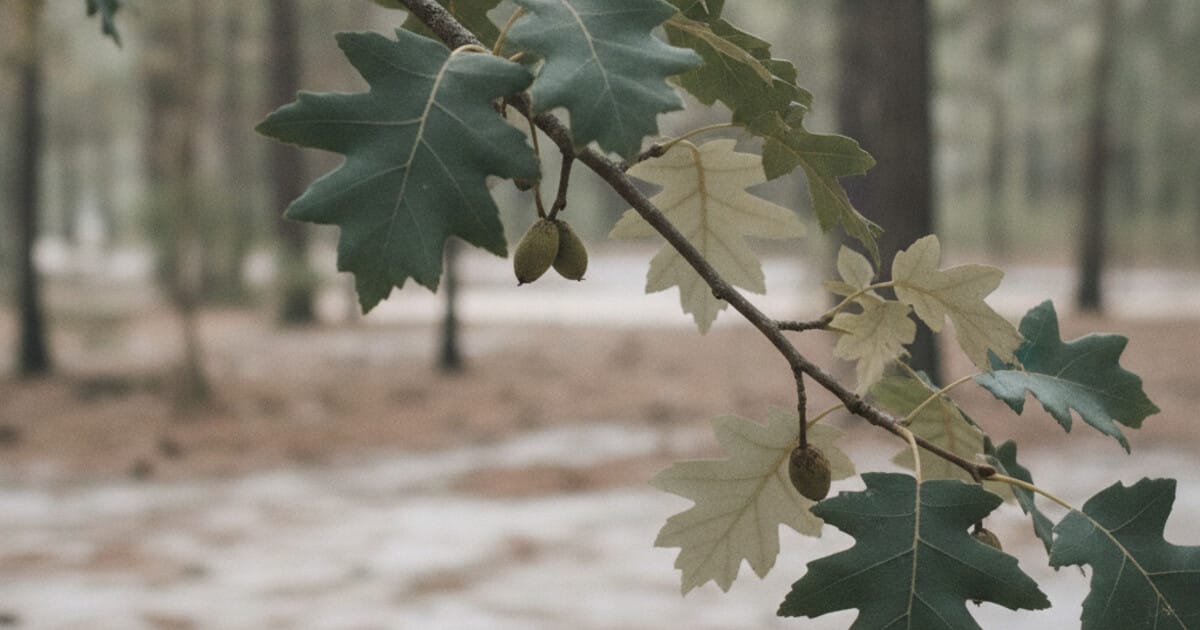
Sand hickory (Carya pallida) is one of the easier hickories to overlook. On dry, sandy ridges and coastal plain sandhills, it blends into a crowd of oaks and pines without drawing much attention. The tree itself is modest in stature compared to its cousins, rarely topping 60 feet on poor soils. Flip a leaf over and the story changes immediately: the undersides are silvery-white, covered in dense star-shaped hairs that give the species its Latin name, pallida, meaning pale. No other common hickory in the eastern United States has leaflet undersides that pale.
This guide covers 7 field signs that confirm sand hickory identification, including how to separate it from the two species it most closely resembles: pignut hickory (Carya glabra) and mockernut hickory (Carya tomentosa).
Sand hickory (Carya pallida) is identified by pale, silvery-white leaflet undersides covered in stellate hairs; 7 leaflets per leaf (range 5-9); pear-shaped nuts in husks that split only in the upper half; and strict preference for dry, sandy soils on the coastal plain and piedmont from New Jersey south to Florida and west to Missouri and Texas.
What Is Sand Hickory?
Sand hickory (Carya pallida) belongs to the pignut hickory group within the genus Carya. It grows across the eastern and central United States, from southern New Jersey, Delaware, and Pennsylvania south through the coastal plain states to Florida, and west through the Gulf Coast states to eastern Texas, Oklahoma, and southern Missouri. Within that range, it sticks almost exclusively to dry, nutrient-poor substrates: sandhills, sandy ridges, sandy upland woods, and dry pine-oak barrens. Soils tend to be deep, well-drained sands or sandy loams that drain quickly after rain. Finding a sand hickory in clay or heavy loam soil would be unusual. Mature trees typically reach 40-60 feet on poor sandy sites, occasionally to 80 feet on better soils. Trunk diameter runs 1-2 feet at maturity. The tree grows in mixed stands with longleaf pine, turkey oak, post oak, blackjack oak, and other dry-site species. In the piedmont, it appears on dry ridges and rocky slopes with similar site preferences. The species is less well-known than shagbark or mockernut hickory because it tends to grow in scrubby, dry vegetation types that receive less botanical attention than richer hardwood forests.
Signs #1 and #2: Pale Leaflet Undersides and Leaflet Count
These two features together narrow sand hickory identification to near-certainty in the field.
Pale undersides: Turn a leaf over and look at the underside of a leaflet. Sand hickory leaflets are coated in dense stellate (star-shaped) hairs that give the undersides a silvery to dull white appearance. The hairs are also present on the leaf rachis (the central stalk) and on young twigs. In strong sunlight, the underside of a sand hickory leaf looks noticeably paler than any surrounding hickory foliage. This feature is consistent throughout the growing season.
Compare this to:
- Pignut hickory leaflets: nearly hairless or with only scattered simple hairs on the underside, no stellate hairs, underside green to yellow-green rather than silvery
- Mockernut hickory leaflets: also hairy underneath, but with denser woolly hairs on the rachis and typically fewer leaflets; the hairs are coarser and more matted than sand hickory’s finer stellate coating
Leaflet count: Sand hickory typically carries 7 leaflets per leaf, with a range of 5-9. The terminal leaflet is the largest, noticeably bigger than the lateral pairs. This follows the same general pattern as pignut hickory (5-7 leaflets) and mockernut hickory (7-9), which is one reason leaf count alone can’t clinch the ID. You need the pale underside plus the count working together.
Sand Hickory Leaf Identification
The compound leaf of sand hickory runs 8-12 inches in total length. Leaflets are lance-shaped to narrowly ovate, with the widest point at or below the middle, tapering to a pointed tip. The upper surface is dark green and mostly smooth. The lower surface is the key: silvery-white with a dense mat of stellate hairs that feel slightly rough to the touch.
Leaflet margins carry fine, sharp teeth along the full edge. The serrations are consistent from base to tip on each leaflet, similar to other hickory species. In fall, sand hickory turns yellow before leaf drop. The color tends toward a muted golden yellow rather than the bright orange-yellow of shagbark hickory.
The rachis is covered in the same stellate hairs as the leaflets, which is a secondary check: run your fingers along the central stalk of the compound leaf. On sand hickory, it feels distinctly fuzzy. On pignut hickory, the rachis is essentially smooth or only lightly hairy.
Bud break happens in mid-spring. Young leaves as they emerge are pale and hairy, gradually darkening on the upper surface while retaining the pale coating underneath.
Nuts and Husk: Signs #3 and #4
Sand hickory nuts are pear-shaped to nearly round, about 3/4 to 1-1/4 inches long. The shell is thin relative to other hickories, and the kernel ranges from slightly bitter to mildly sweet depending on the individual tree and site. They’re edible but not as prized as shagbark hickory nuts. Wildlife, including squirrels, deer, and turkeys, consumes them readily.
The husk is thin to moderately thick, about 1/8 inch or less. It splits only partway at maturity, typically only in the upper half or two-thirds of the fruit, and often incompletely. The husk ridges (sutures) run down most of the length but the splitting doesn’t extend to the base. This is different from shagbark hickory, where the thick husk splits all the way to the base in 4 clean sections.
The nut itself is light brown, with a somewhat flattened to round cross-section. The shell is thinner than mockernut (which has a very thick, hard shell) and about comparable to pignut. The base is slightly flattened or notched.
Nuts ripen in September through October and fall with the partially split husk still attached. You’ll often find husks on the ground in varying states of opening.
Buds, Twigs, and Bark
Buds: Sand hickory buds are small to medium-sized, yellowish-brown to pale tan, with overlapping scales. They’re covered in fine hairs, which contributes to the pale appearance. The terminal bud is larger than the lateral buds, as in most hickories. Bud size and color are useful for winter ID but less distinctive than the leaf features.
Twigs: Slender to moderately stout, light gray-brown when young, covered in stellate hairs that persist through the first growing season. Older twigs lose most of the hairs and become smoother. The lenticels (small pores on the bark surface) are pale and visible.
Bark: On young trees, bark is smooth to slightly ridged and grayish. On mature trees, it develops narrow, interlacing ridges with shallow furrows. The ridges are tighter and less dramatic than shagbark hickory’s exfoliating strips. The overall texture is closer to pignut hickory or bitternut hickory bark than to the dramatic plated bark of mockernut or the shaggy strips of shagbark.
Sand hickory bark doesn’t offer a single dramatic visual cue at a distance. On a dry sandy site, though, it’s worth checking the nearest hickory-looking tree with tight gray bark: the leaf undersides will confirm or rule it out quickly.
Sand Hickory vs. Pignut and Mockernut Hickory
These two comparisons cover the most likely misidentifications in the field.
Sand hickory vs. pignut hickory (Carya glabra):
Pignut is the closest relative and the most common confusion species. The two share similar habitat overlap in some areas, similar leaflet count, and similar nut shape.
- Leaflet undersides: pignut leaflets are green to yellow-green below with few or no hairs. Sand hickory undersides are silvery-white with dense stellate hairs. This is the single most reliable field separator.
- Rachis: pignut rachis is smooth or lightly hairy. Sand hickory rachis is clearly hairy with stellate hairs.
- Habitat: pignut grows on a wide range of sites from dry ridges to moist slopes and bottomland edges. Sand hickory is more restricted to dry, sandy sites. On a clay soil slope, the tree is more likely to be pignut.
- Range: pignut is found throughout most of the eastern US, including areas where sand hickory is absent. Sand hickory is absent from northern New England, the upper Midwest, and most of the Appalachians.
See our pignut hickory identification guide for a full profile of that species.
Sand hickory vs. mockernut hickory (Carya tomentosa):
Mockernut also has hairy leaves, which is the source of confusion. The differences come down to hair type, nut shell thickness, and husk behavior.
- Leaflet hairs: mockernut leaflets have coarser, often more matted hairs, especially on the rachis, which is densely woolly (tomentose). Sand hickory hairs are finer and more uniformly stellate.
- Nut shell: mockernut shell is very thick and hard, with only a small kernel inside. Sand hickory shell is noticeably thinner.
- Husk: mockernut husk splits to the middle or less at maturity. Sand hickory husk splits in the upper half to two-thirds.
- Leaflet count: mockernut runs 7-9 leaflets with the terminal noticeably the largest, similar to sand hickory.
- Site: mockernut grows widely on upland sites including rich hardwood slopes, dry ridges, and mixed forests. Sand hickory is more narrowly confined to sandy soils.
See our mockernut hickory identification guide for a full breakdown of that species.
How Tree Identifier Helps with Sand Hickory
Sand hickory is a species where the single best field photo is the underside of a compound leaf. Photograph it in good light from close enough to show the texture of the leaflet surface. The pale, silvery-white underside is distinctive, and Tree Identifier’s AI picks up on that pale coating as a key feature for Carya pallida identification. Including a photo of the nut or husk alongside the leaf improves confidence further.
The app works offline, which is useful on dry sandy ridges and pine barrens far from cell coverage. You get 2 free identifications per day, with each result including species habitat notes and characteristics you can cross-check against the field signs in this guide. Download Tree Identifier at treeidentifier.app and test it on the next hickory you find on a sandy slope.
Frequently Asked Questions
What makes sand hickory different from other hickories?
The clearest difference is the leaflet underside: sand hickory has silvery-white undersides covered in dense stellate hairs, visible even in dim light. No other common eastern hickory has leaflet undersides that pale. The species also grows strictly on dry, sandy soils on the coastal plain and piedmont, which rules out many similar-looking hickories that prefer richer sites.
Where does sand hickory grow?
Sand hickory grows in the eastern and central United States, from southern New Jersey south through the coastal plain states to Florida, and west to eastern Texas, Oklahoma, and southern Missouri. Within that range, it’s a strict dry-site specialist found on sandhills, sandy ridges, dry pine-oak barrens, and piedmont uplands with sandy to sandy-loam soils.
How do you tell sand hickory from pignut hickory?
Look at the leaflet undersides. Pignut hickory leaflets are green to yellow-green below, nearly hairless. Sand hickory leaflets are silvery-white below, covered in dense star-shaped (stellate) hairs. Also check the leaf rachis: sand hickory’s central stalk is clearly hairy; pignut’s is smooth or barely hairy. These two features together reliably separate the species.
Are sand hickory nuts edible?
Sand hickory nuts are edible. The kernel is thin-shelled and ranges from mildly sweet to slightly bitter depending on the individual tree. They’re not as consistently sweet as shagbark hickory, but wildlife including squirrels, turkeys, and deer consumes them readily. The nuts are small enough that cracking them for human consumption is usually not worth the effort compared to shagbark or shellbark.
What does sand hickory bark look like?
On mature trees, sand hickory bark is grayish with narrow interlacing ridges and shallow furrows. The texture is firm and close to the trunk, similar to pignut or bitternut hickory. It doesn’t exfoliate in dramatic strips like shagbark hickory. Young trees have smoother, lighter gray bark.
Identify a tree from your photo — free
Upload a leaf, bark, or whole-tree photo and get the species in seconds. No signup.
Confidence:
Unlock the full species profile
Free in the app — with unlimited identifications.


AI result for guidance — the app gives full species details and works offline.
Want unlimited identifications?
Get the full species profile, photos and details — free in the app, with unlimited scans.
- Unlimited identifications
- Full species profiles & details
- Works offline, anywhere
- Save and revisit your finds
Elena Torres
Tree Identifier Team