Pignut Hickory Tree Identification: 7 Reliable Signs
Pignut hickory (Carya glabra) is one of the most widespread trees on dry ridges and upland slopes across eastern North America, yet it slips past most hikers unnoticed. Spend a morning in a mixed hardwood forest from Connecticut to Georgia and you’ll almost certainly walk past a dozen of them. The name comes from the small, bitter nuts once considered suitable only for wild pigs and other foraging animals. Once you know the 7 key markers, pignut hickory tree identification is reliable in any season.
Pignut hickory (Carya glabra) is identified by tight, interlocking ridge-and-furrow bark that never peels, pinnately compound leaves with 5 to 7 leaflets (usually 5), small pear-shaped nuts with extremely bitter flesh, slender gray-brown twigs with distinctive leaf scars, and a strong preference for dry upland ridges and slopes throughout the eastern United States.
What Is a Pignut Hickory? Range and Overview
Pignut hickory is a medium to large deciduous tree in the walnut family (Juglandaceae), grouped with shagbark, mockernut, and bitternut as a “true hickory.” It grows slowly, lives 200 or more years, and thrives on dry, well-drained soils where it often co-dominates ridgetop forests alongside oaks.
Pignut hickory (Carya glabra) is a medium to large deciduous tree reaching 50 to 80 feet tall at maturity, native to eastern North America from southern Maine and Ontario south to northern Florida and west through Illinois to Kansas. It belongs to the true hickory subgroup within the genus Carya and is among the most abundant hickory species on dry upland sites. The bark forms a tight network of interlocking ridges and furrows with a diamond or chainlink pattern, a key feature separating it from shagbark hickory’s dramatic peeling plates. Leaves are alternate and pinnately compound, typically carrying 5 leaflets (occasionally 7), with the terminal leaflet noticeably larger than the laterals. The nuts are small to medium, pear-shaped, with a thin husk that splits incompletely along 4 sutures when ripe. The flesh is extremely bitter and high in tannins, making the nuts inedible for humans but an important food source for squirrels, foxes, and black bears.
The wood is dense and hard, burning hot as firewood and widely valued for tool handles and smoking meat.
Pignut Hickory Bark: Tight, Ridged, and Never Peeling
Bark is the fastest field identifier for pignut hickory, especially in winter when leaves are gone.
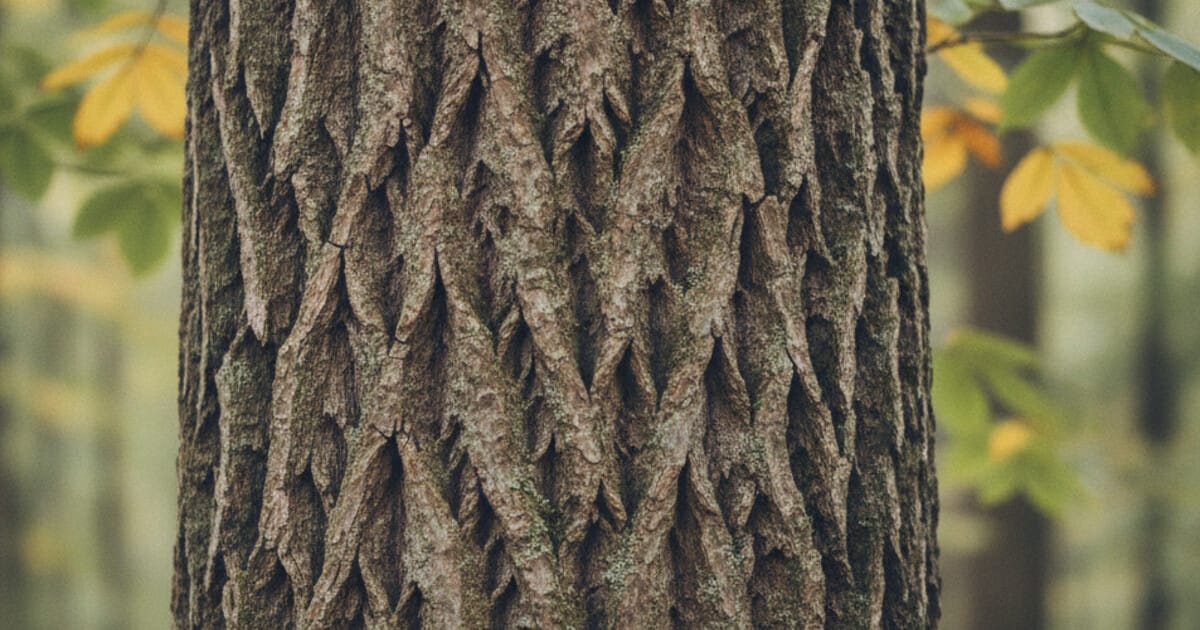
Mature pignut hickory bark forms a tight network of interlocking ridges and V-shaped furrows. Step back from the trunk and you’ll often see a diamond or chainlink-like pattern across the entire surface. The ridges are sharp on older trees, but the bark stays firmly attached throughout the tree’s life.
This is the clearest separation from shagbark hickory (Carya ovata), which has long, shaggy plates that peel dramatically away from the trunk in curving strips. Pignut hickory’s bark won’t peel, no matter how old the tree gets.
Young pignut hickories (under 20 to 30 years old) have smoother bark with less pronounced ridging. The furrows deepen and the diamond pattern becomes more distinct as the tree ages. On specimens over 60 years old, the ridges can be quite sharp and pronounced.
Pignut Hickory Leaves: Compound, Usually 5 Leaflets
Pignut hickory has pinnately compound leaves, with all leaflets arranged along a single central stem called the rachis. Most leaves carry 5 leaflets, though vigorous shoots sometimes produce 7.
The leaflets are lance-shaped to ovate, with finely serrated (toothed) edges. The terminal leaflet at the tip is noticeably larger than the 2 pairs of lateral leaflets. Leaflets are dark green and slightly glossy on the upper surface, paler underneath, and essentially hairless in most specimens.
Leaflet count is a reliable separator within the hickory family. Pignut hickory usually has 5 leaflets. Mockernut hickory typically has 7 to 9, with hairy undersides. Our hickory tree identification guide covers all the major species side by side for a full comparison.
In fall, pignut hickory leaves turn bright golden yellow, sometimes with bronze tones. The color is reliable and worth noting as a secondary seasonal marker.
Pignut Hickory Nuts: Pear-Shaped and Extremely Bitter
The nuts are the most definitive identifier when they’re present, from late summer through mid-fall.
Pignut hickory nuts are small to medium, typically pear-shaped or slightly round. The outer husk is thin (about 1/8 inch thick) and splits partway along 4 sutures when ripe, but often doesn’t fully open or release the nut. The hard inner shell encloses the nutmeat.
The key identifier is flavor: a small taste of the nutmeat is intensely bitter and astringent from high tannins. There’s no mistaking it. Shagbark hickory nuts are sweet and edible; pignut hickory nuts are not.
Despite being unpalatable for humans, the nuts are a critical wildlife food. Squirrels, foxes, raccoons, wild turkeys, black bears, and deer mice all rely on pignut hickory mast, particularly in fall when other food sources thin out.
Pignut Hickory Twigs and Buds: Slender and Small-Scaled
Pignut hickory twigs are slender and gray-brown, noticeably thinner and smoother than the stout, hairy twigs of mockernut hickory. In winter, the twigs alone help narrow down the species before any leaves or nuts are present.
The leaf scars (where leaves were attached) are distinctive: roughly shield-shaped or 3-lobed, with small bundle scars inside arranged in 3 groups. Some people describe the shape as a simple 3-lobed face.
The buds are small and grayish-brown, covered with overlapping scales. They’re much smaller than mockernut hickory buds and lack the bright sulfur-yellow color of bitternut hickory buds (Carya cordiformis). Checking bud color in winter is a quick way to rule out bitternut: if the buds are bright yellow and non-scaly, you’re looking at bitternut, not pignut.
The terminal bud at each twig tip is slightly larger than the lateral buds but still modest in size compared to other hickory species.
Where Pignut Hickory Grows
Habitat narrows down identification before you even look at leaves or bark.
Pignut hickory is a dry-site specialist. It grows on ridges, south- and west-facing slopes, rocky hillsides, and well-drained sandy or loamy upland soils. It tolerates droughty conditions better than most hickory relatives and rarely occurs in wet bottomlands or floodplains.
Typical forest companions include white oak, black oak, scarlet oak, chestnut oak, black cherry, and Virginia pine. In the Southeast, it’s common on ridgetops in mixed pine-hardwood stands.
When you’re on a moist, flat bottomland site, the hickory you’re looking at is more likely bitternut or pecan (Carya illinoinensis). Pignut hickory’s home is the drier uplands.
Pignut Hickory vs Similar Hickory Species
Four species come up most often in pignut hickory misidentification:
Shagbark hickory (Carya ovata): Bark settles it instantly. Shagbark has long, curving plates that peel away from the trunk. Pignut’s bark stays tight. Shagbark also produces larger, rounder, sweet-tasting nuts worth eating.
Mockernut hickory (Carya tomentosa): Mockernut typically has 7 to 9 leaflets (pignut usually has 5) and distinctly hairy twigs and leaf undersides. The nuts have much thicker husks. Mockernut also tends toward moister, richer sites.
Bitternut hickory (Carya cordiformis): The bright sulfur-yellow buds make bitternut unmistakable in any season. Bitternut also favors wet lowlands and bottomlands. The nuts are bitter like pignut, but the bud color is definitive.
Sand hickory (Carya pallida): Closely related to pignut and sometimes treated as a variety of it. Sand hickory tends to have silvery, scaly leaf undersides and is largely confined to the Atlantic and Gulf coastal plain. In interior forests, if it looks like pignut, it almost certainly is.
Using Tree Identifier App to Confirm Pignut Hickory
After working through the field markers, a photo confirmation can settle remaining questions. The Tree Identifier app identifies hickory species from photos of leaves, bark, or nuts taken in the field. It covers all major eastern hickory species and returns species-level results with a confidence score.
The app works on iOS and Android, with 2 free identifications per day and an offline mode once you’ve downloaded the species database. That offline function matters on remote ridges where cell coverage drops out.
For best results with pignut hickory, photograph the bark pattern on a mature trunk, then snap a close-up of a complete compound leaf showing the full leaflet count. If nuts are present, include a photo of the husk and exposed nut.
If you’re regularly running into hickories you can’t place in the field, it’s worth working through the full hickory tree identification guide alongside the app, since photo results are most useful when you already have the key features in mind.
Frequently Asked Questions
How do you tell pignut hickory from shagbark hickory?
Bark is the fastest tell. Shagbark hickory (Carya ovata) has long, shaggy plates that peel away from the trunk in curving strips. Pignut hickory’s bark forms a tight, interlocking ridge-and-furrow pattern and stays against the trunk its entire life. Shagbark also produces larger, rounder, sweet-tasting nuts that are edible for humans.
Are pignut hickory nuts edible?
No. Pignut hickory nuts are extremely bitter due to high tannin content and aren’t palatable for humans. Wildlife, including squirrels, bears, foxes, and wild turkeys, eat them readily. The “pignut” name comes from their historical reputation as food suitable only for pigs and hogs, not people.
Where does pignut hickory grow?
Pignut hickory ranges across the eastern United States from southern Maine and Ontario south to northern Florida and west through Illinois to Kansas. It grows on dry upland ridges, south-facing slopes, and rocky hillsides with well-drained soils. It’s one of the most abundant hickory species in its range.
How large does a mature pignut hickory get?
Mature trees typically reach 50 to 80 feet tall, with trunk diameters of 1 to 2 feet. Specimens in favorable conditions occasionally exceed 100 feet. The crown is oval to rounded, and trees can live 200 or more years.
What is pignut hickory wood used for?
Pignut hickory produces dense, extremely hard wood used for tool handles, sporting equipment, ladders, and axe handles. As firewood, it burns hot with excellent BTU output, on par with other true hickories. It’s also a popular BBQ smoking wood, giving food a strong classic hickory smoke flavor.
Identify a tree from your photo — free
Upload a leaf, bark, or whole-tree photo and get the species in seconds. No signup.
Confidence:
Unlock the full species profile
Free in the app — with unlimited identifications.


AI result for guidance — the app gives full species details and works offline.
Want unlimited identifications?
Get the full species profile, photos and details — free in the app, with unlimited scans.
- Unlimited identifications
- Full species profiles & details
- Works offline, anywhere
- Save and revisit your finds
Elena Torres
Tree Identifier Team