Mockernut Hickory Tree Identification: 7 Reliable Signs
Mockernut hickory (Carya tomentosa) is the most widespread of the true hickories, growing in upland forests from southern New England to Nebraska and south to northern Florida. It’s also the hairiest species in the genus. Run your fingers along the underside of a mockernut leaf or down a young twig and you’ll feel the dense, velvety pubescence that sets it apart from every other hickory in the field. Most forest hikers walk past mockernut hickories daily without registering them. These 7 field signs make mockernut hickory tree identification reliable in any season, with or without leaves on the branches.
Mockernut hickory is identified by pinnately compound leaves with 7 to 9 leaflets (usually 7), distinctly hairy leaf undersides and twigs, large fragrant terminal buds, tight interlocking bark that never peels, and thick-husked round nuts with a small, sweet kernel. It grows on dry to moderately moist upland hardwood sites across the eastern United States.
What Is a Mockernut Hickory? Range and Overview
Mockernut hickory (Carya tomentosa) is a medium to large deciduous tree in the walnut family (Juglandaceae), reaching 60 to 80 feet tall at maturity and occasionally topping 100 feet in favorable conditions. The species belongs to the true hickory subgroup within the genus Carya, alongside shagbark, pignut, shellbark, and bitternut. It’s the most abundant hickory throughout much of the southeastern United States and one of the most widely distributed in the East overall. The natural range runs from southern Maine and Michigan south to northern Florida and west through Iowa, Kansas, and Nebraska. Mockernut favors dry to moderately moist upland sites: south-facing ridges, upper and middle slopes, sandy loam and clay-loam soils. It tolerates a broader moisture range than pignut hickory but avoids the wet bottomlands favored by bitternut and shellbark. Trees grow slowly and live long, with documented specimens reaching 200 to 400 years in old-growth remnants. The wood is ring-porous and extremely dense, ranking among the hardest and heaviest of any native North American hardwood.
The name “mockernut” comes from the nuts themselves. A thick, tough husk surrounds a hard shell with a small, difficult-to-extract kernel. The tree appears to offer food, then makes getting to it genuinely frustrating.
Typical forest companions include white oak, black oak, scarlet oak, red oak, pignut hickory, and shagbark hickory. On dry ridgetops in the Southeast, it’s often one of the two or three dominant overstory trees.
Mockernut Hickory Bark: Tight Ridges with a Diamond Pattern
Bark is a reliable year-round identifier, especially in winter when leaves are absent.
Mature mockernut hickory bark forms a tight, interlocking network of ridges and furrows. The pattern across the trunk often resembles a diamond or chainlink grid. The ridges on mockernut tend to be slightly more rounded and blunt compared to the sharper ridges of pignut hickory, though both species have bark that stays firmly attached throughout the tree’s life.
Young trees up to about 20 to 30 years old have smoother, lighter gray bark with less pronounced ridging. The diamond pattern deepens as the tree ages. On old specimens, the ridges are coarse and the furrows are deep enough to slip a finger into.
Unlike shagbark hickory, which has long, curving plates that peel dramatically away from the trunk, mockernut’s bark never shags. If the bark is plated and peeling, you’re looking at shagbark. If it’s tight and ridged, the field narrows to mockernut, pignut, or bitternut, and leaf count closes it.
Mockernut Hickory Leaves: 7 to 9 Hairy Leaflets
Leaf count and texture together separate mockernut from every other hickory in eastern North America.
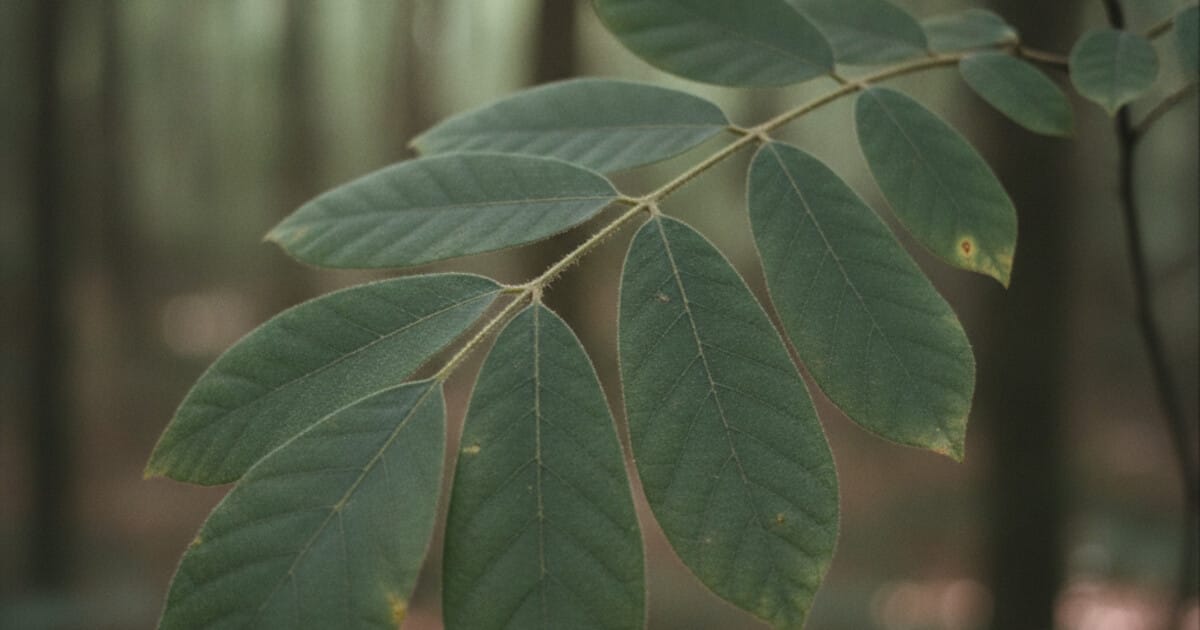
Mockernut hickory has pinnately compound leaves with all leaflets arranged along a central stem called the rachis. Most leaves carry 7 leaflets, though 9 is common on vigorous shoots. Rarely, 5 appears on suppressed branches. The leaflets are lance-shaped to broadly ovate, with finely toothed margins and the terminal leaflet noticeably larger than the lateral pairs.
The key feature is pubescence. Flip a leaflet over and the underside is visibly hairy, dense, almost velvety in many specimens. The rachis is hairy too, and the upper surfaces of leaflets often show hair along the midveins. No other common eastern hickory is this consistently pubescent across leaves, rachis, and twigs simultaneously.
Pignut hickory usually has 5 leaflets with essentially hairless undersides. Shagbark has 5 to 7, with undersides that are far less hairy than mockernut. The full hickory tree identification guide covers all major species side by side for comparison.
In fall, mockernut leaves turn golden yellow to bronze, with the color arriving reliably across the crown. Worth noting as a seasonal secondary marker, though not definitive on its own.
Mockernut Hickory Nuts: Large, Thick, and Hard to Crack
Nuts are the most definitive identifier when present, from late summer through mid-fall.
Mockernut hickory nuts are large and round to slightly oval, with a very thick husk (typically a quarter inch or more). The husk splits along 4 sutures when ripe but is slow to open and often drops to the ground intact or only partially open. Inside is a hard, round shell with thick walls. The nutmeat is small relative to the nut’s overall size (hence “mockernut”) but is sweet and edible, unlike the bitter flesh of pignut hickory.
The thick husk is the most reliable nut feature. Shagbark hickory nuts have noticeably thinner husks that split cleanly at maturity. Pignut hickory husks are also thinner and often split only partway. A large, round nut with a husk that barely budges is a strong indicator of mockernut.
Wildlife dependence on mockernut mast is high. Squirrels, deer, wild turkeys, black bears, and blue jays all eat the nuts in fall. Squirrels crack through the thick shell more efficiently than most people can manage without a solid hammer and patience.
Mockernut Hickory Buds and Twigs: Large and Aromatic
Buds and twigs provide some of the clearest winter identification features for mockernut hickory.
The terminal bud is large, the largest of any eastern hickory. It’s oval to egg-shaped, covered with overlapping hairy scales, roughly the size of a large marble. Crush a bud between your fingers and you’ll notice a spicy, aromatic scent. This characteristic odor comes from glands in the bud scales and is distinctive enough to serve as a field identifier on its own, especially in winter when other features are less obvious.
The twigs are stout and hairy, carrying the same pubescence as the leaf undersides. This directly separates mockernut from pignut hickory, whose twigs are slender and smooth. If the twigs feel furry and robust, mockernut is the leading candidate.
Lateral buds are smaller than the terminal bud but also hairy and overlapping-scaled. Bud color runs dull gray-brown to reddish-brown, nowhere near the bright sulfur-yellow of bitternut hickory (Carya cordiformis). Bright yellow, non-hairy buds mean bitternut, not mockernut.
Where Mockernut Hickory Grows
Habitat context can narrow identification before you examine a single leaf.
Mockernut hickory is an upland species. It’s most common on dry to moderately moist ridges, south- and west-facing slopes, and well-drained upland flats with sandy loam or clay-loam soils. It tolerates a broader moisture range than pignut hickory and appears on both dry ridgetops and gently sloping middle positions, but it avoids wet bottomlands and floodplains entirely.
In the Southeast, mockernut is often one of the dominant hickory species in mixed hardwood-pine stands on upper slopes. In the Northeast, it’s less frequent and somewhat less abundant than shagbark hickory on comparable sites.
Typical forest neighbors include white oak, black oak, red oak, scarlet oak, and pignut hickory. When you’re in a low, moist bottomland site, the hickory you’re looking at is more likely bitternut (Carya cordiformis) or shellbark (Carya laciniosa). Mockernut stays on the drier ground upslope.
Mockernut Hickory vs Similar Hickory Species
Four species come up most often in mockernut misidentifications.
Shagbark hickory (Carya ovata): Bark settles it instantly. Shagbark has long, curving plates that peel away from the trunk in dramatic strips. Mockernut’s bark stays tight against the wood. Shagbark also has 5 leaflets with less hairy undersides, and produces larger, rounder nuts with thinner husks.
Pignut hickory (Carya glabra): Usually 5 leaflets rather than 7 to 9, smooth or barely hairy undersides, slender smooth twigs, and small, modest terminal buds. Both species have tight ridged bark, so leaf count and twig texture are the primary separators. If the twig feels rough and furry, it’s mockernut.
Shellbark hickory (Carya laciniosa): Also produces leaves with 7 to 9 leaflets, which causes confusion. Shellbark has shaggy, peeling bark (like shagbark), grows in wet floodplains and bottomlands, and produces very large nuts. Site and bark settle the comparison quickly.
Bitternut hickory (Carya cordiformis): Bright sulfur-yellow buds make bitternut unmistakable in any season, and it prefers moist lowlands. If the buds are bright yellow and non-scaly, that’s bitternut.
Using Tree Identifier App to Confirm Mockernut Hickory
After working through the field markers, a photo confirmation can settle remaining uncertainty. The Tree Identifier app identifies hickory species from photos of leaves, bark, or nuts taken in the field. It covers all major eastern hickory species and returns species-level results with a confidence score.
The app works on iOS and Android, with 2 free identifications per day and an offline mode after downloading the species database. That offline function matters on remote ridges where cell service drops out mid-hike.
For best results with mockernut hickory, photograph a complete compound leaf showing the full leaflet count alongside a close-up of the hairy underside. Add a shot of the bark pattern on a mature trunk. If nuts are present, include the husk and cracked nut in the same frame.
If you’re regularly running into hickories you can’t place, working through the full hickory tree identification guide alongside the app gives you the best results, since photo identifications are most accurate when you already know the key features to look for.
Frequently Asked Questions
How do you tell mockernut hickory from pignut hickory?
Leaf count and twig texture are the clearest separators. Mockernut usually has 7 to 9 leaflets with distinctly hairy undersides and stout, hairy twigs. Pignut typically has 5 leaflets with smooth or barely hairy undersides and slender, smooth twigs. Both have tight ridged bark that never peels, so bark alone won’t resolve the question.
Are mockernut hickory nuts edible?
Yes, the nutmeat is sweet and edible, unlike the intensely bitter nuts of pignut hickory. The challenge is extraction: the very thick husk and hard shell make cracking frustrating, which is exactly where the “mockernut” name comes from. Wildlife, especially squirrels, bears, and deer, eat them readily in fall.
What does mockernut hickory bark look like?
Mature mockernut hickory bark forms a tight, interlocking network of ridges and furrows, often in a diamond or chainlink grid across the trunk. The bark stays firmly attached throughout the tree’s life and never develops the shaggy, peeling plates of shagbark hickory. The ridges tend to be slightly more rounded than the sharper ridges of pignut hickory.
Where does mockernut hickory grow?
Mockernut hickory ranges across the eastern United States from southern Maine and Michigan south to northern Florida and west through Iowa, Kansas, and Nebraska. It prefers dry to moderately moist upland sites: ridges, south-facing slopes, and well-drained soils. It’s one of the most abundant hickory species in the Southeast and grows alongside oaks and other hardwoods in mixed upland forests.
What is mockernut hickory wood used for?
Mockernut hickory wood is extremely hard, dense, and shock-resistant, making it a preferred species for tool handles, axe handles, sporting equipment, and ladders. As firewood it burns hot, with BTU output on par with shagbark hickory. It’s also a popular smoking wood, producing the strong, classic hickory smoke flavor prized in BBQ.
Identify a tree from your photo — free
Upload a leaf, bark, or whole-tree photo and get the species in seconds. No signup.
Confidence:
Unlock the full species profile
Free in the app — with unlimited identifications.


AI result for guidance — the app gives full species details and works offline.
Want unlimited identifications?
Get the full species profile, photos and details — free in the app, with unlimited scans.
- Unlimited identifications
- Full species profiles & details
- Works offline, anywhere
- Save and revisit your finds
Elena Torres
Tree Identifier Team