Silver Maple vs Red Maple: Tree Identification
Silver maple is one of the most common trees in eastern North America, and most people walk past one every day without recognizing it. It lines suburban streets, fills city parks, and crowds the banks of rivers from Quebec to Florida. The tree blends in all summer, then drops a blizzard of helicopter seeds in spring that coat driveways and sidewalks for weeks.
Knowing how to do silver maple tree identification means you’re no longer guessing at one of the continent’s most common trees. The seven key features below work together, and most of them are visible year-round.
Silver maple (Acer saccharinum) has deeply 5-lobed leaves with a silvery-white underside, shaggy plated bark on mature trunks, and large samaras that drop in April–May. Red maple (Acer rubrum) has shallower lobes, a pale grayish-green underside, brilliant scarlet fall color, and smaller seeds in May–June. The silvery underside separates silver maple at a glance in any season.
Silver Maple Leaves: The First and Most Reliable Sign
The leaf is where silver maple identification starts. Once you know what to look for, you’ll spot this tree from 30 feet away.
Each leaf has 5 deep lobes with sinuses that cut almost to the center of the leaf. The spaces between the lobes go much further toward the midrib than on red maple or sugar maple, giving the leaf a jagged, nearly star-like outline. Leaf size runs 3 to 6 inches across.
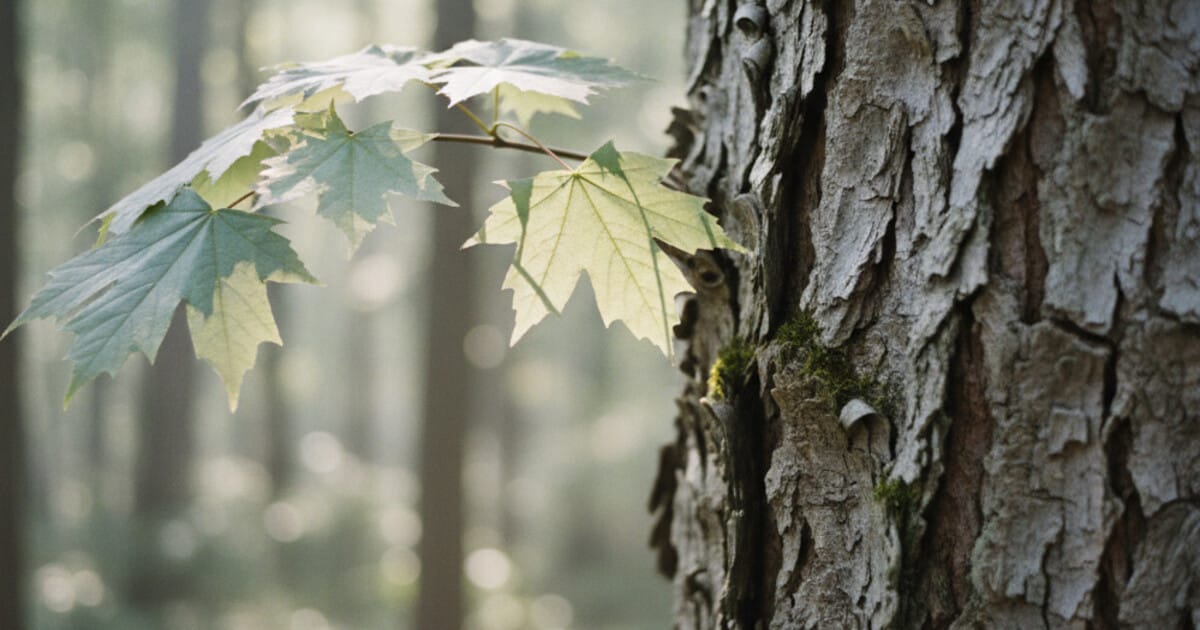
Flip the leaf over. The underside is silvery-white, covered in fine pale hairs that catch light at certain angles. When the wind moves through a silver maple canopy, the foliage ripples with a shimmer of pale silver. That’s where the name comes from, and it’s one of the clearest field ID signs in the entire maple family.
Silver maple (Acer saccharinum) grows natively across eastern North America from southern Canada south to Florida and west through the Great Plains. Its leaves are deeply 5-lobed with sinuses that extend nearly to the midrib, a feature that quickly separates it from red maple and sugar maple, which have shallower, more rounded cuts.
The leaf surface is medium green and slightly rough to the touch on top. The underside is pale silvery-white, caused by dense fine hairs that reduce moisture loss and give the canopy a shimmering look in a breeze. That two-tone effect is the single fastest way to pin down a silver maple in summer: from a distance, a wind gust flips the leaves and the whole crown flashes pale for a second.
Leaves grow in opposite pairs on long, slender reddish stems and measure 3 to 6 inches across. In fall, silver maple turns pale yellow to golden rather than the vivid reds of red maple. The combination of deeply cut lobes, opposite arrangement, and silvery undersides makes it one of the more reliable maples to identify by leaf alone, even from a distance.
The silvery backing isn’t unique to this tree. Poplars, some willows, and Russian olive share the same trick of pale undersides. The guide on trees with silver leaves walks through how to tell those apart from a silver maple so the shimmer alone doesn’t send you down the wrong path.
The long reddish stem is worth noticing. It’s slender and flexible, which is why the leaves flutter so readily. Leaves attach in opposite pairs at each node, meaning two leaves grow directly across from each other rather than staggered. That opposite arrangement (shared by all true maples) narrows things down fast when you’re comparing to other large shade trees.
For a broader look at how leaf shape works as an ID tool, the guide on tree identification by leaf shape covers the full range of leaf types found on common North American trees.
Bark: Smooth When Young, Shaggy When Old
Young silver maples have smooth, pale gray bark, similar to many other hardwoods in their early years. The real diagnostic value comes later.
On mature trees (usually trunks over 10 to 12 inches in diameter), the bark breaks into long, flat plates that curl outward slightly at the ends. The plates are gray to dark gray and often loosely attached at the tips. This shaggy, plated texture is one of the most distinctive bark patterns of any eastern hardwood.
The shaggy look sets in earlier than on many species, so a tree in its 20s or 30s already shows the characteristic plating. On very old trees the bark becomes deeply furrowed between the plates, with thick, rough-edged strips that peel slightly but don’t detach fully.
If you want to compare this to other trees with similar bark characteristics, the article on trees with peeling bark puts silver maple side by side with birch, sycamore, and shagbark hickory.
Seeds and Flowers: Spring’s Most Reliable Sign
Silver maple is one of the earliest trees to flower and fruit each year, and the seeds are hard to overlook.
Flowers appear from February to April (depending on latitude) as small clusters of red or yellowish-green blooms on bare branches. They’re small and easy to miss individually, but a mature silver maple in bloom has a distinct reddish haze along its branches before a single leaf opens.
The seeds are what most people notice: large, paired samaras (helicopter seeds) with wide, curved wings. Silver maple produces the largest samaras of any native North American maple, typically 1.5 to 2 inches long per wing. They ripen and fall in April and May, weeks before most trees have fully leafed out, and they cover the ground beneath the tree in dense mats.
The samaras are significantly bigger than red maple seeds and drop earlier in the season. That combination (size and timing) makes them a reliable early-spring ID clue, even when leaves aren’t fully out yet.
The trees with helicopter seeds guide covers how to distinguish silver maple samaras from red maple, ash, and elm.
Shape, Size, and Habitat
Silver maple grows fast. Most trees reach 50 to 80 feet tall, with some topping 100 feet along rivers where conditions are ideal. Trunk diameter on mature trees often reaches 2 to 3 feet.
The crown is broad and somewhat irregular. Young trees have a vase-shaped silhouette that fills outward over time. The branch structure is one of the more recognizable features at a distance: main scaffold branches arch out and downward, and the smaller branchlets at the tips turn back upward. The drooping-then-curling silhouette is easier to spot in winter when leaves are gone.
Habitat is a strong ID clue. In the wild, silver maple is almost exclusively a lowland species. It grows along stream banks, in river flood plains, and at the edges of wetlands. It tolerates flooding and even prolonged standing water much better than most hardwoods.
In cities and suburbs, it’s widely planted as a fast-growing street and shade tree. You’ll still find planted trees doing best in spots with consistent soil moisture. Dry hilltops and sandy, well-drained soils are where silver maple struggles.
Silver Maple vs. Red Maple: How to Tell Them Apart
These two are the most common silver maple identification mix-up, and they’re worth going through carefully because they overlap widely in range and habitat.
Both are native to eastern North America, both have opposite leaves with 5 lobes, and both produce helicopter seeds in spring. The differences come down to a few specific clues that are reliable in any season.
Leaf sinuses: Silver maple sinuses cut almost to the midrib. Red maple sinuses go about halfway to the center. Lay both leaves side by side and the difference is immediately obvious.
Leaf underside: Silver maple undersides are distinctly silvery-white. Red maple undersides are pale grayish-green, noticeably different when you compare them directly.
Seeds: Silver maple samaras are roughly twice the size of red maple samaras and ripen 3 to 6 weeks earlier (April-May for silver, May-June for red).
Bark: Red maple bark stays smoother and more tightly attached for longer. Silver maple starts breaking into shaggy plates on smaller, younger trunks.
Fall color: Red maple turns vivid red, orange, and yellow. Silver maple turns pale yellow to golden, rarely showing red.
If you’re still uncertain, the main maple tree identification guide covers the full maple family: red, sugar, silver, Norway, and box elder, with comparison notes for each.
How to Identify a Red Maple Tree (Acer Rubrum)
Red maple earns its name three times over: the flowers are red, the leaf stems and new growth are red, and the fall foliage blazes scarlet before almost any other tree in the forest.
Leaves: 3 to 5 lobes with sinuses going roughly halfway to the midrib, noticeably shallower than silver maple. The leaf base is squarish rather than deeply V-shaped. Both sides are green in summer, with a pale grayish-green underside and no silvery sheen. Leaves run 2 to 4 inches across, slightly smaller than silver maple on average.
Fall color: The most reliable single feature at a distance. Red maple turns vivid red, orange, or yellow in September and October, consistently among the earliest and most brilliant trees in eastern fall color. It peaks 2 to 3 weeks before sugar maple across most of its range.
Seeds: Smaller samaras than silver maple, typically 1/2 to 1 inch per wing, dropping in May and June. The wings often flush red or pink before they fully ripen, which gives you a useful early-summer check.
Bark: Smooth and pale gray on young trunks. Older specimens break into long, scaly plates that are tighter and less shaggy than silver maple bark at the same age.
Habitat: More adaptable than silver maple. Acer rubrum grows from wet stream banks to dry ridges, native from Newfoundland south to Florida and west to Minnesota across USDA zones 3–9. A silver maple in a dry upland situation is unusual; a red maple there is normal.
Red maple is the most widely distributed tree in eastern North America. The box elder tree identification guide covers the third common maple mix-up: Acer negundo, the compound-leaved maple that most people don’t recognize as a maple at all.
Silver Maple vs. Norway Maple: The Other Common Mix-Up
Norway maple (Acer platanoides) is the second tree people confuse with silver maple, especially in cities where both get planted as street trees. The leaves look similar at a glance, and both throw helicopter seeds. A few checks settle it every time.
The petiole test: Snap the leaf stem where it meets the twig. Norway maple leaks a drop of milky white sap. Silver maple doesn’t. This is the fastest single check when the two grow side by side, and it works spring through fall.
Leaf shape: Norway maple leaves are broad and flat with shallow sinuses and long tapering points on each lobe. Silver maple leaves are cut far deeper, almost to the midrib, with a jagged silhouette. Norway maple leaves also run wider than they are long.
Leaf underside: Flip the leaf. Silver maple is silvery-white underneath. Norway maple is medium green on both sides, no shimmer.
Samaras: Norway maple seeds spread their two wings almost flat, close to a straight 180-degree line. Silver maple wings form more of a wide horseshoe. Norway maple also drops its seeds in fall, months after silver maple has already finished in May.
Bark: Norway maple bark stays tight with regular shallow ridges into old age. Silver maple breaks into loose shaggy plates much earlier. For a wider look at how lobed maple leaves compare across species, the trees with lobed leaves guide lays them out side by side.
How Tree Identifier Helps With Silver Maple ID
Getting all 7 features in one glance is harder than it sounds. In winter you might only have bark and silhouette. In spring, seeds but no leaves. A photo ID app fills in the gaps regardless of the season.
Tree Identifier uses AI to identify trees from photos of leaves, bark, seeds, or the whole tree shape. Photograph the silvery underside of a leaf in summer, the shaggy plated bark of a mature trunk in winter, or a pile of large samaras in May, and the app returns a species identification with a confidence score and detailed species information.
The app works offline, so you can run it on remote hikes without cell service. You get 2 free identifications per day with no subscription required to start, which is enough to work through most casual encounters. If you’re trying to sort out what kind of maples are growing along a trail or in a neighborhood, it’s a fast way to confirm your field ID.
Frequently Asked Questions
How do I identify a silver maple by its leaves? Look for 5 deeply cut lobes with sinuses that go almost to the leaf center, a medium green upper surface, and a distinctly silvery-white underside covered in fine hairs. Leaves measure 3 to 6 inches across and grow in opposite pairs on long, slender reddish stems. The silvery underside is the most reliable single ID feature in summer.
Is silver maple the same as red maple? They’re closely related but distinct species. Silver maple (Acer saccharinum) has more deeply cut leaves with a silvery-white underside and produces larger seeds in early spring. Red maple (Acer rubrum) has shallower sinuses, a pale grayish-green underside, and smaller seeds that drop later. Both grow throughout eastern North America and often grow near each other.
How can I tell a silver maple from a Norway maple? Snap the leaf stem: Norway maple leaks milky white sap and silver maple doesn’t. Silver maple leaves are also cut far deeper (almost to the midrib) and have silvery-white undersides, while Norway maple leaves are broad, shallowly lobed, and green on both sides. Silver maple drops its seeds in May; Norway maple waits until fall.
When does silver maple drop its seeds? Silver maple seeds ripen and fall in April and May, making it one of the earliest-seeding native trees in the east. The large paired samaras fall heavily for a week or two and can cover the ground under the tree in dense mats. This timing is 3 to 6 weeks earlier than red maple and well before most trees have fully leafed out.
Where do silver maples grow? In the wild, silver maple grows in flood plains, stream banks, and wetland margins throughout eastern North America, from southern Canada south to Florida and west to the Great Plains. In urban areas it’s widely planted as a street and shade tree because of its fast growth. It performs best in moist soils but tolerates a wide range of urban conditions.
How fast does a silver maple grow? Silver maple is one of the fastest-growing native North American hardwoods, commonly adding 3 to 7 feet per year when young. Most trees reach 50 to 80 feet tall at maturity, with exceptional specimens along rivers exceeding 100 feet. The fast growth rate makes it popular for shade planting but also means the wood can be brittle in storm-prone areas.
What does a red maple tree (Acer rubrum) look like? Red maple has 3 to 5 shallowly lobed leaves with a squarish base, pale grayish-green undersides, and reddish leaf stems. In spring it produces small red flower clusters before any leaves open. Seeds are small samaras that flush pink or red before ripening in May–June. In fall, red maple turns brilliant red to orange, usually peaking earlier than other maples. It grows in USDA zones 3–9 across eastern North America.
Silver maple rewards a second look once you know the signs. The deeply cut, silvery-backed leaf is the kind of feature you’ll recognize instantly after seeing it once, and you’ll start noticing it on streets, in parks, and along streams you’ve walked dozens of times. If you want to confirm an ID on the spot, Tree Identifier can sort it out from a single photo of the leaf, bark, or seed.
Identify a tree from your photo — free
Upload a leaf, bark, or whole-tree photo and get the species in seconds. No signup.
Confidence:
Unlock the full species profile
Free in the app — with unlimited identifications.


AI result for guidance — the app gives full species details and works offline.
Want unlimited identifications?
Get the full species profile, photos and details — free in the app, with unlimited scans.
- Unlimited identifications
- Full species profiles & details
- Works offline, anywhere
- Save and revisit your finds
Elena Torres
Tree Identifier Team