Swamp White Oak Tree Identification: 7 Reliable Signs
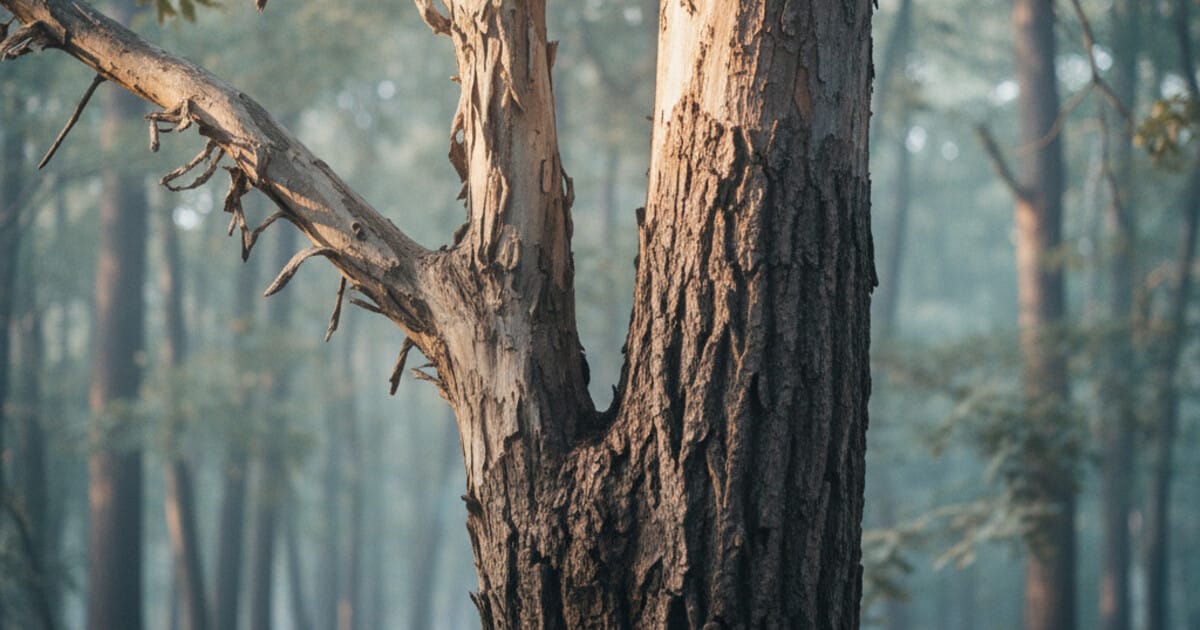
You’re walking a lowland trail in late spring. The canopy is dense, the soil is dark and damp, and there’s a massive oak you can’t quite pin down. The leaves look vaguely like a white oak’s, but the bark is doing something strange: the upper limbs are peeling in flat, curling sheets while the trunk below stays dark and rough. That’s swamp white oak (Quercus bicolor), and once you know what to look for, swamp white oak tree identification gets much more straightforward.
Swamp white oak (Quercus bicolor) is identified by its two-toned bark: upper branches peel in flat, curling strips while the lower trunk stays dark and deeply furrowed. Leaves are shallowly lobed, widest near the tip, with pale undersides. Acorns hang in pairs from unusually long stalks of 1-3 inches. It grows along river floodplains and in wet bottomland forests across eastern North America.
Sign #1: Swamp White Oak’s Two-Toned, Peeling Bark
Swamp white oak’s scientific name, Quercus bicolor, means “two-colored” in Latin, and the bark explains why. On upper branches and young limbs, the bark is thin and grayish-brown, lifting away in flat, papery strips. Lower on the trunk, it switches to thick, dark, deeply ridged bark typical of a mature oak.
This contrast gets sharper as the tree ages. On older specimens, upper limbs look almost silvery from the loose bark curling away from them. On a younger tree (under 20 years), the peeling is subtler, but still visible on branches thicker than a few inches.
No other common eastern oak shows this pattern so consistently. Our guide to tree bark identification covers many species, but swamp white oak’s bicolor peeling stands alone in the genus.
Swamp white oak (Quercus bicolor) belongs to the white oak group of the beech family (Fagaceae) and is native to eastern North America from southern Maine to Minnesota, south into Georgia. It typically grows 50-60 feet tall with crown spreads reaching 50-70 feet, though old-growth specimens have topped 100 feet. The species tolerates poorly drained, compacted, and periodically flooded soils far better than most oaks, making it a common choice for urban plantings near detention ponds and stormwater areas. In natural settings it grows in river floodplains, bottomland forests, and wet meadow edges from USDA hardiness zones 4-8. Compared to white oak (Q. alba), swamp white oak has peeling upper-branch bark, a more obovate leaf shape, and acorn stalks 25-85 mm long, versus under 10 mm for white oak.
Sign #2: Swamp White Oak Leaves — Shallowly Lobed and Spoon-Shaped
Swamp white oak leaves grow 5-7 inches long and are widest near the tip, giving them a spoon or paddle shape (technically called obovate). Most oak leaves are widest in the middle; this narrower-at-the-base silhouette is a reliable tell.
The lobes are shallow and rounded. You’ll count roughly 6-10 rounded bumps along the margin, but they never cut more than a third of the way toward the midrib. The overall outline looks almost blob-like compared to the deeply cut fingers of a pin oak or the more symmetrical lobes of a red oak.
Compare it directly with white oak and the difference is clear: swamp white oak’s leaf is rounder at the top and less dramatically lobed throughout. The shape holds consistently from tree to tree. For a detailed breakdown of how leaf shape helps narrow down species, see our tree identification by leaf shape guide.
Leaves are alternately arranged on the stem, like most oaks. Maples and ashes have opposite leaves, so if you see opposite arrangement, you’re not dealing with any oak species.
Sign #3: Pale Leaf Undersides
Flip any swamp white oak leaf over and you’ll find a noticeably pale, whitish-green underside, sometimes with fine soft hairs. The upper surface is dark green and relatively smooth. That color contrast stays consistent through the growing season.
This underside paleness is shared with some other white oaks, but combined with the leaf shape and bark, it locks in the ID. When a breeze catches the leaves and flips them over, the silvery flash is a field marker worth noting from a distance.
In fall, swamp white oak foliage turns yellow to reddish-brown. It’s not the fiery scarlet of a red oak, but the pale undersides stay pale right through senescence.
Sign #4: Swamp White Oak Acorns on Long Stalks
Most oaks produce acorns on short stalks or no stalks at all. Swamp white oak does something noticeably different: it grows acorns in pairs on stalks 1-3 inches long. That long stalk (called a peduncle) is one of the most reliable field markers the species has.
The acorns are roughly 3/4 to 1 inch long, oval-shaped, and covered about halfway by a cup with slightly fringed scales along the margin. In September and October, those dangling pairs on long stalks are nearly unmistakable once you’ve seen them once.
Acorns ripen and fall in the same year they’re produced, typical for the white oak group (which completes its cycle in one year, unlike red oaks that take two). Wildlife depends heavily on the crop: white-tailed deer, wild turkeys, wood ducks, and mallards all forage in swamp white oak bottomlands during fall mast.
Sign #5: Wet Ground and Floodplain Habitat
Swamp white oak isn’t a true swamp species. It doesn’t stand in permanent water. Instead, it grows in places that flood periodically or stay wet into summer: river floodplains, poorly drained bottomland forests, the edges of wet meadows, and depressional pockets in mixed forest stands.
In urban settings, look for it near retention ponds, along road medians with poor drainage, and in parks where wet soil rules out other oaks. Municipalities plant it specifically because it handles those conditions better than almost any other native oak while still providing large-canopy shade and wildlife value.
If you spot a big oak growing at the edge of a low-lying field or along a wet creek bank in the eastern US, habitat alone should put swamp white oak on your short list. Combine that with bark and leaf clues and you’ll have a confident ID.
Sign #6: Broad, Arching Crown With Low Branches
Mature swamp white oaks have a broad, open crown with large lower branches that arch downward before curving back up. On open-grown trees, these lower limbs can sweep nearly to the ground, creating a wide, spreading silhouette that’s easy to spot from a distance.
This low branch structure makes the peeling upper bark easy to examine without binoculars. On many mature trees, you can reach up and touch a branch with clearly visible bark exfoliation. That accessibility makes this one of the most practical field marks in the mix.
The crown is generally rounder than a pin oak’s (which has many strongly downward-drooping lower branches) and wider-spreading than a willow oak’s narrower profile.
Sign #7: Clustered Buds at Twig Tips
Like all oaks, swamp white oak produces clusters of multiple buds at the tips of each twig, rather than the single terminal bud you’d find on maples or elms. Those bud clusters confirm you’re looking at an oak family member before you even check leaves or bark.
Swamp white oak’s buds are small, reddish-brown, and hairless, distinguishing them from bur oak (whose buds are hairy) and some red oaks (larger, sharper buds). The twigs are gray-brown and fairly smooth. Combined with the other six signs above, the twig tip tells you exactly where you are in the oak family.
Our oak tree identification guide covers the full range of eastern species and how to move through the genus systematically when you’re in mixed-oak bottomland forests.
How Tree Identifier Helps Confirm Swamp White Oak
Bark texture, leaf shape, and acorn stalk length all need to line up for a confident swamp white oak call. In the field, that can be harder than it sounds: young trees peel less, leaves vary in size, and you might not have acorns in hand in spring or early summer.
Tree Identifier can fill in the gaps. Take a photo of a leaf, a branch showing the peeling bark, or both. The app’s AI processes multiple identification inputs — leaves, bark, whole tree shape — and returns a species ID with a confidence score plus detailed information about the species.
It works offline, so you won’t lose functionality on a remote bottomland trail. You get 2 free identifications daily with no subscription required. Upgrade for unlimited use on longer field surveys or when you’re working through a stand of mixed oaks.
Download Tree Identifier on iOS or Android and confirm your next swamp white oak find.
Frequently Asked Questions
How do I tell swamp white oak from white oak? Check the bark on upper branches: swamp white oak peels in flat, curling strips there, while white oak stays furrowed throughout. Also check the acorn stalk — swamp white oak acorns hang on 1-3 inch stalks, much longer than white oak’s nearly stalkless acorns. Habitat helps too: if it’s on wet, poorly drained ground, swamp white oak is the stronger candidate.
Is swamp white oak a good landscape tree? Yes, especially for wet or poorly drained sites where other oaks struggle. It tolerates seasonal flooding, compacted soil, and urban conditions better than most native oaks. It grows 50-60 feet tall with a broad crown, so it needs space, but it’s one of the best native shade trees for low-lying yards in hardiness zones 4-8.
When do swamp white oak acorns drop? Acorns ripen in September and October. They’re produced on a one-year cycle (unlike red oaks, which take two years), so a healthy tree delivers a crop annually. Deer, turkeys, and waterfowl forage under swamp white oaks heavily during fall mast season.
Can you find swamp white oak in urban areas? Yes. Cities and municipalities plant it specifically for its tolerance of wet, compacted, and periodically flooded soils. You’ll find it near stormwater ponds, in median strips with poor drainage, and in urban parks. The peeling upper bark and long-stalked acorns make it identifiable even in a city park setting.
Conclusion
Swamp white oak is one of the more distinctive oaks once you know its core field marks: peeling bark on upper limbs with furrowed bark below, paddle-shaped leaves with shallow lobes and pale undersides, and acorns in pairs on 1-3 inch stalks. Add its preference for wet, low-lying ground and you’ve got a reliable ID that holds up across all four seasons.
If you want a second opinion on a bark pattern or need to confirm a candidate in the field, Tree Identifier handles the photo and returns a species match with confidence score, working even without cell service on remote bottomland trails.
Identify a tree from your photo — free
Upload a leaf, bark, or whole-tree photo and get the species in seconds. No signup.
Confidence:
Unlock the full species profile
Free in the app — with unlimited identifications.


AI result for guidance — the app gives full species details and works offline.
Want unlimited identifications?
Get the full species profile, photos and details — free in the app, with unlimited scans.
- Unlimited identifications
- Full species profiles & details
- Works offline, anywhere
- Save and revisit your finds
Elena Torres
Tree Identifier Team