Sycamore Tree Identification: Bark, Leaves, and Species
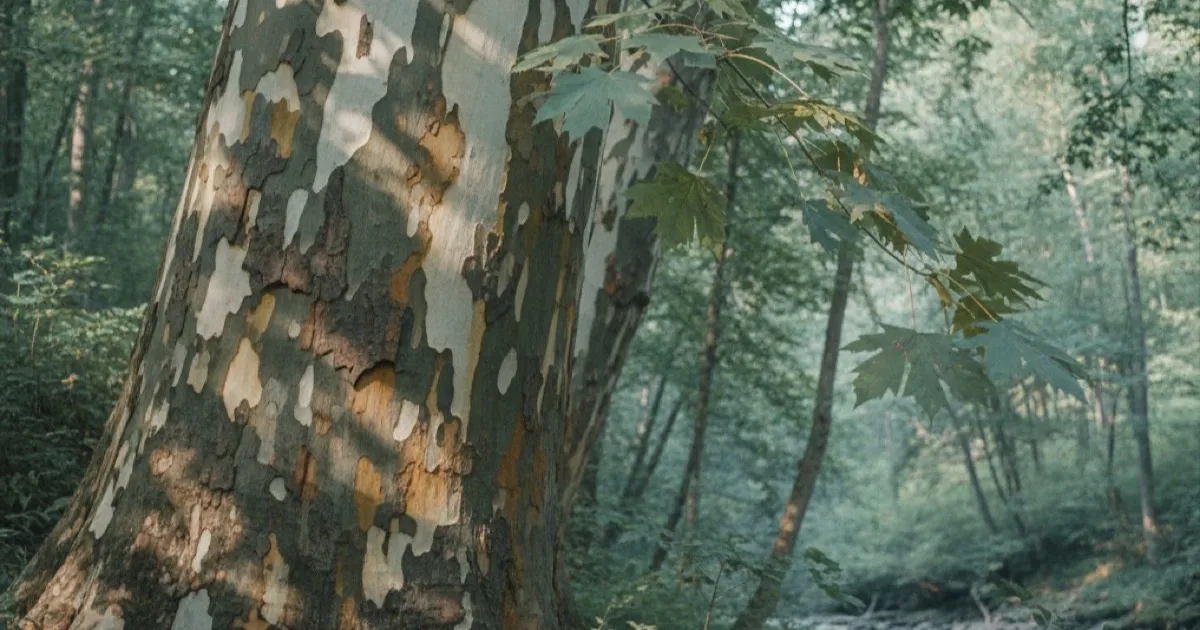
Sycamore tree identification is one of the easiest skills in the tree world, and the bark is the reason. No other North American tree sheds its outer bark in large irregular sheets to reveal a patchwork of white, cream, olive green, and tan beneath. From 200 feet away, a mature sycamore trunk looks like a camouflage pattern painted on wood. Up close, the smooth, pale inner bark feels almost polished where the dark outer layers have peeled away.
This guide covers four sycamore species: American sycamore, California sycamore, Arizona sycamore, and the London plane tree — a hybrid so common in cities that you’ve almost certainly walked past one without knowing its name.
How to Identify a Sycamore Tree: Key Features
Sycamores belong to the genus Platanus, and they share a set of traits that make them straightforward to identify at any time of year. Here’s what to look for.
Bark. This is the defining feature. Young sycamores start with smooth, pale gray-green bark. As the tree grows, the outer bark can’t stretch fast enough to keep up with the expanding trunk. It cracks and peels away in jigsaw-puzzle pieces, exposing the lighter inner bark. The result is a mottled mosaic that ranges from bone white to olive green to dark brown. No other common North American tree produces this effect. For a deeper look at how bark patterns help with tree identification, sycamore is the textbook example.
Leaves. Sycamore leaves are the largest simple leaves of any native North American tree. On American sycamore, a single leaf can measure 6 to 10 inches across, with three to five pointed lobes and coarse, irregular teeth. The overall shape resembles a maple leaf, but much bigger and coarser. Leaves are bright green on top and paler beneath, with fuzzy hairs on the underside. If you’re already familiar with leaf-based identification techniques, the sycamore leaf stands out by sheer size alone.
Seed balls. Sycamores produce round, spiky seed clusters about 1 to 1.5 inches in diameter, hanging from long stalks called peduncles. American sycamore typically hangs one seed ball per stalk. London plane trees hang two to three. This seed ball count is one of the fastest ways to tell the two apart.
Size. American sycamores are among the largest hardwoods in eastern North America. Mature specimens regularly reach 75 to 100 feet tall with trunk diameters of 3 to 8 feet. The national champion American sycamore in Ashland, Ohio has a trunk circumference over 18 feet. These are massive, spreading trees that dominate riverbanks and floodplains.
Hollow trunks. Old sycamores frequently develop hollow interiors. The heartwood rots while the sapwood and bark remain structurally sound, creating cavities large enough for animals to shelter in.
American Sycamore (Platanus occidentalis)
American sycamore is the native eastern species and the one most people picture when they think of sycamores. It grows naturally from southern Maine to Nebraska and south to Texas and Florida, almost always near water. Look for it along rivers, streams, floodplains, and lake shores.
Bark. The classic camouflage pattern. Upper branches and the crown are often strikingly white where bark has peeled cleanly. Lower trunk sections retain more dark, rough outer bark. The contrast between the pale upper trunk and the mottled lower trunk is a reliable long-distance identification clue.
Leaves. Three to five shallow lobes, 6 to 10 inches wide, with coarse teeth. The sinuses (spaces between lobes) are relatively shallow compared to London plane tree. The petiole (leaf stalk) is 3 to 5 inches long with a swollen base that conceals the bud for next year’s growth. When the leaf drops in fall, the bud is revealed — a neat trick unique to Platanus.
Seed balls. One per stalk, almost always solitary. This is the single most useful field mark for separating American sycamore from London plane tree.
Habitat. Bottomlands, riverbanks, and moist soils. American sycamore is a pioneer species that colonizes bare gravel bars and sandy deposits after floods. It grows fast in full sun and tolerates poor drainage.
Wood. The lumber is pale with interlocked grain that creates a distinctive flecked pattern when quarter-sawn. Sycamore wood is used for butcher blocks, furniture, and interior paneling.
California Sycamore (Platanus racemosa)
California sycamore is the western counterpart to American sycamore, native to valleys and canyons throughout California and into Baja Mexico. It’s common along seasonal creeks in the Coast Ranges and Sierra foothills.
Form. California sycamore often grows with multiple trunks leaning at dramatic angles, creating a more sculptural silhouette than the single-trunked American species. The bark shows the same camouflage pattern but tends toward warmer tones — more cream and tan, less stark white.
Leaves. Deeply lobed, with five lobes that are more pointed and deeply cut than American sycamore. The sinuses extend more than halfway to the midrib. Leaves are 6 to 10 inches wide but appear more star-shaped than the broader, shallower-lobed American species.
Seed balls. Three to five per stalk, strung along the peduncle like beads on a string. This multi-ball arrangement separates it from the single-balled American sycamore.
Range. Central and southern California, extending into Baja Mexico. Found along streams, rivers, and canyon bottoms below 4,000 feet. It’s a signature tree of Pacific Northwest and California landscapes, though it doesn’t extend as far north as Oregon.
Arizona Sycamore (Platanus wrightii)
Arizona sycamore grows in the canyons and riparian corridors of southern Arizona, southwestern New Mexico, and northern Mexico. It’s the sycamore of desert creek beds, and finding one almost always means permanent water is nearby.
Form. Multiple trunks with graceful, leaning growth. Trunks are often brilliantly white, standing out against brown desert hillsides.
Leaves. Deeply divided into five to seven narrow, pointed lobes — narrower than either American or California sycamore, giving the leaf a hand-like appearance. Leaves are 6 to 9 inches wide.
Seed balls. Two to four per stalk.
Habitat. Strictly riparian. Arizona sycamore grows only in canyon bottoms and along perennial streams between 2,000 and 6,000 feet elevation. Its presence is such a reliable water indicator that desert hikers use it for navigation.
Sycamore vs London Plane Tree: Telling Them Apart
This is the confusion that trips up most people. London plane tree (Platanus x acerifolia) is a hybrid between American sycamore and Oriental plane tree (Platanus orientalis), first cultivated in the 1600s. It combines the size and vigor of American sycamore with the pollution tolerance and disease resistance of the Oriental parent. The result is one of the most widely planted urban trees in the world.
If you see a sycamore-like tree in a city — along a sidewalk, in a park, lining a boulevard — there’s a strong chance it’s a London plane tree, not an American sycamore. Here’s how to tell them apart.
Seed ball count. American sycamore produces one seed ball per stalk. London plane tree produces two or three per stalk. Look up in fall or winter and count the clusters. Solitary balls mean American sycamore. Pairs or trios mean London plane.
Leaf shape. London plane leaves have deeper sinuses than American sycamore. The lobes are more sharply defined, and the overall leaf is slightly smaller (5 to 8 inches versus 6 to 10 inches). The difference is subtle and best judged with leaves from both species side by side.
Bark. Both species show the camouflage pattern, but London plane tree retains more olive-green and brown bark on the lower trunk. American sycamore typically shows more white, especially in the upper crown.
Disease resistance. American sycamore is susceptible to anthracnose, a fungal disease that causes leaf browning and twig dieback. London plane tree was bred for resistance to anthracnose and urban pollution. A sycamore-type tree thriving on a busy city street with no disease symptoms is likely London plane.
Location. American sycamore grows wild along rivers and floodplains. London plane tree is almost exclusively planted in urban parks, along streets, and in landscaped settings. A sycamore-type tree along a creek in Virginia is almost certainly American sycamore. One in a city tree pit is almost certainly London plane.
| Feature | American Sycamore | London Plane Tree |
|---|---|---|
| Seed balls per stalk | 1 | 2-3 |
| Leaf sinuses | Shallow | Deeper |
| Leaf width | 6-10 inches | 5-8 inches |
| Anthracnose resistance | Low | High |
| Typical habitat | Wild, riparian | Urban, planted |
| Bark color | More white | More olive-green |
Sycamore Tree Identification in Winter
Sycamores are among the easiest trees to identify without leaves. The bark alone is diagnostic at any season. In winter, the camouflage pattern actually becomes more visible because there’s no foliage to obscure the trunk and upper branches. The white and cream patches of the upper canopy stand out against gray winter skies.
Seed balls persist on the tree well into winter and often through early spring, dangling on their long stalks. Count the balls per stalk to determine species. Sycamore buds are distinctive too: conical, reddish-brown, and concealed inside the swollen base of the leaf stalk until the leaf drops. If you want a full approach to leafless identification, the winter tree identification guide covers techniques for dozens of species.
The sheer size of mature sycamores also helps in winter. In a leafless eastern forest, the tree with the thickest, whitest trunk is very likely a sycamore.
How Tree Identifier Can Help with Sycamore Identification
Telling American sycamore from London plane tree is the most common sycamore identification challenge, and it’s hard to judge from leaf shape alone when you don’t have both species in front of you. Tree Identifier uses AI to analyze photos of bark, leaves, seed clusters, and overall tree form, returning a species match with a confidence score.
For sycamores, bark photos tend to produce the most confident results. The camouflage pattern is distinctive, and the database covers thousands of species for comparison. Snap a photo of the mottled trunk from a few feet away. You can also photograph the hanging seed balls — the one-versus-two count is a strong diagnostic the app can pick up.
The app runs on iOS and Android with 2 free identifications per day. Offline mode works in remote river valleys where sycamores grow thick and cell service runs thin. Whether you’re confirming a London plane in a city park or an American sycamore along a backcountry stream, a photo gives you an answer in seconds.
Frequently Asked Questions
How can I tell a sycamore from a maple tree?
Sycamore leaves resemble maple leaves at first glance because both are broad with pointed lobes. The differences are clear up close: sycamore leaves are much larger (6 to 10 inches versus 3 to 6 inches for most maples), coarser in texture, and have fuzzy undersides. The bark is the giveaway — no maple produces the white, peeling, camouflage-patterned bark that defines sycamores. For a full rundown of maple identification traits, the bark and leaf differences are covered in detail.
Are sycamore trees native to North America?
Yes. American sycamore (Platanus occidentalis) is native to eastern North America. California sycamore (Platanus racemosa) is native to California and Baja Mexico. Arizona sycamore (Platanus wrightii) is native to the desert Southwest. The London plane tree is a cultivated hybrid and is not native, though it is widely planted in cities across the continent and around the world.
Why does sycamore bark peel off?
Sycamore bark is rigid and doesn’t expand as readily as the bark of most other trees. As the trunk grows in diameter each year, the outer bark cracks under the tension and flakes away in irregular plates. The newly exposed inner bark is smooth and pale, creating the signature mottled pattern. This process is continuous throughout the tree’s life and is most dramatic on the upper trunk and large branches.
How long do sycamore trees live?
American sycamores commonly live 200 to 300 years, with some specimens estimated at over 500 years. Their longevity, combined with fast growth rates of 2 to 3 feet per year when young, explains why they reach such enormous sizes. Hollow trunks on old trees don’t necessarily indicate poor health — sycamores can thrive for decades with hollow interiors as long as the outer sapwood remains intact.
Is a London plane tree the same as a sycamore?
Not exactly. London plane tree (Platanus x acerifolia) is a hybrid between American sycamore and Oriental plane tree. It shares the camouflage bark and lobed leaves but differs in seed ball count (two to three per stalk versus one), deeper leaf lobes, and much higher disease resistance. In British English, “sycamore” often refers to Acer pseudoplatanus, a maple — so terminology varies by country.
Sycamores anchor riverbanks, shade city streets, and produce the most visually striking bark of any tree on the continent. Whether you’re standing beneath an American sycamore along an eastern creek or looking up at a London plane tree on an urban block, the camouflage bark tells you exactly what you’re looking at. Learn to read that bark, count the seed balls, and you’ll have sycamore tree identification sorted for good.
Identify a tree from your photo — free
Upload a leaf, bark, or whole-tree photo and get the species in seconds. No signup.
Confidence:
Unlock the full species profile
Free in the app — with unlimited identifications.


AI result for guidance — the app gives full species details and works offline.
Want unlimited identifications?
Get the full species profile, photos and details — free in the app, with unlimited scans.
- Unlimited identifications
- Full species profiles & details
- Works offline, anywhere
- Save and revisit your finds
Elena Torres
Tree Identifier Team