Trees That Bloom in Summer: 8 Species Identified
Most flowering trees are finished by June. Cherry, dogwood, redbud, magnolia: they all put on their show in March, April, and May, then get back to the business of making leaves.
But some trees do it differently. Trees that bloom in summer skip the spring rush entirely, opening their flowers in June, July, or August when pollinators are still active and the competition for their attention has dropped off. If you spot a tree covered in flowers on a hot July afternoon, you’re looking at something worth identifying.
This guide covers 8 common trees that bloom in summer, with the specific features to tell them apart.
Trees that bloom in summer include crape myrtle (pink, red, or white clusters, July-September), mimosa (pink pom-poms, June-August), black locust (fragrant white chains, May-June), sourwood (white drooping bells, July-August), and goldenrain tree (yellow panicles, July-August). Summer bloomers are far rarer than spring-flowering trees, which makes identification easier when you spot one in flower.
Why Some Trees Wait Until Summer to Bloom
Spring seems like the obvious time to flower. Days are lengthening, temperatures are climbing, and every pollinator is out hunting for its first meal of the season.
The problem with spring is the crowding. Thousands of trees bloom simultaneously. Pollinators get spread thin, and any single tree competes against every other flowering tree in the landscape.
Summer-blooming trees took a different route. They leaf out in spring like everything else, then hold their flowers until June or later, when the spring crowd has already dispersed.
Summer-blooming trees follow a distinct flowering strategy that sets them apart from the spring majority. Most deciduous trees bloom early in the season, before or just as their leaves emerge, to maximize early pollinator access. Summer bloomers, by contrast, flower well after leafing out, often between June and September. This timing correlates with continued activity from bumblebees, butterflies, and clearwing moths, all of which remain active through summer heat and face fewer floral options once spring blooms finish. The result is that summer-blooming trees often achieve strong pollinator visitation rates despite a smaller number of competing flowers. For identification purposes, this timing is a real advantage: a tree in full bloom between June and September belongs to a much narrower group than spring bloomers. Common examples include crape myrtle, mimosa, sourwood, goldenrain tree, Japanese pagoda tree, and catalpa, each with a distinctive flower structure that differs sharply from spring bloomers like cherry, redbud, or dogwood.
8 Trees That Bloom in Summer
1. Crape Myrtle (Lagerstroemia indica)
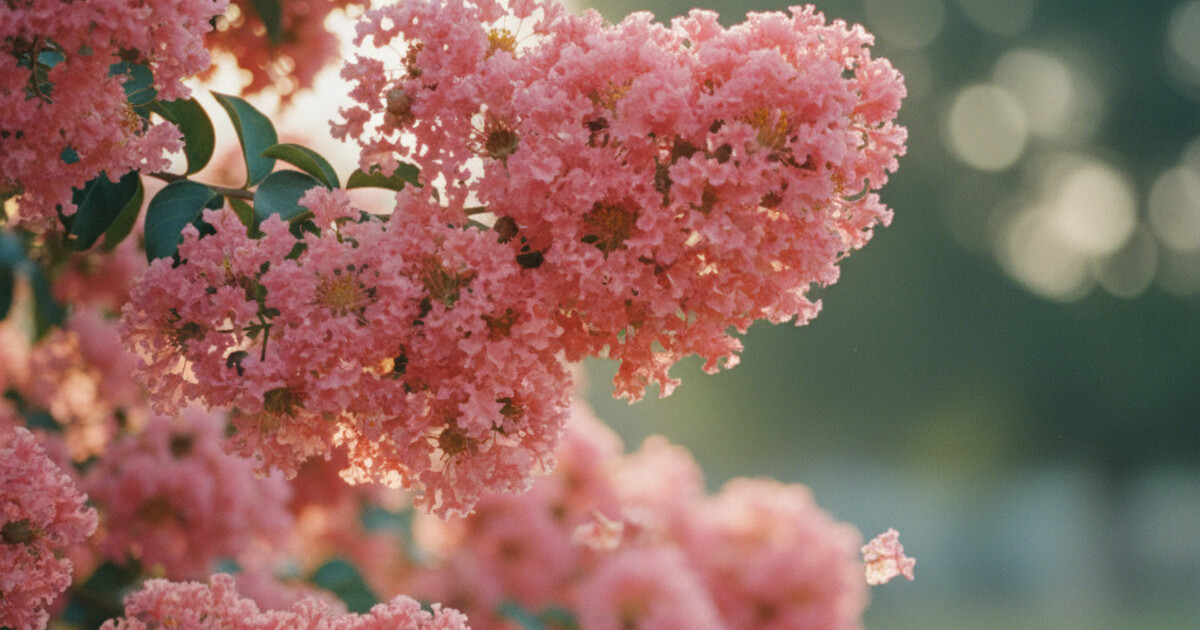
Bloom time: July to September Flower color: Pink, red, white, or lavender, depending on variety Flower structure: Dense upright clusters (panicles) at branch tips, 6 to 18 inches long
Crape myrtle is the most planted summer-blooming tree in the US. It’s ubiquitous across the South: parking lots, highways, front yards. When it blooms, entire branch tips explode in color for weeks on end.
The flowers have crinkled, crepe-paper-textured petals (hence the name). Each cluster holds dozens of individual blooms.
Year-round, the smooth peeling bark is a reliable identifier. Patches of gray, tan, and cinnamon peel away in sheets to reveal fresh layers underneath. Leaves are oval and 1 to 3 inches long. In fall, they turn orange, red, or yellow before dropping.
Size: 10 to 30 feet, depending on variety Range: Southeast and Southwest US; widely planted along the Pacific Coast
2. Mimosa / Silk Tree (Albizia julibrissin)
Bloom time: June to August Flower color: Pink Flower structure: Round, fluffy pom-poms made of thread-like stamens (no visible petals)
Mimosa is one of the easiest summer-blooming trees to identify. The flowers look like pink powder puffs at branch tips. There are no traditional petals: just dozens of long pink stamens bundled into a rounded mass.
The leaves are equally distinctive: finely divided and fernlike, with each leaf splitting into paired stems, each stem carrying many small leaflets. They fold up at night and in heavy rain, which surprises people the first time they notice it.
Mimosa was introduced from Asia and is now invasive across many eastern states, spreading quickly along roadsides and disturbed areas.
Size: 20 to 40 feet, with a wide, flat-spreading crown Range: Eastern and Southern US; invasive in many states east of the Mississippi
3. Black Locust (Robinia pseudoacacia)
Bloom time: Late May to early June Flower color: White Flower structure: Hanging chains (racemes) of pea-like flowers, 4 to 8 inches long, intensely fragrant
Black locust is the earliest bloomer on this list, flowering in late May to early June. You’ll often smell it before you see it. The fragrance carries far, a heavy, sweet, honey-like scent that saturates the surrounding air.
Each flower in the dangling chain is shaped like a classic pea flower: two upright petals and three lower ones. Black locust belongs to the legume family, which explains the flower structure and the long seed pods that follow.
Outside bloom season, look for deeply furrowed bark on mature trees. Young twigs have short paired thorns at each leaf node.
Size: 40 to 70 feet Range: Native to the Appalachians; naturalized across much of North America
4. Sourwood (Oxydendrum arboreum)
Bloom time: July to August Flower color: White Flower structure: One-sided drooping chains of tiny urn-shaped flowers, resembling lily of the valley
Sourwood is one of the few trees that reliably blooms in midsummer. The flower chains drape downward from branch tips, each tiny bloom a white bell-shape. From a distance, the effect is a cascade of white ribbons laid over dark green foliage.
Leaves are lance-shaped, 5 to 7 inches long. If you chew one, it tastes slightly sour. That’s where the name comes from. In fall, the foliage turns brilliant scarlet, rivaling maple for color in the southern Appalachians.
If you’re hiking in North Carolina, Tennessee, or Virginia in July and spot drooping white flower chains on a mid-sized tree, it’s almost certainly sourwood.
Size: 25 to 50 feet Range: Eastern US, primarily the Appalachians and adjacent piedmont
5. Goldenrain Tree (Koelreuteria paniculata)
Bloom time: July to August Flower color: Yellow Flower structure: Large upright panicles of small 4-petaled flowers, followed by papery lantern-shaped seed pods
Goldenrain tree is the only common ornamental tree in North America that blooms yellow in midsummer. That alone makes it easy to spot. The flowers appear in loose, upright clusters up to 18 inches tall, turning the tree golden for 2 to 3 weeks in July.
After the flowers drop, it sets papery three-sided pods: salmon-pink when fresh, drying to tan by fall. These pods rattle in the wind and stick around through winter, giving you a second way to identify the tree out of season.
Leaves are pinnately compound or bipinnate, with leaflets that have irregular lobing, somewhat like a large ash leaf.
Size: 20 to 40 feet Range: Originally from Asia; planted widely across the US as a street tree and ornamental; naturalized in some areas
6. Catalpa (Catalpa speciosa and C. bignonioides)
Bloom time: Late May to early June Flower color: White with purple speckles and yellow stripes inside Flower structure: Upright clusters (panicles) of trumpet-shaped flowers, each up to 2 inches across
Catalpa is hard to miss when it’s in flower. The blooms appear in dense clusters above the canopy, with each individual flower large enough to see clearly from the ground.
The leaves are even more recognizable than the flowers: enormous heart-shaped blades up to 12 inches long, arranged in whorls of three along the branches. Catalpa is one of the very few US trees with a whorled leaf arrangement.
After blooming, catalpa sets its signature seed pods (thin, bean-like tubes up to 18 inches long) that hang through winter and rattle in the wind.
For full bark details and species comparisons, see the catalpa tree identification guide.
Size: 50 to 70 feet Range: Native to Midwest and South; planted widely across North America
7. Tulip Poplar (Liriodendron tulipifera)
Bloom time: May to early June Flower color: Greenish-yellow with an orange band at the base Flower structure: Solitary tulip-shaped cups at branch tips
Tulip poplar blooms in late spring, and the flowers are unlike any other North American tree. Each bloom is a tulip-shaped cup with greenish-yellow petals and a bright orange band inside. The problem: they often sit 70 to 100 feet up in the canopy, out of easy view.
The leaf shape is the easier identifier. Each leaf has four lobes with a notch at the tip, like someone trimmed the end off a maple leaf. Once you learn that shape, you’ll spot tulip poplars throughout eastern forests.
For a full identification breakdown, see the tulip tree identification guide.
Size: 70 to 100 feet in forest settings Range: Eastern US, from the Great Lakes south to the Gulf Coast
8. Japanese Pagoda Tree (Styphnolobium japonicum)
Bloom time: July to August Flower color: Creamy white to pale yellow Flower structure: Upright panicles of small pea-like flowers, 12 to 15 inches long
Japanese pagoda tree earns its spot as a city street tree by blooming in July and August when almost nothing else is flowering. The large creamy clusters are conspicuous from the sidewalk.
Like black locust, it belongs to the legume family, and the individual flowers show the classic pea-flower shape. Leaves are pinnately compound with 7 to 17 oval leaflets. Bark on mature trees is gray-brown with shallow interlacing ridges.
It lines streets and parks throughout Washington D.C., New York, Philadelphia, and other eastern cities.
Size: 50 to 75 feet Range: Widely planted across eastern and midwestern US
How Tree Identifier Helps You Name a Blooming Tree
Spotting an unfamiliar tree in full bloom is one of the better moments to get a confident identification. Flowers give an AI identification tool a lot of specific visual information, more than bark or a bare branch ever could.
Tree Identifier processes photos of leaves, bark, flowers, fruit, and whole tree shape. During summer, a close-up of the flower cluster is often the strongest signal. Take one photo of the flowers and one of the leaves, submit both, and the app cross-references them against its species database for a more accurate result than a single photo alone.
A few things that help:
- Photograph flowers before they’re fully spent: fresh blooms show cleaner color and structure
- Capture the cluster shape (drooping chain vs. upright panicle vs. round pom-pom), not just the color
- If the flowers are high in the canopy, a leaf photo plus a full-tree shot gives the app enough to work with
Tree Identifier has offline identification built in, so it works on hikes and trails without cell service. You get 2 free identifications per day to start. Download species data before heading out and it’ll work anywhere.
Frequently Asked Questions
What trees bloom in summer in the Southeast?
Crape myrtle is the most common, flowering from July through September across the region. Sourwood blooms in July and August, primarily in the Appalachians. Mimosa is widespread, blooming June through August. Catalpa wraps up its bloom in early June across the Gulf states and Midwest. All four can overlap in the same area during early summer.
How do I identify a blooming tree I can’t get close to?
Look at the bloom structure first. Is the flower mass upright or drooping? Clustered tightly or spread along the branches? A large upright yellow cluster in July is likely goldenrain tree. Drooping white chains in August point to sourwood. Pink pom-poms on a wide flat crown are almost always mimosa. Color is a starting point, but cluster shape narrows it down faster.
What trees have white flowers in summer?
Black locust blooms with strongly fragrant white chains in late May to early June. Sourwood blooms July-August with drooping urn-shaped white flowers. Japanese pagoda tree blooms July-August with large creamy-white clusters. Catalpa blooms in late May to early June with white trumpet flowers marked inside with purple and yellow. Each has a distinct cluster structure.
Can an app identify a tree that’s in flower?
Yes, and summer bloom is a good time to try. Apps like Tree Identifier work well when trees are flowering because the flower structure gives the AI more specific visual detail to match. Take close-up photos of the flower cluster and the leaves together for the most accurate result.
Spotted a tree in bloom this summer and can’t name it? Download Tree Identifier, snap a photo of the flowers or leaves, and get an identification in seconds. It works offline on trails and in areas without cell service. Try it free at treeidentifier.app.
Identify a tree from your photo — free
Upload a leaf, bark, or whole-tree photo and get the species in seconds. No signup.
Confidence:
Unlock the full species profile
Free in the app — with unlimited identifications.


AI result for guidance — the app gives full species details and works offline.
Want unlimited identifications?
Get the full species profile, photos and details — free in the app, with unlimited scans.
- Unlimited identifications
- Full species profiles & details
- Works offline, anywhere
- Save and revisit your finds
Elena Torres
Tree Identifier Team