Trees With Pink Flowers: 10 Species to Know
Walking through a neighborhood in spring and spotting a tree covered in pink blooms you can’t name is genuinely frustrating. Trees with pink flowers show up in yards, parks, and roadsides across most of North America, ranging from the magenta redbud popping open in February to the feathery silk tree lighting up July. Knowing which species you’re looking at tells you when it blooms, how large it grows, and whether it makes sense for your yard. This guide covers 10 of the most common pink-flowering trees, organized by bloom season so you can match what you’re seeing to the right species.
The most common trees with pink flowers are Eastern Redbud, Yoshino and Kwanzan cherry, crabapple, pink dogwood, saucer magnolia, mimosa, and crepe myrtle. Most bloom in spring. Mimosa and crepe myrtle wait until summer. Each has distinct bloom colors, from pale blush to deep magenta, with reliable identification clues in the flowers, bark, and leaf shape.
Early Spring: Pink Before the Leaves Come Out
The earliest pink bloomers do something striking: they flower before their leaves unfurl. If you see a tree covered in pink with bare branches still visible, you’re almost certainly looking at a redbud or a magnolia.
Eastern Redbud (Cercis canadensis)
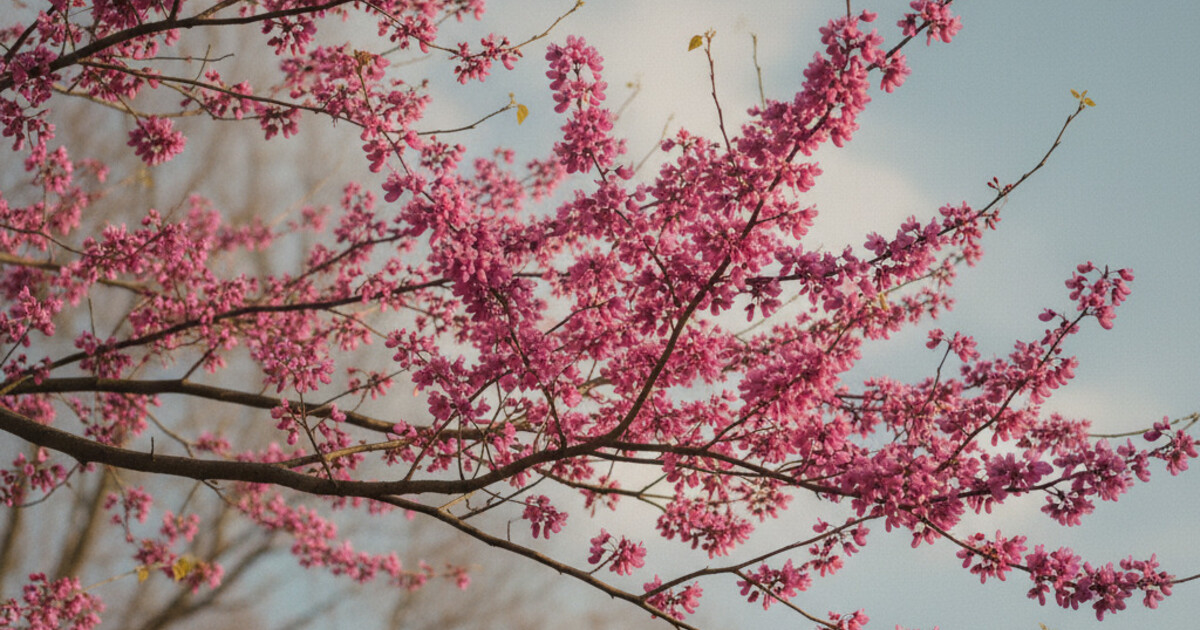
Redbuds are probably the most recognized early spring tree in eastern North America. Their flowers are a vivid magenta-pink, almost purple in some lights, and they bloom directly from the branches and trunk in late February or March. Once the flowers drop, the tree produces heart-shaped leaves that turn yellow in fall. Redbuds stay small, usually 20-30 feet tall, which makes them a popular choice for small yards and understory planting. The flat, 3-4 inch seed pods that follow hang through winter.
The 2 most reliably early pink-flowering trees in temperate North America are Eastern Redbud and Saucer Magnolia. Both bloom in late winter to early spring, from February through April depending on climate zone, before their leaves fully emerge. Eastern Redbud (Cercis canadensis) produces magenta-pink flowers directly on its branches and trunk, followed by heart-shaped leaves and flat seed pods. Saucer Magnolia (Magnolia x soulangeana) produces large, 4-6 inch tulip-shaped flowers in pink-purple and white. To tell them apart, check the flower shape: redbud flowers are small, pea-like clusters packed along bare branches, while magnolia flowers are large and solitary. Both species are deciduous, grow to 20-30 feet, and perform best in USDA zones 4-9 (redbud) and 5-9 (magnolia). Both drop their flowers quickly after blooming, giving a window of 2-3 weeks to catch them at peak color.
Saucer Magnolia (Magnolia x soulangeana)
Saucer magnolias bloom in late March to early April, just before or as the leaves emerge. The flowers are large (4-6 inches across), tulip-shaped, and typically pink-purple on the outside with white or pale pink inside. One mature tree in full bloom is hard to miss. Leaves are large, oval, and smooth, reaching 3-6 inches long. The tree grows to 20-30 feet. The main identification pitfall: saucer magnolias look similar to star magnolias, which bloom white or pale pink and slightly earlier.
For a deeper look at magnolia varieties, see our Magnolia Tree Identification guide.
Mid-Spring: The Cherry and Dogwood Season
Peak pink-flowering tree season runs from late March through May. Cherry trees, dogwoods, and crabapples dominate this window.
Yoshino Cherry (Prunus x yedoensis)
Yoshino cherries are what most people picture when they think of cherry blossoms. The flowers are pale pink to almost white, blooming in dense clusters before the leaves emerge. A mature Yoshino cherry in full bloom looks like a pink cloud. The tree grows 20-40 feet tall with a rounded crown. Leaves are oval with serrated edges and a pointed tip. The bark is reddish-brown with horizontal lenticels, small lines running across it. That bark pattern is the fastest way to confirm you’re looking at a cherry species.
Kwanzan Cherry (Prunus serrulata ‘Kwanzan’)
Kwanzan cherries bloom 1-2 weeks later than Yoshinos and the difference is striking. Their flowers are deep pink and double, with each bloom carrying 20-30 petals instead of 5, creating a fluffy, pompom-like appearance. The tree is vase-shaped when young, spreading wider with age. Leaves emerge bronzy-red alongside the flowers, which makes the pink-on-bronze-green contrast particularly vivid. If the cherry blossoms you’re looking at are dark pink and look ruffled rather than flat, it’s almost certainly a Kwanzan.
For a full breakdown of cherry species, see our Cherry Tree Identification guide.
Pink Dogwood (Cornus florida f. rubra)
Dogwood is native to eastern North America, and the pink form (rubra) is widely planted in yards and parks. What looks like 4 pink petals are actually bracts, modified leaves surrounding the small true flowers in the center. The blooms appear in April-May as the leaves emerge. Dogwood grows as a small understory tree, 15-25 feet, and has a distinctive cross-shaped branching pattern. Fall berries are bright red and attract birds.
Crabapple (Malus species)
Hundreds of crabapple varieties exist and many produce pink flowers. Bloom time is mid-spring, and the flowers go through a color change: deep pink buds open to lighter pink or white flowers. Leaves are oval with serrated edges. In fall, the small fruits, under 2 inches across, range from yellow to orange to deep red. If you see a small tree with spring flowers and small persistent fruits in fall and winter, crabapple is almost certain. The fruits are the clearest identifier.
Summer: Two Pink Bloomers Worth Knowing
Most flowering trees peak in spring, but 2 common species hold off until summer.
Mimosa / Silk Tree (Albizia julibrissin)
Mimosa trees bloom June through August with feathery, powder-puff flowers in pink and white. The flowers are unlike any other tree: they look like brushes or pom-poms rather than petals. The leaves are bipinnately compound, meaning each leaf divides into multiple smaller leaflets arranged in rows, giving the tree a fern-like texture. Mimosa grows fast (up to 5 feet per year) and reaches 20-40 feet tall with a wide, spreading crown. One key fact: mimosa is considered invasive in parts of the Southeast and Mid-Atlantic. Knowing this tree helps you decide whether to keep it or remove it.
Crepe Myrtle (Lagerstroemia indica)
Crepe myrtle is a summer staple in the Southeast and is increasingly planted in zone 6-7 areas. Flowers come in pink, red, white, and purple, with pink varieties the most common. The flowers form in large clusters at the branch tips from July through September. The bark is one of the best identifiers: crepe myrtle has smooth, peeling bark that reveals tan, orange, gray, and cinnamon tones underneath. At street level, look for the exfoliating bark first, then confirm with the glossy oval leaves, about 2 inches long.
Two More Worth Knowing
Princess Tree (Paulownia tomentosa)
Paulownia blooms in April-May with clusters of lavender-pink, trumpet-shaped flowers. The flowers appear before or alongside enormous leaves, which can reach 12 inches across and make the tree easy to recognize for the rest of the season. Paulownia grows extremely fast (8-10 feet per year) and is considered invasive in much of the eastern U.S. If you see a tree with very large leaves and lavender-pink flowers, Paulownia is the first thing to check.
Weeping Cherry (Prunus pendula)
Weeping cherries have the same pale pink blooms as Yoshino cherries but on dramatically drooping branches that cascade toward the ground. The weeping form is a grafted shape, not a separate species. Bloom time is early-to-mid spring. Identification is straightforward from the silhouette alone: the cascading form is distinctive even before the flowers open. Most yard specimens are kept at 10-20 feet through pruning.
How to Identify a Pink Flowering Tree in the Field
When you’re standing in front of an unfamiliar pink-flowering tree, work through these questions:
- When is it blooming? Early spring (Feb-March): redbud or magnolia. Mid-spring (April-May): cherry, dogwood, crabapple, or paulownia. Summer: mimosa or crepe myrtle.
- What do the flowers look like? Large, tulip-shaped: magnolia. Small pea-like clusters on bare branches: redbud. Double and ruffled: Kwanzan cherry. 4 notched bracts around a center: dogwood. Fluffy puffballs: mimosa.
- Are there fruits or seed pods? Small round fruits: crabapple or cherry. Flat brown pods: redbud. Woody capsules: crepe myrtle.
- What’s the bark doing? Horizontal lenticels: cherry. Peeling, multicolor: crepe myrtle. Ridged and furrowed: most others.
If you’re out on a walk and want a faster answer, a photo-based identification app can match flowers, leaves, or bark against thousands of species. Our full guide to identifying trees by photo walks through how to get the clearest photos for the best results.
How Tree Identifier Can Help
Spring is actually a tricky time to identify trees by leaf, because many species have similar young foliage. Flowers are better clues than leaves for most spring bloomers, and that’s where Tree Identifier comes in.
The app works from photos of flowers, leaves, bark, or the whole tree shape. Take a close-up of the blooms, and it matches the image against its database of thousands of species. For look-alikes like Yoshino vs. Kwanzan cherry, or pink dogwood vs. crabapple in early bloom, the confidence score helps you understand how clear the match is.
Tree Identifier also works offline. Download the species data before your hike and you’ve got a field guide in your pocket, no cell service required. You get 2 free identifications per day without any subscription. If you’ve been cataloging trees you’ve found, the personal collection feature lets you log each one with photos and species info.
Download Tree Identifier for iOS or Android to start identifying the pink-flowering trees in your area this spring.
Frequently Asked Questions
What tree has pink flowers in early spring before the leaves come out?
Eastern Redbud (Cercis canadensis) is the most common early spring pink-flowering tree in North America. It blooms from late February through March with magenta-pink flowers covering bare branches before any leaves appear. Saucer Magnolia is another early bloomer, typically late March to early April, with large tulip-shaped pink-purple flowers.
What tree has pink flowers and heart-shaped leaves?
Eastern Redbud has heart-shaped leaves that emerge after the flowers drop. The combination of magenta-pink spring blooms followed by heart-shaped leaves is distinctive to this species. Leaves turn yellow in fall, and the tree produces flat brown seed pods that hang through winter.
What pink flowering trees bloom in summer?
Mimosa (Albizia julibrissin) blooms June through August with feathery pink puffball flowers, and Crepe Myrtle (Lagerstroemia indica) blooms July through September with clustered pink flowers. Both are widely planted in southern states, and crepe myrtle is cold-hardy up to zone 6.
How do I tell pink dogwood from cherry blossoms?
Pink dogwood flowers have 4 notched bracts surrounding a cluster of tiny true flowers in the center. Cherry blossoms have 5 true petals (or 20-30 in double varieties) with visible stamens. Dogwood also has a distinctive branching pattern where branches grow in pairs at the same point, creating a layered, horizontal form.
What’s the difference between Yoshino and Kwanzan cherry trees?
Yoshino cherries have single, pale pink to white flowers and bloom earlier (late March to April). Kwanzan cherries have double, deep pink flowers with a ruffled look and bloom 1-2 weeks later. Kwanzan leaves emerge bronzy-red alongside the flowers, while Yoshino leaves come out green.
Conclusion
Trees with pink flowers span early spring through summer, from the magenta blast of redbud in February to crepe myrtle still blooming in September. The fastest way to narrow down an unfamiliar species: check bloom time first, then flower structure, then bark and leaf shape. Spring is busiest with pink bloomers, but the flower details (petal count, bracts vs. true petals, single vs. double) make most of them identifiable once you know the differences.
If you want to ID the pink tree in your yard or on your next walk, Tree Identifier can match a photo of the flowers, leaves, or bark against thousands of species in seconds. Start with 2 free identifications per day, no subscription needed.
Identify a tree from your photo — free
Upload a leaf, bark, or whole-tree photo and get the species in seconds. No signup.
Confidence:
Unlock the full species profile
Free in the app — with unlimited identifications.


AI result for guidance — the app gives full species details and works offline.
Want unlimited identifications?
Get the full species profile, photos and details — free in the app, with unlimited scans.
- Unlimited identifications
- Full species profiles & details
- Works offline, anywhere
- Save and revisit your finds
Elena Torres
Tree Identifier Team