Trees With Serrated Leaves: 8 Species Identified
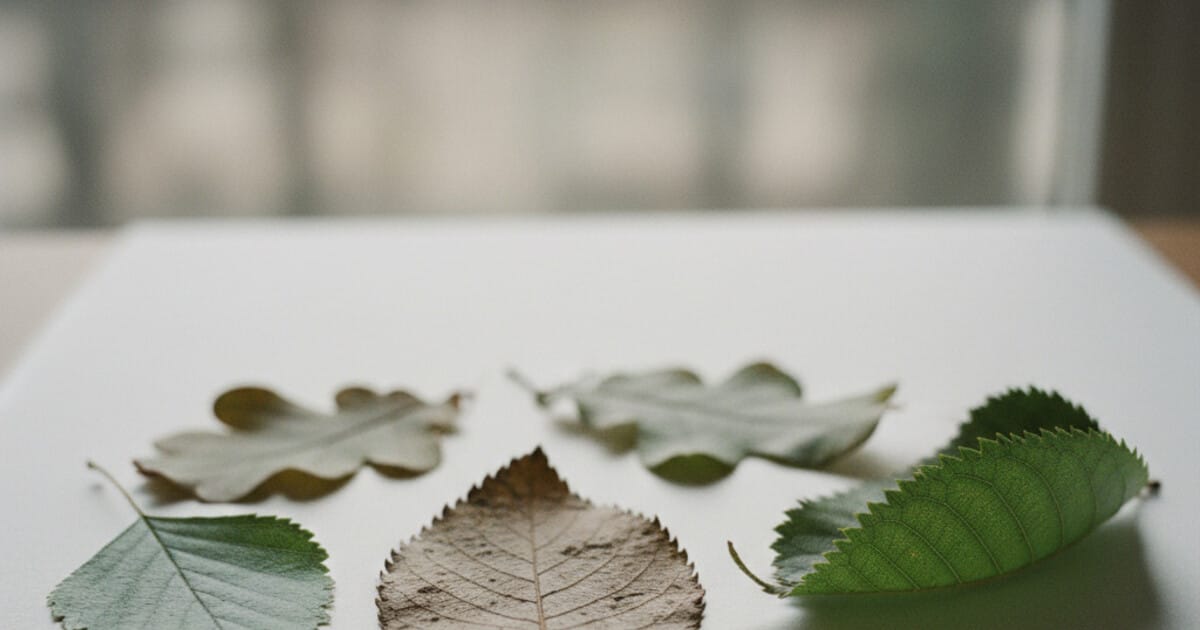
You’re standing next to an unfamiliar tree, holding one of its leaves. The edges aren’t smooth. They’re jagged, toothed, cut like a saw blade. That’s a serrated leaf margin, and it’s one of the fastest clues you can use to narrow down a tree’s identity.
Serrated leaves appear across dozens of common North American species. Once you know the different kinds of serration, toothed leaf margins can take you most of the way to a family or genus before you’ve even looked at the bark.
Trees with serrated leaves include elms, birches, beeches, cherries, alders, chestnuts, hornbeams, and serviceberries. “Serrated” describes leaf margins with teeth that point toward the leaf tip, like a saw blade. Most deciduous broadleaf trees in eastern North America have some degree of serration, making leaf margin shape one of the most useful identification features in the field.
Standing in front of one? Identify it from a photo in seconds — free, no sign-up needed.
What “Serrated” Means in Leaf Identification
Botanists use specific terms for leaf margins. “Serrated” or “serrate” means the teeth point forward, toward the leaf tip. “Toothed” or “dentate” means the teeth point outward. “Crenate” means rounded scallops instead of sharp points.
In field identification, these terms get used interchangeably, which is fine for casual ID. The distinctions matter more as you work with harder species pairs.
The most useful distinction is single versus double serration. A doubly serrated (or biserrate) leaf has large teeth with smaller teeth riding on top of them. That pattern narrows a tree to a small group of families quickly.
Serration also varies in size. Coarse serration means fewer, larger teeth with space between them. Fine serration means many small teeth packed closely together. Both show up in different species.
Leaf margin serration is one of the most reliable first-pass identification features for deciduous trees. In North America, serrated leaves appear across several families: Betulaceae (birches, alders, hornbeams), Ulmaceae (elms), Fagaceae (beeches, chestnuts), and Rosaceae (cherries, serviceberries). The distinction between single and double serration carries real diagnostic weight. Doubly serrated species like American elm and paper birch show a repeating tooth-on-tooth pattern along the margin, while singly serrated species like black cherry have a simpler, more uniform tooth row. Coarsely serrated species like American beech have fewer, larger teeth with pointed tips that correspond to lateral veins. Finely serrated species like serviceberry have many small, closely spaced teeth that continue almost to the leaf base. When combined with leaf shape, venation pattern, and surface texture, margin serration allows experienced observers to identify a tree family at a glance, cutting the identification process from dozens of species to a handful in seconds.
Single vs. Double Serration: The Fastest Shortcut
If you see double serration, you’ve already cut the field significantly. The clearest examples in North American trees are American elm, paper birch, and American hornbeam. All three show the repeating small-tooth-on-big-tooth pattern clearly.
Single serration is more common. Cherries, beeches, chestnuts, alders, and serviceberries all have it.
Look at tooth size and spacing first. Coarse, widely spaced teeth point toward beech or chestnut. Fine, tightly packed teeth point toward cherry or serviceberry. Then check whether those teeth have secondary teeth sitting on top.
Those two observations, tooth size and single versus double, can get you to a genus in most cases without any other features.
8 Common Trees With Serrated Leaves
1. American Elm (Ulmus americana)
Elm leaves are oval with an asymmetrical base where one side attaches higher on the stem than the other. The margin is doubly serrated, and the surface has a rough, sandpaper texture. American elm once lined streets across the eastern US before Dutch elm disease cut through most of the population. The off-center base is the fastest shortcut to confirm you’re looking at an elm. For a full breakdown of the six native species, the elm tree identification guide covers how to tell them apart by bark, twig, and seed.
2. Paper Birch (Betula papyrifera)
Birch leaves are triangular to oval with a doubly serrated margin. The teeth are irregular in size, giving the edge a slightly uneven look compared to elm. Paper birch has peeling white bark that makes the whole tree identifiable at a distance. The combination of white bark and doubly serrated triangular leaves is enough for a confident field ID across most of the northern US and Canada.
3. American Beech (Fagus grandifolia)
Beech leaves are oblong with a pointed tip and coarsely toothed margins. Each tooth lines up with a lateral vein, so the leaf has a neat, parallel-vein pattern running from midrib to tooth tip. The bark stays smooth and silver-gray even as the tree ages. Paired with the coarse, evenly spaced teeth, that smooth gray bark makes beech one of the easier IDs once you know what you’re looking for.
4. Chestnut (Castanea species)
Chestnut leaves are long and narrow with large, widely spaced teeth that look almost comb-like. The tips of the teeth are sharp and bristle-tipped. American chestnut is rare now because of the chestnut blight that swept through eastern forests in the early 1900s, but Chinese chestnut is widely planted and looks nearly identical. That long, narrow leaf with prominent, evenly spaced bristle-tipped teeth is unlike most other North American species.
5. Black Cherry (Prunus serotina)
Cherry leaves are narrowly oval with fine, incurved teeth. “Incurved” means the teeth curve inward toward the leaf tip rather than pointing straight out. The leaf surface is dark, glossy green on top. Black cherry grows in almost every eastern forest type. Check the underside of the midrib near the base for tiny reddish or orange glands at the junction of the petiole and blade. That gland is one of the most reliable field marks for cherry and separates it from similar Prunus species.
6. Red Alder (Alnus rubra) and Speckled Alder (Alnus incana)
Alder leaves are coarsely toothed to slightly doubly toothed, with a somewhat irregular margin. Red alder, native to the Pacific Coast, has a leaf with revolute margins that roll slightly under. Speckled alder, found in wet areas across the northern US and Canada, shows more clearly doubly toothed margins. Both grow near water. If you find a serrated-leaf tree standing beside a stream or in a wet area, alder is worth checking first.
7. American Hornbeam (Carpinus caroliniana)
Hornbeam leaves are doubly serrated and resemble elm, but the tree is much smaller, usually under 30 feet. The bark is smooth and gray with a sinuous, muscular look, as if the trunk were flexing under the surface. Hornbeam grows as an understory tree in moist, shaded forest edges and streambanks. Its small size and distinctive trunk shape separate it from elm despite the similar leaf.
8. Serviceberry (Amelanchier species)
Serviceberry leaves are oval with finely serrated margins. The teeth are small, even, and run almost to the base of the blade. Serviceberries bloom early, often the first native flowering trees to open in spring, and produce small, dark red to purple berries by June. The fine serration plus that early bloom is a reliable combination for spring ID. For a closer look at the different native serviceberry species, the serviceberry identification guide covers blooms, leaves, and berries.
How to Use Leaf Margins in the Field
Leaf margin shape is one part of a four-part leaf identification system: overall shape, margin type, venation, and surface texture.
You usually don’t need all four. Two features are enough in most cases.
If the margin is doubly serrated, check shape and texture next. Rough and asymmetrical base points to elm. Smooth and triangular points to birch. Smooth and smaller with muscular bark points to hornbeam.
If the margin is finely and singly serrated, check the leaf surface. Glossy dark green with reddish glands near the petiole points to cherry. Smaller, lighter green oval with early-season berries points to serviceberry.
For a broader approach to leaf-based identification, the tree identification by leaf shape guide walks through all the main leaf forms, from simple to compound and lobed to unlobed.
How Tree Identifier Helps
When you’ve checked the margins and still can’t place a tree, take a photo.
Tree Identifier uses AI to identify trees from photos of leaves, bark, flowers, fruit, or the whole tree shape. Snap the leaf, submit the photo, and get a species match in seconds with a confidence score.
The app works offline, so it’s useful on remote trails without cell service. You get 2 free identifications per day without a subscription, which covers most backyard or trailside encounters.
Download the app at treeidentifier.app and identify the next serrated-leaf tree you come across.
Frequently Asked Questions
What does it mean when a leaf is serrated?
A serrated leaf has sharp teeth along its margins that point toward the leaf tip, like the teeth on a saw blade. Serration can be fine (many small, closely spaced teeth) or coarse (fewer, larger teeth). Some trees have doubly serrated leaves, where small teeth sit on top of larger ones.
Which trees have doubly serrated leaves?
American elm, paper birch, and American hornbeam all have doubly serrated leaves. The double-tooth pattern, where small teeth sit on top of larger ones, narrows your identification to a small group of tree families. It’s one of the more distinctive leaf margin features in eastern North American trees.
How is serrated different from lobed?
Serrated leaves have small teeth or notches along the margin, but the blade stays intact as a continuous surface. Lobed leaves have large sinuses cut deep into the blade itself, creating finger-like projections. Oak leaves are lobed; elm leaves are serrated. Some species, like sassafras, can have both lobed and unlobed leaves on the same tree.
Do cherries and serviceberries have similar leaves?
Both have oval leaves with fine serration, which makes them easy to confuse at first. Black cherry leaves are longer and darker, with tiny reddish glands at the base of the blade near the petiole. Serviceberry leaves are usually smaller, lighter green, and the tree blooms very early in spring. By summer, the dark red to purple berries on serviceberry make it a clear separation.
Is serration useful for winter tree identification?
Not directly, since deciduous trees drop their leaves in fall. But knowing a species by its serrated leaves in summer helps you build a mental map of which trees are where, making winter identification by bark and branching pattern much easier. The guide to identifying trees in winter covers the bark and bud features that work when leaves are gone.
Wrapping Up
Serrated leaf margins show up across dozens of common trees, but paying attention to tooth size, spacing, and single versus double serration narrows the field fast. Doubly serrated points to elm, birch, or hornbeam. Coarse single serration points to beech or chestnut. Fine single serration points to cherry or serviceberry.
If you want a definitive ID without spending time working through field features, Tree Identifier matches a leaf photo to a species in seconds, even offline. Download the app at treeidentifier.app and take it on your next walk.
Identify a tree from your photo — free
Upload a leaf, bark, or whole-tree photo and get the species in seconds. No signup.
Confidence:
Unlock the full species profile
Free in the app — with unlimited identifications.


AI result for guidance — the app gives full species details and works offline.
Want unlimited identifications?
Get the full species profile, photos and details — free in the app, with unlimited scans.
- Unlimited identifications
- Full species profiles & details
- Works offline, anywhere
- Save and revisit your finds
Elena Torres
Tree Identifier Team