Serviceberry Tree Identification: Blooms, Leaves, and Berries
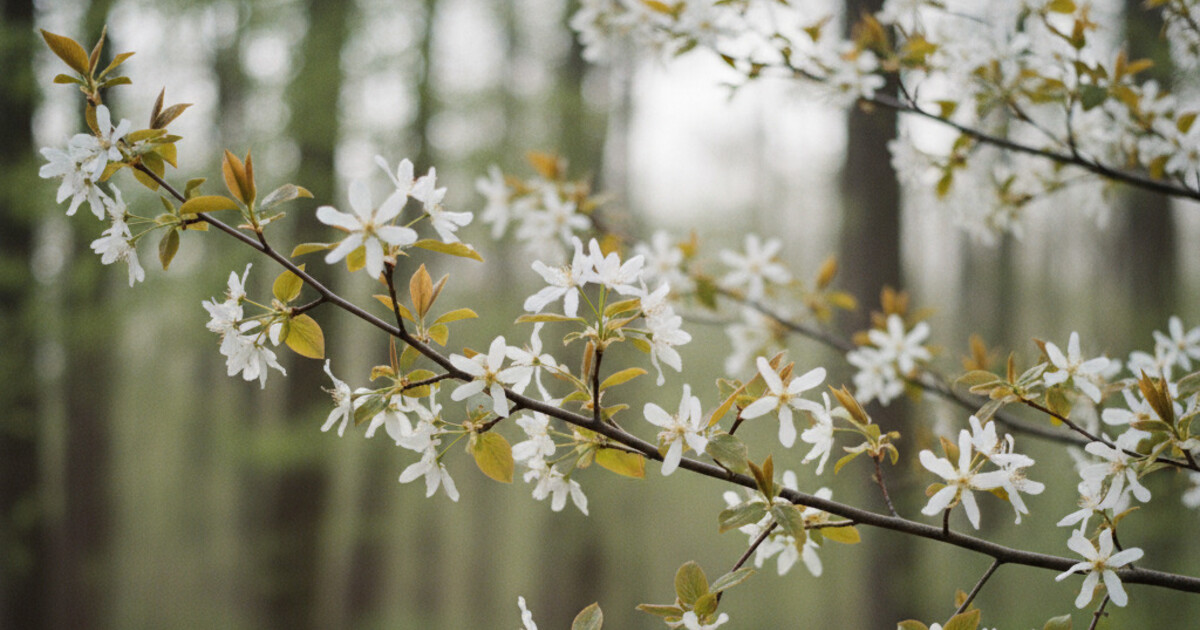
Serviceberry trees are one of spring’s first surprises. Long before the maples leaf out or the cherries bloom, a serviceberry at the edge of a woodland is already covered in white flowers. Walk past one in late March or early April and you’d think you’re imagining things, with everything else still gray and bare. Learning serviceberry tree identification is worth it because once you spot the first bloom, you’ll start noticing them in hedgerows, backyards, and forest edges everywhere.
Serviceberry trees are identified by clusters of narrow white flowers that appear in early spring before the leaves fully emerge. Leaves are oval with fine teeth, bark is smooth gray with faint vertical streaks, and small round berries ripen from red to dark purple in June. Tree size ranges from shrubby multi-stemmed forms under 15 feet to upright trees reaching 40 feet, depending on species.
What Is a Serviceberry Tree?
Serviceberry is the common name for trees and shrubs in the genus Amelanchier, which includes roughly 20 species native to North America plus several popular garden hybrids.
The name “serviceberry” reportedly traces to early American settlers who noticed the trees bloomed when mountain passes thawed enough for clergy to travel again and conduct burial services after a hard winter. Other common names tell you more about the plant: shadbush and shadblow reflect how the flowers appear when shad fish run upriver in the East; Juneberry describes when the berries ripen; saskatoon is the western name used in Indigenous cooking from the Great Plains through Canada.
Serviceberries fill a valuable ecological niche as early bloomers. Many native bee species emerge before most trees flower, and serviceberry pollen is a critical early-season food source. The berries that follow, ripening weeks ahead of most summer fruit, are devoured by birds and small mammals.
How to Identify a Serviceberry in Bloom
The flowers are the clearest ID feature in spring, and they’re hard to miss.
Serviceberry flowers are white, about 1/2 to 3/4 of an inch across, and arranged in drooping clusters called racemes, typically 4-10 flowers per cluster. Each flower has 5 petals that are distinctly strap-shaped or ribbon-like — narrow, sometimes slightly twisted. This strap petal shape is one of the clearest ways to separate serviceberry from cherry or crabapple at a distance.
The flowers open in late March to April in most of the eastern US, sometimes earlier in warmer zones. They appear at the same time the leaves are emerging. Newly unfolding leaves often have a bronze or copper tint at bloom time, creating a distinctive two-toned look: white flowers against reddish young foliage.
Amelanchier is one of the most reliable early-spring indicators in northeastern North America. Most species bloom between late March and mid-April, overlapping with shad migration and snowmelt at higher elevations. The flowers open before the foliage fills in, making them conspicuous against bare woodland edges. Racemes contain 4-10 individual flowers, each with 5 narrow, strap-like petals averaging 8-12 millimeters in length. This petal shape is longer and narrower than the rounded petals of cherry (Prunus species) or crabapple (Malus species), allowing visual separation even from 20-30 feet away. The overall effect in bloom is a loose, airy cluster rather than the densely packed flower head you’d see on hawthorn or crabapple. Trees in full bloom show white against reddish-bronze emerging foliage, a combination unique among early spring trees in the genus’s native range. Wildlife ecologists consider Amelanchier a keystone early-season plant; spring azure butterfly larvae feed on the flower buds, and the early pollen supports solitary bees that emerge before willows leaf out.
The blooms last 1-2 weeks before petals drop. After that, small developing berries are visible where the flowers were.
Serviceberry Leaves, Bark, and Berries
Leaves are oval to elliptical, 1 to 3 inches long, with finely toothed edges running all the way around the leaf margin, including near the base. This full-margin toothing helps separate serviceberry from cherry, where teeth are absent near the stem. The arrangement is alternate along the branch. Color starts bronze-green as the leaves emerge, matures to medium-dark green through summer, then shifts to orange, red, or gold in fall.
Bark on young serviceberry trees is smooth and light gray with faint vertical streaking running up the trunk. This striped pattern is subtle, but it’s one of the most useful year-round features when no flowers or leaves are present. Older bark develops low ridges and may flake slightly on larger trunks. The bark never develops the horizontal lenticels that make cherry bark unmistakable.
Berries ripen in June or early July, which is exactly why “Juneberry” is such an accurate name. They start out red and ripen to deep purple-red or nearly black. The berries are small, roughly 1/4 to 1/2 inch across, with a small calyx crown at the tip. They’re edible and genuinely good, tasting like a cross between blueberry and mild cherry. Birds typically strip a productive tree within a few days of peak ripeness.
For a broader look at how spring tree features stack up across species, see How to Identify Trees in Spring.
5 Common Serviceberry Species
Amelanchier arborea (Downy serviceberry): The most widespread tree-form species in eastern North America. Grows 25-40 feet. Leaves and twigs are covered in fine white hairs early in the season, which gives it the “downy” name. One of the most common serviceberries in eastern deciduous forests, often found on dry slopes and ridges.
Amelanchier laevis (Allegheny serviceberry): Similar range to downy serviceberry, but leaves emerge bronze-purple and are essentially hairless (laevis means smooth in Latin). Reaches 25-40 feet. Often grows in clumps with multiple stems. The emerging bronze foliage against white flowers makes it one of the showiest species in bloom.
Amelanchier canadensis (Shadblow serviceberry): Typically grows as a large shrub or small multi-stemmed tree, usually under 20 feet. Common in wet areas and coastal thickets from Nova Scotia south through the Carolinas. The names “shadblow” and “shadbush” both come from this species’ northeastern range.
Amelanchier alnifolia (Saskatoon serviceberry): The western species, native from the Great Plains through the Rocky Mountains and Pacific Northwest. More shrubby, usually 6-15 feet. Widely harvested for fruit in western Canada and featured in Indigenous food traditions. The city of Saskatoon, Saskatchewan takes its name from the Cree word for the berry.
Amelanchier × grandiflora (Apple serviceberry): A naturally occurring hybrid of A. arborea and A. laevis, now widely planted in gardens and parks. Reaches 20-25 feet, produces large showy flowers, and gives reliable orange-red fall color. Cultivars like ‘Autumn Brilliance’ and ‘Princess Diana’ are what you’ll find at most nurseries.
Serviceberry vs. Similar Trees
Three trees get confused with serviceberry most often, especially in bloom.
Serviceberry vs. Cherry: Both produce white flowers in spring on similar-sized trees. Differences: cherry flowers have 5 rounded petals, not strap-like ones; they appear slightly later and in denser clusters; cherry bark has unmistakable horizontal lenticels (small lines) running around the trunk, while serviceberry shows vertical streaks. For a detailed cherry comparison, see Cherry Tree Identification.
Serviceberry vs. Hawthorn: Hawthorn also produces white flowers in spring and small berries in fall, but hawthorn flowers arrive several weeks later when leaves are already fully developed. Hawthorn leaves are lobed, not finely toothed ovals. The clearest difference: hawthorn has sharp thorns on the branches. Serviceberry has none. See Hawthorn Tree Identification.
Serviceberry vs. Crabapple: Crabapple flowers are larger, usually pink to white with broad rounded petals, and they open on a fully leafed tree. Serviceberry flowers open when leaves are barely starting, and the strap petal shape looks clearly different up close. Crabapple fruit stays on the tree through fall and winter; serviceberry berries drop by July.
For a side-by-side comparison of 10 white-flowering tree species across the season, see Trees With White Flowers.
How Tree Identifier Helps With Serviceberry
Serviceberry can be tricky to pin down to exact species in the field, especially when multiple species grow in the same region and hybrids are common. The Tree Identifier app handles serviceberry identification from several input types: flower photos in spring, leaf photos through summer, and fruit photos in June.
Photographing the flowers gives the clearest ID, particularly if you can capture the strap-shaped petal cluster. A leaf photo works well in summer, especially showing the fine-toothed edge and alternate arrangement. Bark photos are useful year-round for the smooth gray striped pattern.
The app works offline, which is useful since serviceberries often grow in forest edges and stream corridors where cell service cuts out. You get 2 free identifications per day, so you can confirm what you’re looking at on the trail without a subscription.
Download Tree Identifier on iOS or Android at treeidentifier.app.
Frequently Asked Questions
Are serviceberries edible? Yes. The berries are edible and genuinely tasty, with a flavor often compared to a cross between blueberry and mild cherry. They ripen in June or early July. Birds usually strip a productive tree within a few days of peak ripeness, so timing matters if you want to beat them.
How do I tell serviceberry from cherry when both are blooming? Check the petal shape and the bark. Serviceberry petals are narrow and strap-like, sometimes slightly twisted. Cherry petals are broader and rounded with a small notch at the tip. Serviceberry bark shows vertical gray streaking; cherry bark shows horizontal lenticels banding around the trunk.
When do serviceberry trees bloom? In most of the eastern US, serviceberry blooms in late March to mid-April, before most other flowering trees. In the upper Midwest and New England, peak bloom usually falls in the first two weeks of April. In the southern Appalachians, it can start in early March.
Can I grow a serviceberry in my yard? Serviceberry does well in full sun to partial shade and handles a wide range of soil types. It’s one of the most recommended native alternatives to ornamental cherries and crabapples, offering spring flowers, summer fruit that wildlife loves, and fall color. The Amelanchier × grandiflora cultivars are bred for ornamental use and handle suburban growing conditions well.
How tall does a serviceberry tree get? Most tree-form serviceberries reach 20-40 feet at maturity, though growth is gradual. Shrubby species like saskatoon and shadblow stay under 15-20 feet. Popular ornamental cultivars typically top out around 15-25 feet.
Serviceberry is one of those trees that rewards paying attention. It blooms when almost nothing else does, feeds bees and birds before summer fruit arrives, and burns orange-red in fall. Learning to spot it means you’ll never walk past that early April cloud of white flowers without knowing what you’re looking at.
To identify serviceberry and other spring-blooming trees by photo, download Tree Identifier at treeidentifier.app.
Identify a tree from your photo — free
Upload a leaf, bark, or whole-tree photo and get the species in seconds. No signup.
Confidence:
Unlock the full species profile
Free in the app — with unlimited identifications.


AI result for guidance — the app gives full species details and works offline.
Want unlimited identifications?
Get the full species profile, photos and details — free in the app, with unlimited scans.
- Unlimited identifications
- Full species profiles & details
- Works offline, anywhere
- Save and revisit your finds
Elena Torres
Tree Identifier Team