Water Tupelo Tree Identification: 7 Reliable Signs
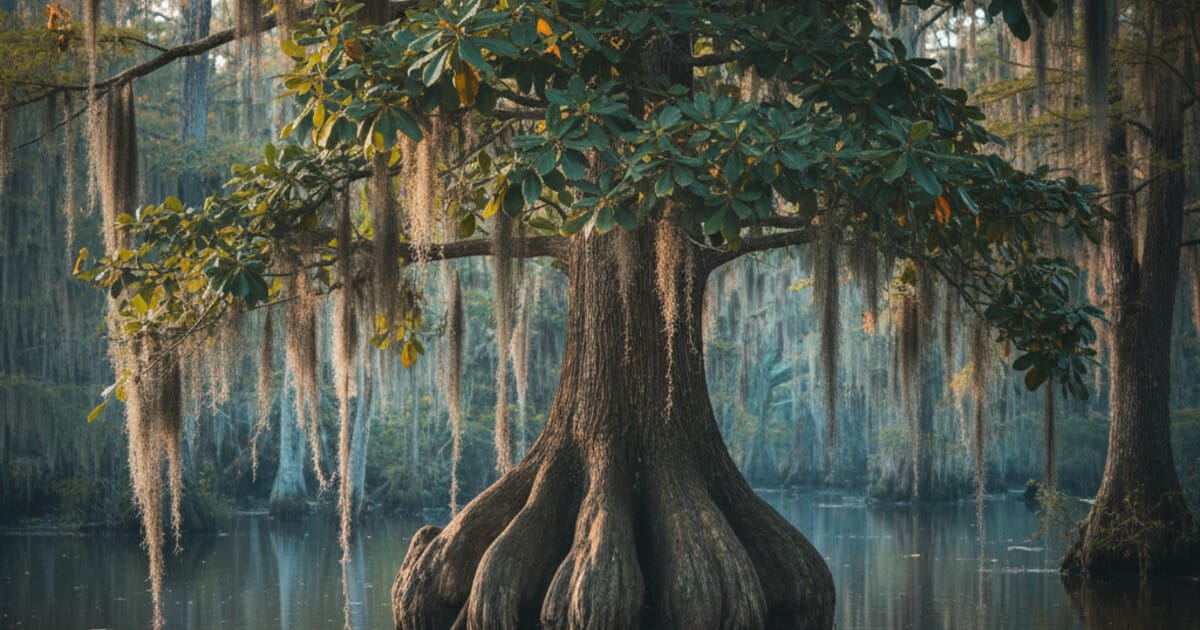
If you’ve hiked through a southern swamp and noticed a tall hardwood with a massively flared trunk base standing calf-deep in the water, there’s a good chance it was water tupelo (Nyssa aquatica). It’s one of the Southeast’s most distinctive wetland trees, and once you know the key features, water tupelo identification becomes one of the more reliable field skills you can build. Unlike bald cypress, which often grows right alongside it, water tupelo is a broadleaf hardwood with large oval leaves, small dark fruits, and bark that gets deeply furrowed with age. This guide covers the 7 most reliable signs to confirm the ID in any season.
Water tupelo (Nyssa aquatica) is a large deciduous tree native to southeastern swamps and river floodplains. Identify it by its dramatically swollen, buttressed trunk base, large oval alternate leaves 5-10 inches long with smooth margins, and small oval bluish-purple drupes that ripen in fall. It’s almost always found growing in standing or seasonally flooded water.
Why Water Tupelo Is Worth Knowing
Water tupelo grows from eastern Texas east to Virginia, reaching its densest populations in the Mississippi Alluvial Valley, Georgia’s Okefenokee Swamp, and the river swamps of Florida’s Panhandle. Mature trees reach 80 to 100 feet, with trunk diameters of 2 to 3 feet and base flares that spread considerably wider in permanently flooded conditions.
The ecological story is substantial. Black bears, white-tailed deer, wood ducks, mallards, and at least 30 other wildlife species eat the fall fruit. Beekeepers prize water tupelo for its nectar: bees foraging on the spring flowers produce a pale amber honey with a mild floral flavor that resists crystallization for years due to its unusually high fructose content. The Apalachicola River region of Florida is famous for it.
Water tupelo (Nyssa aquatica) is a flood-tolerant hardwood that grows in permanently or seasonally flooded bottomlands across the southeastern US, from eastern Texas to coastal Virginia. Mature trees can live 300 to 400 years, reaching 100 feet tall in undisturbed river swamps. The species supports more than 30 wildlife species: its small oval drupes are a primary fall food source for black bears, wood ducks, and white-tailed deer. The trunk’s dramatic basal buttressing develops in response to saturated, unstable soils, providing structural anchorage where conventional root systems can’t grip. Root tissue tolerates anaerobic conditions through internal oxygen transport, allowing the tree to thrive where other hardwoods drown. Tupelo honey, made from the spring flowers, resists crystallization because the nectar produces a high fructose-to-glucose ratio, around 1.5:1, which keeps it liquid far longer than most honeys. Apalachicola River tupelo honey from the Florida Panhandle fetches prices 3 to 4 times higher than standard clover honey.
The species often grows alongside bald cypress, overcup oak, swamp black gum, and water hickory. Finding bald cypress nearby is a reliable cue to start looking for water tupelo in the same stand.
7 Signs for Water Tupelo Identification
1. Dramatically Swollen, Buttressed Base
The base is the single most reliable feature. Water tupelo trunks flare out at the waterline into wide, spongy buttresses that can spread several feet across before tapering to a more cylindrical shape above. In mature trees standing in permanent flooding, the base looks almost volcanic from a distance.
This buttressing develops in response to saturated, unstable soil. Trees in the deepest water show the most pronounced flare, making them easy to pick out across an open swamp.
2. Large Oval Alternate Leaves
The leaves are large: 5 to 10 inches long, oval to oblong with a pointed tip. Margins are smooth or carry a few shallow teeth near the tip, but the leaf edge generally looks clean. Leaves attach alternately on the stem, one per node, spiraling up the branch.
The upper surface is dark green and somewhat shiny. The lower surface is paler with fine hairs along the veins. In fall, before they drop, the leaves turn a clean bright red that stands out sharply against dark swamp water.
3. Small Bluish-Purple Oval Drupes
The fruit is roughly 1 inch long, oval, and dark bluish-purple when ripe in September and October. Each drupe holds a single ridged pit. They hang from long slender stalks, singly or in clusters of 2 or 3.
The color combination (dark blue-purple fruit on a large swamp hardwood) is fairly distinctive. Wildlife consume the fruit quickly; by late October, most trees are already stripped clean. Finding the pits scattered on the ground below is still useful evidence of the species.
4. Deeply Furrowed Gray-Brown Bark
The bark on mature trees is gray to brownish-gray, broken into flat-topped ridges separated by deep furrows. The ridges run lengthwise and intersect at angles, giving the trunk a blocky appearance from a distance.
Young trees have smoother bark that roughens gradually with age. The texture pattern is similar to black tupelo but runs deeper on old water tupelo specimens. Up close, the ridges feel hard and angular.
5. Flooded Swamp Habitat
Water tupelo is particular about where it grows. It colonizes areas with extended seasonal flooding or permanent shallow flooding: saturated, low-oxygen soil that kills most other hardwoods. River floodplains, lake margins, bayous, and cypress swamps are the right places to look.
This habitat preference is one of the fastest ID shortcuts in the field. If you’re standing in knee-deep water looking at a large deciduous tree with a swollen base, the list of candidates is short.
6. Alternate Leaf Arrangement
This check takes about 5 seconds. Look at a twig and scan toward the tip. If leaves attach one per node, alternating sides, water tupelo stays on the candidate list.
Opposite leaves (paired across from each other at the same node) point toward maple, ash, or dogwood. Water tupelo’s leaves are always alternate.
7. Small Greenish Spring Flowers
In April and May, water tupelo produces clusters of tiny greenish flowers before the leaves fully open. Male and female flowers grow on separate trees (the species is dioecious), so not every individual will flower and set fruit.
The flowers are small and easy to overlook. If you spot them on a swamp tree with an obvious swollen base in spring, that confirms the ID. The absence of showy petals also helps rule out spring-flowering swamp species like swamp rose or buttonbush.
Water Tupelo vs. Similar Swamp Species
Water Tupelo vs. Black Tupelo
Black tupelo (Nyssa sylvatica), also called black gum, is the closest relative and shares the small blue-black fruit. The differences are consistent: black tupelo grows on dry to moist upland sites, has smaller leaves (2 to 5 inches), and lacks the swollen base entirely. The habitat alone separates them in most situations.
Water Tupelo vs. Bald Cypress
Bald cypress shares the flooded swamp habitat and buttressed base, but it’s a conifer with small, flat deciduous needles arranged in feathery branchlets. Bald cypress foliage looks nothing like the broad oval leaves of water tupelo. The two grow together frequently, so recognizing one makes spotting the other easier.
Water Tupelo vs. Cottonwood
Cottonwood grows along rivers and in moist bottomlands but generally in less permanently flooded conditions. Cottonwood leaves are triangular to heart-shaped with toothed margins and a flattened leafstalk that makes them tremble in the slightest breeze. The leaf shape is completely different from water tupelo’s smooth oval.
Water Tupelo vs. Willow
Willow trees in wet habitats have narrow, lance-shaped leaves 3 to 5 inches long, nothing like the broad oval of water tupelo. Willows also grow in a very different form, with pendulous or arching branches rather than a tall straight trunk with a swollen base.
Where Water Tupelo Grows
The range runs from eastern Texas to coastal Virginia, with the heaviest concentration in:
- The Atchafalaya Basin and Mississippi River delta in Louisiana
- Georgia’s Okefenokee Swamp
- Florida’s Apalachicola, Chipola, and Suwannee River floodplains
- The Mississippi Alluvial Valley from Louisiana north to southern Illinois
Outside the southeastern coastal plain, water tupelo thins out quickly. If you’re in the upper Midwest or Northeast, the tupelo you’re looking at is almost certainly black tupelo on moist upland ground, not water tupelo.
Water tupelo typically grows in mixed stands with bald cypress, overcup oak, swamp black gum, and water hickory. Spotting bald cypress nearby is a reliable indicator to search for water tupelo in the same area.
How Tree Identifier Can Help in the Field
Swamp identification has its challenges. Leaves can be high overhead, light is filtered and patchy, and the silhouettes of several swamp species look similar at first glance. If you’re unsure whether the tree in front of you is water tupelo, black tupelo, or something else, the Tree Identifier app can confirm the ID from a photo of the leaf, bark, or buttressed base.
The app works offline, which matters on remote swamp hikes or river paddles where cell service doesn’t reach. Take a photo of the swollen base with visible leaves, and the AI cross-references thousands of species to return a confident match. Water tupelo’s combination of large oval leaves and dramatically swollen base is distinctive enough that the app flags it reliably.
Download Tree Identifier on iOS or Android at treeidentifier.app and bring expert identification to every wetland you explore.
Frequently Asked Questions
Is water tupelo the same as black gum?
They’re related but different species. Water tupelo (Nyssa aquatica) grows in flooded swamps and has larger leaves with a dramatically swollen base. Black gum (Nyssa sylvatica) grows on drier upland sites, has smaller leaves (2-5 inches), and has no pronounced trunk flare. Both produce small blue-black fruits, which is the main source of confusion between them.
What makes water tupelo honey special?
Bees foraging on water tupelo’s spring flowers produce a honey with an unusually high fructose-to-glucose ratio, around 1.5:1. That ratio keeps the honey liquid far longer than most varieties, resisting crystallization for years. Apalachicola River tupelo honey from the Florida Panhandle is considered among the finest in the US and sells at a significant premium over standard varieties.
How do you tell water tupelo from bald cypress in a swamp?
Look at the leaves. Bald cypress has small, flat, feathery needles arranged in fern-like branchlets and drops them completely in winter. Water tupelo has broad oval leaves 5-10 inches long. Both species have buttressed bases, but the foliage types are completely different and easy to distinguish once you know what to look for.
Does water tupelo grow outside the Southeast?
Rarely. Its natural range covers the southeastern coastal plain from Virginia to Texas, with the densest populations in the Mississippi Alluvial Valley and Florida’s river floodplains. Black tupelo, the upland relative, grows much farther north into New England and Michigan, so that’s the species to expect outside the Deep South.
When is the best time to identify water tupelo?
Fall is easiest: the leaves turn bright red, and the dark bluish-purple drupes are ripe and visible before wildlife strips them. Summer works well too, with full dark green foliage clearly showing the large oval leaf shape. In winter, the swollen base and deeply furrowed bark are diagnostic on their own, even without leaves.
Identify a tree from your photo — free
Upload a leaf, bark, or whole-tree photo and get the species in seconds. No signup.
Confidence:
Unlock the full species profile
Free in the app — with unlimited identifications.


AI result for guidance — the app gives full species details and works offline.
Want unlimited identifications?
Get the full species profile, photos and details — free in the app, with unlimited scans.
- Unlimited identifications
- Full species profiles & details
- Works offline, anywhere
- Save and revisit your finds
Elena Torres
Tree Identifier Team