American Hornbeam Tree Identification: 7 Reliable Signs
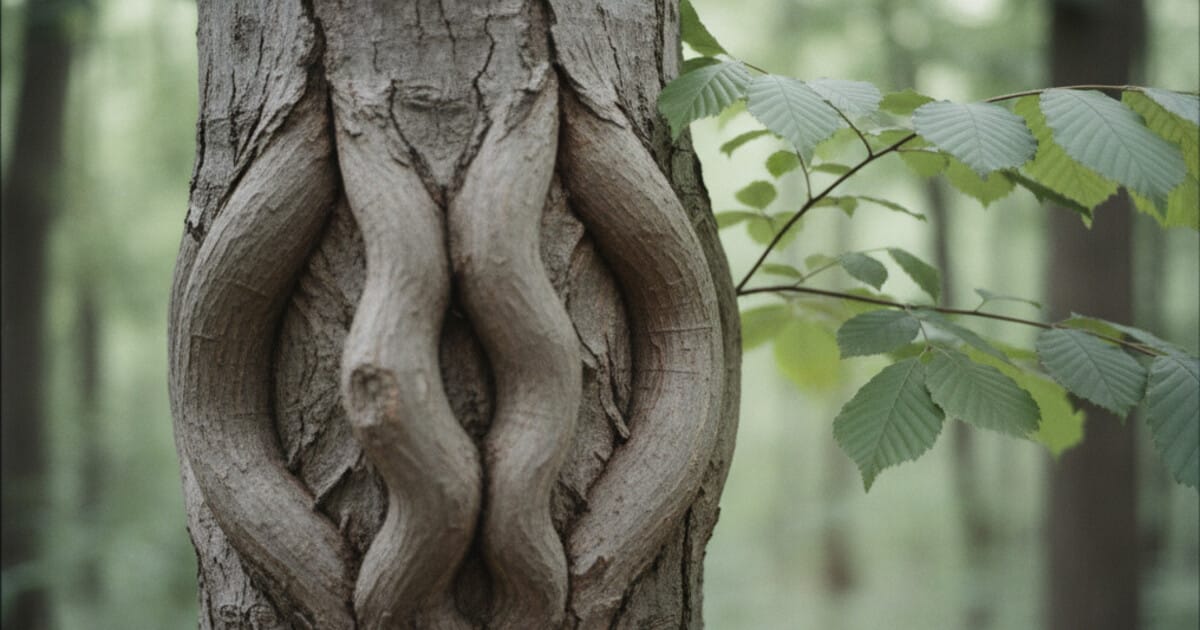
You’re walking along a streambank in the eastern woods when a small tree catches your eye. The bark is smooth and gray, but the trunk is covered in long, sinuous ridges that run lengthwise, like braided rope or a forearm muscle flexing just beneath the skin. There’s no peeling, no plates, no furrows. Just that unmistakable sinewy surface.
That’s American hornbeam (Carpinus caroliniana), and once you’ve seen it, you won’t confuse it with anything else. It’s one of the most distinctive trees in eastern North American forests, yet most people walk right past it because it stays small and lives in the shade.
American hornbeam (Carpinus caroliniana) is a small native understory tree recognized by its smooth, sinewy blue-gray bark, often called “musclewood.” Leaves are alternate, oval, and sharply double-serrated, similar to birch or elm. Fruit clusters hang in hop-like chains with leafy 3-lobed bracts. It grows 15–30 feet tall along streams and in shaded bottomlands across eastern North America.
What Is American Hornbeam?
American hornbeam is a native hardwood in the birch family (Betulaceae), closely related to birch and alder. Despite sharing the nickname “ironwood” with several other species, it goes by two names that actually describe it: musclewood (for the bark) and blue-beech (for the smooth, blue-gray surface that loosely resembles American beech from a distance).
It’s a slow-growing tree. A 30-year-old hornbeam in the wild might only stand 15–20 feet tall. That patience shows up in the wood itself.
American hornbeam (Carpinus caroliniana) ranges across eastern North America from Nova Scotia to Florida and west to Minnesota and Texas. It grows as an understory tree beneath oaks, maples, and ashes in moist valleys, along streambanks, and in shaded bottomlands. Mature trees reach 15–30 feet tall with trunks rarely over 10 inches in diameter. The wood is among the hardest of any native North American tree, with a specific gravity around 0.70, heavier than oak and comparable to persimmon. It tolerates heavy shade and periodic flooding better than most hardwoods, which is why you find it persisting in floodplain forests long after larger canopy trees have been cleared. American hornbeam is the only North American representative of Carpinus, a genus of roughly 40 species distributed primarily across Asia.
The Muscle-Like Bark: American Hornbeam’s Signature Feature
No other tree in eastern North America has bark like this. American hornbeam’s trunk and major limbs are covered in long, sinuous ridges that run vertically, making the surface look like braided muscle or twisted rope. Run your hand along it and it feels solid and smooth, nothing like the plated roughness of oaks or the papery curl of birch.
This texture comes from how the wood grows in interlocked, overlapping bands. The bark never peels away, cracks into plates, or develops deep furrows even on very old trees. A century-old hornbeam still has that same smooth, rippled surface.
That muscle-bark is sign number one. Here are all 7:
- Smooth, sinewy blue-gray bark with rope-like fluting (no peeling, no scaling, no furrows)
- Small understory tree, 15–30 feet tall; rarely reaches the main canopy
- Alternate, oval leaves with sharply double-serrated margins (teeth on the teeth)
- Pointed leaf tips; leaves 1.5–4 inches long with prominent parallel veins running to each tooth
- Hop-like fruit clusters: leafy 3-lobed bracts attached to small nutlets, hanging in chains of 6–15
- Male catkins in early spring, 1–1.5 inches long, before the leaves open
- Habitat strictly near water: streambanks, moist bottomlands, shaded ravine floors
American Hornbeam Leaves and Fruit
The leaves are alternate and oval to slightly oblong, with a pointed tip and a rounded to heart-shaped base. Most measure 1.5–4 inches long. The edges are doubly serrated: each large tooth has smaller teeth along its edge. That’s a pattern shared with elm, birch, and alder, so leaves alone don’t confirm the ID.
Flip a leaf and look at the underside. Prominent, parallel veins fan out from the midrib to each tooth, giving the surface a slightly corrugated appearance. Both sides are mostly hairless at maturity, with small tufts in the vein axils underneath.
The fruit is where American hornbeam becomes unmistakable. Starting in late summer, the tree produces clusters of nutlets, each attached to a flat, leafy bract with 3 lobes about 1 inch across. These clusters hang in loose chains of 6–15 units. The bracts are open and leaf-like, completely different from the inflated papery sacs on Eastern hop-hornbeam.
Fall color varies from yellow to orange-red, sometimes mottled on the same tree. It’s not a reliable ID sign, but it’s pleasant in a shaded forest where color tends to be subtle.
American Hornbeam vs. Similar Trees
Three species get confused with American hornbeam. Knowing their differences saves a lot of head-scratching in the field.
American hornbeam vs. American beech. Beech also has smooth gray bark and alternate oval leaves, so the first glance can mislead you. The tell is size: beech grows 50–80 feet tall with a broad crown and a trunk 2–3 feet across. Its bark is uniformly smooth without any of the sinewy muscle ridging. Beech leaves are larger (3–5 inches), with widely spaced teeth that aren’t doubly serrated, and the parallel veins are more prominent. See the full breakdown in our beech tree identification guide.
American hornbeam vs. Eastern hop-hornbeam. These two share a name and both belong to the birch family, but they look completely different. Hop-hornbeam (Ostrya virginiana) has shaggy, gray-brown bark that peels in narrow, flat strips. Its fruit is the diagnostic clue: each nutlet is enclosed in an inflated papery bladder, and the clusters hang like common hops used in brewing. American hornbeam’s bracts are flat, leafy, and open.
American hornbeam vs. alder. Both grow along streams and look similar in leaf shape. Alder tends to grow taller and more upright along water edges, has rounded leaves with shallower teeth, and produces small woody cone-like fruits (strobiles) that persist through winter. American hornbeam’s sinewy bark is nothing like alder’s rougher, darker surface. Our alder tree identification guide covers the full details.
Where American Hornbeam Grows
American hornbeam is strictly an eastern species. Its range spans from southern Canada (Ontario, Quebec, New Brunswick, Nova Scotia) south through all the eastern states to central Florida, then west through the Great Plains edge to Iowa, Missouri, Kansas, and east Texas.
Within that range, it’s a habitat specialist. You find it:
- Along streams, creeks, and river corridors, often in the first row of trees from the water
- In moist, well-shaded bottomland forests under taller canopy species
- On north-facing slopes where shade is deep and soil stays damp
- In ravine bottoms where cold air pools
If you’re standing on a dry, sunny hillside looking at a small tree with smooth, sinewy gray bark, step back and reconsider. American hornbeam doesn’t grow there. The habitat alone rules it out.
The tree is easiest to spot in late summer when the fruit clusters are visible, and in early spring when male catkins dangle on bare branches before the leaves emerge. In full summer, it disappears into the understory.
How Tree Identifier Helps
American hornbeam can be tricky until the muscle-bark clicks. On young trees, that sinewy texture is less developed, and a beginner might mistake them for beech saplings or young alder. The leaves look similar to several birch-family species.
Tree Identifier’s AI handles this. Snap a photo of the bark, a leaf close-up, or the fruit cluster when it’s present. The app pulls from thousands of North American species and gives you a match with a confidence score, plus detail on habitat, range, and similar lookalikes.
It works offline too, which matters in the bottomland forests where hornbeam lives. You won’t always have a cell signal in a shaded ravine along a small creek. The offline mode has you covered. Start with 2 free daily IDs and try it on your next hike. Download Tree Identifier for iOS or Android.
Frequently Asked Questions
Is American hornbeam the same as musclewood? Yes, musclewood is one of the most common common names for American hornbeam (Carpinus caroliniana). The name refers directly to the distinctive sinewy, muscle-like bark. Blue-beech is another frequent name, pointing to the smooth blue-gray color. Both names describe the same tree. “Hornbeam” itself comes from Old English words for hard (horn) and tree (beam), reflecting the density of the wood.
What does American hornbeam look like in winter? Without leaves, the muscle-bark is the primary ID sign and it’s actually easier to see in winter with no foliage in the way. The sinewy, fluted gray trunk stands out clearly in bare woods. Spent fruit bract clusters sometimes persist into winter on the branches. The small size and streambank habitat also help narrow the ID when leaves are absent.
Is American hornbeam good for wildlife? The seeds and buds are eaten by wild turkeys, ruffed grouse, bobwhite quail, and various songbirds. White-tailed deer browse the twigs and leaves. Beavers use the wood for dam construction. The dense understory canopy also provides cover. Hornbeam doesn’t draw crowds of wildlife the way fruiting oaks or cherries do, but it’s a consistent, reliable food source for streamside species.
How fast does American hornbeam grow? Slowly. In average conditions, American hornbeam typically adds 6–10 inches of height per year. On rich, moist bottomland sites it grows faster; in deep shade or poor soil it slows considerably. A tree that’s 20 feet tall is probably at least 30–40 years old. The slow growth rate is directly connected to the exceptional wood density.
Can you grow American hornbeam as a landscape tree? Yes, and it’s underused in native plant landscaping. It tolerates shade better than almost any other native hardwood, making it useful for shaded corners, rain gardens, and streamside plantings. It works well under large oaks or maples. The interesting bark provides winter interest. One limitation: it transplants poorly from the wild, so always start with nursery-grown stock.
Conclusion
American hornbeam is one of those trees where the ID sticks permanently once you’ve felt that muscle-bark under your hand. Start at the trunk: smooth, sinewy, blue-gray, with rope-like ridging and zero peeling. Confirm with the doubly serrated oval leaves and the hop-like fruit clusters when the season is right.
If you want a second opinion on a tricky bark or a confusing leaf, Tree Identifier does the work. Photograph whatever’s most visible, get a confidence-scored match, and know what you’re looking at before you leave the woods.
Identify a tree from your photo — free
Upload a leaf, bark, or whole-tree photo and get the species in seconds. No signup.
Confidence:
Unlock the full species profile
Free in the app — with unlimited identifications.


AI result for guidance — the app gives full species details and works offline.
Want unlimited identifications?
Get the full species profile, photos and details — free in the app, with unlimited scans.
- Unlimited identifications
- Full species profiles & details
- Works offline, anywhere
- Save and revisit your finds
Elena Torres
Tree Identifier Team