Beech Tree Identification: Bark, Leaves, and Species
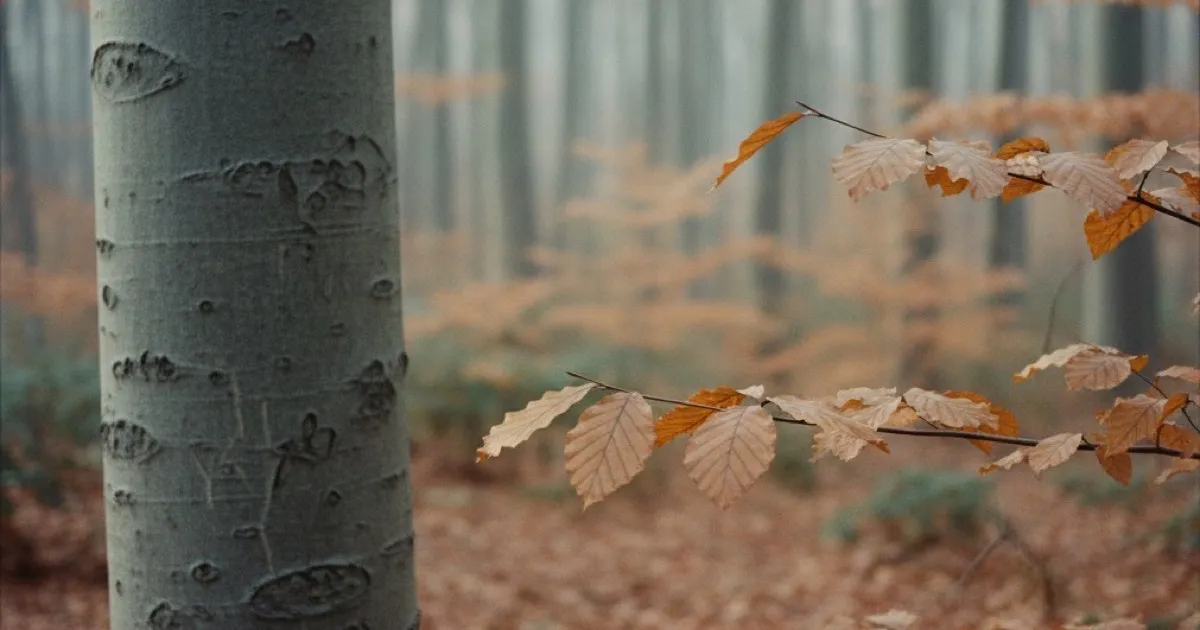
Few trees are as immediately recognizable as the beech. While most hardwoods develop deeply furrowed, rough bark as they age, beech trees keep their smooth, silvery-gray bark for life. That elephant-skin surface makes beech tree identification straightforward once you know what to look for. Whether you’re walking through an old-growth forest in the Appalachians or admiring a copper-leaved specimen in a city park, the beech announces itself.
This guide covers the three beech types you’re most likely to encounter in North America: the native American beech, the widely planted European beech, and the ornamental copper (purple) beech. You’ll learn how to identify each by bark, leaves, fruit, and winter silhouette.
Beech Tree Identification Starts with the Bark
Beech bark is the single most reliable identification feature, and it’s unlike anything else in the forest. While oaks develop deep furrows, maples crack into plates, and birches peel into papery strips, beech bark stays smooth and tight from sapling to centuries-old giant. The color is a distinctive pale gray, often compared to elephant hide.
Run your hand across a mature beech trunk and the surface feels almost like skin — firm, slightly cool, and unbroken by cracks or ridges. This smoothness is so unusual among large hardwoods that it narrows identification to beech almost immediately. If you’re building your bark identification skills, beech is one of the easiest starting points because nothing else looks or feels like it.
The smooth surface also makes beech trees a magnet for carved initials and graffiti. Because the bark doesn’t flake or peel, carvings can persist for decades, expanding as the trunk grows. If you spot a large gray tree covered in old carvings, you’ve almost certainly found a beech.
One important note: young beech bark is uniformly pale gray. On very old trees (150+ years), the bark may develop a slightly rougher texture near the base, but it never approaches the deep furrowing of oaks or ashes. The upper trunk and branches remain smooth throughout the tree’s life.
American Beech Identification (Fagus grandifolia)
American beech is the only beech species native to North America. It grows across the eastern United States and southeastern Canada, from Nova Scotia to Wisconsin and south to Texas and Florida. In mature forests, it’s one of the dominant canopy trees, often growing alongside sugar maples, red oaks, and eastern hemlocks.
Size and form. American beech reaches 60 to 80 feet tall with a spreading, rounded crown. The trunk is often short and thick relative to the tree’s height, with large lateral branches that sweep outward. In open settings, the lower branches sometimes droop nearly to the ground, creating a dense canopy that shades out almost everything beneath it.
Leaves. Ovate to elliptical, 3 to 5 inches long, with coarsely toothed margins. Each tooth corresponds to one of the prominent parallel veins running from the midrib to the leaf edge — typically 9 to 14 vein pairs. The upper surface is dark green and slightly glossy. The underside is paler with fine silky hairs, especially along the veins. If you’re familiar with identifying trees by leaf shape, the combination of coarse teeth, parallel veins, and a papery texture is distinctly beech.
Beechnuts. Small triangular nuts enclosed in spiny husks that split into four sections when ripe. Each husk contains two nuts, about half an inch long. Beechnuts ripen in fall and are an important food source for black bears, wild turkeys, blue jays, and squirrels. Heavy mast years (big nut crops) occur every two to three years.
Fall color. Golden bronze to pale yellow. American beech fall color isn’t as vivid as sugar maple, but the warm bronze tones stand out in a mixed hardwood forest.
Marcescent leaves. This is one of the most useful winter identification clues for American beech. Marcescence means the dead leaves hang on the branches through winter instead of falling. Young beech trees and the lower branches of mature trees retain their dry, papery, tan-colored leaves well into spring. Walking through a winter forest, the rattling clusters of pale leaves on otherwise bare branches mark beech trees from a distance. For a deeper look at leafless identification strategies, the winter tree identification guide covers marcescence and other cold-weather clues.
Habitat. American beech is shade-tolerant and thrives in the understory of mature forests, gradually growing into the canopy over decades. It prefers rich, well-drained soils but tolerates a range of conditions. Beech-maple forests are one of the classic forest types across the northeastern and Great Lakes regions. American beech also qualifies as a native keystone species — its nuts feed dozens of wildlife species and its dense shade shapes the plant community beneath it.
European Beech and Copper Beech Identification
European beech (Fagus sylvatica) was brought to North America as a landscaping tree in the 1700s and has been planted widely in parks, estates, and arboreta ever since. It’s not found in wild forests here, but you’ll encounter it in botanical gardens, college campuses, historic properties, and older residential neighborhoods.
How it differs from American beech. European beech leaves are slightly smaller (2 to 4 inches), with fewer vein pairs (5 to 9 versus 9 to 14) and smoother, less prominently toothed margins. The edges sometimes appear almost wavy rather than sharply serrated. The bark is similar — smooth and gray — but often darker than American beech, sometimes approaching charcoal gray.
European beech also tends to hold its lower branches more densely, creating a heavy, ground-sweeping canopy. Mature specimens in open settings can look like enormous green domes, with branches touching the ground in a full circle around the trunk.
Copper beech (purple beech). The most visually striking beech you’ll encounter is the copper beech, which is a cultivar of European beech with deep purple to copper-red foliage. The leaves emerge reddish-purple in spring, darken through summer, and turn copper-bronze in fall. The variety is sometimes labeled Fagus sylvatica ‘Purpurea’ or ‘Atropurpurea.’
Copper beech identification is straightforward — the purple-red leaf color is unmistakable. The bark, form, buds, and beechnuts are identical to green-leaved European beech. Some copper beeches have deeply cut, almost fern-like leaves; these are the cut-leaf or fern-leaf varieties (‘Asplenifolia’ and ‘Rohanii’), occasionally seen in specialty collections.
Weeping beech. Another common cultivar is the weeping form (‘Pendula’), with branches that cascade to the ground, creating dramatic tent-like canopies.
Beech Tree Leaves: A Closer Look
Beech leaves share a consistent set of features across species that separate them from other hardwoods.
Parallel veins. Each lateral vein runs straight from the midrib to a tooth at the leaf margin, creating a neat, regular pattern. Count the vein pairs: 9 to 14 on American beech, 5 to 9 on European beech. This vein count is one of the fastest ways to separate the two species.
Simple, toothed margins. Beech leaves are simple (one blade, not compound) with teeth along the edge. American beech teeth are sharp and pronounced; European beech margins are gently wavy.
Papery texture. Beech leaves feel thin and slightly papery compared to the thicker, leathery leaves of oaks. When backlit by sunlight, the veins show prominently through the translucent blade.
Buds. Beech buds are long, narrow, and sharply pointed — about three-quarters of an inch long, covered in overlapping brown scales. They look like miniature cigars at the tips of twigs, useful for winter identification alongside marcescent leaves and smooth bark.
Beech Bark Disease: A Conservation Threat
Beech bark disease has been killing American beech trees across the northeastern United States and southeastern Canada since the early 1900s. It’s a two-step attack: first, the beech scale insect (Cryptococcus fagisuga) infests the bark, feeding on sap and creating tiny wounds. Then Neonectria fungi invade through those wounds, causing cankers that girdle and kill the tree.
The disease was introduced to Nova Scotia around 1890 when beech scale arrived from Europe on imported nursery stock. It has since spread south and west through the beech’s native range, reaching the Great Smoky Mountains and continuing to move.
Infected trees develop rough, bumpy, or cratered bark — a stark contrast to the smooth surface of a healthy beech. Heavy scale infestations create a white, woolly coating on the trunk. Cankers from the fungal infection cause bark to crack, blister, and slough off in patches. Severely affected trees decline over several years, with crown dieback, reduced nut production, and eventual death.
Not all American beeches are equally susceptible. About 1 to 5 percent of trees in affected stands show natural resistance, remaining smooth-barked and healthy while surrounding trees die. These resistant individuals are genetically important. Conservation programs at the USDA Forest Service and several universities are identifying and propagating resistant trees to restore beech populations.
If you find a large, healthy, smooth-barked American beech in an area where beech bark disease is present, it could be one of these resistant survivors — worth noting and reporting to your state’s forestry department.
How Tree Identifier Helps with Beech Species
Beech identification is usually simple when you have smooth gray bark to work with. But confirming whether you’re looking at an American beech or a European beech takes a closer look at leaf details — vein count, margin shape, and leaf size. And spotting beech bark disease symptoms versus normal aging takes an experienced eye.
Tree Identifier analyzes photos of leaves, bark, flowers, fruits, and whole-tree form using AI, returning a species match with a confidence score. Snap a photo of those smooth gray trunks or the papery toothed leaves, and the app will confirm the species in seconds. It works on both iOS and Android, with 2 free identifications per day.
If you’re hiking in a remote forest where American beech and sugar maple grow side by side, offline mode means you can identify species without cell service. The app handles multiple input types, so if the leaves are out of reach on a tall tree, a bark photo will work just as well.
Frequently Asked Questions
How do I tell American beech from European beech?
Count the lateral veins on a leaf. American beech has 9 to 14 vein pairs with sharply toothed margins, while European beech has 5 to 9 vein pairs with gentler, wavy-edged teeth. American beech leaves are also slightly larger (3 to 5 inches versus 2 to 4 inches). If the tree is growing wild in an eastern forest, it’s almost certainly American beech. European beech is found in parks and landscaped areas.
Why do beech trees keep their leaves in winter?
The phenomenon is called marcescence. Dead leaves remain attached to branches instead of dropping in fall, persisting through winter until new spring growth pushes them off. Scientists aren’t entirely sure why beech trees do this. One hypothesis is that the dry leaves deter browsing animals like deer from eating the buds. Another suggests that leaves falling in spring add nutrients to the soil when decomposition is fastest.
What does beech bark disease look like?
Healthy beech bark is smooth and pale gray. Trees with beech bark disease develop rough, bumpy, or cratered bark surfaces. Look for white woolly patches on the trunk (the beech scale insect), areas where bark has cracked or fallen away exposing reddish-brown wood, and overall bark that has lost its smooth character. Severely affected trees also show crown thinning and branch dieback.
Can I identify a beech tree in winter?
Yes. Beech trees are among the easiest hardwoods to identify in winter. Three traits work year-round: the smooth, silver-gray bark; the long, narrow, pointed buds that look like tiny cigars; and the marcescent leaves that cling to branches through the cold months. No other large hardwood tree combines all three of these winter features.
Are beech trees related to oak trees?
Yes. Beeches (genus Fagus) and oaks (genus Quercus) both belong to the family Fagaceae, along with chestnuts and chinquapins. They share some traits, including producing nuts and having alternate leaf arrangement. But their bark, leaf shape, and fruit structure differ significantly. Oaks produce acorns in caps, while beeches produce triangular nuts in spiny husks. If you’d like to compare, the oak tree identification guide covers the key features of that genus.
Beech Tree Identification in the Field
Beech tree identification comes down to a short checklist. Start with the bark: smooth, pale gray, and unbroken on the trunk — that alone narrows the possibilities to beech in most eastern forests. Confirm with the leaves: simple, toothed, with prominent parallel veins running to each tooth. In winter, look for marcescent foliage and those slender, pointed buds.
If you’re in a wild forest, you’re looking at American beech. If you’re in a park or residential area with a purple-leaved tree on smooth gray bark, that’s a copper beech. And if the bark on an otherwise obvious beech looks rough, bumpy, or cratered, beech bark disease may be the cause.
The smooth gray trunk of a healthy beech is one of the most distinctive sights in any eastern woodland. Once you learn to spot it, you’ll notice beech trees everywhere — and you’ll understand why people have been carving their initials into that inviting bark for centuries.
Identify a tree from your photo — free
Upload a leaf, bark, or whole-tree photo and get the species in seconds. No signup.
Confidence:
Unlock the full species profile
Free in the app — with unlimited identifications.


AI result for guidance — the app gives full species details and works offline.
Want unlimited identifications?
Get the full species profile, photos and details — free in the app, with unlimited scans.
- Unlimited identifications
- Full species profiles & details
- Works offline, anywhere
- Save and revisit your finds
Elena Torres
Tree Identifier Team