Bitternut Hickory Tree Identification: 7 Reliable Signs
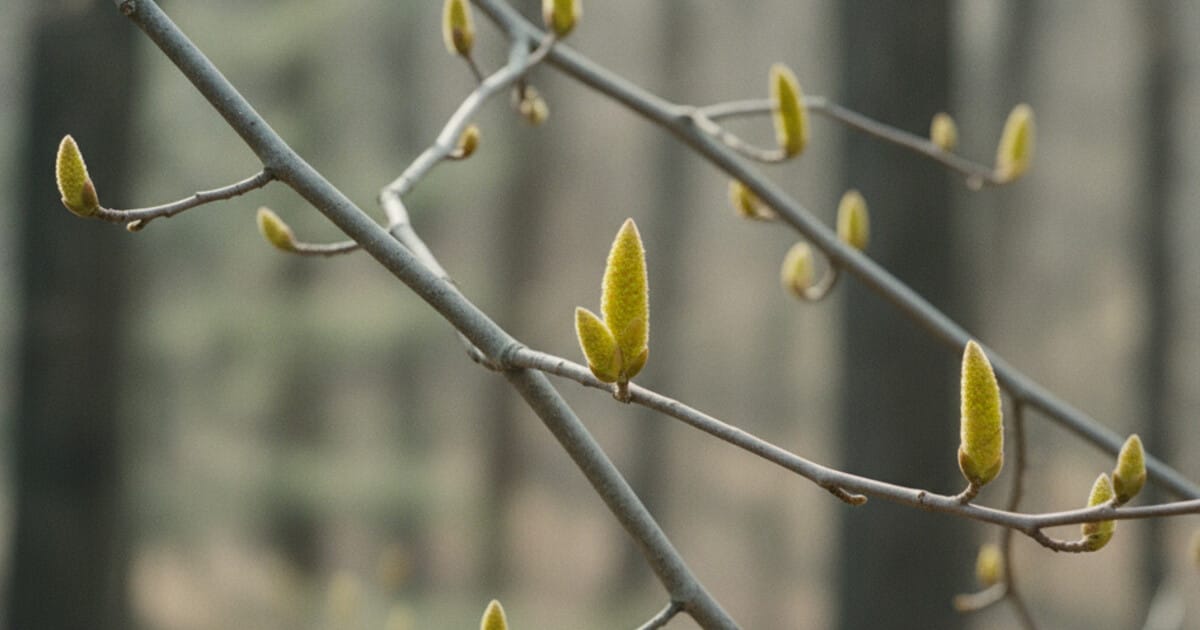
Walk through a moist forest in the eastern U.S. in late fall and you might spot a hickory with sulfur-yellow buds glowing against gray bark. That’s bitternut hickory (Carya cordiformis), and those bright yellow buds are the single most reliable ID feature you’ll find all year long, even in the dead of winter when there’s nothing else to go on.
Bitternut hickory grows across an enormous stretch of eastern North America, from southern Canada to the Gulf Coast. It’s common in bottomlands and mixed forests, yet it gets overlooked next to flashier species like shagbark. Once you know what to look for, bitternut is surprisingly easy to pick out. This guide walks through 7 reliable signs that confirm the ID, from the distinctive yellow buds to the bitter, thin-shelled nuts.
Bitternut hickory is identified by its sulfur-yellow buds, compound leaves with 7-11 narrow leaflets, and thin-hulled round nuts with a 4-winged husk. The bark shows narrow, interlaced ridges that don’t peel. It’s the most widespread hickory in eastern North America, growing in moist bottomlands from Quebec to Florida and west to Nebraska.
What Makes Bitternut Hickory Different from Other Hickories
Bitternut hickory sits in the “true hickory” group (genus Carya), alongside shagbark, pignut, and mockernut. What separates it is the sulfur-yellow bud scales that show up clearly in winter and early spring. No other North American hickory has this coloring. The terminal bud is slender, slightly flattened, and coated in bright mustard-yellow scales you can spot from 20 feet away.
The nuts add another layer to the ID. Most edible hickory nuts have thick husks that split cleanly in 4 sections. Bitternut’s husk is thin, has 4 narrow ridges along the top half, and doesn’t split as cleanly at maturity. The nut itself is round to slightly pear-shaped, about 1 inch across, and extremely bitter. Squirrels eat them, but usually only when other food runs out by late winter.
Bitternut also prefers wetter ground than most hickories. It grows in river bottoms, along creek banks, and in moist mixed forests from Quebec to northern Florida and west to Nebraska. That range makes it the most widely distributed hickory in North America, and you’ll encounter it more often than any other member of the genus once you know what to look for.
For a side-by-side comparison with another common species, see our guide to shagbark hickory tree identification.
Sign #1: Sulfur-Yellow Buds (The Standout Feature)
The buds are what set bitternut hickory apart from every other hickory in North America. They’re bright sulfur-yellow, sometimes described as mustard-yellow or lemon-yellow, and they’re visible from fall through early spring when the tree is bare.
The terminal bud is slender, about 0.5 to 1 inch long, and slightly flattened. Lateral buds are smaller but show the same yellow coloring. There’s no equivalent elsewhere in the genus:
- Shagbark hickory buds are brown and form large, overlapping scales
- Pignut hickory buds are reddish-brown to dark brown
- Mockernut hickory buds are gray-brown and hairy
When you see yellow, it’s bitternut. This feature makes winter ID of bitternut hickory easier than almost any other hardwood species.
Sign #2: Compound Leaves with 7-11 Leaflets
Like all true hickories, bitternut has large pinnately compound leaves. Each leaf typically carries 7-11 leaflets (most commonly 7-9), arranged in opposite pairs along the stem with a single terminal leaflet at the tip.
The leaflets are lance-shaped with finely serrated edges and a pointed tip. They’re narrower than the leaflets on mockernut or shagbark, and the undersides are mostly smooth or only slightly hairy. The terminal leaflet is usually the largest, and the leaflets get progressively smaller toward the base of the leaf.
Total leaf length reaches 12-15 inches. In fall, the leaves turn a clean golden-yellow before dropping cleanly from the tree.
Compare this to mockernut hickory identification, which has 7-9 broader leaflets with distinctly hairy undersides and a strong, spicy scent when crushed.
Sign #3: Narrow, Ridged Bark That Doesn’t Peel
Bitternut hickory bark is gray to gray-brown with narrow, interlaced ridges running up the trunk in a tight, woven pattern. The ridges don’t peel away from the trunk.
This sets it immediately apart from shagbark hickory, whose long, shaggy plates of bark lift away visibly even from a distance. Bitternut bark stays close to the trunk through the tree’s entire life, deepening slightly with age but never shaggy.
On younger trees (6-8 inches diameter), the bark is smoother and almost gray. On older trees, the ridges become more defined but still interlock tightly. The overall texture reads as fine-grained and orderly compared to the chaotic peeling of shagbark.
Sign #4: Thin-Hulled Nuts with a 4-Winged Husk
Bitternut hickory nuts ripen in September and October. They’re round to slightly pear-shaped, about 0.75 to 1.25 inches across, and covered in a green outer husk.
The husk has 4 narrow ridges or wings that run from the tip down about halfway, giving it a slightly angular or keeled shape. The husk wall is noticeably thin compared to shagbark or mockernut, and it often doesn’t split fully into 4 clean sections when the nut matures.
The nut inside has a thin shell, but the meat is extremely bitter because of high tannin content. That bitterness is where the tree gets its name. Squirrels and wood ducks eat bitternut nuts, but typically as a late-winter fallback when sweeter hickory nuts and acorns are gone.
Sign #5: Tall, Straight Form with a Narrow Crown
Bitternut hickory grows 50-80 feet tall under normal conditions, reaching 100 feet or more in rich bottomland sites. The trunk is straight and columnar, with a crown that’s narrower than shagbark or mockernut.
The crown tapers toward the top and shows an open, somewhat irregular structure. In dense bottomland forest, bitternut grows tall and straight as it reaches through the canopy. In more open settings, it develops more spreading lateral branches, but still stays narrower than many competing hardwoods.
The overall silhouette is upright and relatively slender for a large hardwood, which can help separate it from the broader, more spreading form of mature shagbark.
Sign #6: Moist Habitat Preference
Habitat is one of the most useful clues. Bitternut hickory favors moist to well-drained bottomland soils. You’ll find it alongside streams, in river floodplains, on moist lower slopes, and in lowland mixed forests.
Common associates include silver maple, American elm, cottonwood, green ash, and American sycamore. If you’re walking near a creek in the Midwest, Appalachian foothills, or Mid-Atlantic region and you see a hickory, bitternut is the likely candidate. The other common hickory species (shagbark, mockernut, pignut) typically prefer drier ridgetops and upland sites.
Bitternut is adaptable, though. In parts of its range, particularly in the Northeast and upper Midwest, it also grows on dry upland sites in mixed oak-hickory forest. Moist bottomland is the strong preference, but don’t rule it out on drier ground.
Sign #7: Wide Distribution Across Eastern North America
Range narrows the candidates. Bitternut hickory’s natural range covers most of the eastern U.S. and southern Canada. It grows from Quebec and Ontario south through New England, the Mid-Atlantic, Midwest, and Appalachians, down to northern Florida, and west to Nebraska, Kansas, and Oklahoma.
It’s absent from the deep coastal plain of the Southeast and from most of Texas, but it’s common everywhere else in the eastern interior. If you’re in a moist forest anywhere from Maine to Missouri and you find a hickory, bitternut is statistically the most probable species.
For a broader look at the genus and how all these species relate, the hickory tree identification guide covers the full family with comparison charts.
How Tree Identifier Helps with Bitternut Hickory ID
When you’re in the field with a candidate bitternut and you want confirmation before moving on, a photo scan can close the gap fast. Tree Identifier lets you photograph a leaf, bark sample, or the full tree and returns a species match with confidence scores.
It covers thousands of species including all the common hickories, so you’re not relying on a partial database. The offline mode works without a cell signal, which matters in remote bottomlands. You get 2 free identifications per day at no cost, or you can upgrade for unlimited scans on longer field days.
Download it on iOS or Android at treeidentifier.app and keep it ready the next time you spot a yellow-budded hickory by a creek.
Frequently Asked Questions
How do I tell bitternut hickory from shagbark hickory?
The bark is the fastest tell. Shagbark hickory has long, loose plates of bark that peel visibly from the trunk. Bitternut bark stays tight and shows narrow interlaced ridges. In winter, bitternut’s sulfur-yellow buds confirm it instantly. Shagbark buds are brown. The two species also differ in habitat: shagbark prefers dry uplands, bitternut prefers moist bottomlands.
Are bitternut hickory nuts edible?
They’re technically edible but very bitter due to high tannin content. Most people find them unpalatable raw. Some foragers leach the tannins with repeated water soaking, but the result is still less sweet than shagbark or shellbark nuts. Wildlife eat them as a late-winter fallback when better food is scarce.
What does bitternut hickory look like in winter?
In winter, bitternut is one of the easiest hardwoods to identify because of its bright sulfur-yellow buds. No other eastern hickory has this coloring. The buds are slender, about half an inch to an inch long, and show up clearly against the tight gray bark.
Is bitternut hickory good firewood?
Yes, hickory is among the best firewood available. Bitternut hickory burns hot and long with a good coal bed, similar to other true hickories. The bitterness of the nuts has no effect on firewood quality. It produces about 26 million BTUs per cord, comparable to shagbark hickory.
Where does bitternut hickory grow most commonly?
Bitternut hickory grows most commonly in moist bottomlands, along stream banks, and in lowland mixed forests across the eastern U.S. It’s especially prevalent in the Midwest, Appalachian foothills, and Mid-Atlantic states. Its range extends from southern Canada to northern Florida and west to Nebraska, making it the most geographically widespread hickory in North America.
The sulfur-yellow buds make bitternut one of the most distinctive hickories in eastern North America once you know what you’re looking for. Pair that with the compound leaves, tight-ridged bark, thin-hulled bitter nuts, and a preference for moist ground, and you’ve got a complete, reliable ID package for every season.
If you want to confirm a field ID, Tree Identifier can back you up with a quick photo scan. Download it at treeidentifier.app and take it along on your next walk through bottomland forest.
Identify a tree from your photo — free
Upload a leaf, bark, or whole-tree photo and get the species in seconds. No signup.
Confidence:
Unlock the full species profile
Free in the app — with unlimited identifications.


AI result for guidance — the app gives full species details and works offline.
Want unlimited identifications?
Get the full species profile, photos and details — free in the app, with unlimited scans.
- Unlimited identifications
- Full species profiles & details
- Works offline, anywhere
- Save and revisit your finds
Elena Torres
Tree Identifier Team