Black Gum Tree Identification: 7 Reliable Signs
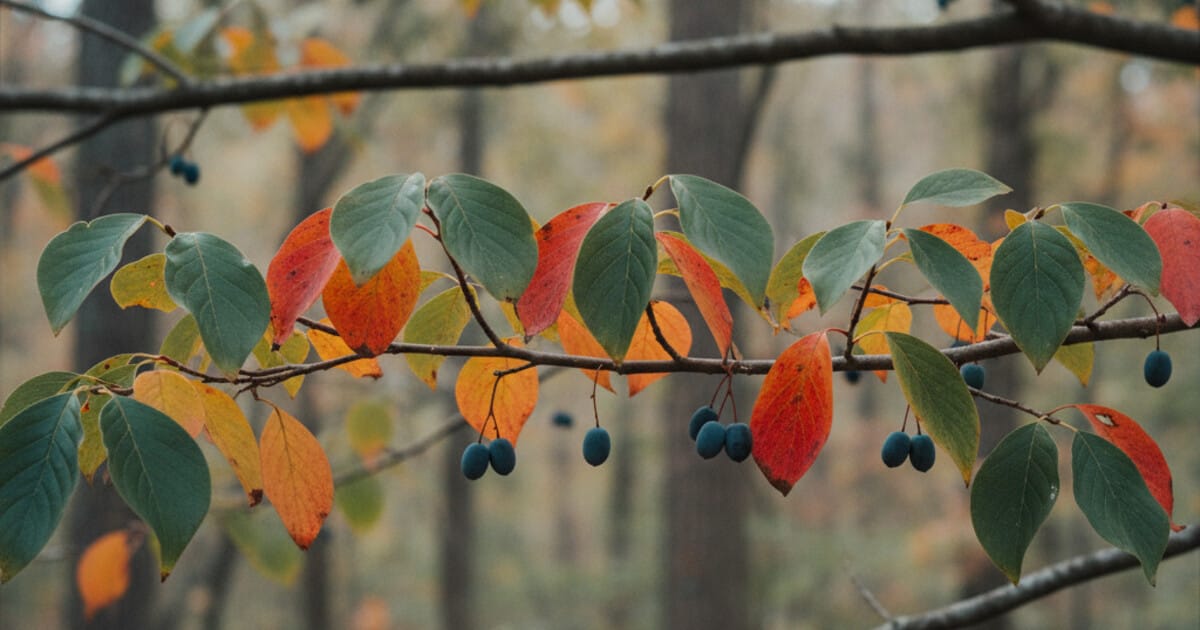
Few eastern trees put on a fall show earlier or more dramatically than black gum. The leaves shift from summer green to blazing red, orange, and deep purple weeks before most surrounding trees have changed at all, making a lone black gum visible from across a field in late September. But black gum tree identification doesn’t have to wait for fall color season. This species has reliable field marks year-round.
Black gum (Nyssa sylvatica) grows across most of eastern North America and goes by several names: black tupelo, sour gum, and pepperidge are all the same tree. This guide covers 7 signs that hold up in any season.
To identify a black gum tree, look for elliptical glossy leaves with smooth margins and a horizontal branching pattern. Mature trees develop blocky, alligator-hide bark. In late September, the leaves turn brilliant red, orange, and purple, often among the first trees to color. Small blue-black drupes ripen in clusters in early fall.
What Is the Black Gum Tree?
Black gum (Nyssa sylvatica) is a native eastern hardwood that grows from Maine to Florida along the Atlantic coast and west to Michigan, Kansas, and east Texas. Unlike its close relative water tupelo, which is restricted to standing water and permanent swamps, black gum is far more adaptable. It tolerates wet bottomlands but grows equally well on moist slopes and dry upland ridges.
The tree typically reaches 30 to 50 feet tall, occasionally 80 feet or more in rich bottomland sites. It’s slow-growing and exceptionally long-lived.
Black gum (Nyssa sylvatica) is a long-lived native hardwood found across the eastern U.S. from Maine to Florida and west to Kansas and east Texas. It grows 30 to 50 feet tall in most conditions, with some bottomland specimens exceeding 80 feet. Unlike water tupelo, which grows only in permanent swamps, black gum occupies a wide range of habitats from moist bottomlands to dry upland ridges. Its tolerance for acidic and poorly drained soils makes it common in eastern forests. Some documented specimens are over 650 years old. The fall foliage is among the most brilliant in eastern North America: leaves turn deep red, orange, and purple 4 to 5 weeks before surrounding species, making isolated trees visible from a distance in late September. The small blue-black drupes ripen in September and October and feed dozens of bird species during fall migration, including wood thrush, robins, and cedar waxwings.
Black Gum Identification: Leaves and Bark
Four of the 7 signs come from features you can check any time of year.
Sign 1: Elliptical, glossy leaves with smooth margins. Black gum leaves are simple and alternate, 3 to 6 inches long, widest toward the tip and tapering to the base. The upper surface is glossy dark green, noticeably shiny in direct sunlight, with smooth or very slightly wavy margins. Flip a leaf over and the underside is paler, sometimes softly hairy along the midvein.
Sign 2: Nearly horizontal branching. This is the field mark that makes black gum unmistakable in winter silhouette. Mature trees develop almost perfectly horizontal branches, arranged in loose tiers up the trunk. From a distance the crown looks flat-topped and layered rather than rounded. Younger trees show this tendency too, though less dramatically.
Sign 3: Blocky, alligator-hide bark on mature trees. Young black gum bark is gray-brown with shallow furrows, similar to several other species. By middle age the bark builds into distinctive rectangular blocks separated by narrow furrows, giving the trunk a texture that resembles alligator skin or interlocking cobblestones. This bark is one of the most reliable year-round features once a tree reaches maturity.
For more on using bark as a field mark, see our tree bark identification guide.
Sign 4: Simple leaves, never compound. Black gum leaves are always single-bladed. They don’t split into leaflets, even though clusters of leaves at branch tips can look compound at first glance. This rules out ash (opposite, compound), box elder (opposite, compound), and hickory (alternate, compound). Each black gum leaf has one blade on its own stem.
Flowers, Fruit, and Fall Color
Sign 5: Small greenish-white flowers in spring. Black gum flowers in April through June, producing tiny greenish-white blossoms in small clusters. The flowers are not showy. You’re more likely to notice bees working them than to spot the flowers themselves. Male and female flowers often occur on separate trees.
Sign 6: Blue-black drupes in early fall. The fruit is a small oval drupe, about a third to a half inch long, turning from green to deep blue-black as it ripens September through October. Fruits grow in clusters of 2 to 4 on a shared stem at the ends of branches. They’re technically edible but intensely sour, which accounts for the common name “sour gum.”
The fruit timing matters for wildlife. Blue-black drupes ripen exactly when fall bird migration peaks, making black gum a critical food source for wood thrush, American robin, eastern bluebird, cedar waxwing, and northern flicker.
The fall color deserves its own mention. Black gum turns red, orange, and purple earlier than nearly every other eastern deciduous tree. By late September, when surrounding oaks and maples are still fully green, black gum is already at peak color. The leaves sometimes show 3 or 4 distinct shades on the same branch simultaneously. Our article on why leaves change color in fall explains the pigment mechanics behind this early shift.
Black Gum Habitat and Range
Sign 7: Moist upland to bottomland habitat across eastern North America. Black gum grows in a wider variety of sites than most trees in its genus. You’ll find it in wet bottomlands alongside swamp white oak and red maple, and just as often on dry upland slopes where water tupelo couldn’t survive. It tolerates acidic, poorly drained, and compacted soils well.
Range covers most of the eastern U.S.: Maine south to Florida, west through the lower Midwest to Kansas, and into east Texas. It’s absent from the drier central plains and high mountain zones, but present in nearly every eastern forest type.
Common associates in moist lowland settings include sweetgum, red maple, swamp white oak, and sweetbay magnolia along the coastal south. Knowing the plant community around a tree helps confirm identification when features are ambiguous.
Black Gum vs. Similar Species
Black gum vs. water tupelo (Nyssa aquatica): Both belong to the Nyssa genus and share similar fruit and leaf shape.
- Habitat: Water tupelo grows only in standing water and permanent swamps. Black gum tolerates dry ground.
- Trunk base: Water tupelo develops a strongly flared, buttressed base at the water line. Black gum’s base is straight.
- Leaves: Water tupelo leaves are 5 to 10 inches, often with coarse teeth. Black gum leaves stay 3 to 6 inches with smooth margins.
Black gum vs. black cherry (Prunus serotina): Both have dark bark that turns scaly with age and produce small dark fruit.
- Leaf margins: Black cherry leaves have fine, gland-tipped teeth along the margin. Black gum margins are smooth.
- Bark detail: Young black cherry bark has horizontal lenticels (tiny raised pores) that black gum lacks.
- Fruit: Black cherry fruit hangs in elongated racemes of 20 or more. Black gum drupes grow in small clusters of 2 to 4.
Black gum vs. flowering dogwood: Both are common understory species and often grow side by side.
- Leaf arrangement: Dogwood leaves are opposite (2 leaves directly across from each other). Black gum leaves are alternate.
- Leaf veins: Dogwood has curved veins that arc toward the leaf tip, one of the most distinctive features in the eastern forest. Black gum veins run more parallel.
How Tree Identifier Helps You Confirm the ID
Black gum identification gets easier with practice, but the early-stage bark transition can confuse even experienced naturalists, and the leaves resemble several common species. The Tree Identifier app handles this directly. Photograph a leaf, a bark section, or a fruit cluster and the AI matches it against thousands of species in its database.
The offline mode is worth knowing about if you’re in remote woods: the full species database downloads to your device and works without cell service. You get 2 free identifications per day, no subscription required to start.
Download Tree Identifier on iOS or Android at treeidentifier.app and confirm your next black gum sighting on the spot.
Frequently Asked Questions
Is black gum the same as black tupelo? Yes. Black gum and black tupelo are two common names for Nyssa sylvatica. Other names include sour gum and pepperidge. The name “black gum” refers to the dark fruit and the gummy sap in young twigs. All names refer to the same species across eastern North America.
Why does black gum turn red so early in fall? Black gum starts breaking down its chlorophyll earlier than most deciduous species, uncovering the anthocyanin pigments underneath. This early timing is partly genetic and partly linked to soil conditions: trees in acidic, poorly drained soils tend to color up earlier and more intensely. You’ll often see isolated black gums fully red in late September while surrounding oaks and maples are still completely green.
Are black gum berries edible? Technically yes, but they’re extremely sour and astringent when raw. That sourness is one reason the tree is called “sour gum.” Wildlife, particularly migratory songbirds, eat them readily. Most people find them unpleasant fresh, though the pulp has been used historically in preserves.
How do I tell black gum from water tupelo? Black gum grows on dry to moist upland and bottomland sites. Water tupelo grows only in standing water, usually with a swollen base. Black gum leaves are 3 to 6 inches with smooth margins; water tupelo leaves are 5 to 10 inches with coarse teeth. If your feet are dry and the tree isn’t standing in water, it’s almost certainly black gum rather than water tupelo.
How long do black gum trees live? Black gum is exceptionally long-lived. Documented specimens reach 500 to 650 years based on ring-count data, and its slow growth rate (12 to 18 inches per year in height) contributes to this longevity. Older trees are hollow-stemmed more often than not, which doesn’t stop them from continuing to grow for centuries.
Identify a tree from your photo — free
Upload a leaf, bark, or whole-tree photo and get the species in seconds. No signup.
Confidence:
Unlock the full species profile
Free in the app — with unlimited identifications.


AI result for guidance — the app gives full species details and works offline.
Want unlimited identifications?
Get the full species profile, photos and details — free in the app, with unlimited scans.
- Unlimited identifications
- Full species profiles & details
- Works offline, anywhere
- Save and revisit your finds
Elena Torres
Tree Identifier Team