Blue Ash Tree Identification: 7 Reliable Signs
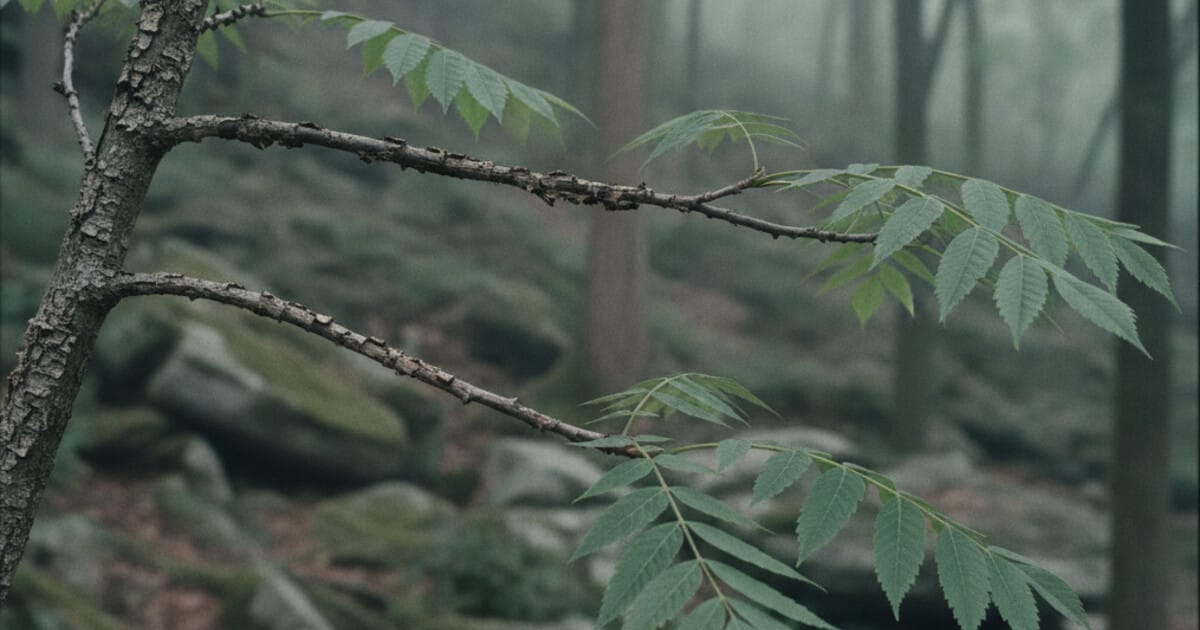
Blue ash (Fraxinus quadrangulata) is easy to overlook until you touch it. Run your fingers along a young branch and you’ll notice something odd: the twig isn’t round. It has 4 distinct flat sides separated by low corky ridges, giving it a square cross-section that feels different from every other ash species in eastern North America. That single feature narrows identification to one species before you’ve even looked at a leaf.
This guide covers all 7 reliable signs for blue ash identification, from twig shape and leaf structure to bark texture, fruit type, and habitat. It also explains how blue ash differs from white ash and green ash, the two species most likely to cause confusion.
Blue ash tree identification relies on 4 key features: square (4-angled) twigs with corky ridges, opposite compound leaves with 7-11 short-stalked leaflets, gray bark with shaggy interlaced ridges, and a preference for dry rocky limestone uplands. No other eastern North American ash has square twigs, so checking that feature first saves time in any ash identification scenario.
The Square Twig: Blue Ash’s Most Recognizable Feature
Every ash species shares a few traits: opposite compound leaves, opposite branching, and winged seeds. Blue ash keeps all of those, then adds one feature that belongs to it alone. The twigs are 4-sided, with 4 corky wings running lengthwise along each young stem.
The botanical name says it directly. Quadrangulata is Latin for “4-angled,” and Asa Gray documented this feature in the 1850s when he formally described the species. The 4 corky ridges are sharpest and most visible on first-year and second-year growth. On older wood, the ridges soften but remain faintly detectable if you press firmly.
Always check branch tips and the current season’s growth when looking for this feature. Snap a slender twig with your fingernail and the cross-section shows 4 corners rather than a round edge. That’s the fastest confirmation available in the field.
Range and Conservation Status
Blue ash (Fraxinus quadrangulata) holds a distinctive place among North American ash species both botanically and ecologically. The species is native to a relatively narrow range centered on the Interior Highlands and central Appalachians, where it colonizes rocky limestone outcrops, dolomite bluffs, and well-drained upland slopes. It reaches its greatest natural densities in Kentucky, Tennessee, Missouri, Ohio, and Indiana, with scattered populations in Illinois, Arkansas, West Virginia, and northern Alabama. Unlike white ash (Fraxinus americana) and green ash (Fraxinus pennsylvanica), which both tolerate moist to wet bottomlands, blue ash is adapted to dry, thin soils over carbonate bedrock. This habitat specificity keeps populations naturally small and scattered. Conservation surveys from 2018 to 2024 in Ohio and Missouri found living blue ash in fewer than 30% of previously documented stands, with emerald ash borer cited as the primary cause. The species is listed as a species of concern in multiple states.
Emerald ash borer (Agrilus planipennis), the invasive beetle that has killed hundreds of millions of ash trees since its 2002 detection in Michigan, has hit blue ash hard. Because blue ash grows in scattered, low-density stands on rocky ridges rather than dense floodplain forests, recovery after beetle kill has been particularly slow. Finding a living blue ash today is genuinely notable.
Leaves: 7-11 Leaflets, Short-Stalked
Blue ash has opposite compound leaves ranging from 8 to 12 inches long. Most leaves carry 7, 9, or 11 leaflets, with 7 and 9 being most common. The leaflets are lance-shaped to broadly oval, 2.5-4 inches long, with sharply toothed (serrated) edges.
One feature that helps separate blue ash from white ash and green ash: the individual leaflets sit on short but visible stalks called petiolules. White ash leaflets are often stalkless or nearly so. On blue ash, these short stalks are consistently present and give the leaf a slightly open, airy appearance.
The upper surface is medium green and smooth. The underside is paler, with fine hairs running along the central vein. In fall, blue ash turns yellow to orange-yellow before dropping. The fall color is clean and warm but doesn’t rival maples for intensity.
Bark: Shaggy and Gray
Blue ash bark is gray to light brown on mature trunks, with narrow, interlaced ridges that cross and weave in a slightly diagonal pattern. The overall texture is rougher and shaggier than white ash, which tends to form cleaner diamond-shaped furrows.
On young trees under 6 inches in diameter, the bark is relatively smooth and thin. As the trunk expands, the ridges deepen and the shaggy quality becomes more obvious. On older trees, loose edges on the ridges give the trunk a disheveled appearance worth noting.
The common name comes from the inner bark. Soak it in water and it releases a blue-gray dye. Native American communities across the Midwest used this to color cloth, and early European settlers adopted the practice. If you encounter a freshly cut stump or broken branch on a candidate blue ash, look for a faint greenish-blue tinge in the exposed cambium layer.
Samaras: Broadly Winged Fruit
Blue ash produces winged seeds (samaras) that differ from other ash species in one consistent way. The wing on a blue ash samara encircles the full length of the seed body rather than extending only from the tip the way white ash samaras do. This creates a broader, paddle-shaped fruit roughly 1 to 2 inches long.
The samaras hang in loose, drooping clusters that persist into early winter. By late October they’ve turned tan and papery, and they rattle audibly in the wind. On bare or partially leafless trees in fall, these clusters are visible at a distance and can point you toward the species before you’re close enough to check twigs or bark.
Habitat and Range: Where to Look
Blue ash prefers dry, rocky, well-drained soils over limestone or dolomite bedrock. Look for it on blufftops, rocky south- or west-facing ridges, and thin-soiled slopes where most other trees struggle to establish. This habitat preference is one of its most useful identification clues.
Within a forest tract, blue ash often grows in mixed stands with chinkapin oak, post oak, and shagbark hickory on rocky uplands. It’s rarely the dominant species, and finding even one or two mature trees in a stand is notable.
The core range runs through central Kentucky and Tennessee, northwest through Ohio, Indiana, and Missouri, and into the Ozark Plateau in Arkansas. Illinois holds scattered populations mainly in the southern counties. West Virginia and northern Alabama have outlying occurrences.
Blue Ash vs. White Ash and Green Ash
Three features sort these species quickly. For a deeper look at the full genus, the ash tree identification guide covers the shared traits and the key separators across all North American ash species.
Twig shape. Blue ash twigs are square with 4 corky ridges. White ash and green ash both have round twigs with no ridges. This is the fastest separator.
Habitat. Blue ash grows on dry limestone uplands. White ash prefers rich, moderately moist upland soils. Green ash occupies bottomlands, stream banks, and floodplains. Habitat alone often narrows the field before you check anything else.
Leaflet undersides. White ash leaflets are noticeably pale (whitish) on the underside, which is the source of its common name. Green ash leaflets are green on both surfaces. Blue ash leaflets are pale green below but not notably white, with fine hairs along the midrib.
For a side-by-side look at each close relative, the white ash tree identification and green ash tree identification articles cover their key features in detail.
How Tree Identifier Helps
Blue ash can be tricky to confirm from a single photo, especially when the 4-angled twigs aren’t in frame or the tree is too tall to reach. Tree Identifier’s AI accepts multiple photo types: leaves, bark, fruits, and whole-tree shots. Submitting a leaf photo alongside a twig photo gives the app more to cross-reference and sharpens accuracy on harder-to-distinguish species.
The app works offline, which matters on the rocky ridgetops and bluffs where blue ash tends to grow. Cell coverage on limestone outcrops in the Ozarks or central Kentucky isn’t guaranteed. Download species data before your hike and you’re covered. You get 2 free identifications daily with no subscription required to try it.
Blue ash populations have declined sharply. Documenting living specimens and submitting them to iNaturalist or your state’s natural heritage program is useful conservation data that takes 2 minutes after you’ve already identified the tree.
Frequently Asked Questions
What’s the easiest way to identify a blue ash tree?
Check the twigs first. Blue ash twigs are distinctly square (4-sided) with 4 low corky ridges running lengthwise. Roll a young twig between your fingers and you’ll feel the flat sides and corners. No other eastern North American ash shares this feature, so it’s a reliable one-step separator from white ash, green ash, and all other relatives.
Where does blue ash grow?
Blue ash is native to the central Midwest and central Appalachians. Its core range covers Kentucky, Tennessee, Ohio, Indiana, Missouri, and Arkansas, with scattered populations in Illinois, West Virginia, and northern Alabama. It grows on dry, rocky limestone and dolomite uplands rather than the moist bottomlands where white ash and green ash are most common.
Is blue ash rare?
Blue ash has never been abundant, but populations have declined severely since emerald ash borer arrived. Field surveys between 2018 and 2024 found living blue ash in fewer than 30% of previously documented stands in some core states. Several state wildlife agencies list it as a species of concern. Finding a healthy, living blue ash today is worth documenting and reporting to local conservation programs.
How many leaflets does blue ash have?
Blue ash leaves carry 7-11 leaflets, with 7 or 9 being most common. The leaflets are lance-shaped to oval, 2.5-4 inches long, with serrated margins and short visible stalks (petiolules) that attach each leaflet to the central leaf stem.
Why is it called blue ash?
The name comes from the blue-gray dye that the inner bark produces when soaked in water. The dye comes from tannins and other compounds in the cambium layer. Native American communities across the Midwest used this to color cloth, and early settlers adopted the practice. The outer bark and wood show no blue coloration; the name refers to the inner bark’s dye property specifically.
If you’re exploring rocky limestone ridges in the Midwest or central Appalachians and want to confirm what you’re looking at, Tree Identifier can help. Take a photo of the compound leaves, snap the twig if you can reach one, and let the AI cross-reference both features for a confident identification.
Identify a tree from your photo — free
Upload a leaf, bark, or whole-tree photo and get the species in seconds. No signup.
Confidence:
Unlock the full species profile
Free in the app — with unlimited identifications.


AI result for guidance — the app gives full species details and works offline.
Want unlimited identifications?
Get the full species profile, photos and details — free in the app, with unlimited scans.
- Unlimited identifications
- Full species profiles & details
- Works offline, anywhere
- Save and revisit your finds
Elena Torres
Tree Identifier Team