Green Ash Tree Identification: 7 Reliable Signs
Stand near a green ash in July and you’d never guess it’s one of the most threatened trees in North America. The leaves are full and green, the canopy spreads wide, and the tree looks completely healthy. Green ash (Fraxinus pennsylvanica) grows in millions of yards, parks, and floodplains across 39 states, and it’s the most widely distributed native ash species on the continent. But right now, an invasive beetle is cutting through those populations at a pace that’s changed the composition of entire forests. Knowing how to identify a green ash has never been more useful.
This guide covers 7 reliable field marks for green ash identification, how to tell it apart from white ash and other look-alikes, and what the current crisis means for trees near you.
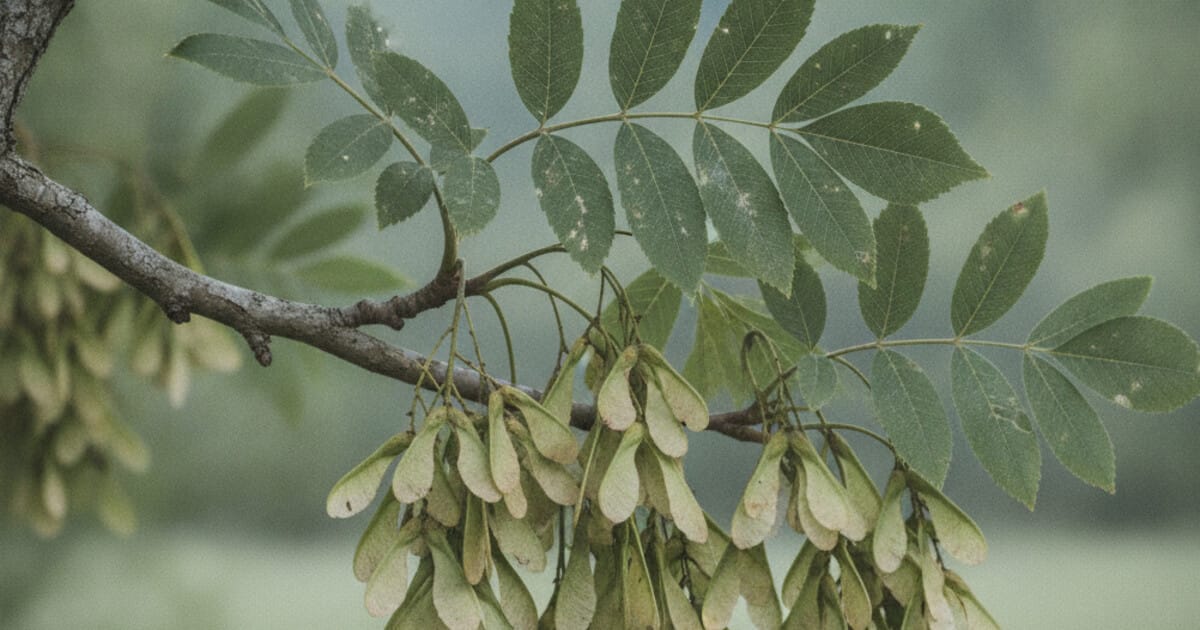
Green ash trees are identified by opposite, pinnately compound leaves with 7 leaflets (sometimes 5-9), interlocking diamond-furrowed gray-brown bark, and paddle-shaped seeds called samaras. The leaflets are nearly stalkless, unlike white ash leaflets, which are clearly stalked with whitish undersides. Green ash also favors wet bottomlands and floodplains over the drier upland sites white ash prefers.
The 7 Field Marks for Green Ash Identification
Green ash shares the genus Fraxinus with white ash, black ash, and blue ash. They all have compound leaves and opposite branching. But green ash has specific traits that separate it from every look-alike in the forest. Here are the 7 most reliable signs.
Green ash (Fraxinus pennsylvanica) is native across all of the eastern United States and much of the Great Plains, the most broadly distributed native ash in North America. Its range runs from Nova Scotia and Quebec south to northern Florida, and west through the Plains to Wyoming and New Mexico. Unlike white ash (Fraxinus americana), which favors well-drained upland soils, green ash thrives in wet bottomlands, stream banks, and floodplain forests, tolerating standing water for weeks at a time. This moisture tolerance made green ash the dominant street tree planted across Midwest and Plains cities during the 20th century; the USDA estimates tens of millions were planted in urban landscapes nationwide. Since the Emerald Ash Borer (Agrilus planipennis) arrived in Michigan in 2002, it has spread to 35 states and five Canadian provinces, functionally eliminating green ash from large portions of its native range and killing trees in nearly every U.S. urban forest where it was planted.
Sign 1: Opposite, Pinnately Compound Leaves
The single most reliable starting point is leaf structure. Green ash leaves are opposite (two leaves emerge from the same node on opposing sides of the twig) and pinnately compound (multiple leaflets arranged along a central stalk called a rachis).
Each leaf runs 6–12 inches long and carries 5 to 9 leaflets, with 7 being the most common. The leaflets are lance-shaped to oval, 2–4 inches long, with finely serrated edges and a pointed tip. Both leaf surfaces are medium green; the underside is only slightly paler than the top, sometimes nearly hairless.
This is the sharpest contrast with white ash: white ash leaflets are clearly whitish or silvery beneath, visible even at a distance. On green ash, both surfaces read as the same shade of green.
If compound leaves are new to you, the trees with compound leaves guide explains how to read pinnate and palmate leaf structure across species.
Sign 2: Nearly Stalkless Leaflets
Turn the leaf over and look at how each leaflet attaches to the rachis. On green ash, the leaflets are nearly sessile: they have very short individual stalks (petiolules) or none at all. On white ash, those petiolules are noticeably longer, giving the leaflets a more floated appearance along the central stem.
It’s a small detail but a consistent one. Once you’ve seen both species side by side, the difference is obvious. In the field, it’s one of the fastest ways to confirm green ash vs. white ash when the two species grow together.
Sign 3: Diamond-Furrowed Gray-Brown Bark
Mature green ash bark is gray-brown with a distinctive interlocking diamond or X-shaped ridge pattern. The ridges cross at angles, creating a lattice of flat-topped ridges separated by narrow furrows. The pattern is tighter and more regular than white ash bark, which tends to have broader, more open diamonds with deeper furrows.
Young green ash trees (under 6 inches in diameter) have smoother, gray bark with only shallow grooves forming. The full diamond pattern develops as the tree matures. In winter with no leaves available, bark is your primary identification tool. Once you know the interlocking-diamond look, it’s distinctive enough to call from 20 feet away.
Sign 4: Opposite Branching
Step back and look at the whole tree. Ash trees branch in an opposite pattern: each branch has a matching branch directly across from it on the trunk or parent limb. This gives the crown a symmetrical, almost architectural quality.
Most North American deciduous trees have alternate branching, which makes opposite-branching trees easy to narrow down. The mnemonic “MAD Cap Horse” covers the main groups: Maple, Ash, Dogwood, Caprifoliaceae (honeysuckle family), and Horse chestnut. If you’re looking at a compound-leaved tree with opposite branching, ash is your most likely answer by far.
Sign 5: Paddle-Shaped Samaras
Green ash produces seeds called samaras, single-winged paddle-shaped fruits that hang in dense clusters. Each samara is 1–2 inches long. The seed sits at the base, and the papery wing extends from the seed all the way to the tip in a flat, elongated paddle.
This shape distinguishes ash samaras from maple samaras (paired helicopter sets with broader wings) and from box elder (also paired helicopter-style). Ash samaras fly solo and land flat. Green ash is dioecious: individual trees are either male or female, and only female trees produce seeds. Female trees can carry such heavy seed clusters in late summer that the weight noticeably bends the branches.
Sign 6: Purple Flowers Before the Leaves
In March and April, before the leaves emerge, green ash puts out small clusters of dark purple flowers directly from the twigs. They’re tiny and inconspicuous; most people walk past without noticing them. The flowers appear on bare branches, not from leaf axils, and they bloom before leaf-out, which is standard ash behavior.
Male trees produce pollen; female trees produce the flowers that become samaras. If you spot a bare tree in early spring covered in tight, dark flower clusters, green ash is a strong candidate, especially if the bark shows that diamond-ridge pattern.
Sign 7: Wet Bottomland Habitat
Green ash grows wherever the soil stays moist. Floodplain forests, stream banks, the edges of wetlands, and low areas in fields and yards are all prime green ash territory. It handles seasonal flooding better than almost any other upland hardwood.
In wild settings, green ash often grows alongside silver maple, cottonwood, black willow, sycamore, and box elder. If you’re walking through that community and spot a compound-leaved, opposite-branched tree, green ash is your first guess.
As a street and yard tree, green ash was planted in enormous quantities across Chicago, Kansas City, Omaha, and Denver throughout the 20th century, precisely because it tolerates compacted urban soils, road salt, and wet spots that kill other species.
Green Ash vs White Ash: How to Tell Them Apart
These two species often grow together and can fool experienced naturalists. Here’s a direct comparison of the key field marks.
| Feature | Green Ash | White Ash |
|---|---|---|
| Leaflet undersides | Medium green, nearly same as top | Clearly whitish or silvery pale |
| Leaflet stalks | Very short or absent (sessile) | Noticeably longer |
| Bark ridges | Tighter, more interlocking | Broader, more open diamonds |
| Habitat preference | Wetter bottomlands, floodplains | Drier upland and well-drained sites |
| Typical height | 50–70 feet | 60–80 feet |
The fastest field test: pick a compound leaf and compare the leaflet color top to bottom. If the undersides are clearly two-toned (pale silvery), lean toward white ash. If both sides read the same medium green, you’re likely looking at green ash.
For a detailed breakdown of white ash’s specific ID traits, the white ash tree identification guide covers its 7 field marks side by side.
Why Green Ash Identification Matters Now
The Emerald Ash Borer has moved through North American ash populations faster than almost any invasive pest on record. Since its discovery near Detroit in 2002, EAB has spread to 35 states and five Canadian provinces. It kills all native North American ash species with near-complete efficacy in untreated trees.
Green ash, planted so widely in urban and suburban landscapes, has been hit especially hard. The signs of EAB infestation include canopy dieback starting from the top down, S-shaped larval galleries just under the bark (visible if you peel a section), and D-shaped exit holes about 1/8 inch wide in the outer bark. Crown dieback of 30% or more usually means larvae have been working for 2–3 years.
Knowing you have a green ash (not an elm, box elder, or tree of heaven) is the first step toward deciding whether to treat it. Soil drench and trunk injection treatments with emamectin benzoate or imidacloprid are highly effective if applied before significant dieback. A certified arborist can assess whether your specific tree is a candidate.
For a broader look at the ash family and the EAB situation, the ash tree identification guide covers white, green, black, and blue ash with full context on each.
How Tree Identifier Can Help
Ash trees have a few look-alikes that trip people up in the field. Box elder (Acer negundo) has compound leaves and opposite branching like green ash but carries only 3–5 leaflets and paired helicopter samaras. Tree of heaven (Ailanthus altissima) has similar-looking compound leaves but they’re alternate, not opposite, and the leaflets have a small notch near the base with a distinctive musty smell.
If you’re not confident in your field ID, Tree Identifier can confirm it. Take a photo of the leaf (underside visible if possible), a close-up of the bark, or the branch structure. The app identifies from leaves, bark, flowers, and whole-tree photos, returning a species ID with a confidence score and detailed species information. It works offline, so it’s useful on trails and in parks where cell service is patchy. Tree Identifier offers 2 free identifications per day, enough to confirm a tree you’re uncertain about right on the spot.
Frequently Asked Questions
How do I tell green ash from white ash in the field?
The fastest check is the underside of the leaflets. White ash leaflets are clearly whitish or silvery pale beneath; the difference is obvious when you hold a leaf to the light. Green ash leaflets are close to the same medium green on both surfaces. Also look at where each leaflet connects to the central stem: green ash leaflets are nearly stalkless, while white ash leaflets have noticeably longer individual stalks.
Is green ash native to North America?
Yes. Green ash (Fraxinus pennsylvanica) is one of the most widely distributed native trees in North America, with a natural range covering 39 states and multiple Canadian provinces. The invasive threat to green ash is the Emerald Ash Borer, an Asian beetle accidentally introduced near Detroit in 2002; the beetle is invasive, the tree is native.
Can a green ash tree survive the Emerald Ash Borer?
Untreated trees have near-zero survival rates in areas with established EAB populations. Insecticide treatments (soil drench or trunk injection with emamectin benzoate or imidacloprid) are highly effective when applied before significant crown dieback. Once more than 50% of the canopy is dead, treatment usually isn’t cost-effective. A certified arborist can assess whether your tree is a good treatment candidate.
What does green ash look like in winter without leaves?
In winter, look for opposite branching structure, the interlocking diamond-ridged gray-brown bark, and clusters of dry, tan samaras that persist on female trees through the season. The bark pattern is the most reliable winter ID tool: once you’ve seen the tight, interlocking diamond lattice, it’s distinctive enough to recognize without leaves.
How fast does green ash grow?
In ideal moist bottomland conditions, green ash puts on 1.5–2 feet per year when young. Street trees in compacted urban soils grow more slowly, often 6–12 inches per year. At maturity, green ash typically reaches 50–70 feet tall with a canopy spread of 25–40 feet, though floodplain trees in optimal conditions can exceed these numbers.
Identify a tree from your photo — free
Upload a leaf, bark, or whole-tree photo and get the species in seconds. No signup.
Confidence:
Unlock the full species profile
Free in the app — with unlimited identifications.


AI result for guidance — the app gives full species details and works offline.
Want unlimited identifications?
Get the full species profile, photos and details — free in the app, with unlimited scans.
- Unlimited identifications
- Full species profiles & details
- Works offline, anywhere
- Save and revisit your finds
Elena Torres
Tree Identifier Team