Buckeye Tree Identification: Ohio, Yellow, and Red Species
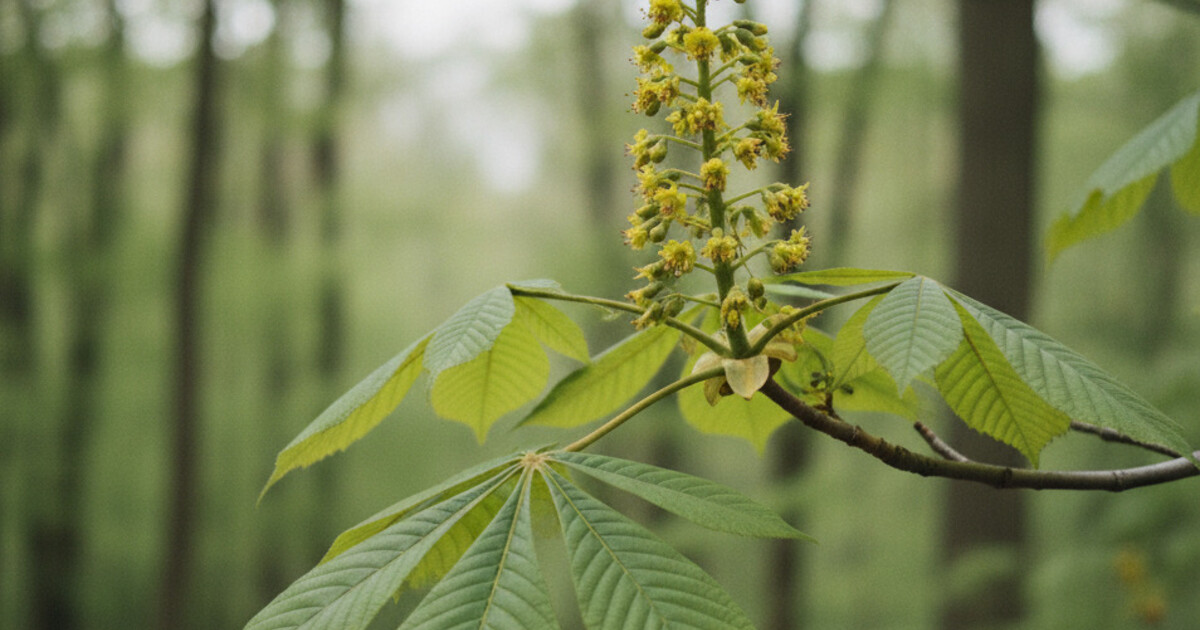
Few trees announce spring as dramatically as the buckeye. While most deciduous trees are still bare in March, buckeyes have already flushed bright green. Their palmate compound leaves fan out in five-part whorls, and by late April, tall candles of flowers shoot up from every branch tip. Buckeye tree identification is straightforward once you know the signature features, but the tree does get confused with the horse chestnut, its European relative. This guide covers the three main native North American buckeyes, how to tell them apart, and the key differences from horse chestnut.
To identify a buckeye tree, look for palmately compound leaves with 5 leaflets fanning out from a single point. Ohio buckeyes have pointed leaflets with toothed edges; yellow buckeyes are larger with finer teeth. Both flower in April and May. The glossy brown nut inside a warty, leathery husk is the final confirmation.
The Ohio Buckeye: Most Common Native Species
The Ohio buckeye (Aesculus glabra) is the state tree of Ohio and grows across the Midwest from Nebraska to Pennsylvania, south into the Appalachians.
It’s a medium-sized tree, typically 20-40 feet tall at maturity, though older specimens in ideal conditions reach 60 feet. The crown is rounded and dense.
Leaf identification: Leaves are palmately compound with 5 leaflets (occasionally 7) radiating from a central point, like a hand spread open. Each leaflet is 3-6 inches long, elliptical, with a pointed tip and finely toothed edges. The leaflets have no individual stalks; they attach directly at the tip of the main leaf stem.
Flowers: Upright panicles 4-7 inches tall appear in April and May. The flowers are yellow-green with slightly orange stamens. They’re not showy from a distance but create a distinctive silhouette at the branch tips.
The smell test: Crush a leaf or break a small twig and smell it. Ohio buckeye releases a distinctly unpleasant, skunky odor. Few other trees share this trait. If the crushed leaf smells bad, you’ve almost certainly got an Ohio buckeye or one of its close relatives.
Fruit: Ripe in September and October, the fruit is a round or oval husk, 1-2 inches across, covered in warty bumps. Inside sits 1-3 glossy mahogany-brown nuts with a tan circular spot (the “eye”). The nuts look polished and appealing. They’re also toxic to humans and most animals; read more in our guide to poisonous trees to avoid.
Bark: Gray and relatively smooth on young trees. With age the bark develops thick, irregular scaly plates, often cracking into rough chunks that can peel away from the trunk.
The Ohio buckeye (Aesculus glabra) is identified by 3 key features: palmately compound leaves with exactly 5 leaflets, upright clusters of yellow-green flowers that bloom April through May, and warty-husked nuts containing glossy brown seeds. The leaves emerge very early in spring, often before most other deciduous trees. Each leaflet is 3-6 inches long with a pointed tip and finely serrated edges. Mature trees reach 20-40 feet tall, with gray, thick-plated bark that develops irregular scaly ridges with age. A reliable field identification trick: crush a leaf or twig and smell it. Ohio buckeye has a distinctly unpleasant, skunky odor that few other trees share. All parts of the tree, including the nut, are toxic to humans and livestock, despite the seeds’ appealing, polished appearance. Range covers Missouri east through Ohio and into Pennsylvania, with extension south through the Appalachians.
Yellow Buckeye and Red Buckeye: Two More Native Species
Yellow Buckeye
Yellow buckeye (Aesculus flava, also called sweet buckeye) is the largest native buckeye in North America. It grows throughout the Appalachian Mountains, from southwestern Pennsylvania south to northern Georgia.
Expect trees of 40-70 feet tall. The leaves also have 5 leaflets, but they’re larger than Ohio buckeye (4-8 inches), with less pronounced teeth and a slightly smoother texture.
The flowers are bright yellow, blooming slightly later than Ohio buckeye in May. They don’t have the skunky smell of Ohio buckeye; the crushed leaves of yellow buckeye are basically odorless. The fruit husk is notably smoother, with few or no wart-like bumps.
Yellow buckeye grows in rich, moist forest soils, particularly in coves and along stream banks. If you’re hiking in the southern Appalachians and see a large-leaved compound-leaf tree in a valley, yellow buckeye is a strong candidate.
Red Buckeye
Red buckeye (Aesculus pavia) is a smaller species, reaching 10-25 feet as a large shrub or small tree. It grows in the southeastern US, from Virginia and North Carolina west to Texas.
The leaves follow the same 5-leaflet pattern, but the key identifier is the flowers: tubular, bright red to orange-red, blooming in April and May. No other native buckeye has red flowers. Hummingbirds actively seek out red buckeye in early spring when little else is blooming.
The fruit husk is round and fairly smooth, 1-2 inches across. Red buckeye grows in woodland edges and understory areas, often along streams.
Buckeye vs Horse Chestnut: The Key Differences
Horse chestnut (Aesculus hippocastanum) is native to the Balkans but planted widely throughout North American cities and parks. The confusion with buckeyes makes sense because they’re in the same genus, but several features separate them clearly.
Leaf count: Horse chestnut has 7 leaflets; most native buckeyes have 5. This is the quickest field ID.
Flowers: Horse chestnut produces large upright clusters of white flowers with pink and yellow spots, in May. They’re more visually striking than any native buckeye flower.
Fruit husk: Horse chestnut husks are more spiny, with sharp pointed spines resembling a green sea urchin. Ohio buckeye husks have blunt wart-like protrusions; yellow buckeye husks are nearly smooth.
Tree size: Horse chestnut commonly grows 50-75 feet tall and is planted as a street tree. Ohio buckeye stays smaller in similar conditions.
Toxicity: Both are toxic. For a deeper comparison of related species, see our chestnut tree identification guide, which covers horse chestnut, American chestnut, and Chinese chestnut.
Identifying Buckeyes Through the Seasons
Buckeye tree identification shifts considerably depending on the time of year.
Spring (March-May): This is the easiest season. Ohio buckeye leafs out earlier than almost any other deciduous tree; look for the distinctive 5-part compound leaves while surrounding trees are still bare. The April flowers are a dead giveaway. For more spring ID tips, see our guide to identifying trees in spring.
Summer (June-August): The full compound leaf is your main tool. The palmately compound structure with 5 pointed leaflets is distinctive, though confusion with other compound-leaf trees increases. Look for the opposite leaf arrangement on the branch (leaves attached in pairs, not alternating).
Fall (September-October): Buckeyes are also among the earliest trees to drop their leaves in fall, often browning and falling in September while most trees still look green. The ripe fruit splits open and drops the glossy nuts. Look for the warty husks and polished seeds on the ground beneath the tree.
Winter (November-February): Without leaves, look for stout branches with large opposite buds. Ohio buckeye has distinctive large, orange-brown terminal buds. The warty empty husks often stay on the ground into winter. On young twigs, the opposite bud arrangement (paired buds at each node) is consistent.
How Tree Identifier Helps with Buckeye ID
Buckeyes are one of those trees where a second opinion helps, especially when distinguishing between species or settling the buckeye vs horse chestnut question.
The Tree Identifier app can identify buckeyes from several types of photos, which is useful because the best identifying feature shifts by season. In spring, photograph the compound leaf clearly against a clean background. In fall, photograph the fruit and husk. In winter, a clear shot of the bark and branch pattern with visible buds works well.
The app identifies from leaves, bark, fruit, and flowers, so you can work with whatever’s available. It covers thousands of tree species, including all native North American buckeyes and horse chestnut. For remote hikes in the Appalachians where you might find yellow buckeye, the offline mode downloads species data ahead of time so you don’t need a cell signal to get results.
You get 2 free identifications per day, which is usually enough to confirm a species in the field. Snap the leaf, bark, or fruit and the AI returns results in seconds with species details, range, and key characteristics.
Frequently Asked Questions
Are buckeye nuts safe to eat? No. All parts of buckeye trees are toxic, including the nuts, leaves, bark, and roots. The nuts contain aesculin and other compounds that cause nausea, muscle weakness, and in severe cases, paralysis. Deer and squirrels can eat them safely, but humans and most livestock cannot. Don’t be fooled by how polished and appealing the nuts look.
How do I tell a buckeye from a horse chestnut? Count the leaflets. Native buckeyes (Ohio and yellow) have 5 leaflets per leaf; horse chestnut has 7. The fruit husk also differs: horse chestnut has sharp spines, while Ohio buckeye has blunt wart-like bumps and yellow buckeye is nearly smooth. Flower color helps too: horse chestnut produces white flowers with pink spots; Ohio buckeye has yellow-green flowers.
Where do buckeye trees grow? Ohio buckeye grows from Nebraska and Kansas east through Ohio and into Pennsylvania, extending south along the Appalachians. Yellow buckeye is concentrated in the Appalachian Mountains from Pennsylvania to Georgia. Red buckeye grows in the southeastern US from Virginia to Texas. California also has its own species, the California buckeye (Aesculus californica), found in the Coast Ranges and Sierra Nevada foothills.
Why do Ohio buckeye leaves smell bad? The unpleasant, skunky odor of crushed Ohio buckeye leaves and twigs comes from saponins and other compounds in the plant’s tissues. It’s thought to be a deterrent to browsing animals (though deer still eat the leaves). Yellow buckeye and red buckeye don’t share this trait. The smell is one of the most reliable ways to confirm Ohio buckeye in the field.
When do buckeye trees bloom? Ohio buckeye typically flowers from mid-April through early May, making it one of the earlier flowering trees in the Midwest. Yellow buckeye blooms slightly later, in May. Red buckeye also flowers in April and May, with its bright red tubular flowers attracting hummingbirds early in the season.
Next time you’re out in April and spot a tree with upright flower spikes and fanned-out compound leaves, take a closer look. Count the leaflets, check the husk, and give the leaf a quick crush. Buckeyes are one of those species that reward attention.
If you want a faster confirmation in the field, download Tree Identifier and photograph the leaf or fruit. The app works offline and covers all North American buckeye species, so you can settle the ID without cell service.
Identify a tree from your photo — free
Upload a leaf, bark, or whole-tree photo and get the species in seconds. No signup.
Confidence:
Unlock the full species profile
Free in the app — with unlimited identifications.


AI result for guidance — the app gives full species details and works offline.
Want unlimited identifications?
Get the full species profile, photos and details — free in the app, with unlimited scans.
- Unlimited identifications
- Full species profiles & details
- Works offline, anywhere
- Save and revisit your finds
Elena Torres
Tree Identifier Team