Bur Oak Tree Identification: 7 Reliable Signs
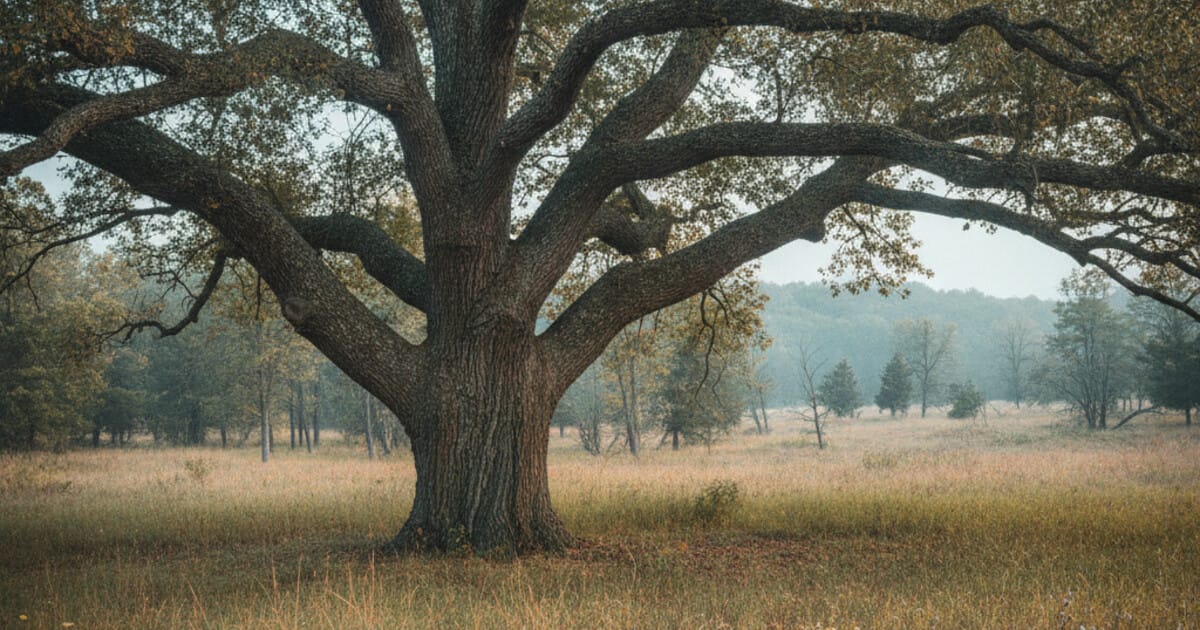
Bur oak might be the most recognizable tree in the American Midwest. Quercus macrocarpa towers over prairie edges and savannas from Texas north to Manitoba and east to Pennsylvania, bringing a physical presence that’s hard to miss: a massive spreading crown, thick furrowed bark built for grassland fires, and acorns so large they look almost out of place.
Bur oak tree identification is one of the easier tasks in the oak family because this tree has two truly diagnostic features no other North American oak shares. Once you know what to look for, you can confirm bur oak at a glance from the acorn cap alone.
Bur oak trees (Quercus macrocarpa) are identified by their lobed leaves with a distinctive narrow waist in the lower half, oversized acorns with a fringed mossy cap covering more than half the nut, and thick deeply furrowed bark. Leaf lobes are rounded with no bristle tips, placing bur oak firmly in the white oak group.
7 Signs That Identify Bur Oak Trees
Bur oak combines several features that, together, make it one of the most distinctive oaks on the continent. Here’s what to check first.
Bur oak (Quercus macrocarpa) is the most fire-resistant oak in North America, a trait shaped by thousands of years of prairie and savanna fires across its native range. It grows from central Texas north through Kansas, Nebraska, and the Dakotas into southern Manitoba, and east through Missouri, Indiana, and southern Michigan to Pennsylvania. Mature trees commonly reach 70-80 feet tall with trunk diameters of 2-3 feet; the largest documented specimens exceed 7 feet in diameter. The bark on mature trunks is 2-4 inches thick, deeply furrowed, and has an almost corky texture that insulates the cambium from heat. Bur oak belongs to the white oak group (Quercus section Quercus), meaning its acorns mature in a single growing season and its leaf lobes are rounded without bristle tips. The name “bur oak” comes from the distinctive fringed edge on the acorn cup, a feature unique among native oaks.
1. Leaves With a Distinctive Waist in the Lower Half
The most recognizable leaf shape in the entire oak family. Bur oak leaves are deeply lobed, but the lobe pattern is asymmetric in a specific way: the lower third to half of the blade narrows dramatically, almost to the midrib, creating a cinched-waist or fiddle-like outline. Above that waist, the leaf expands into 5-7 broad, rounded lobes that spread outward.
This pattern is diagnostic. Red oak and white oak leaves have lobes distributed more evenly along the blade. Pin oak narrows toward the base too, but its lobes are much smaller and bristle-tipped. Bur oak lobes are large, rounded (no bristle tips), and heavily concentrated in the upper half of the leaf.
Leaves run 4-10 inches long with a thick, leathery texture. The upper surface is dark green and somewhat shiny; the underside is paler and sometimes lightly hairy along the veins.
2. Oversized Acorns With a Fringed, Mossy Cap
This is the single most reliable ID clue in the oak family. Bur oak produces the largest acorns of any native North American oak, ranging from 3/4 inch to more than 1.5 inches long. That size alone draws attention.
What makes them truly diagnostic is the cap. On bur oak, the acorn cap covers anywhere from half to nearly the entire nut, and the cap’s edge is fringed with elongated, mossy scales that curl outward. This fringe looks almost fuzzy from a distance. No other North American oak produces a fringed cap like this, which is exactly what gives the tree its name.
Acorns ripen and fall in a single growing season (fall of the year they formed), typical of the white oak group. They’re sweeter and less tannic than red oak acorns, making them a preferred food source for deer, wild turkeys, and squirrels.
3. Thick, Deeply Furrowed, Gray-Brown Bark
Bur oak bark is among the thickest and roughest of any eastern tree. On mature trunks, it’s gray-brown to brownish-gray, deeply furrowed into coarse, blocky ridges with an almost corky texture near the base of old trees.
The thickness is functional: bur oak evolved in fire-maintained savannas and prairies, and this bark insulates the living cambium from heat. Trees can survive low to moderate fires that would kill other hardwoods outright.
Compare it to white oak bark: white oak bark is lighter gray and breaks into smoother, flatter plates. Bur oak bark is darker, rougher, and more deeply cut. On young branches, look for slightly corky, winged ridges, though these are less pronounced than on hackberry branches. Our guide to tree bark identification covers how to use bark as a year-round ID tool.
4. Massive, Wide-Spreading Crown
Open-grown bur oaks develop some of the widest crowns in the temperate deciduous forest. The main branches are stout and often nearly horizontal, giving mature trees a broad, flat-topped or dome-shaped silhouette visible from a long distance in open landscapes.
The trunk is thick relative to the tree’s height. A 60-foot bur oak may carry a trunk 2-3 feet across at chest height, thicker proportionally than most oaks of comparable stature.
In savannas and prairie edges, bur oaks typically grow as isolated specimens with a full, open-grown form. In denser forest settings, they grow taller and narrower, but still show heavy, spreading branches in the upper crown.
5. Prairie and Savanna Habitat
Where you find a bur oak matters for ID as much as what it looks like. It’s the defining tree of the oak savanna, the transition zone between eastern deciduous forest and Great Plains grassland. Most bur oaks grow on sites with a history of periodic fire: open hillsides, prairie remnants, dry south-facing slopes, river bluffs, and floodplain terraces across the Midwest.
A big, solitary oak at the edge of a field, in a remnant savanna in Illinois or Iowa, or on a dry bluff overlooking a river valley is bur oak until proven otherwise.
Bur oak also extends east of the prairie zone, growing on dry rocky ridges in Indiana, Ohio, and Pennsylvania, and on sandy floodplain terraces. In the eastern part of its range, trees tend to be smaller and less isolated than their Great Plains counterparts.
6. Yellow-Brown Fall Color
Bur oak fall foliage isn’t as vivid as red maple or scarlet oak. Leaves turn yellow-brown to golden-brown in October, sometimes with orange tints on individual trees. The color is pleasant but subdued compared to the red oak group.
Like white oak, bur oaks sometimes hold dried brown leaves on younger branches through winter, a phenomenon called marcescence. On small trees in open landscapes, this combination of deeply furrowed bark and clinging russet leaves is a useful cold-season ID clue.
7. Rounded Leaf Lobes With No Bristle Tips
Bur oak belongs to the white oak group, so its leaf lobes end in smooth, rounded tips rather than the pointed, bristle-tipped lobes of red, pin, and scarlet oak. Run your finger along a bur oak lobe and you’ll feel a smooth, blunt edge.
This one check separates bur oak from all red oak group members in about 3 seconds. Combined with the leaf’s distinctive waisted shape, you have a combination specific to bur oak. For a full overview of how the white and red oak groups differ across dozens of species, see our complete oak identification guide.
Bur Oak vs. Other White Oaks: Quick Comparison
Bur oak gets confused most often with its white oak group relatives when acorns aren’t present.
| Feature | Bur Oak | White Oak | Chestnut Oak |
|---|---|---|---|
| Leaf shape | Waisted/fiddle, large lobes above | Even lobes, widest above midpoint | Paddle-shaped, coarsely toothed |
| Lobe tips | Rounded, no bristle | Rounded, no bristle | Rounded teeth, no bristle |
| Acorn cap | Deep, mossy fringe, covers >50% | Shallow, bumpy scales, ~25% | Thick, knobby scales, ~50% |
| Bark | Very thick, deeply furrowed, corky | Light gray, blocky plates | Very thick, deeply ridged, dark |
| Habitat | Savannas, prairie edges, open sites | Upland forests, ridges | Rocky ridges, mountain slopes |
| Range | Central US and Midwest | Eastern US | Appalachians, eastern ridges |
Bur oak’s fringed acorn cap is the clearest separator from chestnut oak and white oak. Neither of those species produces a mossy, fringed cap edge. For how bur oak’s white oak group traits contrast with red oak and its relatives, the red oak guide covers the key differences in leaf, acorn, and bark.
How Tree Identifier Helps With Bur Oak ID
The waisted leaf shape and fringed acorn cap make bur oak fairly easy to confirm in summer and fall. Outside those seasons, or when you’re working from bark or full tree silhouette alone, it gets harder.
Tree Identifier lets you photograph a leaf, bark section, acorn, or full tree and returns a species ID with a confidence score in seconds. The app works offline, so you can use it in remote savannas or prairies without cell service. It accepts multiple input types, which matters when you’re trying to confirm a winter-dormant tree by bark structure alone.
Download Tree Identifier on iOS or Android to put a name to any oak you’re standing in front of. 2 identifications are free every day, no subscription required to start.
Frequently Asked Questions
How do I identify bur oak leaves?
Bur oak leaves are large (4-10 inches) with a distinctive narrow waist in the lower half that almost pinches to the midrib. The upper half expands into 5-7 large, rounded lobes. Lobe tips are smooth and blunt with no bristle points. The waisted or fiddle-shaped outline is unique among oaks and the fastest way to confirm bur oak from a leaf alone.
What do bur oak acorns look like?
Bur oak acorns are the largest of any North American oak, ranging from 3/4 inch to more than 1.5 inches long. The most distinctive feature is the acorn cap, which covers half to nearly the entire nut and has a fringe of elongated, mossy scales curling outward from the cap edge. This fringed cap is unique in the oak family and immediately identifies the tree.
Where does bur oak grow?
Bur oak grows across the central and eastern United States, from central Texas north through the Great Plains to southern Manitoba, and east through Missouri, Indiana, and southern Michigan to Pennsylvania and Virginia. It’s most associated with oak savannas and prairie edges in the Midwest, and with dry rocky ridges in the eastern part of its range.
How big does bur oak get?
Mature bur oaks typically reach 70-80 feet tall with trunk diameters of 2-3 feet. Open-grown specimens develop especially wide crowns, sometimes equal to the tree’s height. The largest documented bur oaks exceed 7 feet in trunk diameter. Bur oak is long-lived; 200-400-year-old trees aren’t unusual, and some specimens have been dated past 500 years.
Is bur oak in the white oak or red oak group?
Bur oak is in the white oak group (Quercus section Quercus), along with white oak, chestnut oak, and swamp white oak. White oak group trees have rounded leaf lobe tips with no bristles and acorns that mature in a single growing season. Red oak group trees have bristle-tipped lobes and acorns that take two years to ripen.
Identify a tree from your photo — free
Upload a leaf, bark, or whole-tree photo and get the species in seconds. No signup.
Confidence:
Unlock the full species profile
Free in the app — with unlimited identifications.


AI result for guidance — the app gives full species details and works offline.
Want unlimited identifications?
Get the full species profile, photos and details — free in the app, with unlimited scans.
- Unlimited identifications
- Full species profiles & details
- Works offline, anywhere
- Save and revisit your finds
Elena Torres
Tree Identifier Team