White Oak Tree Identification: Leaves, Bark & Acorns
Walk into any mature eastern forest and you’ll likely find a white oak within a few hundred feet. Quercus alba covers roughly 72 million acres from Maine to Florida and west to Minnesota and Texas, making it one of the most common trees on the continent. Yet white oak tree identification trips up a lot of people, especially those who confuse it with red oak, pin oak, or its close cousin swamp white oak.
The good news: white oak has a handful of reliable markers that rule out other species quickly. Once you know what to look for, you can spot one from 30 feet away.
White oak trees (Quercus alba) are identified by their rounded leaf lobes with no bristle tips, light gray bark that breaks into blocky plates, and acorns that mature in a single growing season. They grow 60-100 feet tall across eastern North America and belong to the white oak group, which also includes bur oak, chestnut oak, and swamp white oak.
What Does a White Oak Tree Look Like?
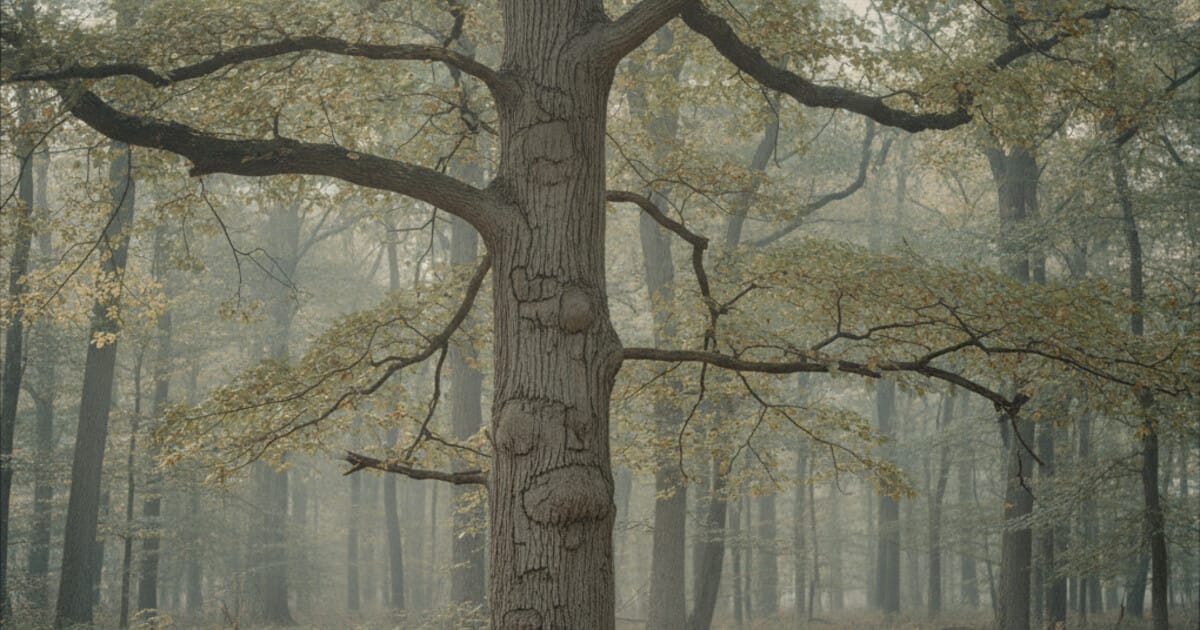
From a distance, a mature white oak is recognizable by three things: pale gray bark, a broad rounded crown, and thick nearly horizontal main limbs. Open-grown trees spread as wide as they are tall, sometimes wider, with a massive trunk and stout limbs that suggest centuries of growth. Forest-grown specimens narrow toward the light, but still carry fewer, heavier branches than nearby oaks or hickories.
In spring, the emerging leaves are a soft reddish-pink before shifting to the signature blue-green of summer. The leaf surface is thick and waxy, which gives white oak canopies a slightly silver cast on bright days. Fall color runs wine red to russet orange-brown, varying by individual tree. On young white oaks and lower branches, dried leaves cling well into winter, rustling against pale gray bark. That winter silhouette (light platy trunk, clinging russet leaves) is one of the most reliable ways to pick white oak out of a leafless forest when other ID clues disappear.
Mature trees typically stand 60-100 feet tall with a trunk that can exceed 4 feet in diameter on old-growth specimens. Some trees in protected woodlands have been documented at 500+ years old.
7 Signs That Identify White Oak Trees
White oak has a combination of leaf, bark, acorn, and growth features that, taken together, are almost unmistakable. Here’s what field botanists check first.
White oak (Quercus alba) is the dominant hardwood across eastern North America, occupying upland ridges, dry slopes, and mixed forests from the Atlantic coast to the Great Plains. A mature specimen can live 500 years or longer and reach 80-100 feet tall with an equally wide canopy spread. The bark is light to medium gray, breaking into irregular plates and scaly blocks, noticeably lighter than the dark, furrowed bark of red oak or black oak. Leaves are 5-9 inches long with 7-9 rounded lobes and no bristle tips; sinuses between lobes run deep in the middle of the blade. Leaves emerge reddish-pink in spring, mature to blue-green, and turn wine red or russet in fall. Young white oaks hold their dried leaves through winter, a trait called marcescence. Acorns mature in a single growing season, unlike red oak acorns, which take two years.
1. Rounded Leaf Lobes With No Bristle Tips
This is the fastest way to separate white oak from the red oak group.
White oak leaves have rounded lobes with no bristle points at the tip. Run your finger along the edge of a lobe, and it’s smooth and blunt. Red oak, pin oak, and scarlet oak all have small hair-like bristles at each lobe tip; you can feel them as a faint prickle.
White oak leaves typically have 7-9 lobes with deep sinuses, especially in the middle of the blade. The lobes near the base are shorter and more subtle. The leaf is widest above its midpoint, giving it a slightly top-heavy silhouette.
2. Light Gray, Blocky Bark
White oak bark is light gray, sometimes nearly silvery, and breaks into irregular rectangular plates or flaky scales. On older trees, these plates can stack into chunky ridges, but the overall color stays noticeably lighter than related oaks.
Compare it to red oak bark: red oak is darker gray to near-black with flat, shiny ridges running vertically. White oak bark looks more weathered and broken up, less streaky. Even on young trees, the pale gray color stands out.
The bark on the upper branches is often smoother and lighter still, which can help distinguish white oak from swamp white oak, whose upper branches peel into distinctive papery flakes.
3. Acorns That Ripen in One Season
White oak belongs to the white oak group, where acorns go from flower to ripe nut in a single growing season. The acorns you see forming in summer drop in the same autumn. Red oak group acorns take two full years to mature, so in fall, a red oak carries both current-year unripe acorns and second-year ripe ones simultaneously.
White oak acorns are 1/2 to 3/4 inch long, oblong, with a thin, warty cap covering roughly the top quarter of the nut. They’re sweeter and less tannic than red oak acorns. Deer, turkeys, and squirrels actively seek them out and will cross a hillside to find white oak mast when it’s available.
4. Shallow Acorn Cap With Bumpy Scales
The acorn cap on white oak is thin and shallow, sitting like a small bowl over just the top portion of the nut. The cap scales are small and bumpy rather than flat or knobby.
This distinguishes it from other white oak relatives. Bur oak has a distinctive fringed cap covering more than half the nut. Chestnut oak has thick, knobby cap scales. Swamp white oak produces acorns in pairs on long stalks, while white oak acorns sit individually on short stems.
Acorn caps on the ground are easy to ID at a glance once you know the pattern: shallow, thin, lightly scaled.
5. Blue-Green Leaves With Pale Undersides
In summer, white oak leaves are a distinctive blue-green on top, cooler in tone than most other oaks. Flip one over and you’ll find a pale, almost whitish underside, sometimes with fine hair tufts where the veins branch.
This coloration comes partly from a thick, waxy leaf surface white oaks build to handle summer heat and drought stress. On a sunny day, a stand of white oaks often looks lighter and more silver-green than the surrounding forest canopy.
6. Wine-Red Fall Color That Lingers Into Winter
White oak fall foliage runs from deep wine red to russet brown to orange-brown, depending on the individual tree and growing conditions. Some specimens rival red maple for autumn color.
What makes white oak distinct in fall and early winter is marcescence: young trees and lower branches hold their dried, papery leaves well after everything else has dropped. You’ll see rustling brown leaves clinging to branches in December and January.
This is genuinely useful for winter ID. Pale gray platy bark plus remnant russet leaves on lower branches points firmly to white oak. Our guide on how to identify trees by their bark covers more winter identification techniques if you’re working without leaves.
7. Broad, Spreading Crown With Stout Limbs
Old-growth white oaks develop enormous crowns, often as wide as the tree is tall or wider. The main limbs are stout and spread nearly horizontally, giving mature trees a broad, rounded silhouette that’s hard to miss in an open field or pasture.
In forest settings, white oaks grow taller and narrower as they compete for light, but they still tend toward a more rounded crown than red oaks. A forest-grown white oak typically shows fewer, thicker branches than a red oak of similar size.
Young white oaks (under 30 years old) have a more upright, irregular form. The signature spreading habit takes several decades to develop fully.
White Oak vs. Red Oak: Key Differences at a Glance
These two species often grow side by side, and they genuinely confuse people. Here’s the comparison:
| Feature | White Oak | Red Oak |
|---|---|---|
| Leaf lobe tips | Rounded, no bristle | Pointed, bristle-tipped |
| Bark color | Light to medium gray | Dark gray to near-black |
| Bark texture | Blocky, platy | Flat, shiny vertical ridges |
| Acorn maturation | 1 season | 2 seasons |
| Acorn cap depth | Shallow, ~25% coverage | Deeper, flat-scaled |
| Acorn taste | Sweeter, less tannic | Bitter, tannic |
| Fall color | Wine red to russet | Dull brick red to brown |
The bristle-tip check on leaves takes about 3 seconds and gives you a reliable answer. If you want to go deeper into the whole oak family, our complete oak identification guide covers the full white oak and red oak groups with field comparisons.
Northern red oak (Quercus rubra) is the specific red oak species most likely to grow alongside white oak across the eastern US and into Canada. It follows all the red oak group rules: bristle-tipped lobes, dark gray to near-black bark with flat shiny ridges, and acorns that take two full years to mature. It can reach 80-90 feet tall, matching white oak in size, but the darker bark and sharper leaf tips make it straightforward to distinguish once you know the pattern. The leaf sinuses on northern red oak are also shallower than white oak’s deep-cut lobes.
How Tree Identifier Helps With White Oak ID
Sometimes the signs aren’t clear-cut in the field. A young tree might have atypical leaf shape. Winter ID from bark alone is trickier. A photo taken from a distance might not show lobe tips clearly.
That’s where Tree Identifier comes in. Take a photo of the leaf, bark, or acorn and the app returns a species ID with a confidence score in seconds. It works offline too, so you can use it on remote hikes without cell service. The app accepts multiple input types: leaves, bark, fruit, or whole tree silhouette. That flexibility matters when you’re trying to distinguish white oak from chestnut oak using bark alone, or sorting a pile of mixed acorns.
Download Tree Identifier on iOS or Android to put a name to the oak you’re standing in front of. Two identifications are free every day with no subscription required to start.
Frequently Asked Questions
How do I tell white oak from red oak?
Check the leaf lobe tips. White oak lobes are rounded with no point. Red oak lobes end in a small bristle tip you can feel with your fingertip. White oak bark is also lighter gray and breaks into blocky, plate-like scales, while red oak bark is darker with flat, shiny ridges running vertically up the trunk.
What do white oak acorns look like?
White oak acorns are 1/2 to 3/4 inch long, oblong, with a thin, warty cap covering about the top quarter of the nut. They’re less bitter than red oak acorns and mature in a single growing season, dropping in the same autumn the tree flowered. Deer and wild turkeys strongly prefer them over red oak mast.
Why does white oak hold its leaves in winter?
Young white oaks and lower branches often hold their dried, brown leaves through winter, a trait called marcescence. The mechanism isn’t fully understood, but it may help protect young growth from browsing deer. For identification purposes, it’s a useful clue: pale gray platy bark plus clinging russet leaves in January points reliably to white oak.
Where does white oak grow?
White oak grows across eastern North America, from southern Maine and Quebec south to northern Florida, and west to Kansas and Minnesota. It prefers upland sites: ridges, dry to mesic slopes, and well-drained soils. It’s less common in bottomlands, where swamp white oak takes over in wetter spots.
Is white oak the same as swamp white oak?
No, though they’re closely related members of the white oak group. Swamp white oak (Quercus bicolor) differs in several ways: its bark peels and flakes prominently on the upper trunk and branches, its leaves are widest near the tip rather than the middle, and its acorns grow in pairs on long stalks. White oak acorns grow individually on short stems.
What does a white oak leaf look like?
White oak leaves are 5-9 inches long with 7-9 rounded lobes and no bristle tips at the ends. They’re widest above the midpoint, giving them a slightly top-heavy silhouette. The upper surface is a distinctive blue-green in summer; the underside is pale and nearly whitish, sometimes with small hair tufts where the veins branch. In fall, leaves turn wine red to russet, and young trees hold dried brown leaves on lower branches through winter.
Identify a tree from your photo — free
Upload a leaf, bark, or whole-tree photo and get the species in seconds. No signup.
Confidence:
Unlock the full species profile
Free in the app — with unlimited identifications.


AI result for guidance — the app gives full species details and works offline.
Want unlimited identifications?
Get the full species profile, photos and details — free in the app, with unlimited scans.
- Unlimited identifications
- Full species profiles & details
- Works offline, anywhere
- Save and revisit your finds
Elena Torres
Tree Identifier Team