How to Identify a Butternut Tree: 7 Reliable Signs
Butternut trees are disappearing from eastern North American forests. A fungal disease called butternut canker has killed an estimated 80% of the native population since the 1960s, leaving scattered survivors along stream banks, hillsides, and valley floors from New Brunswick to Arkansas. When you spot a candidate tree, confirming the identification is worth the effort.
Butternut (Juglans cinerea), also called white walnut, is a medium-sized hardwood in the same genus as black walnut. The two share overlapping ranges and similar compound leaves, and people regularly confuse them in the field. The differences are clear once you know what to check. This guide covers 7 reliable signs for butternut tree identification, from the distinctive oblong nuts to the bark’s orange inner layer.
Butternut trees (Juglans cinerea) are identified by light ash-gray bark with a diamond-ridge pattern, orange inner bark when scratched, oblong nuts 1.5-2.5 inches long with sticky hairy husks, and compound leaves with 11-17 leaflets including a terminal leaflet. These features together distinguish butternut from black walnut and other walnut-family trees in its native range.
Butternut Tree Identification: 7 Key Field Marks
Butternut is a medium-sized deciduous hardwood with a broad, open crown and ascending branches that spread wide as the tree matures. It grows on rich, moist, well-drained soils along stream banks, rocky hillsides, and valley floors throughout its eastern range.
Juglans cinerea is native to the eastern United States and southern Canada, found from New Brunswick west through New England, the Appalachians, and into the Midwest. It prefers rich, moist, well-drained soils on rocky hillsides, stream banks, and valley floors. Mature trees reach 40-60 feet tall with a broad, spreading crown. The bark on mature specimens is light ash-gray with a distinctive interlacing diamond-ridge pattern and flat-topped ridges. When the outer bark is scratched, the exposed inner layer is a characteristic bright orange-tan. The nuts are oblong and pointed (1.5-2.5 inches long), clearly distinguishable from the round nuts of black walnut. Compound leaves carry 11-17 leaflets with a terminal leaflet usually present. Butternut canker, caused by the fungus Sirococcus clavigignenti-juglandacearum, has killed an estimated 80% of butternut trees in parts of its range since the 1960s, making surviving specimens worth documenting.
Here are the 7 field marks that confirm a butternut ID:
1. Ash-gray bark with diamond ridges
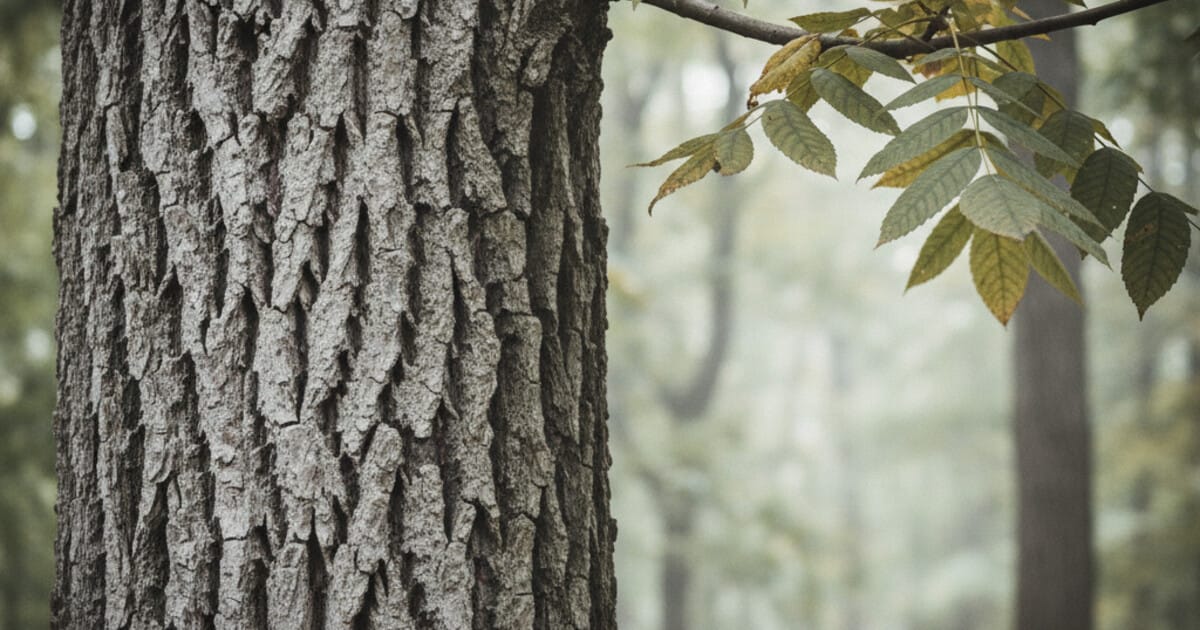
Mature butternut bark is light ash-gray to silver-gray, with wide, flat-topped ridges separated by deep fissures. The ridges form an interlacing diamond pattern on older trunks. The color reads distinctly lighter than black walnut, which carries dark brown to near-black bark with rougher, more irregular furrows.
2. Orange inner bark
Scratch the outer bark with a thumbnail or snap a small twig. The inner layer exposed is a characteristic bright orange-tan to orange-brown. This single test cuts through most field ambiguity. Black walnut’s inner bark is yellow-brown, not orange.
3. Oblong nuts with sticky hairy husks
Butternut nuts are oblong and pointed, 1.5-2.5 inches long. The outer green husk is covered in fine, sticky hairs. Inside sits a hard, deeply ridged shell with an oily, edible nut. Black walnut nuts are round. Once you’ve seen both side by side, the shape difference is unmistakable.
4. Compound leaves with 11-17 leaflets
Butternut leaves are pinnately compound, 15-30 inches long, with 11-17 leaflets arranged along a central stalk. Each leaflet is lance-shaped with finely toothed edges and a slightly hairy surface. A terminal leaflet at the end of the stalk is usually present and is often the largest on the leaf.
5. Hairy twigs with chambered pith
Snap a twig and look at the cut end. The pith (center) is chambered, divided into horizontal sections like a small ladder. This is a walnut-family trait. Butternut’s pith is dark brown, and the twig surface itself is noticeably hairy, unlike the mostly smooth twigs of black walnut.
6. “Monkey face” leaf scars
After leaves drop in fall, the scars on the twig look like a small monkey’s face, with a fringe of hairs along the top edge of the scar. Black walnut leaf scars lack this fringe. It’s a reliable year-round marker and works well from October through spring when leaves are absent.
7. Catkins in early spring
In April and May, before the leaves open, butternut produces long drooping male catkins, 2-4 inches in length. Female flowers are smaller, clustered near branch tips. If you’re in butternut territory in early spring, the catkins flag the species before leaves or nuts are available.
Butternut Bark Identification
Bark is the most accessible feature for butternut tree identification in any season. But it changes with age, which can complicate ID on young trees.
On saplings (under 6 inches in trunk diameter), the bark is smooth and grayish-brown with faint vertical streaks and horizontal lenticels. At this stage it can look similar to young ash or hickory. The scratch test still gives the orange inner bark at any age.
As the tree matures, the bark develops into the characteristic diamond-ridge pattern. On large specimens (12+ inches in diameter), the ridges are wide, flat-topped, and silvery in direct sunlight. The texture looks more ordered and interlocking than the rough, irregular furrows of a mature black walnut. For a broader look at how bark texture varies across species, the tree bark identification guide covers the main patterns: plated, furrowed, shaggy, and smooth.
On diseased trees, the bark shows elongated dark sunken patches called cankers. These are dead zones where the fungus has girdled the cambium layer beneath. A tree with butternut’s basic features but with large black patches running vertically down the trunk or major branches is likely infected. Some infected trees survive for years with partial canopy intact, so don’t discount a candidate based on canker presence alone.
Butternut Leaves and Twigs
Butternut’s compound leaves place it firmly in the walnut family (Juglandaceae), alongside black walnut, hickory, and pecan. But specific details separate it from its relatives.
Check these features on the leaves:
- Leaflet count: 11-17 leaflets (black walnut typically has 15-23)
- Terminal leaflet: Usually present, often the largest (frequently absent in black walnut)
- Texture: Slightly hairy on both surfaces, stickier on the underside from resin glands in summer
- Edges: Finely toothed, without coarse or spreading serration
Compound leaves with hairy leaflets and a consistent terminal leaflet are a reliable mid-season marker. For side-by-side comparison with other walnut-family trees, the hickory tree identification guide covers how hickory leaves and twigs differ from butternuts and walnuts across the full growing season.
Twigs work as a year-round identifier. Butternut twigs are stout, grayish-brown, and covered in fine hairs with a slightly sticky feel in summer. Snap one and look at the pith: it’s chambered and dark brown. The leaf scars carry the fringed top edge that distinguishes butternut from black walnut. Once you know to look for it, it’s fast.
Butternut vs. Black Walnut: Key Differences
Butternut and black walnut are the only 2 native Juglans species in eastern North America, and they overlap through much of the Appalachians, the mid-Atlantic, and the Midwest. Telling them apart matters for foragers and naturalists alike.
| Feature | Butternut | Black Walnut |
|---|---|---|
| Bark color | Light ash-gray | Dark brown to black |
| Inner bark | Orange-tan | Yellow-brown |
| Nut shape | Oblong, pointed | Round |
| Husk texture | Hairy, sticky | Smooth to slightly hairy |
| Terminal leaflet | Usually present | Often absent |
| Twig hairs | Hairy | Mostly smooth |
| Typical height | 40-60 ft | 50-75 ft |
One practical difference for foragers: butternut shells are easier to crack than black walnut, though the kernel is smaller. Butternut kernels have a higher oil content and a slightly sweeter, richer flavor. Both are edible, and both produce a dark stain from the husks that takes weeks to wear off skin.
How Tree Identifier Helps with Butternut ID
Young trees without nuts, or diseased specimens where canker has damaged the bark, can be harder to confirm in the field. A photo-based ID app narrows things down quickly.
Tree Identifier uses AI to analyze photos of bark, leaves, and nuts separately, returning a species match with a confidence score for each input. The multi-input approach is useful for diseased butternuts where intact leaves and developing nuts are still present even if the bark looks compromised.
The app works offline after downloading species data, so it’s useful in remote hillsides and stream valleys where butternuts tend to survive in larger numbers. You get 2 free identifications per day, no subscription required. Available on iOS and Android.
Frequently Asked Questions
How do I tell butternut from black walnut?
The fastest check is the inner bark scratch test. Butternut inner bark is bright orange-tan; black walnut’s is yellow-brown. Nut shape confirms it: butternut nuts are oblong and pointed, black walnut nuts are round. Butternut bark is also noticeably lighter gray compared to the dark brown-to-black of mature black walnut.
Are butternut nuts edible?
Yes. The kernels inside the hard shell are edible, oily, and have a slightly sweet, rich flavor. Extraction takes some effort since the shell is deeply ridged, though easier than black walnut. Butternut kernels are high in unsaturated fats and were an important food source for indigenous peoples across the tree’s native range.
Why are butternut trees endangered?
Butternut canker, caused by the fungus Sirococcus clavigignenti-juglandacearum, has killed an estimated 80% of butternut trees in parts of the US and Canada since the 1960s. The disease spreads through water and wind and creates elongated dark cankers that girdle branches and trunks. There’s no known effective treatment. The species is listed as endangered in Canada.
Where do butternut trees grow?
Butternut is native to eastern North America, from southern New Brunswick and Quebec through New England, the Appalachians south to Georgia, and west through the Midwest to Minnesota and Nebraska. It prefers rich, moist, well-drained soils on stream banks, rocky hillsides, and valley floors. It doesn’t reach western North America.
When do butternuts produce nuts?
Butternut trees start producing nuts at around 20 years of age. Nuts develop through summer and ripen in September and October. The green husks turn brown and begin to split as the nuts fall. Squirrels are the primary dispersers, caching nuts in the ground and often leaving uncollected ones to germinate.
Spot a Butternut, Document It
Butternut is a species worth stopping for. With so many trees gone to canker, each confirmed live specimen matters. If you find a candidate on a hike, Tree Identifier can confirm the ID from a leaf or nut photo in seconds, with results that work offline in remote terrain. Download the app on iOS or Android, and use your first 2 scans free. Visit treeidentifier.app to learn more.
Identify a tree from your photo — free
Upload a leaf, bark, or whole-tree photo and get the species in seconds. No signup.
Confidence:
Unlock the full species profile
Free in the app — with unlimited identifications.


AI result for guidance — the app gives full species details and works offline.
Want unlimited identifications?
Get the full species profile, photos and details — free in the app, with unlimited scans.
- Unlimited identifications
- Full species profiles & details
- Works offline, anywhere
- Save and revisit your finds
Elena Torres
Tree Identifier Team