Chestnut Oak Tree Identification: 7 Reliable Signs
Chestnut oak is the defining tree of rocky Appalachian ridges. Quercus montana grows where other oaks don’t try: shallow soils, steep south-facing slopes, sun-baked ridge crests where frost heaves and thin bedrock over sandstone make most hardwoods give up. It’s the most drought- and rock-tolerant oak in eastern North America, and on those stony ridgelines from Maine to Alabama, it’s often the dominant species by a wide margin.
Chestnut oak tree identification is straightforward once you know the key features. The leaves look like an American chestnut leaf, and the bark is so dark and deeply ridged that once you’ve seen it, you won’t mistake it for any other eastern oak again.
Chestnut oak trees (Quercus montana) are identified by large paddle-shaped leaves with coarsely rounded teeth, very dark and deeply ridged bark, and oval acorns with thick bumpy caps covering roughly half the nut. Leaf teeth are smooth-tipped with no bristles, placing chestnut oak firmly in the white oak group alongside white oak and bur oak.
7 Signs That Identify Chestnut Oak Trees
Chestnut oak has a combination of features that set it apart from every other eastern oak. Here’s what to look for in the field.
Chestnut oak (Quercus montana) is the most abundant tree on dry, rocky ridges throughout the Appalachian Mountains, from southern Maine and Vermont south through the mid-Atlantic states, the Blue Ridge, the Smokies, and into northern Alabama and Georgia. It also grows on rocky outcrops in the Ozarks and on dry upland sites across the eastern Midwest. Mature trees typically reach 60-80 feet tall, with trunks 2-3 feet in diameter on good sites. On the poorest, rockiest ridges they’re often shorter and wider in proportion. The bark is the darkest of any native eastern oak, nearly charcoal-gray to black on old trunks, with deep ridges that can run 1-2 inches in depth. Chestnut oak belongs to the white oak group (Quercus section Quercus), so its acorns ripen in a single growing season and its leaf teeth are rounded with no bristle tips. Historically, its bark fueled the American tanning industry: chestnut oak bark contains 11-14% tannin by dry weight, the highest of any American oak, which drove widespread harvesting across the Appalachians through the early 20th century.
1. Paddle-Shaped Leaves With Coarsely Rounded Teeth
This is the feature that gives chestnut oak its name. The leaves are large (5-9 inches long, 2-4 inches wide), oblong, and shaped roughly like a paddle or spatula: widest somewhere above the midpoint, tapering to a rounded or wedge-shaped base, with a gently wavy outline along both edges.
The leaf margin has 7-16 large, rounded, crenate teeth per side. These teeth are evenly spaced and consistent in size, like a shallow wave running around the leaf margin. They’re broader and more regularly spaced than the jagged, forward-pointing teeth on an actual chestnut leaf, and they’re completely smooth-tipped with no needle-like bristle at the apex.
The leaf surface is thick and somewhat leathery. The upper surface is dark green; the underside is paler, sometimes lightly hairy along the veins. This leaf is fundamentally different from white oak, which has deeply cut finger-like lobes with deep sinuses. Chestnut oak has shallow teeth on an otherwise continuous, unlobed margin.
2. Very Dark, Deeply Ridged Bark
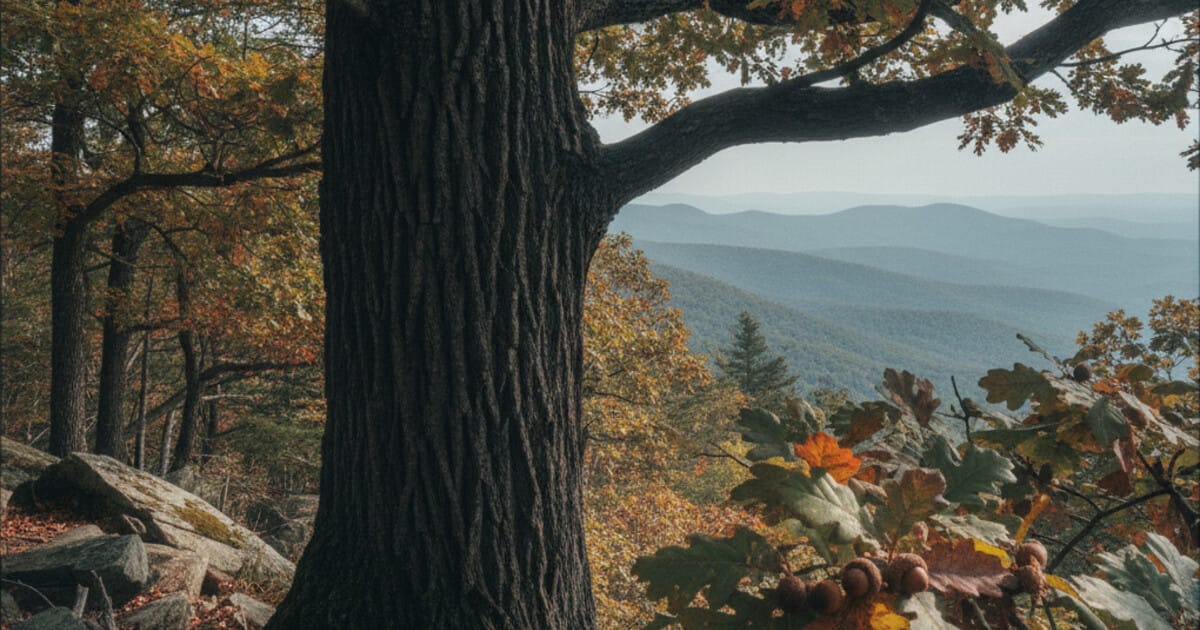
If there’s one field mark that makes chestnut oak unmistakable, it’s the bark. On mature trunks, it’s nearly black (charcoal to very dark gray-brown), with deep, sharp-edged ridges running vertically in long, thick, somewhat angular plates. The ridges are blocky and irregular, not the smooth rounded ridges you’d find on most maples or ashes.
Compare this to its closest relatives. White oak bark is light gray and breaks into flatter, smoother plates. Bur oak bark is dark and coarsely ridged but has a distinctly corky texture at the base of old trees. Red oak bark is medium gray with flat-topped ridges and an orange-red color visible in the inner bark if you scratch the surface.
Chestnut oak bark is darker than all of them. On an old ridgetop specimen, the trunk looks almost burned. Our tree bark identification guide covers how to read bark as a reliable year-round field clue across dozens of species.
3. Oval Acorns With Thick, Knobby Caps
Chestnut oak produces some of the largest acorns of any eastern oak. They’re oval to nearly round, 3/4 to 1.5 inches long, with a shiny, chestnut-brown nut that fits snugly in a deep cup.
The cap is the key mark. It covers roughly 40-50% of the nut and is made up of thick, knobby, somewhat warty scales that give the cap a rough, bumpy texture unlike the thin flat scales of white oak or the mossy fringed cap of bur oak. The cap margin isn’t fringed, but the individual scales are noticeably thicker and more prominent than on any other member of the white oak group.
Chestnut oak acorns are low in tannins relative to other oaks, which makes them a preferred food source. Deer, wild turkeys, black bears, and squirrels target them heavily in fall. On a productive ridge in a good mast year, a single mature chestnut oak can drop thousands of acorns.
4. Rocky Ridge and Mountain Slope Habitat
Where you find a chestnut oak matters as much for ID as what it looks like. This tree grows on sites that other oaks avoid: rocky outcrops, dry south-facing slopes, thin soil over sandstone or quartzite, ridge crests where shallow bedrock is the norm.
In the Appalachians, chestnut oak dominates the driest ridgelines. On those sites, it grows alongside pitch pine, Virginia pine, scarlet oak, and blueberry shrubs. On slightly better soils downslope, it mixes with white oak and red oak. In richer, deeper-soiled coves and hollows, it gives way entirely to red oak and tulip poplar.
A big, dark-barked oak on a rocky ridgetop with thin soil, anywhere in the eastern US? That’s chestnut oak until you can prove otherwise.
5. Stout Trunk and Broad Rounded Crown
Open-grown chestnut oaks develop a broad, somewhat irregular rounded crown with thick, spreading main branches. On rocky ridges with thin soil, they’re often shorter and wider than the same species on better ground, sometimes more shrub-like on the most exposed outcrops.
The trunk is stout relative to the tree’s height. A 60-foot chestnut oak can carry a trunk 2 feet across at chest height, which is thick for an oak of that height on rocky terrain. In denser forest settings, the trunk grows more upright and the crown branches higher, but the overall form stays heavy and spreading in the upper canopy.
The combination of short stature, thick trunk, and broad crown on a rocky ridgetop is a useful whole-tree silhouette clue for chestnut oak.
6. Yellow-Brown Fall Color
Chestnut oak fall foliage isn’t its most dramatic feature. Leaves turn yellow to yellow-brown in October, sometimes with orange tints on individual trees. The color is warm but subdued compared to the vivid scarlet of the red oak group members that share the same ridgelines.
Like other white oak group trees, chestnut oak sometimes holds dried brown leaves on smaller branches through winter (marcescence). On a rocky ridgetop in January, the combination of very dark bark, stout form, and clinging russet leaves is a useful cold-season ID package.
7. Rounded Leaf Teeth With No Bristle Tips
Chestnut oak belongs to the white oak group, so its leaf teeth are smooth and rounded with no needle-like bristle tip at each apex. Run your finger along a leaf edge and you’ll feel a soft, blunt curve at each tooth tip.
This single check separates chestnut oak from all red oak group members (red, scarlet, pin, black oak) in about 3 seconds. Those species all have bristle-tipped leaf lobes that prick your fingertip. Combined with the paddle-shaped leaf outline and coarse, even tooth pattern, you have a combination that points specifically to chestnut oak. For a full breakdown of how the two oak groups differ across dozens of species, see our complete oak identification guide.
Chestnut Oak vs. Similar Species: Quick Comparison
Chestnut oak is confused most often with chinkapin oak and white oak, and sometimes with American chestnut leaves on the ground.
| Feature | Chestnut Oak | White Oak | Chinkapin Oak |
|---|---|---|---|
| Leaf shape | Paddle, coarsely rounded teeth | Deeply lobed, finger-like | Narrower, sharply pointed teeth |
| Leaf teeth | Rounded, 7-16 per side | Rounded lobes, deep cuts | Sharp, forward-pointing, no bristle |
| Bark | Very dark, deeply ridged | Light gray, blocky plates | Gray-brown, scaly or plated |
| Acorn cap | Thick, knobby scales, ~50% | Thin, bumpy scales, ~25% | Thin scales, ~50% |
| Habitat | Rocky ridges, dry slopes | Upland forest, broad range | Rocky uplands, limestone soils |
| Range | Appalachians, eastern US | Eastern US, broad | Eastern and central US |
The clearest separator is bark color. Chestnut oak bark is noticeably darker than white oak or chinkapin oak, especially on mature trunks. Acorn cap texture (thick and knobby vs. thin and flat) also separates them when acorns are present.
How Tree Identifier Helps With Chestnut Oak ID
The leaf and bark combination make chestnut oak fairly easy to confirm in summer. Outside leaf season, bark alone is often enough once you know what to look for.
Tree Identifier lets you photograph a leaf, bark section, acorn, or the full tree and returns a species ID with a confidence score in seconds. It works offline, which is useful on rocky ridges where cell service is unreliable. The app accepts multiple photo types, so you can photograph bark in winter and then cross-check with a leaf in spring.
Download Tree Identifier on iOS or Android to put a name to any oak you find on your next ridge hike. 2 identifications are free every day, no subscription required to get started.
Frequently Asked Questions
What do chestnut oak leaves look like?
Chestnut oak leaves are 5-9 inches long, oblong, and paddle-shaped, with 7-16 large, evenly spaced rounded teeth per side. The teeth look like gentle waves rather than deep cuts. Leaf tips are rounded or blunt. The texture is thick and somewhat leathery. The leaf resembles an American chestnut leaf, but chestnut oak teeth are broader, more rounded, and lack any bristle tip.
How do you tell chestnut oak from white oak?
White oak leaves have deeply cut, finger-like rounded lobes separated by deep sinuses that reach toward the midrib. Chestnut oak leaves have shallow, evenly spaced rounded teeth on an otherwise continuous, unlobed margin. Chestnut oak bark is also much darker, nearly black on mature trunks, while white oak bark is light gray with flatter plates. These two features together make the separation straightforward.
Where does chestnut oak grow?
Chestnut oak grows primarily on rocky ridges, dry slopes, and thin-soiled hillsides throughout the Appalachian Mountains, from southern Maine and Vermont south to northern Alabama and Georgia. It also grows on rocky outcrops in the Ozarks and on dry upland sites across the eastern Midwest. On the driest, rockiest Appalachian ridge crests, it’s often the dominant tree.
What do chestnut oak acorns look like?
Chestnut oak acorns are oval, 3/4 to 1.5 inches long, with a shiny chestnut-brown nut. The cap covers roughly 40-50% of the nut and is made of thick, knobby, somewhat warty scales that give it a rough, bumpy texture. This thick knobby cap is distinctive in the white oak group and separates chestnut oak from white oak (thin flat cap) and bur oak (fringed mossy cap).
Is chestnut oak in the white oak or red oak group?
Chestnut oak is in the white oak group (Quercus section Quercus), alongside white oak, bur oak, and swamp white oak. White oak group oaks have rounded leaf teeth or lobe tips with no bristles, and acorns that ripen in a single growing season. Red oak group members have bristle-tipped lobes and acorns that take two seasons to mature.
Identify a tree from your photo — free
Upload a leaf, bark, or whole-tree photo and get the species in seconds. No signup.
Confidence:
Unlock the full species profile
Free in the app — with unlimited identifications.


AI result for guidance — the app gives full species details and works offline.
Want unlimited identifications?
Get the full species profile, photos and details — free in the app, with unlimited scans.
- Unlimited identifications
- Full species profiles & details
- Works offline, anywhere
- Save and revisit your finds
Elena Torres
Tree Identifier Team