Crabapple Tree Identification: Blossoms, Bark, and Fruit
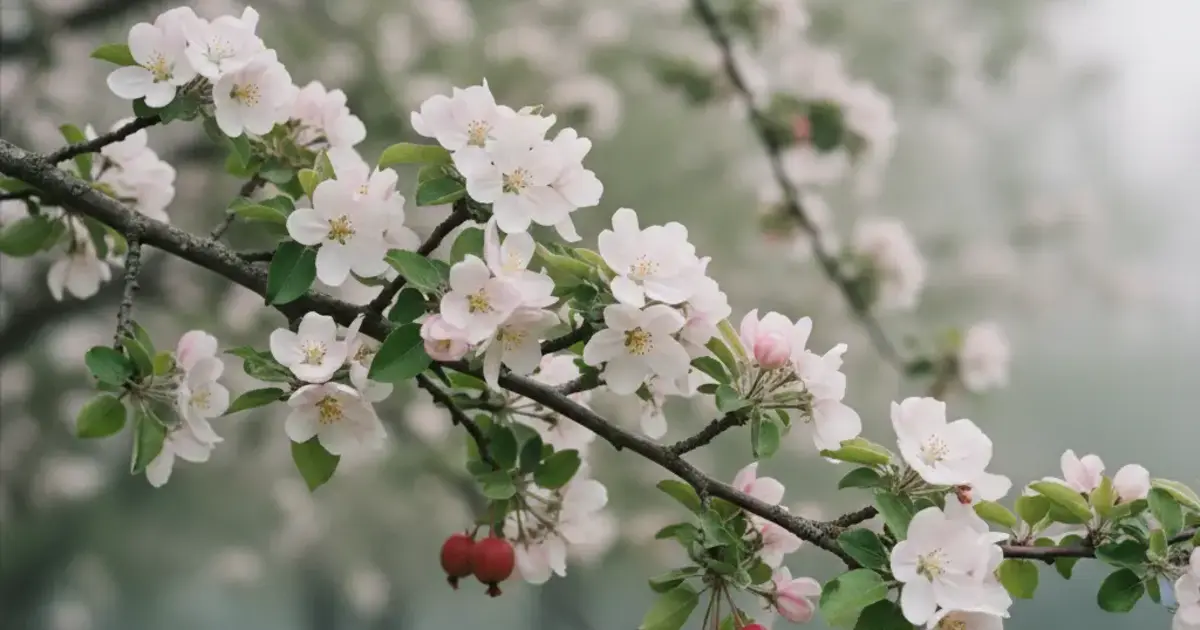
Every spring, neighborhood trees explode in pink and white clouds. Most people assume they’re looking at cherry trees. Many of them aren’t. Crabapple tree identification trips up even experienced gardeners because these two species bloom at the same time, in the same colors, at the same size. This guide walks through how to identify crabapple trees across all four seasons, from the first pink buds in April to the clusters of small fruit still hanging on bare branches in December.
Identify crabapple trees by their small pome fruits (under 2 inches in diameter), 5-petaled spring blossoms in pink to white, oval serrated leaves, and grayish-brown furrowed bark. The fruit that hangs on branches through winter is the most reliable year-round identifier. Unlike cherries, crabapple fruit has an apple-like core with seeds, not a single stone pit.
What Makes a Tree a Crabapple?
The term “crabapple” applies to wild and ornamental trees in the Malus genus that produce small fruits, typically 2 inches in diameter or less. Cultivated apple trees (Malus domestica) are in the same genus but were selected for large, sweet fruit. Crabapples weren’t, so they stayed small and tart.
There are about 35 wild Malus species worldwide, plus hundreds of ornamental cultivars bred specifically for flowers, foliage color, or disease resistance. In North America alone, you might encounter Japanese flowering crabapple (M. floribunda), the native sweet crabapple (M. coronaria), and dozens of hybrid cultivars like ‘Prairifire’ or ‘Snowdrift.’
Crabapples occupy a broad ecological and horticultural niche. They’re small enough for residential yards (most top out at 15-25 feet), they tolerate a wide range of soil conditions, and they feed birds through winter when other food sources are scarce. Over 40 species of birds feed on crabapple fruit, which is part of why so many wildlife gardeners plant them. Identifying crabapple correctly matters whether you’re choosing a tree for your yard, trying to name the flowering tree at the end of your street, or figuring out if the fruit on a trail is edible.
Identifying Crabapple Blossoms in Spring
Spring is when crabapple identification is easiest, and most spectacular. Blossoms appear from late March through mid-May depending on your region, typically opening first in the South and moving north as temperatures rise.
Look for these features in the flowers:
- 5 petals per flower, rounded at the tip
- Pink buds that often open to lighter pink or white
- Flowers that emerge at the same time as the first leaves unfurl
- Clusters of individual blooms, each on its own slender stem
The color range varies considerably across species and cultivars. Some trees bloom pure white. Others hold deep rose-pink even when fully open. ‘Prairifire’ crabapple blooms in a rich pink-red. Japanese flowering crabapple (M. floribunda) opens from bright pink buds to white flowers in just a few days, creating a two-tone effect on a single tree.
The most common spring confusion is crabapple versus cherry. Two features help sort them out. First, look at the petal tip: cherry petals have a small notch at the tip, while crabapple petals are smoothly rounded. Second, watch the timing. Cherry blossoms tend to open before the leaves emerge. Crabapple flowers come in alongside the first leaves. If you see flowers mixed with green buds starting to unfurl, that’s a strong crabapple indicator. Our guide to flowering tree identification covers the full range of spring-blooming species.
Leaves and Bark: Year-Round Identification
Once the flowers drop in late spring, leaves take over as the main identification feature.
Crabapple leaves are oval to elliptic, 2-4 inches long, with serrated or finely toothed margins. They attach alternately along the stem. The leaf surface is smooth to slightly hairy on some species.
Some cultivars were selected for colorful foliage. ‘Prairifire’ holds reddish-purple leaves through much of the growing season before settling to a bronze-green in summer. If you’re looking at a tree with purplish leaves and haven’t seen it flower yet, that’s worth noting.
Bark on mature crabapple trunks is grayish-brown, with irregular furrows and scaly ridges developing with age. Young branches are smooth and often carry a slight reddish-brown tint. Older specimens have more pronounced texture and can look rough in patches.
One detail useful for field ID: crabapple branches sometimes develop short, stubby spurs that look almost like thorns but aren’t sharp. Wild species can occasionally develop true thorns. Most ornamental cultivars sold at nurseries are thornless.
What crabapple bark does not have: the horizontal lenticels that run around cherry tree trunks. If you see smooth bark with thin horizontal lines wrapping partway around the trunk, that’s a cherry. Crabapple lacks this feature, which makes it one of the fastest bark-based ways to separate the two species.
Crabapple Fruit: The Most Reliable Identifier
If you want one feature that definitively pins down crabapple identification, it’s the fruit.
Crabapple fruit is a pome, the same structure as a full-sized apple. Slice one open and you’ll see a five-chambered seed core surrounded by fleshy tissue. The fruit is typically 0.25 to 2 inches in diameter, roughly spherical, and hangs from the branch on a slender stem.
Fruit colors vary by species and cultivar:
- Bright red (most common on ornamental varieties)
- Orange-red to orange-yellow
- Yellow-green on some species
- Deep maroon to near-purple on select cultivars
The fruit ripens from August through October and often stays on branches well into winter, sometimes lasting until March or April. This persistence through winter is one reason wildlife gardeners plant crabapples. When most other food sources are gone, those frost-exposed fruits provide critical calories for waxwings, robins, and bluebirds.
If you pick a fruit and see a core with seeds rather than a single pit, that confirms a pome fruit tree. That single observation rules out cherry, plum, or any other stone fruit. Combined with leaf shape and flower characteristics, pome structure makes for a confident identification. For comparison with similar fruiting trees, see our fruit tree identification guide.
Common Crabapple Species to Know
Japanese flowering crabapple (Malus floribunda) — Probably the most widely planted ornamental crabapple. Pink buds open to white flowers. Small red and yellow fruit. Dense, arching canopy. Reaches 15-25 feet.
Sweet crabapple (Malus coronaria) — Native to eastern North America. Pale pink to white flowers with a rose fragrance. Larger fruit than most ornamentals, up to 1.5 inches. One of the few crabapple species with genuinely scented blossoms.
Prairie crabapple (Malus ioensis) — Native to the Midwest. Large, fragrant pale pink flowers. Blooms later in spring than most species. A double-flowered cultivar called ‘Plena’ (Bechtel crabapple) is widely planted in parks and residential yards.
‘Prairifire’ crabapple — A popular disease-resistant hybrid. Deep pink-red flowers, reddish-purple new foliage that fades to bronze-green, small dark red fruit that holds through winter. One of the most commonly sold cultivars at nurseries.
‘Snowdrift’ crabapple — Pure white flowers from pink buds, orange-red fruit that persists well into winter. Compact and dense. Often used as a street or lawn specimen tree.
Crabapple vs Cherry: Side-by-Side Comparison
These two confuse more people than almost any other spring-blooming pair. Both produce small fruits, both have pink to white flowers in spring, and both are common in parks and yards.
| Feature | Crabapple | Cherry |
|---|---|---|
| Petal tip | Rounded | Notched |
| Bloom timing | Flowers emerge with leaves | Often before leaves |
| Fruit structure | Pome (apple-like core) | Drupe (single stone pit) |
| Bark texture | Furrowed, grayish-brown | Smooth, reddish-brown |
| Horizontal lenticels | Absent | Prominent |
Cherry bark is the fastest tell when you can see the trunk. The horizontal lenticels that wrap around cherry trunks are distinct enough that once you’ve spotted them on one tree, you’ll recognize them everywhere. Crabapple bark is rougher and more furrowed with no lenticels. For more on cherry species and bark patterns, see our cherry tree identification guide.
How Tree Identifier Helps With Crabapple ID
Crabapple identification is one of the cases where a photo works especially well. The distinguishing features are visual: rounded petals, pome fruit, furrowed bark without lenticels. A clear photo of any one of these goes a long way.
The Tree Identifier app handles crabapple ID from multiple photo types. Take a photo of the open flowers in spring, the fruit in fall, the leaf in summer, or the bark year-round. The app analyzes the image and returns the species with details about characteristics, habitat, and uses.
It also works offline. If you encounter a wild crabapple on a remote trail without cell service, you can still get a result as long as you’ve downloaded the species data beforehand.
You get 2 free identifications per day. Download Tree Identifier on iOS or Android to put a name to any tree you come across.
Frequently Asked Questions
Are crabapples edible? Technically yes. Crabapples are the same genus as edible apples and contain no toxic compounds. Most varieties taste extremely tart and astringent when eaten raw, which is why few people eat them straight off the tree. They work well in jelly, cider, and preserves where their high pectin content and tartness are assets.
What’s the difference between a crabapple and a regular apple? Fruit size is the main distinction. Apples were selectively bred over centuries for large, sweet fruit. Crabapples are wild or ornamental Malus species with small fruit under 2 inches. Both are in the same genus. The biology is essentially the same, and a seedling apple tree bearing small fruit could technically be classified as a crabapple.
When do crabapple trees bloom? Most crabapples bloom from late March through mid-May in North America. Earlier cultivars like M. floribunda can open in March in warmer zones. Later bloomers like prairie crabapple (M. ioensis) often don’t peak until late April or May. The timing shifts by 2-4 weeks between the Deep South and northern states.
How big do crabapple trees get? Most ornamental cultivars reach 15-25 feet tall with a similar spread. Weeping cultivars tend to stay shorter and spread wider. Even larger crabapples are still considered small trees, which is a key reason they’re popular for residential yards, street planting, and small gardens.
How do I know if a crabapple tree is healthy? Dense bloom in spring and good leaf coverage through summer are both positive signs. Persistent fruit through winter is normal behavior. Watch for bark wounds, thinning leaf coverage, or branches that die back with no obvious cause. Our guide on how to tell if a tree is dying covers the specific warning signs to look for across all tree species.
Conclusion
Crabapple trees are easier to identify than most people think once you know the features. Rounded petals (not notched), small pome fruit with an apple-like core, alternate serrated leaves, and grayish furrowed bark without horizontal lenticels. The persistent fruit clusters hanging through winter are the most distinctive single feature. Spot those in January on a bare tree and you’ve almost certainly got a crabapple.
If you’ve got an unidentified tree in your yard or on a trail, Tree Identifier can confirm it from a photo. It handles flowers, fruit, leaves, and bark, and works offline for remote locations. Start with your 2 free daily IDs at treeidentifier.app.
Identify a tree from your photo — free
Upload a leaf, bark, or whole-tree photo and get the species in seconds. No signup.
Confidence:
Unlock the full species profile
Free in the app — with unlimited identifications.


AI result for guidance — the app gives full species details and works offline.
Want unlimited identifications?
Get the full species profile, photos and details — free in the app, with unlimited scans.
- Unlimited identifications
- Full species profiles & details
- Works offline, anywhere
- Save and revisit your finds
Elena Torres
Tree Identifier Team