Trees With Long Seed Pods: 6 Species Identified
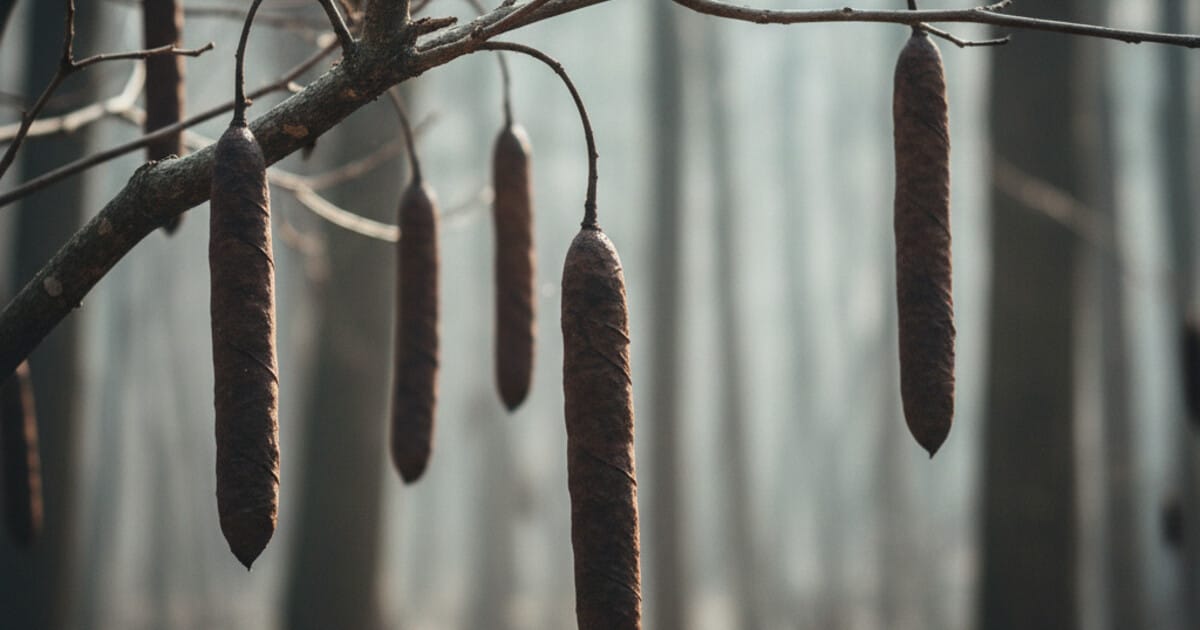
You find a tree covered in what look like giant green beans or brown cigars. Some are scattered across the sidewalk. Some still dangle from bare winter branches weeks after the leaves dropped. Trees with long seed pods are some of the most distinctive you’ll encounter — once you know what to look for, you can ID them from 30 feet away.
This guide covers the 6 most common trees with long seed pods in North America, with the specific clues you need to tell them apart in the field.
Trees with long seed pods include catalpa, honey locust, Kentucky coffeetree, black locust, mimosa (silk tree), and Eastern redbud. Catalpa produces cigar-shaped pods up to 20 inches long, the most distinctive of any North American tree. Honey locust pods reach 18 inches and lie flat with a slight twist. The remaining four species have shorter, flat pods under 6 inches that need leaf or bark clues to confirm.
Standing in front of one? Identify it from a photo in seconds — free, no sign-up needed.
What Trees Have Long Seed Pods?
North America has 6 trees commonly identified by their long, prominent seed pods: catalpa, honey locust, Kentucky coffeetree, black locust, mimosa (silk tree), and Eastern redbud. These trees span four botanical families but share one practical clue: dangling pods that stay visible long after leaves drop. Catalpa pods are the most striking, reaching up to 20 inches and remaining on branches through winter. Honey locust pods average 12 to 18 inches, lie flat, and twist as they dry. Kentucky coffeetree produces thick, leathery pods 5 to 10 inches long that look more like a flattened bean bag than a typical pod. Black locust, mimosa, and redbud all have shorter pods under 6 inches, distinguished by leaf and bark patterns rather than pod size alone. Pod identification works best combined with at least one other feature from the same tree: leaf shape, bark texture, or growth form.
Here’s the quick comparison before diving into each species:
| Tree | Pod length | Pod shape | When pods are visible |
|---|---|---|---|
| Catalpa | 8–20 inches | Round/cigar-shaped | Fall through winter |
| Honey Locust | 12–18 inches | Flat, twisted, glossy | Fall |
| Kentucky Coffeetree | 5–10 inches | Thick, leathery | Fall through winter |
| Black Locust | 2–4 inches | Flat, dark brown | Fall through early winter |
| Mimosa (Silk Tree) | 4–6 inches | Flat, papery, tan | Late summer through fall |
| Redbud | 2–4 inches | Flat, papery | Late summer through winter |
6 Trees Identified by Their Long Seed Pods
1. Catalpa (Northern and Southern Catalpa)
Catalpa is the tree people most often call the “cigar tree” or “bean tree.” Its pods are the longest of any tree in this guide: typically 8 to 20 inches, slender, and round in cross-section like a thick string bean or a skinny rolling pin.
The pods turn dark brown in fall and hang from branches through most of winter. When they finally dry and split, they release flat, papery seeds with fringed edges that scatter on the wind.
How to confirm it’s a catalpa:
- Leaves are enormous: 6 to 12 inches across, heart-shaped, with a pointed tip
- Leaves attach in whorls of 3 at each node (three leaves per point on the stem, which is unusual for a broadleaf)
- White flowers with purple and yellow spots appear in late spring, before pods form
- Bark is grayish-brown with flat, irregular ridges on older trees
Two species are common: Northern Catalpa (Catalpa speciosa) and Southern Catalpa (Catalpa bignonioides). Northern has slightly larger pods and grows throughout the Midwest and East. Southern Catalpa is more common in the Southeast and has a bushier form. Their pods look nearly identical. Both are widely planted in parks and yards.
For more ID details on this species, see the article on Catalpa Tree Identification: Giant Leaves, Flowers, and Bean Pods.
2. Honey Locust
Honey locust pods are flat, strap-shaped, and reach 12 to 18 inches on mature trees. They’re glossy reddish-brown and twist slightly as they dry. Unlike catalpa pods, they’re wide and flat — more like a thick ribbon than a cigar.
One dead giveaway: honey locust bark has clusters of large branching thorns, sometimes 3 to 4 inches long. They grow in groups directly from the trunk and main branches. Some cultivated landscaping varieties are thorn-free, but wild trees almost always carry them.
Key features:
- Compound leaves with 20 to 30 small oval leaflets, feathery and light-looking
- Pods are sweet-smelling inside when fresh; deer and other wildlife eat the pulp
- Bark is grayish-brown with long, flat ridges and thorn clusters
- Pods fall from October onward and pile up in quantities under the canopy
For a detailed side-by-side comparison of both locust species, see Locust Tree Identification: Honey Locust vs Black Locust.
3. Kentucky Coffeetree
Kentucky coffeetree produces some of the most unusual pods of any native North American tree. They’re thick, leathery, and reddish-brown: 5 to 10 inches long, with a chunky profile that looks more like a deflated rubber pouch than a classic flat pod.
The pods persist well into winter, sometimes still hanging in January after nearly everything else has dropped. They contain large, round seeds that early settlers roasted as a coffee substitute. The seeds contain cytisine, a toxic alkaloid, so don’t eat them raw.
How to identify it:
- Largest compound leaves of any native eastern tree: can reach 3 feet long with dozens of small blue-green leaflets
- Leaflets are opposite in pairs and fall individually in autumn, leaving the leaf stem behind
- Bark is dark gray, deeply ridged, and almost scaly on older trees
- A large, spreading tree most often found in floodplain forests and parks
Kentucky coffeetree is uncommon in the wild but planted fairly often in parks and urban settings. The chunky pods, blue-green foliage, and scaly bark make it identifiable across all four seasons.
4. Black Locust
Black locust pods are the smallest on this list: 2 to 4 inches, flat, and dark brown at maturity. They’re not long by the standards of catalpa or honey locust, but they appear in dense clusters and persist through winter, so they’re hard to miss.
Separating black locust from honey locust comes down to two things. First, pod length: black locust pods max out at about 4 inches, well under the 12-inch minimum you’d expect from a honey locust. Second, thorns: black locust has small paired thorns at leaf nodes, not the large multi-branching thorn clusters that grow from honey locust trunks.
The tree produces dense, drooping clusters of white, fragrant flowers in spring: one of the most recognizable blooms in the eastern US. Black locust is invasive in many regions and spreads fast in disturbed ground along roadsides and forest edges.
5. Mimosa (Silk Tree)
Mimosa (Albizia julibrissin), also called silk tree, has flat, papery pods 4 to 6 inches long. They’re light tan, narrow, and slightly constricted between each seed — almost like a string of small bumps pressed under thin paper. They hang in clusters and rattle in the wind as they dry.
The tree is hard to miss in summer: feathery, fern-like compound leaves (even more delicate than honey locust) and fluffy pink flowers that look like powder puffs from late June through August.
Mimosa is invasive throughout the southeastern US and spreading northward. It grows fast on poor soil and colonizes roadsides, forest margins, and abandoned lots. The pods persist through fall and into early winter.
6. Redbud
Redbud pods are on the short end of this list: 2 to 4 inches, flat, and papery. In summer they’re bright pink-red, which makes them surprisingly visible against green foliage. By fall they dry to a tan-brown and hang in clusters through winter, sometimes still attached the following spring.
The tree that produces them is one of the most distinctive in spring. Eastern Redbud (Cercis canadensis) covers its bare branches with tiny magenta-pink flowers before any leaves appear, usually in March or April depending on latitude. It’s a woodland understory tree common throughout the East and Midwest.
What to look for:
- Heart-shaped leaves, 3 to 5 inches across, with a blunt or pointed tip
- Pods hang in dangling clusters from branches and sometimes directly from the trunk
- Bark is dark brown with flat, scaly ridges
- Smaller tree than the others: usually 20 to 35 feet tall, sometimes multi-trunked
For a full field guide to this species, see Redbud Tree Identification: Heart-Shaped Leaves and Pink Blooms.
How to Tell These Trees Apart at a Glance
When you find a mystery pod on the ground, narrow it down in three steps:
Step 1: Check the pod shape. Round and cylindrical? Catalpa. Flat? Continue.
Step 2: Check the length. Over 10 inches? Honey locust. Under 6 inches? Redbud, black locust, mimosa, or Kentucky coffeetree (those are chunkier and feel almost rigid).
Step 3: Look at the bark or any nearby leaves. Large thorns on the trunk? Honey locust. Small paired thorns at branch nodes? Black locust. Massive heart-shaped leaves on the ground? Catalpa or redbud (redbud leaves are smaller). Blue-green feathery leaflets? Kentucky coffeetree. Fluffy pink flower remnants? Mimosa.
For a broader look at how pods fit into tree ID, see Tree Seed Pod Identification: A Visual Guide by Type.
How to Identify a Tree With Long Seed Pods Using an App
Sometimes you’ve got a pod, some bark, and nothing else. That’s where a photo ID app earns its keep. The Tree Identifier app reads photos of pods, leaves, bark, or whole-tree silhouettes and returns an identification with confidence scores. It covers all 6 species in this guide, including tricky cases like catalpa vs. Kentucky coffeetree.
The app works offline: download species data before your hike and it’ll run without cell service. You get 2 free identifications per day with no subscription required. Available for iOS and Android.
Frequently Asked Questions
What tree has long brown pods that look like cigars? That’s almost certainly a catalpa. Catalpa trees produce round, cigar-shaped pods 8 to 20 inches long. They turn dark brown in fall and often stay on bare branches through winter. The leaves are large, heart-shaped, and up to 12 inches across.
What is the tree with flat, long seed pods? Honey locust has the longest flat pods: 12 to 18 inches, glossy brown, and slightly twisted. Black locust produces shorter flat pods (2 to 4 inches). Redbud and mimosa also have flat pods under 6 inches, distinguished by their leaf shapes and growth habits.
Are seed pods from these trees poisonous? Kentucky coffeetree seeds contain cytisine, a toxic compound — don’t eat them raw. Honey locust pods have a sweet pulp that’s safe for wildlife but the seeds aren’t edible. Catalpa pods aren’t edible. Redbud and mimosa pods aren’t considered toxic but aren’t food either.
What time of year do trees drop their seed pods? Most pods mature between September and November. Catalpa and Kentucky coffeetree pods persist well into winter. Redbud pods sometimes remain into spring. Black locust and mimosa pods typically fall by early winter.
Can you identify a tree from just a seed pod? Often yes, especially for distinctive pods like catalpa’s cigars or honey locust’s long flat ribbons. For shorter pods like black locust, redbud, and mimosa, you’ll usually need a second clue: a nearby leaf, the bark texture, or a flower remnant to confirm the species.
Conclusion
Catalpa’s cigar pods are in a category of their own at 20 inches. Honey locust has the longest flat pods. Kentucky coffeetree has the chunkiest ones. Redbud, black locust, and mimosa all produce shorter flat pods that need a second clue to tell apart.
If you’re standing under a tree covered in pods and still not sure, the Tree Identifier app can ID it from a photo of the pod, leaf, or bark. Download it before your next walk and you won’t have to guess.
Elena Torres
Tree Identifier Team