Larch Tree Identification: 7 Reliable Signs
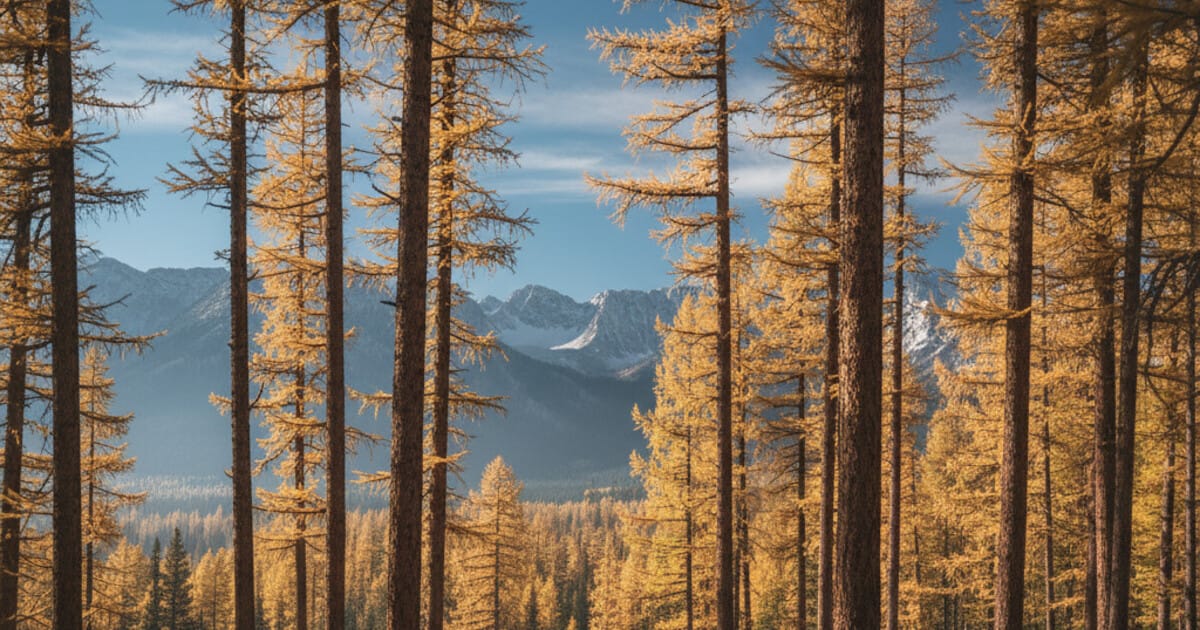
October in a northern forest. Everything around you is green, but one conifer is blazing gold from crown to trunk, every needle catching the low afternoon light. You walk closer and check the branch: short needles, not leaves. It looks like a spruce, except it’s turning yellow and starting to shed.
That’s a larch. And the autumn color is the strongest field clue it has.
Larch trees (genus Larix) are the only common deciduous conifers native to North America. They grow new needles every spring, carry them green through summer, turn gold in fall, and drop every needle before winter. Three species grow across the continent, each tied to a specific habitat. Once you understand how larch works, the ID clicks in any season.
Larch trees are the only common deciduous conifers in North America. Their needles grow in clusters of 10–40 on short spur shoots, turn brilliant gold in October, and drop each fall. North American species include tamarack (Larix laricina) in northern bogs and western larch (Larix occidentalis) on Rocky Mountain slopes. Small woody cones persist on branches year-round.
What Makes Larch Identification Unique
Most people learn early that conifers are evergreen. Larch breaks that rule entirely. It grows fresh green needles every spring, carries them through the season, turns gold in September and October, then drops every one before winter. From November through March, a larch stands completely bare.
That bare-winter silhouette trips people up. A hiker in January might walk past a standing grove and assume dead trees. Foresters sometimes call larch “the conifer that acts like a hardwood.”
The deciduous habit is the single most useful clue in autumn and winter. In spring and summer, you need a few more details.
Here are all 7 signs:
- Deciduous needles: turn gold in fall, drop before winter, return green each spring
- Needles in tufts of 10–40 on short woody spur shoots on older wood
- Single needles on new-growth shoots at branch tips
- Short, soft needles: 1–1.5 inches long, bright green, with two pale lines on the underside
- Small, upright cones: 0.75–2 inches, woody, often persisting on branches for years
- Scaly bark on mature trees: gray-brown on tamarack, reddish-brown on western larch
- Habitat: tamarack in cold boggy lowlands; western larch on open mountain slopes
Tamarack vs. Western Larch: North America’s Two Main Species
North America has three native larch species, but two are the ones most hikers encounter.
Tamarack (Larix laricina) covers the eastern and northern half of the continent. Its range runs from Newfoundland to Alaska across Canada, dipping into the northern United States from New England through Minnesota. Tamarack is a bog specialist. It grows in cold, wet, acidic soils where almost nothing else competes: sphagnum bog margins, pond edges, and open black spruce stands.
Mature tamarack reaches 30–60 feet with a straight, slender trunk and a narrow pointed crown. The bark is thin and scaly, gray-brown with a faint pinkish tinge. Cones are small (0.5–0.75 inches), rounded, with 10–20 scales. No bracts stick out past the scales. They turn reddish-purple when fresh, then age to gray-brown, staying on the tree for 2–3 years.
Western larch (Larix occidentalis) grows in the Pacific Northwest and Northern Rockies, from southern British Columbia into Washington, Oregon, Idaho, and Montana, typically at 2,000–7,000 feet elevation. It’s a much bigger tree.
Western larch (Larix occidentalis) reaches 100–180 feet tall with trunk diameters of 2–4 feet at breast height, making it one of the largest conifers in the interior West. It grows on well-drained slopes between 2,000–7,000 feet elevation across the Northern Rockies and Pacific Northwest. The bark is thick (4–6 inches on old trees) and reddish-brown, providing strong insulation against low-intensity fires: western larch is among the most fire-resistant conifers in its range. After a fire clears a slope, western larch seedlings establish quickly in full sun, outpacing shade-tolerant competitors like Engelmann spruce and subalpine fir. Old-growth stands in Idaho and Montana have been measured at 30,000–75,000 board feet per acre. Cones are 1–2 inches long with bracts that stick out past the cone scales, giving them a bristly look unlike any other native larch. That protruding bract is a reliable field mark. The wood is dense, straight-grained, and rot-resistant, and western larch lumber appears in structural applications across the western United States.
The third native species, subalpine larch (Larix lyallii), grows above treeline in the high Cascades and Northern Rockies, above 6,000 feet. It’s a stunted, gnarled tree shaped by wind and snow. The woolly texture on its new growth distinguishes it from the other two species if you’re in the alpine zone.
Larch Identification by Season
Larch looks completely different depending on when you find it. Most ID guides assume a leafed-out specimen, but larch shifts so dramatically through the year that knowing each season helps.
Spring (April–May): The needles emerge as small bright green tufts on the spur shoots. New growth at branch tips is a lighter yellow-green. Bark and cone shape are most visible before the needles fill in. Pollen cones and small female conelets appear early in the season on the same tree.
Summer (June–September): Full needle coverage. At a quick glance the tree looks like a standard conifer, though the needle clusters on spur shoots set it apart if you look closely. Press your palm against a branch: spruce needles jab; larch needles are soft and don’t.
Fall (September–October): The gold turn. A yellow conifer eliminates nearly every other species. The transition happens fast, often within 2–3 weeks. Tamarack in a sphagnum bog turns gold while the surrounding black spruce stays dark green, making the contrast vivid from a distance.
Winter (November–March): Bare branches with small cones attached. Cones are woody, upright, and persistent. The silhouette is angular and spare, completely unlike a rounded spruce crown. Bald cypress is the only other native North American conifer that also drops its needles in winter, and its range (Southeast wetlands) barely overlaps with larch.
Larch vs. Spruce, Fir, and Other Conifers
In summer, the needle arrangement is the key to separating larch from similar-looking conifers.
Larch vs. spruce. Spruce needles attach one by one directly to the branch on small raised pegs. Larch needles cluster in tufts of 10–40 on short spur shoots. The new-growth shoots at branch tips tell the story: spruce needles spiral densely around the entire shoot from base to tip. Larch new growth carries single needles, but the spur shoots behind them show the clusters clearly. Our spruce tree identification guide covers the spruce-specific details.
Larch vs. fir. True firs attach their needles directly and leave a flat, circular scar when they fall. Fir cones stand upright but disintegrate on the tree, leaving the central spike attached. Larch cones also stand upright, but they stay intact and fall as a complete unit. Fir needles grow in flat horizontal sprays; larch needles cluster on spur shoots. See the fir tree identification guide for the full comparison.
Larch vs. tamarack in winter. If you’re in the eastern half of North America and you find a bare conifer in January, it’s almost certainly tamarack. No other common eastern needle-bearing tree drops its needles voluntarily. The small woody cones clinging to the branches confirm it.
In fall and winter, the decision tree is short: a yellow or bare-needled conifer in North America is larch or bald cypress. Bald cypress grows in standing water in the Southeast and has flat feathery sprays rather than needle clusters, so the habitat and foliage arrangement keep them easy to separate once you know both.
How Tree Identifier Helps
Larch trips people up in two situations: summer (looks like a generic conifer) and winter (looks like a standing dead tree). Knowing the 7 signs above handles both.
If you’re still uncertain, Tree Identifier does the comparison work. Snap a photo of the needle clusters on a spur shoot, a close-up of the cone, or the bark texture. The app matches against thousands of species, including all three native North American larches, returns a confidence-scored result, and shows similar lookalikes so you can rule them out.
The offline mode matters here. Tamarack bogs and western larch mountain slopes are often outside cell service. Download the species data before the hike and the app works anywhere. Start with 2 free daily identifications and try it on your next outing. Download Tree Identifier for iOS or Android.
Frequently Asked Questions
Is larch an evergreen tree? Larch is a deciduous conifer, one of the very few in North America. It grows needles each spring, turns brilliant gold in fall, and drops every needle before winter. From November through March the tree stands bare. This surprises hikers who assume all needle-bearing trees keep their foliage year-round.
How do I identify a larch in summer? In summer, look at the needle arrangement. Larch needles grow in clusters of 10–40 on short stubby spur shoots along older branches. New growth at branch tips carries single needles. Press a branch with your palm: larch needles are soft and flexible, unlike the stiff prickly needles of spruce. Small, upright woody cones often persist on the branches through the growing season.
What’s the difference between tamarack and western larch? Tamarack (Larix laricina) is the eastern and northern species, growing in bogs and wet lowlands from New England to Alaska, reaching 30–60 feet tall. Western larch (Larix occidentalis) grows on mountain slopes in the Pacific Northwest and Northern Rockies and is much larger, reaching 100–180 feet. Western larch cones have bracts that stick out past the scales; tamarack cones are smaller and rounded with no protruding bracts.
Why do larch needles turn yellow in fall? Larch turns yellow for the same reason deciduous hardwoods do: the tree pulls chlorophyll back from its needles before dropping them, revealing the yellow carotenoid pigments underneath. The deciduous strategy avoids the metabolic cost of keeping needles alive through harsh northern winters. It’s an adaptation that works well in the cold, wet, short-season environments tamarack inhabits.
Can you identify larch in winter? Yes, and winter is actually one of the easier times. A bare-branched conifer with needles voluntarily dropped is almost certainly larch in the North or bald cypress in the South. Check for small woody cones still attached to the branches. The spur shoots on older wood stay visible even without needles, giving the branches a knobbier texture than spruce or fir.
Conclusion
Larch earns its reputation as the tree that surprises people. That gold blaze in an otherwise-green conifer forest is the best diagnostic clue in the field, and once you’ve seen it, the species locks in. In summer, the needle clusters on spur shoots and the soft, flexible texture separate it from spruce and fir.
If you want a second opinion on a tricky ID, photograph the needles or cones and let Tree Identifier confirm it. Start with 2 free daily identifications and know what you’re looking at before you leave the woods.
Identify a tree from your photo — free
Upload a leaf, bark, or whole-tree photo and get the species in seconds. No signup.
Confidence:
Unlock the full species profile
Free in the app — with unlimited identifications.


AI result for guidance — the app gives full species details and works offline.
Want unlimited identifications?
Get the full species profile, photos and details — free in the app, with unlimited scans.
- Unlimited identifications
- Full species profiles & details
- Works offline, anywhere
- Save and revisit your finds
Elena Torres
Tree Identifier Team