Male vs Female Willow Tree: How to Tell the Difference
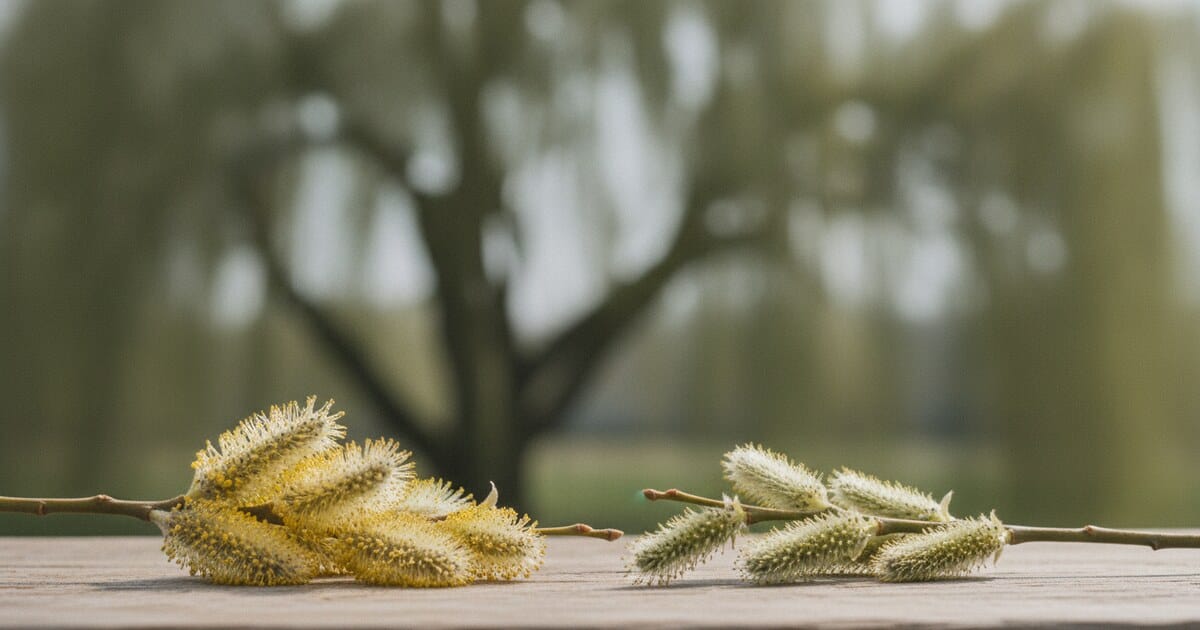
Most of the year, a male willow and a female willow look identical. Same cascading branches, same narrow leaves, same tendency to show up wherever there’s a creek or a wet ditch. The difference only becomes visible for a few weeks each spring, when the trees push out catkins before their leaves even open. If you can read those catkins, you can tell the sexes apart at a glance. If you miss the window, you’re back to guessing until next year.
This guide covers what to look for on both male and female willow trees, when the window opens by species, what popular ornamental varieties tend to be, and whether any of it actually matters when you’re deciding what to plant.
Male willow trees produce pollen-laden catkins that turn bright yellow at maturity. Female willow trees produce green catkins that develop into fluffy, cotton-like seed clusters after pollination. You can only tell the sexes apart during the spring flowering period, before the leaves emerge. Outside that window, male and female willows look identical.
Why Willow Trees Are Either Male or Female
Willows belong to the genus Salix, and every species in that genus is dioecious. That’s the technical term for plants where male and female flowers grow on completely separate trees, unlike maples or oaks where both sexes share a single tree. In practice, it means a solo willow in your yard is either always a pollen producer or always a seed producer, never both.
The genus Salix covers 350 to 500 species worldwide (the count varies because willows hybridize aggressively, and botanists don’t always agree on where one species ends and another begins). About 100 species are native to North America. Every one of them is dioecious. Willows also share a trait called hysteranthous flowering: they bloom before their leaves emerge, sometimes weeks before. This timing maximizes pollen dispersal through wind, since there’s no leaf cover to block airflow. It also gives you a clear identification window. When you see catkins on bare willow branches in late winter or early spring, the tree is advertising its sex in the only way it knows how. Male catkins mature to a bright yellow from the pollen-coated stamens. Female catkins stay green, composed of tiny teardrop-shaped pistillate flowers with ruffled or forked tips. After pollination, the female flowers swell and split open into the cottony seed masses that drift in the breeze from May onward. You need both sexes within reasonable distance (pollinating insects and wind work the transfer) for seeds to form. A yard with only female trees gets no cottony mess. A yard with only males gets no seeds but gets plenty of pollen.
How to Tell Male and Female Willow Catkins Apart
The catkins are the only reliable field marker for sex, and they’re distinct enough that you don’t need a hand lens to read them.
Male catkins start as small, silvery-grey buds coated in silky hairs. As temperatures rise, they elongate from roughly half an inch to 1-3 inches depending on species, and the coloring shifts from grey to pale yellow-green. At peak maturity the stamens carry bright yellow pollen on their tips, and the catkin looks unmistakably yellow. A male in full bloom is one of the cleaner spring identification markers in the temperate tree world: silver bud, then pale green elongated catkin, then yellow pollen cluster.
Female catkins stay green from bud to maturity. Each catkin is a tight cluster of small pistillate flowers, each flower shaped like a tiny teardrop or blunt cone with a ruffled or v-shaped tip at the top. The whole catkin looks stiffer and more compact than the male version. After a male pollinates nearby, the fertilized female flowers begin to develop seed capsules that eventually split open. The white, cottony seed fibers that float off willows in late spring come entirely from female trees.
A quick comparison:
| Feature | Male catkin | Female catkin |
|---|---|---|
| Color at maturity | Bright yellow | Green |
| Texture | Fluffy, pollen-coated | Dense, smooth-looking |
| Shape | Elongated cylinder | Compact cluster of small flowers |
| After bloom | Catkin drops | Develops cottony seeds |
| Allergy concern | Yes (pollen) | No |
The timing matters too. Male catkins typically open first, a few days to about two weeks before female catkins on nearby trees. This staggered timing is normal and doesn’t mean you’re looking at different species.
When Willow Catkins Appear by Species
The short answer is February to May, but that window shifts considerably by species and climate zone.
Goat willow (Salix caprea) is the earliest. In mild parts of the UK and the Pacific Northwest, goat willow male catkins open as early as late February. The familiar “pussy willow” appearance (the silvery-grey stage before pollen emerges) is most visible on goat willow and on Salix discolor in North America.
White willow (Salix alba) and black willow (Salix nigra) tend to flower from April into May, after the earliest species have already finished. Weeping willow (Salix babylonica and its hybrids) typically flowers in March to April in USDA zones 6-8.
The general rule: willows at lower elevations and in warmer zones flower earlier. A black willow in Louisiana starts weeks before one in Minnesota.
You can’t use timing alone to sex a tree, since male and female catkins on the same species appear within days of each other. But knowing when to look saves you from visiting the tree when it’s already leafed out and the catkins are long gone.
Do Popular Willow Varieties Have a Fixed Gender?
Most ornamental willows sold at nurseries are propagated from cuttings rather than grown from seed. Cuttings copy the parent plant’s genetics exactly, so a cultivar that came from a female parent will always be female, no matter how many times it’s propagated.
Weeping willow is a common source of confusion because several trees go by that name. True Salix babylonica is generally female. The weeping willow you’re most likely to see planted in North American yards is Salix x sepulcralis ‘Chrysocoma’, a hybrid between S. babylonica and S. alba. ‘Chrysocoma’ is typically male, though it can be largely sterile and may not produce viable pollen in all conditions. If your weeping willow drops cotton in spring, it’s female or a hybrid with functional female flowers. If it produces yellow catkins without significant cottony follow-up, it’s almost certainly male.
Pussy willow (Salix discolor in North America; Salix caprea in Europe) is sold almost exclusively in the male form, because the male’s silvery catkins are the visual appeal. Female pussy willow catkins are green and inconspicuous. Nurseries and florists source the male.
Dappled willow (Salix integra ‘Hakuro-nishiki’) produces catkins in spring and is generally female in cultivated forms, though the catkins are small enough that most people don’t notice them.
If you’re buying a named cultivar, the gender is fixed. If you’re growing from seed, you won’t know until the tree first flowers, which typically takes 4-6 years.
Does a Willow’s Gender Matter When You’re Planting?
For most people, not much. But there are a few situations where it’s worth thinking about.
Pollen and allergies. Male willows produce pollen in significant quantities. Salix pollen is a known spring allergen, though it’s less potent than birch or grass pollen. If you or someone in your household has tree pollen sensitivity, a female willow near the house is the lower-risk choice.
Cottony seed mess. Female willows release large amounts of white cottony seed fibers in late spring, the same type of drift you see from cottonwood trees (which are also in the Salicaceae family and also dioecious). Near patios, pools, or HVAC intakes, a male tree avoids this. If you specifically want seed for wildlife or natural propagation, the female is the one doing that work.
Wildlife value. Both sexes matter. Male catkins are one of the earliest pollen sources for bees coming out of winter dormancy in February and March. Female seeds feed small birds and provide nesting fiber. If you have room for two trees and you’re planting with wildlife in mind, having at least one of each is the better setup.
For most landscape uses, the choice of species and size matters far more than sex. A male black willow and a female black willow look the same in July, grow at the same rate, and live the same lifespan.
Identifying Your Willow with the Tree Identifier App
If you’re trying to figure out what kind of willow you have before catkin season, the Tree Identifier app can help you narrow down the species from photos of leaves, bark, and overall shape. The willow tree identification guide covers the key visual markers for the most common species.
Once you know the species, you’ll know when to look for catkins in spring, and you’ll know whether the cultivar you’re looking at tends toward male or female in its most common nursery form. The app works offline too, which is useful if you’re tracking down a streamside willow away from cell service.
During catkin season itself, a clear photo of the catkin cluster is often enough for the app to identify the species. At that point, the catkin color and texture are right in front of you to read.
Frequently Asked Questions
Can you tell a male from a female willow tree without flowers?
Outside of the spring flowering period, male and female willows look identical. Leaf shape, bark texture, branch structure, and growth rate don’t differ between the sexes. The catkins are the only reliable external marker, and they’re only present for a few weeks in late winter or early spring before the leaves open.
Are weeping willows male or female?
It depends on the specific tree. True Salix babylonica is typically female. The most common weeping willow in North American gardens is the hybrid Salix x sepulcralis ‘Chrysocoma’, which is generally male but sometimes largely sterile. If your weeping willow produces cottony seed drift in late spring, it has functional female flowers. If it produces yellow catkins without significant cottony output, it’s most likely male.
Which is better to plant, a male or female willow?
For most purposes there’s no meaningful difference. Male willows produce pollen (a mild spring allergen) and no cottony seed drift. Female willows produce cottony seeds in late spring but no pollen. If allergies are a concern, go with a female. If cottony drift near a pool or patio is a concern, go with a male. Neither sex grows faster or lives longer than the other.
Do willow trees need a male and female nearby to reproduce?
Yes, for seed production. A female willow tree needs pollen from a male tree to produce viable seeds. Wind and insects carry the pollen. Without a male nearby, the female tree’s catkins won’t develop into seeds. However, willows also reproduce easily from cuttings and fallen branches that root in moist soil, so seed production isn’t required for the tree to spread in suitable habitat.
When do willow catkins appear?
Most willows produce catkins between late February and May, before or just as the leaves emerge. Goat willow (Salix caprea) is among the earliest, sometimes flowering in late February in mild climates. White willow and black willow tend to flower later, from April into May. The exact timing shifts based on climate zone, elevation, and how warm the winter was.
If you want to identify a willow by its catkins this spring, the Tree Identifier app can help you pin down the species from photos of leaves and bark year-round, so you know what to look for when the flowering window opens. Download it on iOS or Android, or try a free scan at treeidentifier.app.
Identify a tree from your photo — free
Upload a leaf, bark, or whole-tree photo and get the species in seconds. No signup.
Confidence:
Unlock the full species profile
Free in the app — with unlimited identifications.


AI result for guidance — the app gives full species details and works offline.
Want unlimited identifications?
Get the full species profile, photos and details — free in the app, with unlimited scans.
- Unlimited identifications
- Full species profiles & details
- Works offline, anywhere
- Save and revisit your finds
Elena Torres
Tree Identifier Team