How Many Types of Willow Trees Are There?
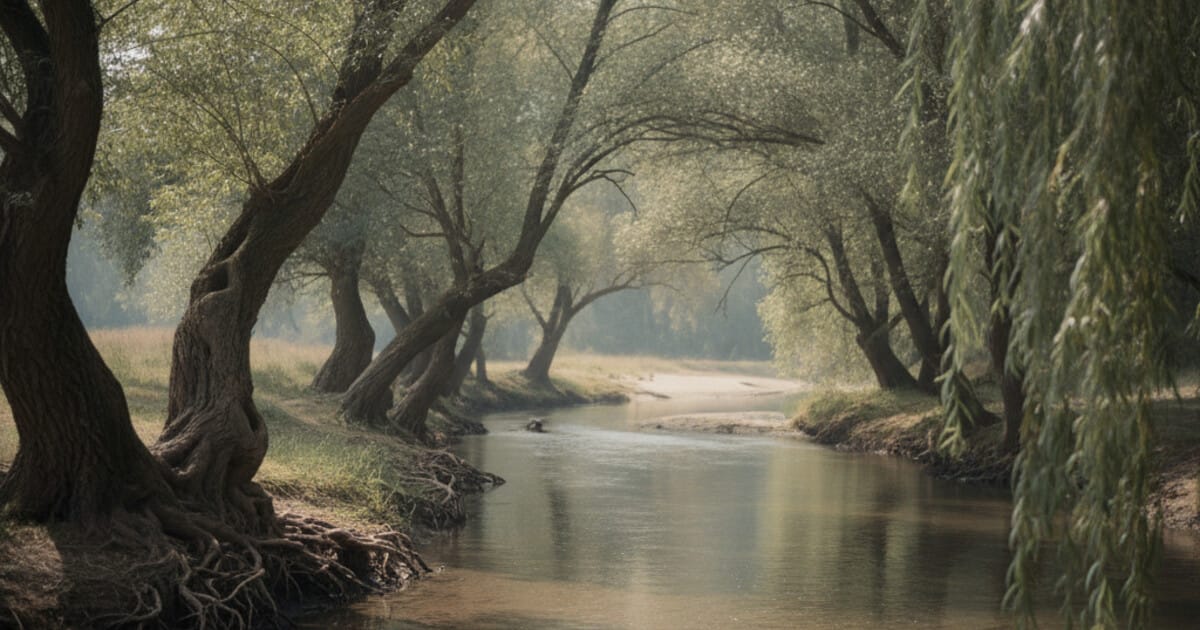
Most people picture the same thing when they hear “willow tree”: long trailing branches sweeping down to a pond’s edge. Ask how many willow trees there are, or how many types of willow trees exist in total, and the answer surprises almost everyone. The genus Salix includes more than 350 species worldwide, ranging from creeping arctic ground-cover barely centimeters tall to riverside giants pushing 100 feet. The variation in size, form, and habitat is far greater than that single iconic silhouette suggests.
More than 350 species of willow trees (genus Salix) exist worldwide, with roughly 100 native to North America. They range from arctic ground-hugging shrubs just centimeters tall to towering riverside trees over 80 feet high. Common types include weeping, black, white, pussy, crack, and dappled willow, each with distinct size, habitat, and leaf characteristics.
How Many Willow Trees Are There Worldwide?
The genus Salix comprises more than 350 recognized species, with some taxonomists putting the count closer to 400 to 500 due to frequent natural hybridization between species. Salix is one of the most species-rich tree genera in the temperate Northern Hemisphere, distributed across North America, Europe, Asia, and parts of Africa and South America. North America alone hosts roughly 100 native Salix species, ranging from the dwarf willow (Salix herbacea), a creeping arctic-alpine plant reaching just 1 to 6 centimeters tall, to the black willow (Salix nigra), the largest native North American willow at 30 to 80 feet, with documented specimens exceeding 100 feet in bottomland forests. White willow (Salix alba), native to Europe and western Asia, reaches 65 to 80 feet and was the original source of salicin, the compound chemists later synthesized into aspirin in 1897. Willows hybridize so freely that identifying exact species in the field often requires professional botanists.
The hybridization problem is significant. Many willows growing along rivers are natural hybrids, carrying traits from two or more parent species. The widely planted ‘Chrysocoma’ weeping willow, for example, is a Salix babylonica × Salix alba cross that now outnumbers true Salix babylonica across most of North America and Europe.
Even with 350-plus species in the genus, Salix share a recognizable family look: narrow leaves, flexible twigs, and a strong preference for wet soils.
Common Types of Willow Trees in North America
The roughly 100 native Salix species in North America span an enormous range. A few dozen qualify as full-sized trees; the rest are shrubby, low-growing, or strictly riparian thickets. These are the types you’ll encounter most often.
Weeping Willow (Salix babylonica / S. × sepulcralis ‘Chrysocoma’)
The most planted ornamental willow worldwide. Most “weeping willows” in parks and gardens are actually the hybrid ‘Chrysocoma’, cold-hardy to zone 4. True Salix babylonica handles only zone 6 winters. Both reach 30 to 40 feet tall with the signature curtain of drooping branchlets that touch the ground. The weeping form develops because the long, thin shoots grow faster than the trunk can hold them upright.
Black Willow (Salix nigra)
The largest native willow in North America, reaching 30 to 80 feet, with occasional specimens topping 100 feet in ideal bottomland conditions. Black willow gets its name from the dark, near-black, deeply furrowed bark and grows from Maine and Ontario south to the Gulf Coast and west to Nebraska. You’ll find it almost exclusively beside moving water.
White Willow (Salix alba)
Originally from Europe and western Asia, white willow naturalized across much of North America after European settlement. It grows 65 to 80 feet tall. The easiest field ID: flip a leaf over and you’ll see a silvery-white undersurface from dense, fine hairs. That silver underside separates it from black willow at a glance.
Pussy Willow (Salix discolor)
Pussy willow grows as a multi-stemmed shrub or small tree, typically 6 to 15 feet. The soft, silver-gray catkins emerge before the leaves in late February or March, well ahead of most other plants. Hardy to zone 4, it’s native across the eastern and central United States and a standard early-spring item in floral arrangements.
Crack Willow (Salix fragilis)
The name comes from a straightforward trait: branches snap cleanly at the base when bent. Crack willow hybridizes freely with white willow, making pure specimens rare in the field. Introduced from Europe, it’s now naturalized along waterways across North America and grows 40 to 70 feet tall.
Sandbar Willow (Salix exigua)
One of the most widespread willows in North America, sandbar willow is a thicket-forming shrub rather than a tree. It stays under 15 feet, with very narrow silvery-green leaves only a few millimeters wide. It colonizes sandbars, gravel bars, and disturbed river edges from Alaska to Mexico, zones 3 to 9.
Peach-Leaf Willow (Salix amygdaloides)
Common along Midwest and Great Plains rivers, peach-leaf willow reaches 20 to 40 feet. Its leaves are longer and broader than most willows, resembling peach foliage (amygdaloides means “peach-like” in Latin). Hardy in zones 3 to 8 and a frequent sight along the Missouri and Mississippi river systems.
Ornamental Willow Trees for Home Landscapes
A handful of willows show up in garden centers specifically for their ornamental value rather than as riverside natives.
The dappled willow (Salix integra ‘Hakuro-nishiki’) is probably the most widely planted ornamental willow in North American gardens. New growth emerges pink-and-white variegated in spring, fading to green-white by midsummer. It stays compact at 4 to 6 feet as a shrub, or 6 to 10 feet when trained on a single stem. Hardy to zone 4, it suits smaller yards that want willow character without a 70-foot riverside tree.
Corkscrew willow (Salix matsudana ‘Tortuosa’) offers dramatically twisted branches and stems that look striking in winter when bare. It grows 25 to 30 feet and is a frequent choice in cut-flower and dried-branch arrangements.
‘Tristis’, a weeping form of white willow (Salix alba ‘Tristis’), has golden-yellow twigs that catch winter light well. It’s often listed in catalogs alongside weeping willow and the confusion between them is common enough to deserve its own breakdown in the white willow vs weeping willow guide.
How to Tell Willow Trees Apart
With so many species and natural hybrids, species-level ID can be tricky even for botanists. But the genus-level features are consistent enough that you can usually peg a willow from any other tree quickly.
Leaf shape. Nearly all willows have narrow, lance-shaped leaves with finely toothed margins, arranged alternately along the stem. Leaf width ranges from 2 to 3 millimeters in sandbar willow to 25 to 30 millimeters in peach-leaf willow, but the basic lanceolate form stays consistent across the genus.
Catkins. Willows produce catkins in early spring, often before leaves emerge. Pussy willow catkins are the most recognizable, but every Salix species produces them. Male and female catkins grow on separate trees.
Habitat. A large tree with narrow leaves growing right beside a river or pond is almost certainly a willow. The genus has a strong preference for wet soils and full sun, and most species won’t grow far from water unless planted and irrigated.
Bark. Young willow bark is smooth and yellowish-green to gray. Mature bark varies: black willow gets dark and deeply furrowed; white willow develops shallower, lighter-colored ridges.
For a deeper look at separating species, the complete willow tree identification guide covers the full genus with bark and leaf ID features for each major type.
How Tree Identifier Helps You Identify Willow Trees
With more than 350 willow species worldwide and dozens of natural hybrids in circulation, getting a species-level ID from a photo is genuinely useful. Tree Identifier’s AI can analyze a photo of a leaf, a patch of bark, or a catkin cluster and return the species with a confidence score.
A close shot of the leaf underside works well for separating white willow from black willow: silvery-white hairs versus glossy green. Bark texture helps narrow down black willow from other large riverside species. The app covers common ornamental willows like dappled willow and native species like sandbar willow, peach-leaf willow, and pussy willow. It works offline too, so you can use it on a riverbank or remote trail without cell service.
Start with 2 free identifications per day on the app, or try the tree identification tool at treeidentifier.app/tools/tree-identifier directly in your browser.
Frequently Asked Questions
What is the most common willow tree in North America? Black willow (Salix nigra) is the most common native willow across North America by range and abundance, found along rivers and streams from the Atlantic coast to the Great Plains. Weeping willow is the most widely planted ornamental type, though it’s not native to North America. Pussy willow is the most recognizable shrubby species.
How many willow trees are native to North America? About 100 Salix species are native or naturalized in North America. The exact count shifts depending on the taxonomy source, partly because willows hybridize so freely that many populations sit somewhere between two recognized species and are difficult to classify cleanly.
What is the smallest willow tree? The dwarf willow (Salix herbacea) is the world’s smallest woody plant, growing just 1 to 6 centimeters tall in arctic and alpine environments and spreading as a ground-hugging mat across tundra. At lower elevations, sandbar willow (Salix exigua) is the smallest common willow in North America, typically staying under 15 feet as a thicket-forming shrub.
Do all willow trees have drooping branches? Most willows grow with upright or spreading branches. The pendulous, weeping habit most people associate with willows belongs to only a handful of species: weeping willow (Salix babylonica), its hybrid ‘Chrysocoma’, and the ‘Tristis’ cultivar of white willow. Black willow, pussy willow, and most other native species grow with conventional upright or arching crowns.
Can willow trees grow away from water? Willows grow best in consistently moist or wet soils but can survive drier conditions once established. Black willow and crack willow are the most water-dependent species. Dappled willow and pussy willow adapt well to average garden soils with regular watering, and most willows handle moderate dry spells once their root systems are established.
If you want to identify a willow species on your next walk, snap a close photo of the leaf underside or bark and run it through Tree Identifier. The AI matches the photo to a species in seconds, with habitat and identification details for whichever willow it finds. Two free identifications per day, no subscription needed to start.
Identify a tree from your photo — free
Upload a leaf, bark, or whole-tree photo and get the species in seconds. No signup.
Confidence:
Unlock the full species profile
Free in the app — with unlimited identifications.


AI result for guidance — the app gives full species details and works offline.
Want unlimited identifications?
Get the full species profile, photos and details — free in the app, with unlimited scans.
- Unlimited identifications
- Full species profiles & details
- Works offline, anywhere
- Save and revisit your finds
Elena Torres
Tree Identifier Team