Dappled Willow: Identification, Care, and Landscaping Guide
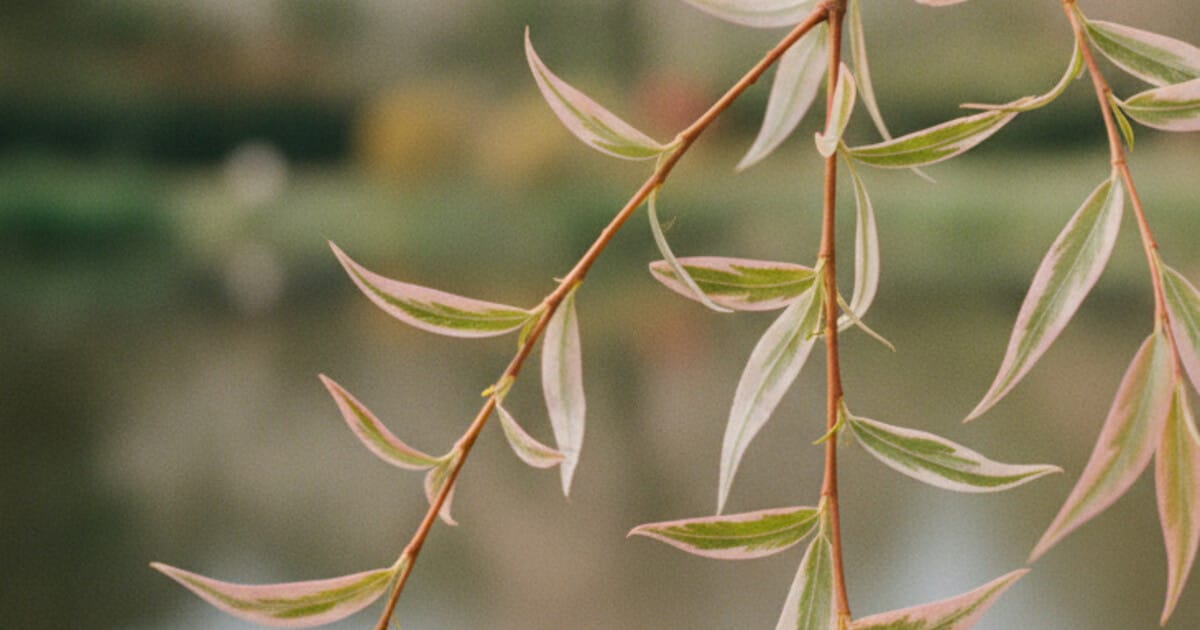
Dappled willow is one of the few shrubs that people stop and photograph in strangers’ gardens. The foliage in spring runs from bright pink at the new tips to white-cream variegation closer to the stem, layered over a green base color. By summer the pink fades, leaving the white-and-green mottling that gives the plant its common name. By autumn the whole shrub turns yellow before dropping its leaves. It’s widely sold at garden centers across USDA zones 4-9, and it stays looking good provided you understand two things: it needs consistent moisture, and it needs a hard annual prune to keep the vivid new growth coming.
Dappled willow (Salix integra ‘Hakuro-nishiki’) is a variegated shrub or small standard tree with lance-shaped leaves that emerge bright pink in spring, fade to white-and-green by early summer, and turn yellow in fall. It grows 4-8 feet tall, thrives in USDA zones 4-9, and performs best in full sun with consistently moist soil, ideally near a pond or water feature.
What Does a Dappled Willow Look Like?
Dappled willow’s leaves are lance-shaped, 1-4 inches long, with finely serrated edges and alternate arrangement along the stems. The stems are slender and flexible, typical of willows, and range from reddish-brown to yellowish-green depending on age and season.
The color is what catches attention first. New growth in early spring comes in pink, ranging from soft rose to a brighter flamingo on vigorous shoots. Within a few weeks that pink shifts toward cream and then white, mixing with the base green to produce the mottled, dappled pattern through late spring and early summer. In full sun with adequate moisture, the variegation holds well into summer. In shade or when the plant is water-stressed, leaves drift toward plain green faster.
In late winter or early spring, before or alongside the first leaves, the plant produces catkins: slender, pinkish-white spikes 1-2 inches long, typical of the willow family. They’re not dramatic, but they signal that the plant is waking up. Fall color is yellow, and bare winter stems often carry a reddish or orange tint in cold climates.
Salix integra ‘Hakuro-nishiki’ (dappled willow) is a cultivated variety of a willow native to Japan, Korea, and Manchuria. The cultivar name ‘Hakuro-nishiki’ translates from Japanese as “white dew brocade,” a reference to the white-mottled summer foliage. Shrub-form plants reach 4-6 feet tall and wide; standard-trained specimens grow 6-10 feet tall with a 4-5-foot spread. Leaves are lance-shaped, 1-4 inches long, with finely serrated edges and alternate arrangement on the stems. New spring growth emerges pink, transitioning to white-and-green variegation by late spring. In full sun the variegation holds through midsummer; in shade or drought it reverts to plain green earlier in the season. Catkins appear in early spring before or alongside the first leaves: slender, pinkish-white clusters 1-2 inches long. The plant is hardy across USDA zones 4-9, with roots surviving temperatures to -30°F in zone 4 and top growth remaining mostly intact in zone 9 mild winters. Growth rate runs 1-2 feet per year in consistently moist soil.
Dappled Willow vs. Other Willows
Most Salix species are large trees with plain green, lance-shaped leaves. Dappled willow stands apart on two counts: size and foliage color.
A mature weeping willow (Salix babylonica) reaches 30-40 feet tall with long, arching branches that graze the ground. A mature dappled willow tops out at 6-10 feet in standard form, or 4-6 feet as a shrub, with upright, ascending branches. Black willow (Salix nigra), the most common native willow across North America, reaches 30-60 feet and carries uniformly green foliage on floodplains and riverbanks.
The variegated foliage is the clearest identifier. No other common garden willow produces pink spring growth fading to white-mottled summer leaves. If you’re sorting out a large willow species in the field, the willow tree identification guide covers the major Salix species by leaf shape, bark, and habitat.
Dappled willow belongs to the Salicaceae family like all true willows, so the leaf-shape resemblance is accurate. It’s unrelated to desert willow, which despite the name belongs to the Bignoniaceae family (the catalpa and trumpet vine group) and grows in dry, xeric conditions, the opposite of what dappled willow needs.
Dappled Willow Care: Soil, Water, and Sun
Dappled willow has a reputation for being fussy, but the requirements mostly come down to one factor: water.
Water. This plant grows naturally along streams and in moist forest margins in Japan and Korea. In gardens it performs best where soil stays consistently moist. Near ponds, rain gardens, and low areas that collect runoff, it thrives without much fuss. In dry, free-draining soil it struggles: leaves drop early, variegation fades, and the plant looks thin by August. Away from a natural water source, plan to water deeply at least twice a week through the growing season.
Sun. Full sun (6+ hours per day) produces the sharpest color. In partial shade the plant grows but the pink and white variegation dulls. For maximum spring pink and clear summer white-mottling, site it where it gets direct morning sun at minimum.
Soil. Dappled willow tolerates clay and heavy soils, which tend to be the same sites that stay moist longest. It doesn’t need sharp drainage the way most ornamental shrubs do. Consistent moisture matters more than soil texture.
Fertilizer. A balanced slow-release granular fertilizer applied in early spring supports vigorous new shoots. Skip heavy nitrogen feeding in summer; it pushes leafy growth but tends to reduce the clarity of the variegation.
Zones. USDA zones 4-9 cover the practical growing range. In zone 4, tops die back in hard winters but roots resprout reliably in spring. In zones 8-9 the plant stays mostly evergreen in mild years.
How to Prune a Dappled Willow
Annual pruning separates a vivid, shapely dappled willow from a scraggly one. Without cutting, the plant gets leggy, the center fills with unproductive woody stems, and the pink spring growth (which only appears on new shoots) becomes sparse.
Hard prune in early spring, before any new growth starts. For shrub form, cut the whole plant back to 6-12 inches from the ground. For standard form, cut back to the main branching scaffold. This looks severe. The plant pushes back fast, and the stems that emerge after a hard prune carry the brightest pink new growth of the season.
For a compact shrub at 4-5 feet, cut it to the ground every year. For a larger specimen, every second or third year works. Plants that haven’t been cut back in several years get woody at the base, with older stems showing little variegation.
Watch for green reversions through the season: shoots that emerge with fully plain, green leaves rather than the variegated pattern. Cut them out as soon as they appear. Green shoots grow faster than variegated ones and can take over the plant within a season or two if left alone.
Dappled Willow in the Landscape
Dappled willow works as a specimen or accent plant, not a background filler. The variegated foliage stands out against dark evergreens, masonry walls, and still water.
Common placements in residential gardens:
- Pond and water feature edges: Plant 3-8 feet from the water’s edge. The reflected color in still water doubles the visual effect, and the soil near the water stays naturally moist.
- Rain gardens: The plant handles occasional standing water at its roots better than most ornamentals, making it a reliable choice for bioswale margins and rain garden plantings.
- Mixed shrub borders: As a mid-border specimen pruned to 4-5 feet, it pairs well with plants that have dark foliage, such as Japanese maple, purple-leafed elderberry, or dark-needled conifers. The contrast sharpens the pink-and-white coloring.
- Standard form near entrances: A single-trunk standard dappled willow makes a tidy front-yard specimen with four seasons of interest, from spring catkins through summer variegation to fall yellow.
For more ideas on trees and large shrubs with multi-season ornamental value, see the ornamental trees guide.
How Tree Identifier Can Help
A close-up photo of dappled willow’s variegated spring foliage, showing the pink-to-white gradient on new growth alongside mature green leaves, is usually enough for the Tree Identifier app to return a confident species match.
The app covers thousands of species including Salix variants, works from leaf, bark, or stem photos, and runs offline, which is useful at nurseries or on garden tours where cell signal isn’t reliable. It’s free to start with 2 daily identifications on iOS and Android. Or try the web-based tree identifier tool in your browser for a quick check without downloading anything.
Frequently Asked Questions
Does dappled willow stay pink all summer?
The pink color is on new spring growth and fades to white-and-green by early summer. In hot climates without enough water, leaves can go plain green by August. A hard prune in early spring and a lighter shaping cut in midsummer encourage another flush of pink growth in late summer. Full sun and consistent moisture extend how long the pink holds.
How big does a dappled willow get?
In shrub form, dappled willow reaches 4-6 feet tall and wide without annual pruning. Hard-pruned shrubs stay compact at 3-4 feet. Standard form, with a single trunk and trained canopy, grows 6-10 feet tall with a 4-5-foot spread. Without any pruning, multi-stemmed plants can reach 8-10 feet but lose vivid variegation as older stems dominate.
Is dappled willow invasive?
Dappled willow (Salix integra ‘Hakuro-nishiki’) is not listed as invasive in North America. It doesn’t spread aggressively by root suckering. It can root from fallen branches that wash into natural waterways, so avoid planting it immediately at the edge of streams or rivers where cuttings could establish downstream.
Can dappled willow grow in containers?
Yes, for a few seasons. A 15-25-gallon container supports the plant for 2-3 years before the root system outgrows it. Container plants dry out faster than in-ground ones and need watering more frequently, sometimes daily in summer heat. Hard prune each spring to keep the canopy proportional to the pot size.
Why is my dappled willow turning all green?
Three causes cover most cases: too much shade, drought stress, or green reversion shoots taking over. Move the plant to full sun if possible, increase watering, and cut out any stems with fully green leaves immediately. Annual hard pruning each spring also helps: new stems show the sharpest variegation, and older, uncut growth gradually fades toward plain green regardless of conditions.
Download Tree Identifier to identify dappled willow and other ornamental willows from leaf, bark, or stem photos. The app works offline for field and nursery use, with 2 free daily identifications on iOS and Android. You can also try the free web tool directly in your browser for quick identifications without downloading anything.
Identify a tree from your photo — free
Upload a leaf, bark, or whole-tree photo and get the species in seconds. No signup.
Confidence:
Unlock the full species profile
Free in the app — with unlimited identifications.


AI result for guidance — the app gives full species details and works offline.
Want unlimited identifications?
Get the full species profile, photos and details — free in the app, with unlimited scans.
- Unlimited identifications
- Full species profiles & details
- Works offline, anywhere
- Save and revisit your finds
Elena Torres
Tree Identifier Team