White Willow vs Weeping Willow: How to Tell Them Apart
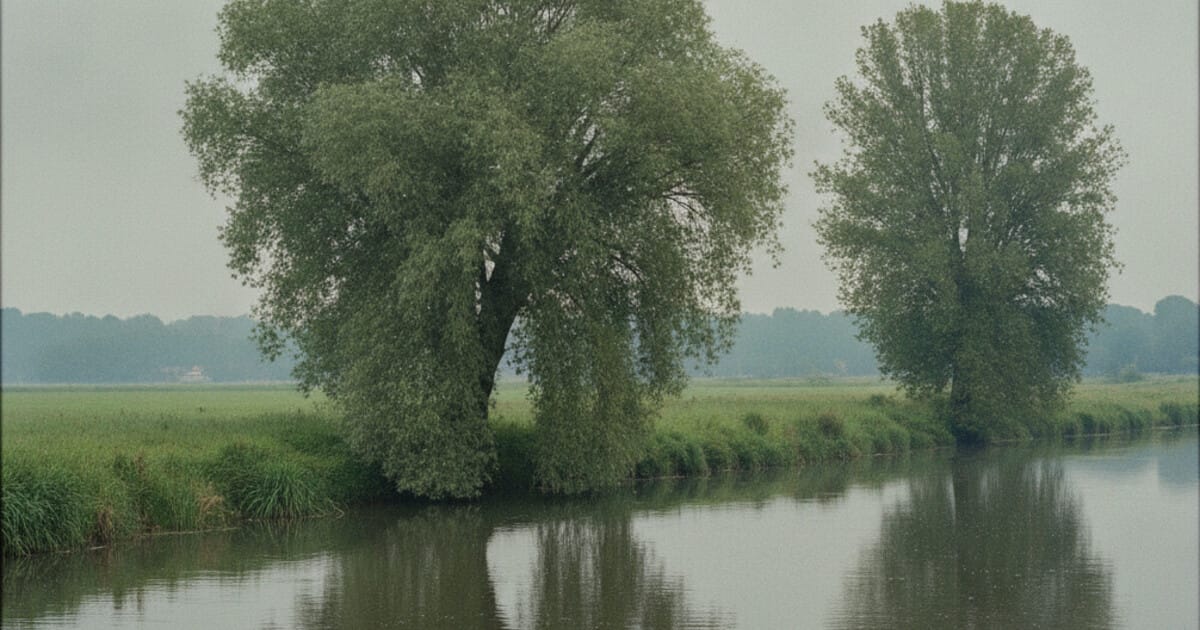
When someone searches white willow vs weeping willow, they’re usually standing in front of a tree they can’t confidently name. Both trees love water, both have long narrow leaves, and both produce yellow catkins in spring. Up close, though, they’re quite different. White willow (Salix alba) holds its branches in a broad spreading crown. Weeping willow (Salix babylonica and its cold-hardy hybrids) trails its branches toward the ground in the familiar drooping curtain. Leaf color, cold tolerance, and native range separate them further. This guide covers the key ID features for each, the cultivar mix-up that fools even experienced gardeners, and the fastest single test you can run in the field. The broader willow tree identification guide covers additional species including pussy willow, crack willow, and corkscrew willow alongside the most useful genus-wide techniques, and if you’re comparing the genus to its famous drooping member, start with willow tree vs weeping willow.
White willow (Salix alba) and weeping willow (Salix babylonica) differ primarily in branch habit and leaf color. White willow has a broad spreading crown with upward-arching branches and silvery-white leaf undersides coated in dense silky hairs. Weeping willow has pendulous branches that hang toward the ground and plain light-green leaf undersides. Flipping a leaf is the fastest single field test.
What Does White Willow Look Like?
Salix alba, white willow, grows natively across Europe and western Asia from the British Isles east through central China, rooted primarily along rivers and floodplains. Mature trees reach 20-25 m (65-82 ft) with crowns spreading 15-20 m (50-65 ft). Bark is deeply furrowed gray-brown on old trunks; young twigs are yellow to olive-green. Leaves run 5-12 cm long and 1-2 cm wide, narrow and lance-shaped, with a dense coat of 1-2 mm silky white hairs on the underside that give the foliage a silver shimmer in the wind. That silver underside is the tree’s most reliable field mark. Cold tolerance reaches USDA zone 2 (-50°F / -46°C), making it one of the hardiest willows. Its bark contains 0.5-2% salicin by dry weight, the compound Hippocrates recorded for fever treatment around 400 BC and the chemical starting point for aspirin synthesis in 1897.
The crown shape is the other main tell. White willow branches angle upward from the trunk and arch outward at the tips, forming a broad oval to rounded crown. You won’t see branches sweeping the ground unless you’re looking at a weeping cultivar (more on that below).
Yellow male catkins appear in April, about 5 cm long, typically alongside the emerging leaves. Female catkins are shorter and greenish. Both sexes produce pollen and seeds early in the season when few other trees are flowering, making them useful for early pollinators.
What Does Weeping Willow Look Like?
Weeping willow’s identity marker is obvious from a distance: the branches droop. On a mature tree, long flexible shoots hang 5-10 m (16-33 ft) from their attachment point, creating the curtain of foliage the tree is famous for.
True weeping willow, Salix babylonica, originates in northern China and traveled west via the Silk Road before the 1700s. It grows reliably in USDA zones 6-8. Most of what you see in North American and northern European parks is actually Salix x sepulcralis ‘Chrysocoma’, a hybrid that looks nearly identical to S. babylonica but handles colder winters, surviving to zone 4 (around -30°F). For a closer look at how it compares with a North American native willow species, the black willow vs weeping willow guide covers those differences in detail.
Weeping willow leaves are similar in outline to white willow: narrow, lance-shaped, and finely toothed. They run 8-16 cm long, typically longer than white willow’s 5-12 cm leaves. The critical difference is the underside. Weeping willow leaves are bright green above and plain lighter green below. No silky hairs. Run your thumb across the underside and it’ll feel smooth.
Bark on mature weeping willows is gray-brown with shallow furrows. Young twigs are yellow-green to golden, most visible in winter when the leaves are down. The golden twig color is shared by several willow species, so it’s a supporting detail rather than a definitive ID feature on its own.
White Willow vs Weeping Willow: Side-by-Side Comparison
The fastest single test in the field: pick a leaf, flip it over, look at the underside. Silvery-white and slightly silky to the touch means white willow. Smooth and plain green means weeping willow or a weeping cultivar.
When you can see the whole tree, crown shape gets you there in seconds:
| Feature | White Willow (S. alba) | Weeping Willow (S. babylonica / ‘Chrysocoma’) |
|---|---|---|
| Branch habit | Upward-arching, broad spreading crown | Pendulous branches hang 5-10 m to the ground |
| Leaf underside | Silvery-white, dense silky hairs | Plain light green, smooth |
| Leaf length | 5-12 cm | 8-16 cm |
| USDA hardiness | Zones 2-8 | Zones 4-8 (‘Chrysocoma’) or 6-8 (S. babylonica) |
| Native range | Europe, western/central Asia | Northern China |
| Max height | 20-25 m (65-82 ft) | 20-25 m (65-82 ft) |
| Young twig color | Yellow to olive-green | Yellow-green to golden |
In spring and summer, leaf underside is your most reliable mark. In winter when leaves are down, crown shape and twig color carry the ID. White willow’s broader, upright crown stays visible year-round.
The Weeping White Willow Mix-Up
Here’s where most people get tripped up. White willow has a widely planted cultivar called Salix alba ‘Tristis’ (also sold as ‘Vitellina-Tristis’). It produces bright golden-yellow twigs and genuinely weeping branches. From 20 meters away, ‘Tristis’ looks nearly identical to a weeping willow.
Garden centers routinely label ‘Tristis’ as “golden weeping willow” or simply “weeping willow” on the tag. If you’re trying to ID a weeping tree in a private garden or park and the species name isn’t posted, the leaf underside check is the only reliable field separation:
- Silver or silky-feeling underside: Salix alba ‘Tristis’ (a weeping cultivar of white willow)
- Plain smooth green underside: Salix babylonica or S. x sepulcralis ‘Chrysocoma’ (true weeping willows)
Twig color adds a secondary clue. ‘Tristis’ typically shows brighter golden-yellow twigs in winter than the olive to yellow-green of S. babylonica, though ‘Chrysocoma’ also has golden twigs, so twig color alone won’t always close the question.
From a practical gardening standpoint, ‘Tristis’ is considerably hardier than true weeping willow. If you’re in USDA zone 4 or colder and see a large weeping willow-type tree surviving hard winters without damage, there’s a strong chance it’s ‘Tristis’ rather than true S. babylonica. The ornamental dappled willow (Salix integra ‘Hakuro-nishiki’) also enters this mix in garden settings. The dappled willow guide covers its distinctive pink-and-white spring foliage, a feature neither white willow nor weeping willow share.
How to Read Crown, Bark, and Leaf Together
Confident willow ID rarely comes from a single feature. The most reliable approach layers three checks:
Crown shape at distance. Drooping branches sweeping toward ground level: weeping willow or a weeping cultivar. Broad spreading crown with upward-arching branches: white willow.
Leaf underside. Silver and slightly silky: white willow (or S. alba ‘Tristis’). Plain green: weeping willow or ‘Chrysocoma’.
Habitat and climate. White willow thrives much farther north (zones 2-8). True weeping willow prefers milder winters. A large weeping-form tree thriving in zone 3 or 4 is almost certainly ‘Tristis’ or ‘Chrysocoma’, not S. babylonica.
In spring and summer, the leaf underside is your single most reliable field mark because it stays consistent across cultivars within a species. In winter when leaves are down, crown shape and twig color carry the ID.
How Tree Identifier Helps with Willow ID
Both species share enough visual overlap that a photo ID can confirm what field observation narrows down. The Tree Identifier app accepts photos of leaves, bark, catkins, or the full crown and returns a species ID with a confidence score in seconds.
For willow ID, photographing the leaf underside in good natural light gives the clearest signal. The silvery hairs on white willow show up distinctly under diffuse daylight; smooth green weeping willow leaf undersides register differently at the texture level. The app compares your photo against a database of thousands of tree species.
Two free IDs are available daily without a subscription. If you’re out by a riverbank and hit an unfamiliar willow, that’s enough to confirm the species on the spot. The app also works offline, downloading species data for use in areas without cell service, so no connection is needed on remote hikes.
If you’d rather skip the download, the web tool at treeidentifier.app/tools/tree-identifier offers one free scan per session directly in your browser.
Frequently Asked Questions
Is white willow the same as weeping willow?
White willow (Salix alba) and weeping willow (Salix babylonica) are related but distinct species. White willow has a broad spreading crown and leaf undersides coated in silvery silky hairs. Weeping willow has pendulous branches that drape toward the ground and smooth plain-green leaf undersides. The two trees are regularly confused because S. alba ‘Tristis’, a weeping cultivar of white willow, closely mimics weeping willow in branch habit while retaining white willow’s silvery leaf undersides.
What’s the fastest way to tell white willow from weeping willow in the field?
Flip a leaf over. White willow leaves have silvery-white undersides covered in fine silky hairs; weeping willow leaves have plain smooth light-green undersides. If you can see the whole tree, crown shape is equally fast: white willow forms a spreading upward-arching crown while weeping willow trails its branches toward the ground. Using both features together closes almost all ambiguous cases.
Can white willow survive colder winters than weeping willow?
White willow handles USDA zones 2-8, tolerating temperatures down to -50°F (-46°C). True weeping willow (S. babylonica) grows in zones 6-8. The hybrid Salix x sepulcralis ‘Chrysocoma’ extends to zone 4. A large weeping-type willow thriving in cold northern climates is typically ‘Chrysocoma’ or the weeping S. alba cultivar ‘Tristis’, rather than true S. babylonica.
Do both willows grow near water?
Both species grow best in moist to wet soil near rivers, lakes, and floodplains, and both tolerate periodic flooding better than most trees. White willow’s native range spans major European river systems from the Thames to the Danube to the Yellow River basin. Weeping willow’s native range centers on river valleys in northern China. In cultivation, both trees do well in consistently moist soil with full sun, and both root aggressively near water lines and drainage pipes.
Does white willow bark have medicinal uses?
White willow bark contains 0.5-2% salicin, a compound closely related to the active ingredient in aspirin. Bark preparations for fever and pain relief date to at least 400 BC, recorded in Hippocrates’ writings and Egyptian papyri. Felix Hoffmann synthesized aspirin in 1897 using salicin from willow bark as the chemical starting point. Weeping willow bark also contains some salicin, but S. alba has historically been the primary medicinal species in traditional and commercial use.
To identify a willow in your yard or on a hike, photograph the leaf underside and run it through the Tree Identifier app. It covers Salix alba, Salix babylonica, ‘Chrysocoma’, and dozens of other willow species, returning a species ID with a confidence score in seconds. Download the app or try the browser tool at treeidentifier.app/tools/tree-identifier to get an ID from your phone or computer.
Identify a tree from your photo — free
Upload a leaf, bark, or whole-tree photo and get the species in seconds. No signup.
Confidence:
Unlock the full species profile
Free in the app — with unlimited identifications.


AI result for guidance — the app gives full species details and works offline.
Want unlimited identifications?
Get the full species profile, photos and details — free in the app, with unlimited scans.
- Unlimited identifications
- Full species profiles & details
- Works offline, anywhere
- Save and revisit your finds
Elena Torres
Tree Identifier Team