Post Oak Tree Identification: 7 Reliable Signs
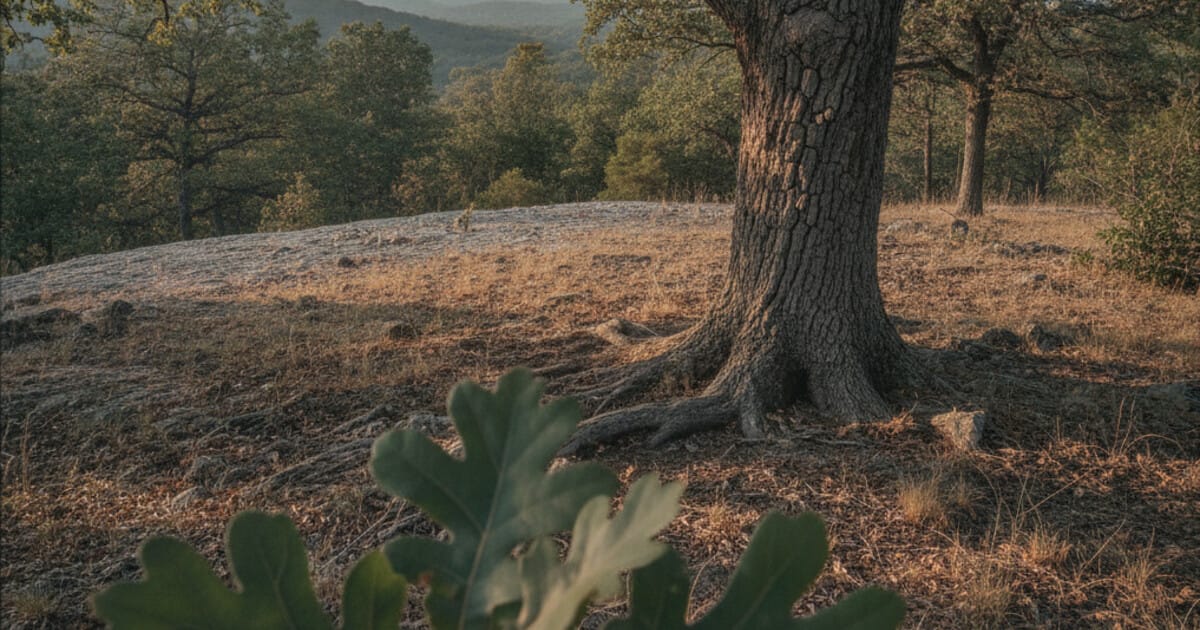
Post oak (Quercus stellata) grows across much of the eastern United States, from southern New England to Kansas and south to Florida and Texas, yet many hikers pass it without recognition. That changes the first time you look closely at the leaf. No other oak in its range has quite the same shape, and post oak tree identification becomes one of the faster calls you can make in the field once you know what to look for.
The species thrives on poor soils where other oaks give up: thin rocky ridge tops, sandy barrens, and south-facing slopes baked by summer sun. Understanding its preferred habitat is nearly as useful as knowing its leaves.
Post oak trees are identified by their distinctive cross-shaped leaves with 3 large lobes at the tip and 2 smaller basal lobes forming a plus sign. Bark is gray-brown with blocky, scaly ridges. Post oaks belong to the white oak group, with rounded (not bristle-tipped) leaf lobes and acorns that ripen in a single growing season.
7 Signs That Identify Post Oak Trees
Post oak (Quercus stellata) ranges from coastal New England south through the Appalachian foothills, the Piedmont, and the Atlantic and Gulf Coastal Plains, then west across the Ozarks into the Cross Timbers region of Oklahoma and Texas. Mature trees typically reach 40-60 feet tall, though specimens on better soils can push 80 feet. The bark is gray-brown, blocky, and moderately furrowed on mature trunks. The species name stellata means “star-shaped,” a reference to the stellate (multi-branched) hairs covering the leaf underside rather than the leaf outline itself. Post oak belongs to the white oak group, which means its leaf lobes are rounded with no bristle tips, and its acorns ripen in a single season rather than two. Its wood is dense and rot-resistant, historically harvested for fence posts, railroad ties, and whiskey barrels. The common name comes directly from that wood use.
1. The Cross-Shaped Leaf
Post oak’s most distinctive feature is also its most reliable. The leaf runs 4-8 inches long with 5 lobes, but the arrangement is unlike any other oak: 3 large lobes spread across the tip, roughly equal in size, while 2 smaller lobes sit near the base close to the stem. Seen from above, the shape is a cross or plus sign.
This cross shape is consistent enough that experienced botanists use it as a first-pass field ID from several feet away, without touching the leaf at all. The 3 terminal lobes are nearly square-ended and broad, giving the leaf a blocky appearance at the tip.
The leaf is also notably large for a species growing on poor soils. Most post oak leaves fall in the 4-6 inch range, with some reaching 8 inches on vigorous shoots.
2. Thick, Leathery Texture With Rough Underside
Turn the leaf over and rub it from tip toward stem. You’ll feel resistance, a rough and almost sandpapery texture from the stellate hairs packed across the lower surface. Those are the hairs the species name refers to: branched like tiny stars, giving the underside a distinctly different feel from white oak or red oak leaves.
The upper surface is dark, somewhat glossy green. The overall leaf texture is thick and leathery compared to most other oaks in the same range.
This texture combined with the cross-shaped outline locks the ID. If the leaf is shaped like a plus sign and feels rough below, you’re looking at post oak.
3. Blocky, Scaly Gray-Brown Bark
Post oak bark is gray to gray-brown with moderately deep furrows and blocky, scaly ridges. On mature trees, the ridges often break into small rectangular segments rather than the long flat plates of white oak or the very deep, nearly charcoal-dark ridges of chestnut oak.
Young post oaks (roughly under 20 years) have lighter, smoother bark with shallower furrows. The blocky texture develops as the tree ages past about 6 inches in diameter.
The bark sits between the deeply corky ridges of bur oak and the pale, plated surface of white oak. On a dry ridge where all three might grow, post oak bark looks darker than white oak but noticeably less extreme than chestnut oak’s nearly black trunks.
4. Small Oval Acorns With Deep Caps
Post oak produces small to medium-sized acorns, typically 1/2 to 3/4 inch long. The nut is oval to nearly round and sits in a cap covering roughly 1/3 to 1/2 of the nut’s length. The cap scales are thick, knobby, and tightly pressed rather than loosely spreading.
As a white oak group member, post oak acorns ripen in a single growing season and drop in late September through October. The nuts are relatively low in tannins, which is why wildlife targets them early and heavily.
If you pick up an acorn where the cap covers close to half the nut and the scales look rough and tightly packed, combined with the leaf shape and habitat, post oak is a confident call.
5. Dry, Rocky, or Sandy Habitat
Post oak has a strong habitat preference that narrows the ID considerably. It’s almost always found on well-drained, nutrient-poor sites: rocky ridge tops, south-facing slopes, sandy barrens over sandstone or granite, and thin soils where moisture doesn’t linger after rain.
On better-quality soils or in moister locations, post oak thins out quickly. You’ll find it scattered among other species but rarely dominant. Where the soil is too shallow and dry for anything else, post oak often takes over entirely.
The Cross Timbers region of Texas and Oklahoma is the clearest example. That narrow belt of rocky, clay-sandy soil runs north to south, and post oak forests there are among the densest and oldest in the entire species range.
6. Stout Trunk and Irregular Crown
Open-grown post oaks develop a broad, somewhat irregular crown with stout, spreading branches. Trees on exposed rocky ridges grow shorter and wider, with twisted branches reflecting decades of wind exposure on thin soil.
In closed-canopy forest, the trunk grows more upright and the crown branches higher, but the overall form stays compact and heavy relative to the tree’s height. A 60-foot post oak on a rocky ridge carries a stout trunk and spreading crown that makes it look older than a similar-height red oak on richer ground.
The tree is long-lived. Post oaks in undisturbed settings routinely reach 200-300 years old, and some documented specimens exceed 400 years.
7. Yellow-Bronze Fall Color
Post oak fall foliage isn’t its showiest trait, but it’s worth knowing. Leaves turn yellow to bronze-brown in October, sometimes with orange tints on individual trees. The color is warm but subdued compared to the vivid scarlet of scarlet oak or red oak sharing the same ridgelines.
Like other white oak group trees, post oak sometimes holds dried leaves on smaller branches through winter (a trait called marcescence). On a rocky ridge in January, those clinging russet leaves combined with the blocky gray-brown bark are a useful cold-season clue.
Fall color alone won’t clinch the ID, but in October combined with habitat and bark, it’s one more piece that fits the pattern.
Post Oak vs. Similar Species: Quick Comparison
Post oak gets confused most often with white oak, chestnut oak, and bur oak. All four are white oak group members with rounded lobes and one-season acorns. Here’s how to separate them quickly.
| Feature | Post Oak | White Oak | Chestnut Oak | Bur Oak |
|---|---|---|---|---|
| Leaf shape | Cross-shaped, 5 lobes (3 large at tip) | 7-9 rounded lobes, even spacing | Paddle-shaped, coarsely rounded teeth | Bottle-shaped, broad lobed top |
| Leaf texture | Thick, leathery, rough below | Thin to moderate, smooth below | Thick, leathery | Thin to moderate |
| Bark | Gray-brown, blocky, scaly | Light gray, flat plates | Very dark, deeply ridged | Dark, corky ridges at base |
| Acorn cap | 40-50%, tightly scaled | 25%, thin flat scales | 50%, thick knobby scales | Fringed, mossy cap |
| Habitat | Dry, rocky, sandy sites | Upland forest, broad range | Rocky ridges, Appalachians | Upland forest, flood plains |
The cross-shaped leaf is the fastest separator. No other oak in the eastern United States makes that leaf.
How Tree Identifier Helps with Post Oak Identification
Post oak is fairly easy to ID in summer when leaves are present. Outside of leaf season, bark texture and habitat narrow things down, but a second opinion helps when you’re not certain.
Tree Identifier lets you photograph a leaf, bark section, acorn, or the full tree and returns a species ID with a confidence score in seconds. It works offline, which is useful on rocky ridges where cell service is unreliable. The app accepts photos of leaves, bark, flowers, and fruit, so you can cross-check your post oak ID with multiple features on the same visit.
Download Tree Identifier on iOS or Android for your next trail walk. 2 identifications are free every day, no subscription required to get started.
Frequently Asked Questions
What do post oak leaves look like?
Post oak leaves are 4-8 inches long with 5 lobes arranged in a cross or plus sign shape. Three large lobes sit at the tip, roughly equal in size, with 2 smaller lobes near the base close to the stem. The top surface is dark, somewhat glossy green. The underside is paler with rough, star-shaped hairs that feel sandpapery when rubbed from tip toward stem.
Is post oak in the white oak or red oak group?
Post oak is in the white oak group (Quercus section Quercus), alongside white oak, chestnut oak, and bur oak. White oak group trees have rounded leaf lobes with no bristle tips and acorns that ripen in a single growing season. Red oak group trees have bristle-tipped lobes and acorns that take two seasons to mature.
Where does post oak grow?
Post oak grows across the eastern and south-central United States, from New England to Florida and west to Kansas, Oklahoma, and Texas. It strongly prefers dry, rocky, or sandy soils and is most common on ridge tops, south-facing slopes, and in the Cross Timbers region of Texas and Oklahoma. It’s one of the most drought-tolerant oaks in eastern North America.
How tall does a post oak get?
Most post oaks reach 40-60 feet tall at maturity. Specimens on better soils can push 80 feet. Post oak grows slowly, roughly 12-18 inches per year in good conditions, and is long-lived. Many trees reach 200-300 years old in undisturbed forest.
How do I tell post oak from white oak?
The leaf shape is the clearest separator. Post oak has a cross-shaped leaf with 3 large lobes clustered at the tip and 2 small basal lobes. White oak has 7-9 rounded lobes distributed more evenly along the full leaf length with no cross pattern. Post oak also grows on drier, poorer soils, while white oak occupies a broader range of sites including moister, deeper-soiled uplands.
Post oak is one of the most rewarding trees to learn to recognize. Once you’ve seen that cross-shaped leaf, you’ll spot it from across a trail without stopping. If you want a quick field confirmation, Tree Identifier lets you photograph any part of the tree and get a species ID in seconds, with full species information and offline support for when you’re deep in the woods.
Identify a tree from your photo — free
Upload a leaf, bark, or whole-tree photo and get the species in seconds. No signup.
Confidence:
Unlock the full species profile
Free in the app — with unlimited identifications.


AI result for guidance — the app gives full species details and works offline.
Want unlimited identifications?
Get the full species profile, photos and details — free in the app, with unlimited scans.
- Unlimited identifications
- Full species profiles & details
- Works offline, anywhere
- Save and revisit your finds
Elena Torres
Tree Identifier Team