Sakura Tree: How to Identify Japan's Cherry Blossom
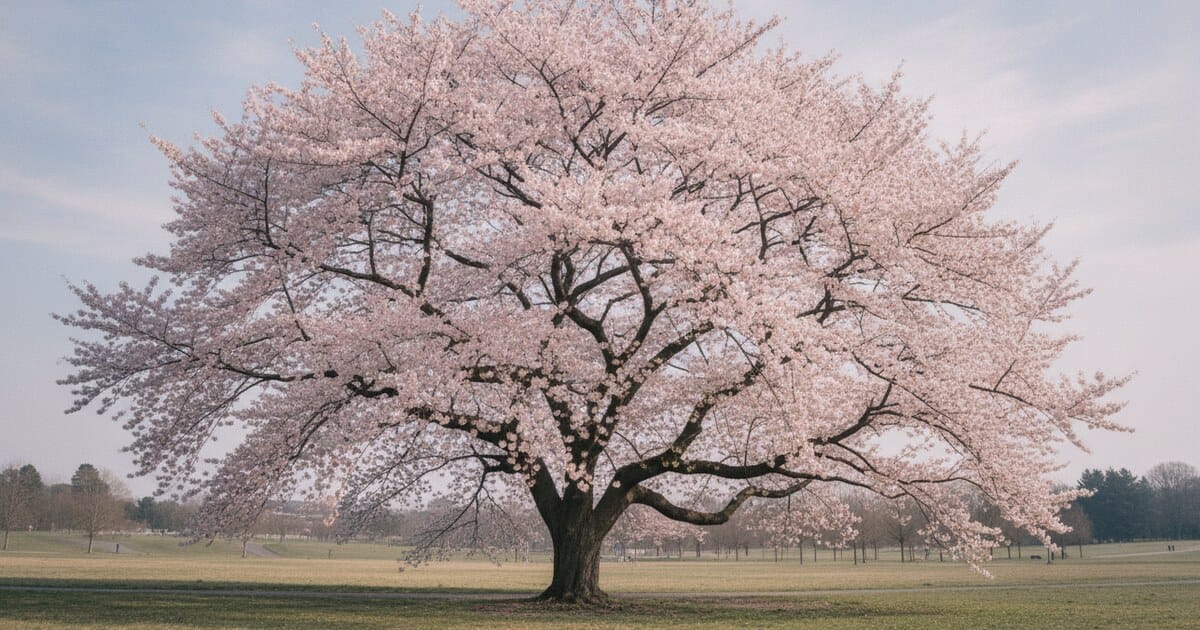
Few trees stop people the way a sakura tree does. For about two weeks in spring, it pushes out clouds of pink and white flowers before a single leaf appears. The bloom is so brief and striking that Japan built a national tradition around watching it. Outside Japan, though, “sakura tree” covers a whole group of ornamental cherry species, and knowing which one you’re looking at takes more than admiring the flowers. This guide covers the four key identification markers (flower structure, leaf shape, bark, and bud pattern) plus how to tell sakura apart from similar-looking trees like crabapple and ornamental pear.
A sakura tree is an ornamental Prunus species, specifically Prunus serrulata or Prunus × yedoensis (Yoshino cherry). These trees grow 15-30 feet tall and bloom 7-14 days in early spring before the leaves open. The key identification markers are 5-petaled flower clusters of 2-5 blooms, sharply serrated oval leaves, and reddish-brown bark with horizontal lenticel banding.
What Is a Sakura Tree?
Sakura (桜) is Japanese for “cherry blossom.” In horticulture, it refers to a group of ornamental Prunus species bred for spring flowers rather than edible fruit. The main species are:
- Prunus serrulata (Japanese flowering cherry): cultivated in Japan for over 1,000 years, ancestor of most named garden varieties
- Prunus × yedoensis (Yoshino cherry): a natural hybrid first noticed in Tokyo around 1872, now the most planted sakura worldwide
- Prunus speciosa (Oshima cherry): large-flowered coastal species, parent of many white-flowered cultivars
- Prunus subhirtella (spring cherry): small-flowered, used in autumn-blooming cultivars like ‘Autumnalis’
Sakura trees belong to the genus Prunus and encompass dozens of cultivated varieties bred from wild species native to Japan, China, and Korea. Prunus serrulata has been cultivated in Japan for over 1,000 years and is the ancestor of most named garden cultivars. The most widely planted variety today is the Yoshino cherry (Prunus × yedoensis), a hybrid first noticed in Tokyo around 1872.
Yoshino cherries make up roughly 70% of the 3,800 cherry trees around Washington D.C.’s Tidal Basin: 3,020 trees across 12 varieties, gifted in 1912 by Tokyo Mayor Yukio Ozaki as a gesture of friendship. Sakura trees typically grow 15-30 feet tall and bloom for 7-14 days. Tokyo’s bloom dates have shifted roughly 10 days earlier over the past 60 years, making sakura phenology one of the longest climate records maintained by any city.
For a broader look at the cherry family, see our cherry tree identification guide.
How to Identify a Sakura Tree: 4 Key Features
1. Flowers
Sakura flowers appear before the leaves. This is the single most reliable early ID marker. Each flower has 5 petals (or multiples of 5 in double-flowered cultivars) ranging from white to deep pink. Look at the tip of each petal for a small notch.
Flower clusters (corymbs) hold 2-5 blooms, each on its own stalk, all emerging from the same point on the branch. The calyx tube (the green cup behind the petals) is smooth and slightly reddish on most varieties. This distinguishes sakura from crabapple flowers, where the calyx develops into a small fruit.
2. Leaves
Sakura leaves emerge after or alongside the flowers, often copper-bronze when young and darkening to glossy deep green by summer. Key markers:
- Ovate to elliptic shape, 2-5 inches long and 1-2 inches wide
- Sharply double-serrated margins (fine teeth with smaller teeth on top of each larger tooth)
- 1-2 small rounded glands at the base of the leaf blade where it meets the petiole
- Petiole (leaf stalk) is reddish-brown
The glands at the petiole base are a reliable botanical marker. Most ornamental cherries have them; crabapple and ornamental pear don’t.
3. Bark
Sakura bark is one of the most distinctive features and works for ID year-round. The key pattern is horizontal banding: prominent lenticels (pores) that ring the branch or trunk in thin lines, giving the bark a banded look.
Young bark is reddish-brown, smooth, and slightly glossy. On older trunks it darkens to grey-brown and may develop shallow, horizontal fissures following the lenticel lines. It doesn’t form the deep furrows of an oak or the chunky plates of a black cherry. Sakura bark stays relatively smooth throughout its life.
4. Winter Buds
In winter, before any flowers or leaves, the buds are your main ID tool. Sakura buds cluster at branch tips in tight groups of 2-4 plump, rounded flower buds, each about 4-6mm long. They’re reddish-brown, slightly pointed, with several scales visible.
This clustered-bud pattern at the tip is different from many other trees, where buds are solitary and evenly spaced along the branch.
Sakura Tree Varieties and How to Tell Them Apart
Five varieties make up most of what you’ll see in parks and gardens across North America and Europe.
Yoshino Cherry (Prunus × yedoensis) Single, pale pink flowers that fade to white as they open. Blooms early, among the first sakura each spring. Grows to 40 feet with a broad, slightly arching crown. Light almond fragrance when you lean into the flowers.
Kwanzan (Prunus serrulata ‘Kanzan’) The easiest sakura to identify: double flowers with up to 30 petals each in vivid deep pink. The heavy flower clusters droop slightly. Vase-shaped when young, spreading with age. Blooms about 2 weeks after Yoshino and has no fragrance. If you see a sakura with thick, puffy, intensely pink blooms, it’s almost certainly Kwanzan.
Weeping Cherry (Prunus pendula) Drooping branches that cascade nearly to the ground. Flowers are small (around 3/4 inch), single or semi-double, pink to deep rose. The weeping habit is a cultivar characteristic. The flowers and leaves are otherwise standard. Usually 15-20 feet tall and wide.
Okame Cherry (Prunus ‘Okame’) One of the earliest to bloom, sometimes in late February in warmer zones. Small, rose-pink single flowers with a slightly carmine-red calyx. Narrow upright form at 20-25 feet. Unusually good fall color (orange-yellow) for an ornamental cherry.
Shirotae / Mount Fuji (Prunus serrulata ‘Shirotae’) Pure white, lightly fragrant semi-double flowers with slightly frilled petals. Broad, flat-spreading canopy (almost table-flat when mature). One of the longest-blooming white varieties. The strongly horizontal branch structure makes it easy to spot even without flowers.
When and Where Sakura Trees Bloom
Sakura bloom timing is temperature-driven. Flowers open after the daily mean temperature averages around 50-60°F (10-15°C) for several consecutive days. That places peak bloom at:
- Zones 5-6 (northern US, UK): April to early May
- Zones 7-8 (mid-Atlantic, Pacific Northwest, southern England): late March to mid-April
- Zones 9-10 (southern California, coastal areas): February to early March
Peak bloom lasts 7-14 days. Rain and wind cut it short; dry, cool weather extends it. The falling-petal phase that follows, called hanafubuki (“flower blizzard”) in Japanese, is as celebrated as the bloom itself. Petals drift in sheets even on still days, loosened by their own weight.
Most sakura varieties are hardy in USDA zones 5-8. They want full sun (6+ hours daily) and well-drained soil. Waterlogged roots are the fastest way to kill one.
Sakura vs. Similar Trees: How to Avoid Confusion
Sakura vs. Crabapple Both bloom in spring with 5-petaled flowers in pink or white. The clearest difference is the fruit: sakura produces small dark-red to black cherries in summer; crabapple produces small apple-like fruits (even if tiny). On the tree itself, crabapple leaves tend to be broader and more rounded with less sharp serrations, and crabapple bark doesn’t have sakura’s clean horizontal banding. The calyx on a crabapple flower stays attached and swells into fruit; on sakura, the calyx drops soon after flowering. See our full crabapple tree identification guide for side-by-side comparisons.
Sakura vs. Wild Black Cherry Wild black cherry (Prunus serotina) also has serrated leaves and clusters of white flowers, but blooms in long hanging chains (racemes of 20-40 flowers), not the rounded two-to-five-flower clusters of sakura. Black cherry bark on mature trees breaks into distinctive dark, plate-like pieces, completely unlike sakura’s smooth banded bark. The two trees also differ sharply in size: black cherry is a forest tree reaching 60-80 feet, while sakura tops out at 30-40 feet. See our black cherry tree identification guide for details.
Sakura vs. Bradford Pear Bradford pear also flowers before its leaves in early spring and can look similar at a distance. Up close, pear petals are rounder and unnotched. Pear leaves are broad-oval with finely scalloped edges rather than sharp double serrations. Pear bark develops vertical furrowing, not horizontal banding. And the smell helps: pear flowers have a sharp, slightly unpleasant odor; most sakura are fragrance-neutral or mildly sweet.
Frequently Asked Questions
Are sakura trees easy to grow? Sakura trees are moderately easy in the right conditions. They need full sun (at least 6 hours daily), well-drained soil, and protection from waterlogged roots. Most ornamental cherry varieties are hardy in USDA zones 5-8. The main challenges are drainage and preventing fungal diseases like blossom wilt and silver leaf, both less common in drier climates with good air circulation.
Do Yoshino cherry trees produce fruit? Yes, Yoshino cherries produce small dark-red to black cherries in summer, but they’re not worth eating. The fruit is tiny (under 1 cm), sour, and mostly stone. Birds eat them readily, and squirrels will strip a tree in a few days. If you want fruiting cherries, you’d plant a different species; Yoshino is bred entirely for flowers.
What do cherry blossoms symbolize? In Japanese culture, sakura represent the transient nature of life: the idea that beauty is precious partly because it doesn’t last. The hanami (flower-viewing) tradition of gathering under blooming trees dates to at least the 8th century CE, when Japanese nobles wrote poetry beneath them. Today it remains one of Japan’s most observed cultural practices.
How long does it take a sakura tree to grow? Most sakura cultivars grow 1-2 feet per year in good conditions. A container-grown specimen reaches blooming size (10-12 feet) in about 5-7 years from planting. Full mature height (15-30 feet for most varieties, up to 40 feet for Yoshino) takes 10-15 years. Grafted cultivars bloom faster than seed-grown trees.
If you’ve spotted a flowering tree and want to confirm the species, the Tree Identifier app can ID it from a photo of the flowers, leaves, or bark. It works offline too, which is handy during a spring park visit. Download it on iOS or Android, or try the free web-based tree identifier to scan a photo right in your browser.
Identify a tree from your photo — free
Upload a leaf, bark, or whole-tree photo and get the species in seconds. No signup.
Confidence:
Unlock the full species profile
Free in the app — with unlimited identifications.


AI result for guidance — the app gives full species details and works offline.
Want unlimited identifications?
Get the full species profile, photos and details — free in the app, with unlimited scans.
- Unlimited identifications
- Full species profiles & details
- Works offline, anywhere
- Save and revisit your finds

Elena Torres
Tree Identifier Team