Shumard Oak Tree Identification: 7 Reliable Signs
Shumard oak is one of the larger and faster-growing red oaks in the South, and if you’ve spotted a big deciduous oak on a river terrace or bottomland edge in Texas, Oklahoma, or across the mid-South, there’s a good chance you’re looking at one. The leaves are large and deeply cut, the acorns have a notably flat base, and the bark on mature trees develops flat-topped gray ridges that stand out once you know what to look for. If you’re working on shumard oak tree identification in the field, the leaf sinuses are where most IDs start.
Shumard oak (Quercus shumardii) is identified by 7 reliable signs: large deeply lobed leaves with C-shaped sinuses cutting more than halfway to the midrib, bristle tips on each lobe, smooth grayish leaf undersides with hair tufts in vein axils, flat-based acorns with a shallow cup covering roughly 25% of the nut, gray-brown bark with flat-topped scaly ridges, bottomland or moist upland habitat across the southeastern and south-central US, and a mature size of 70-100 feet.
Shumard Oak Identification: Key Features at a Glance
Shumard oak belongs to the red oak group (subgenus Lobatae). Its lobe tips carry forward-pointing bristle tips, its acorns take two full years to mature, and the leaf sinuses are the open, C-to-U-shaped cuts typical of this subgroup.
Within the red oak group, shumard oak is most often confused with red oak (Quercus rubra), scarlet oak (Quercus coccinea), and Texas red oak (Quercus buckleyi). Sorting them out requires a close look at the sinuses and the acorn.
Shumard oak (Quercus shumardii), also called Shumard’s red oak or Shumard’s oak, is a native hardwood found from Pennsylvania and New Jersey south through the Atlantic and Gulf Coastal Plains to Florida, then west through the Gulf States to Kansas and central Texas. In the right habitat it grows 70-100 feet tall and spreads to a broad, open crown. The trunk is typically straight and well-formed, with diameter reaching 2-3 feet on older trees. It’s a fast grower for an oak, adding roughly 2 feet per year under good conditions, which makes it a popular urban and park planting across the Southeast and Texas. The species is named after Benjamin Franklin Shumard, a Texas state geologist in the 1800s who collected botanical specimens across the region. Shumard oak is also a significant mast producer: its large acorns are consumed by white-tailed deer, wild turkeys, wood ducks, and squirrels, and it ranks among the more valuable acorn-producing species in the red oak group across its range.
Shumard Oak Leaf Identification
The leaves are the starting point for most field IDs, and shumard oak’s are distinctive once you get the sinus shape locked in.
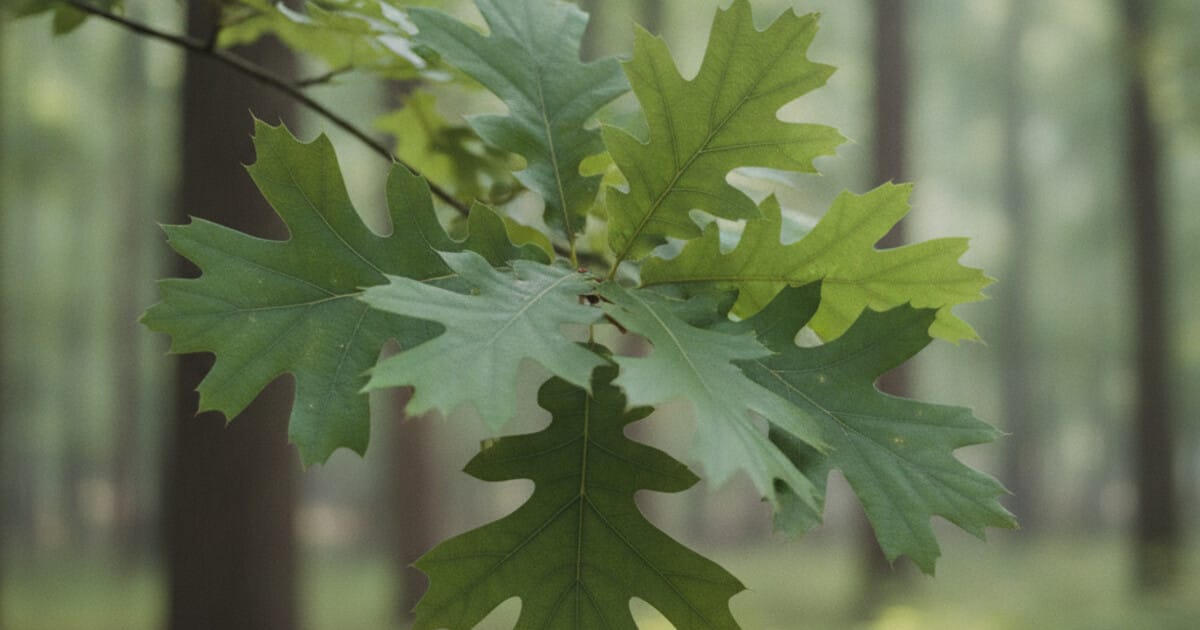
Leaves run 5-9 inches long with 7-9 lobes. The key feature is the sinus shape: the cuts between lobes go more than halfway to the midrib and form a rounded C or U opening. The lobes themselves are relatively slender and forward-pointing, with 2-4 bristle tips per lobe. The overall outline of the leaf looks like a bold, splayed hand with generous space between each finger.
The upper surface is dark green, smooth, and glossy. The underside is paler and hairless except for small tufts of hair in the axils (the junction points) where secondary veins meet the midrib. Those axil tufts are worth checking in the field: run a fingernail gently along the underside and feel for the small fuzzy clumps near the vein junctions.
In fall, shumard oak colors up in shades of red, scarlet, or russet-brown, often holding leaves into late autumn. Color varies by individual and site.
Comparing shumard oak to red oak: both have similar leaf size, but red oak’s sinuses are shallower, not cutting as deeply toward the midrib, and the lobes are somewhat broader. Shumard oak has more pronounced sinus depth with a more defined C-shape. The red oak tree identification guide covers the comparison in detail.
Comparing shumard oak to scarlet oak: scarlet oak’s sinuses cut extremely deeply, often more than 80% of the way to the midrib, leaving very slender lobe bases that look almost skeletal. Shumard oak’s lobes stay connected with a more generous base. The scarlet oak tree identification guide walks through those distinctions.
Shumard Oak Bark and Tree Shape
Young shumard oaks have smooth, silvery-gray bark similar to many red oak group members. As the tree ages, the bark breaks into flat-topped, scaly ridges separated by dark furrows. Compared to red oak, which develops broad gray ridges with a shinier flat surface, shumard oak’s ridges are somewhat narrower and scalier. The overall impression on a mature trunk is gray plating with moderate furrowing.
Crown shape is broad and rounded on open-grown trees, with well-spaced ascending branches forming an open canopy. In forest settings the crown narrows and lifts higher. Shumard oak tends to hold a straight central trunk longer than pin oak, which often forks lower, and it doesn’t have pin oak’s characteristic strongly drooping lower branches. Those shape differences are enough to tell the two apart by silhouette on a clear day.
Twigs are slender, reddish-brown to grayish-brown, and hairless. Buds are gray-brown, small to medium, clustered at twig tips. Bud color leans a bit grayer than red oak’s reddish-brown buds, though this varies and shouldn’t be the primary ID feature.
Shumard Oak Acorns: The Flat-Base Clue
Shumard oak acorns are large for the red oak group, typically 0.75-1 inch in diameter, broadly rounded, and notably flat at the base. The cup is shallow and saucer-shaped, covering roughly 20-25% of the nut. The cup scales are small, flat, and tightly pressed, creating a smooth-looking cup surface.
The flat base is the detail that separates shumard oak acorns from red oak acorns in the field. Red oak acorns are also large and broadly rounded, but they have a more gradually tapered base rather than the distinctly flat, disc-like base on shumard oak. Place an acorn on a flat surface: shumard oak’s sits squarely without rocking; red oak’s often wobbles slightly.
Acorns ripen in the second autumn after pollination, typical for red oak group members, falling from September through November. They’re a primary food source for wildlife in bottomland and upland forest systems throughout the range.
If you find large, flat-bottomed acorns in a bottomland or riverside forest in the Southeast or Texas, shumard oak is the first species to check. The pin oak tree identification article is useful here for comparison: pin oak acorns are much smaller and rounder, making that distinction quick.
Shumard Oak Habitat and Range
Shumard oak is most common on river terraces, bottomland floodplains, and moist-to-mesic upland slopes. It grows alongside swamp chestnut oak, water oak, willow oak, green ash, sweetgum, and American elm in bottomland settings. On upland sites it mixes with other red oaks and hickories.
Its native range covers a broad stretch of the eastern US: from western Pennsylvania and New Jersey south through the Piedmont and Atlantic Coastal Plain to Florida, then west through Alabama, Mississippi, Arkansas, Missouri, Oklahoma, and eastern Kansas into central Texas. It’s one of the most widespread red oaks across the South-Central region.
In Texas, shumard oak is common in the eastern third of the state and into the Hill Country, where it often grows alongside live oak and escarpment oaks. In urban settings across Texas and Oklahoma it’s been planted widely as a shade and street tree because of its fast growth and reliable fall color.
Outside its natural range, shumard oak is planted in parks and campuses across the eastern US into Midwestern states. Planted specimens often grow in more upland, better-drained sites than they’d naturally choose, so habitat alone won’t always confirm the ID.
How Tree Identifier Helps with Shumard Oak Identification
Shumard oak photos work well for AI identification because the leaves have a distinctive outline and the acorns have that flat-bottomed profile that the app can read clearly.
Tree Identifier accepts photos of leaves, bark, acorns, and whole trees. If you’ve found a large red oak group tree in a bottomland setting in the South or Texas and you’re not sure whether it’s shumard, red, or scarlet oak, submit a leaf photo and an acorn photo together. The app’s AI assigns a confidence score to each identification, so you can see how certain the match is.
The app’s offline mode is worth knowing about for bottomland hikes where cell signal isn’t reliable. Download the species data beforehand and you can run identifications in remote floodplain forest without needing a connection.
Tree Identifier is free to start with 2 identifications per day. If you’re out on a walk and come across a promising oak, you can get a same-day answer.
Frequently Asked Questions
What makes shumard oak different from red oak?
The main differences are sinus depth and acorn base shape. Shumard oak’s leaf sinuses cut more than halfway to the midrib with a pronounced C or U shape, while red oak’s sinuses are shallower and the lobes broader. Shumard oak acorns have a distinctly flat base and a shallow saucer-like cup; red oak acorns have a more gradually tapered base. Bark on mature trees looks similar in both, but shumard oak’s ridges tend to be narrower and scalier than red oak’s broader flat-topped plating.
Is shumard oak a red oak or white oak?
Shumard oak is in the red oak group (subgenus Lobatae). The two tells are the bristle tips on each leaf lobe and the 2-year acorn maturation cycle. White oak group members have rounded lobe tips with no bristle points, and their acorns mature in a single season. Shumard oak’s acorns don’t ripen until their second fall.
Where does shumard oak grow?
Shumard oak is native to the eastern and south-central US, from Pennsylvania and New Jersey south through the Atlantic Coastal Plain to Florida, and west through the Gulf States to eastern Kansas and central Texas. It favors river terraces, moist bottomland floodplains, and well-drained upland slopes. It’s also widely planted as a street and shade tree across Texas, Oklahoma, and the broader Southeast.
How big does shumard oak get?
Mature shumard oaks reach 70-100 feet tall with a broad, open crown and a trunk diameter of 2-3 feet. In good conditions with room to spread, open-grown trees can reach proportions similar to large red oaks. It’s a relatively fast grower for an oak, adding about 2 feet of height per year when young.
Can I identify shumard oak without acorns?
Yes. The leaves are reliable enough for a field ID when acorns aren’t present. Focus on sinus depth (more than halfway to the midrib, C-to-U shaped), the overall leaf outline (large, deeply lobed, with bristle tips), and the hair tufts in vein axils on the underside. Bark on mature trees with flat-topped gray ridges and a large, broad crown also help narrow things down. If you’re still uncertain, a photo submitted to Tree Identifier can confirm the species with a confidence score.
If you’re walking through bottomland or river terrace in the Southeast or Texas and spot a large, deeply lobed oak, snap a photo with the Tree Identifier app. Submit the leaf, acorn, or bark and get a species ID with a confidence score. Download it at treeidentifier.app on iOS or Android.
Identify a tree from your photo — free
Upload a leaf, bark, or whole-tree photo and get the species in seconds. No signup.
Confidence:
Unlock the full species profile
Free in the app — with unlimited identifications.


AI result for guidance — the app gives full species details and works offline.
Want unlimited identifications?
Get the full species profile, photos and details — free in the app, with unlimited scans.
- Unlimited identifications
- Full species profiles & details
- Works offline, anywhere
- Save and revisit your finds
Elena Torres
Tree Identifier Team