Tree of Heaven Identification: 6 Clear Signs
Tree of Heaven Identification: 6 Clear Signs
Every city block has at least one. Tree of heaven (Ailanthus altissima) grows through sidewalk cracks, colonizes empty lots, and shoots up 8 feet in a single summer. It’s one of the most common trees in North America, found in all 48 continental states, yet most people have no idea what they’re looking at. If you’ve spotted a fast-growing tree with enormous compound leaves and can’t quite place it, this guide will settle it.
Tree of heaven identification comes down to 6 features: compound leaves with 11-25 leaflets, gland-tipped teeth at the base of each leaflet, a strong pungent smell when crushed, smooth light gray bark, large clusters of winged samaras in late summer, and aggressive root sprouting around the trunk base. Finding 3 or more of these on the same tree confirms the ID.
Standing in front of one? Identify it from a photo in seconds — free, no sign-up needed.
What Tree of Heaven Looks Like
Tree of heaven (Ailanthus altissima) is native to northern China and Taiwan, introduced to North America in 1784 as an ornamental tree. It now grows in all 48 continental US states and is listed as invasive in most of them. The tree spreads both by seed (a single female tree can produce up to 300,000 seeds per year) and by root sprouts that emerge from underground runners. It tolerates pollution, drought, poor soil, and deep shade, which is why it thrives in urban environments, railway corridors, and abandoned lots. Mature trees reach 40-60 feet tall with wide, spreading crowns. Young trees grow 6-8 feet per year, one of the fastest growth rates of any temperate tree species in North America. That rapid growth and prolific seeding make early identification useful. The sooner you know what you’re dealing with, the more removal options you have.
The overall shape is hard to miss once you’ve seen it. Young trees have a gangly, almost tropical look, often just a single stem with enormous leaves shooting out from every node. Older trees develop a broader canopy with large, upward-sweeping branches. The trunk stays relatively narrow for the tree’s height.
Tree of Heaven Leaf Identification
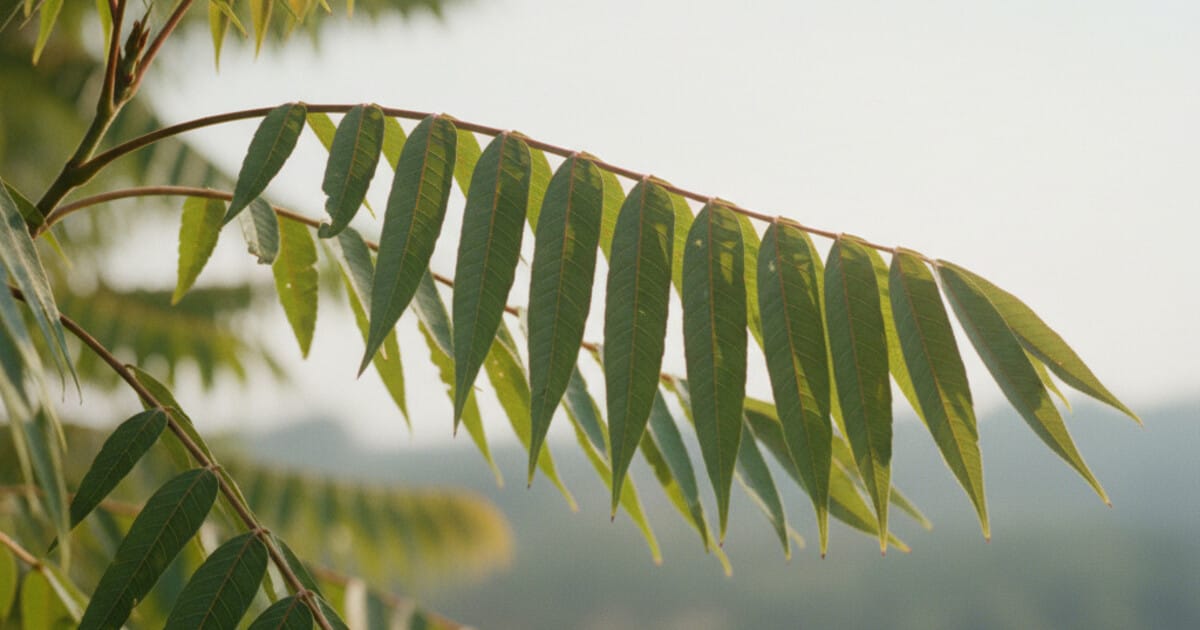
The leaves are where tree of heaven identification becomes definitive. Each leaf is compound, meaning it’s built from many smaller leaflets arranged along a central stem. A single leaf can run 1-4 feet long, with 11-25 leaflets arranged in pairs with one terminal leaflet at the tip.
Each leaflet is lance-shaped, 3-5 inches long, with smooth edges along most of its length. At the base of each leaflet, look close: there are 1-4 small teeth, each tipped with a tiny gland. That gland-tipped basal tooth is tree of heaven’s most reliable diagnostic feature. No other common lookalike has it. You’ll need to get up close and a hand lens helps, but once you see it, you won’t confuse this tree with anything else.
The leaves grow in an alternate pattern along the branch, staggered on each side rather than in facing pairs. That arrangement rules out ash, which also has large compound leaves but always in an opposite (facing) configuration.
For context on how tree of heaven compares to other compound-leaf species, our guide to trees with compound leaves covers the field well.
The Smell Test
You don’t need a hand lens for this one. Crush a leaflet, snap a small stem, or rub a leaf between your fingers. Tree of heaven produces a distinctive pungent odor, often described as rancid peanut butter, strong musk, or cat urine. Some people find it mildly unpleasant; others find it pretty strong.
The smell comes from resin glands throughout the plant, the same glands that produce the tiny tips on each leaflet’s basal teeth. It’s strongest on warm days and on fresh growth in spring and early summer, but even older leaves release it when rubbed.
This is the fastest field check available when you’re not sure. A large compound-leaf tree that smells pungent when crushed narrows your list down fast. Combined with the gland-tipped teeth, those two features together close most identification questions.
Tree of Heaven Bark Identification
On young trees and branches, the bark is smooth, light gray, and often marked with pale stripes or faint lines running vertically. It doesn’t furrow deeply even on mature trees. Older trunks develop a texture sometimes compared to cantaloupe skin: interlacing shallow ridges over a pale gray background, but never the deep diamond furrows of ash or the shaggy plates of shagbark hickory.
Cut a twig and the pith inside is large, pale yellow, and spongy. Leaf scars (where leaves were attached before falling) are large and heart-shaped, prominent in winter when the leaves are gone.
Root sprouting is another bark-level sign. If you see multiple fast-growing stems shooting up from the ground around an existing tree, or young stems emerging through pavement nearby, that’s tree of heaven’s root suckering at work. Each sprout can become a new tree within a few years, which is part of why this species is so hard to control once established.
Tree of Heaven Seed Identification
Female trees produce large, distinctive seed clusters in summer and early fall. Each seed is a samara, an elongated, paper-thin wing with the seed sitting in its center. Individual samaras are 1-2 inches long, twisted slightly in the middle, and turn from green to reddish-tan as they ripen. The clusters are dense and can hold hundreds of samaras, sometimes drooping with their own weight at branch tips.
A single female tree can produce 300,000 seeds in a productive year. Wind carries them hundreds of feet from the parent tree, which is why tree of heaven colonizes new sites so quickly.
If you spot these clusters in late summer or early fall, identification is nearly certain. For the rest of the year, leaves, smell, and bark are your primary tools.
Tree of Heaven vs Common Lookalikes
Several trees with large compound leaves get mixed up with tree of heaven. Here’s how to split them.
Tree of heaven vs Ash
Ash is the most common confusion. Both trees have large compound leaves with similarly shaped leaflets. The critical difference is arrangement: ash leaves grow opposite on the branch, in facing pairs. Tree of heaven leaves are alternate, staggered on each side. Check the branching pattern first — it’s the fastest split.
Ash leaflets don’t have gland-tipped basal teeth, and mature ash bark develops distinctive diamond-shaped ridges, quite different from tree of heaven’s smoother pale gray surface. Our ash tree identification guide has a full side-by-side breakdown.
Tree of heaven vs Black Walnut
Black walnut also has large alternate compound leaves, but the leaflets have fine teeth along their entire edge (not just the base), and the tree produces round green husks that turn black when ripe — no samaras. Crushed walnut leaves smell nutty, not pungent.
Tree of heaven vs Staghorn Sumac
Staghorn sumac grows in similar disturbed habitats and has large compound leaves. The differences: sumac leaflets have teeth along the full edge, the stems are covered in dense reddish hair, and it produces upright clusters of red berries rather than winged samaras. Sumac also stays much shorter, typically 15-25 feet, and often grows in dense colonies rather than as single large trees.
Tree of heaven vs Honey Locust
Honey locust has similarly large compound leaves and tolerates urban conditions just as well. But honey locust leaflets are much smaller (under 2 inches), the trunk and branches carry clusters of large, branching thorns, and the tree produces long flat seed pods instead of samaras.
Tree of heaven vs Elderberry
Elderberry is smaller overall, rarely exceeding 20 feet, with leaflets that are smaller and often slightly serrated. It produces clusters of small dark berries in late summer, not samaras, and doesn’t have the distinctive pungent smell when crushed.
Tree of heaven’s invasive history and impact sit alongside other problem species in our guide to invasive tree species in North America.
How Tree Identifier App Can Help
If you’ve found a tree that matches most of these features and want a confirmed ID, Tree Identifier handles it quickly. Take a clear photo of a leaf cluster — aim to get the full compound leaf with several leaflets visible, ideally showing the leaflet base where the gland-tipped teeth are.
The app runs the photo through AI trained on thousands of species and returns an identification with a confidence score. It also shows the key characteristics for that species, so you can cross-check against what you’re seeing in front of you.
For multiple confirmation points, photograph the bark and seed clusters separately. Each photo is processed independently. Tree Identifier also works offline — download the species data before you head out and the app runs without cell service, which matters when you’re checking a tree in an area without coverage.
You get 2 free identifications per day, enough to check the same tree from different angles if you want extra certainty.
Frequently Asked Questions
Is tree of heaven dangerous to humans?
Tree of heaven isn’t dangerous to touch or be around. Some people experience mild skin irritation from sap contact, but it’s not toxic in the usual sense. The main concern is ecological: it’s highly invasive, spreads rapidly, and crowds out native vegetation. Many states list it as an invasive species and recommend removal from private property.
Why does tree of heaven smell bad?
The unpleasant odor comes from compounds in the plant’s resin glands, the same glands that produce the tiny gland-tipped teeth at the base of each leaflet. The smell is strongest when leaves or stems are crushed and on warm days in spring and summer. It’s one of the most reliable field identification features the tree has.
How do I tell tree of heaven from ash trees?
Check whether the leaves grow opposite each other on the branch or alternate (staggered). Ash leaves are opposite; tree of heaven leaves are alternate. Then look for the gland-tipped basal teeth on each leaflet; ash leaflets don’t have these. Ash bark also develops distinctive diamond-shaped ridges that tree of heaven never develops.
How fast does tree of heaven grow?
Under good conditions, tree of heaven adds 6-8 feet per year. A seedling can become a 20-foot tree in 3-4 years. Root sprouts grow even faster because they draw from an established root system. This rate is among the highest of any broadleaf tree in North America.
How do I get rid of tree of heaven?
Cutting alone triggers aggressive root sprouting and can make the problem worse. Effective removal combines cutting with herbicide applied directly to the cut stump or painted onto a strip of bark near the base. Late summer is the best timing; the tree is moving nutrients toward its roots then, which carries the herbicide deeper into the root system. For large or established trees, a certified arborist or local cooperative extension office can advise on the right approach.
Conclusion
Tree of heaven is everywhere, and it’s almost always unidentified. The gland-tipped basal teeth on the leaflets, the pungent smell when crushed, and the smooth pale gray bark narrow it down fast. Add the alternate leaf arrangement and winged seed clusters in late summer, and you’ve got a confident identification.
If you want to confirm from a photo, Tree Identifier processes the image in seconds and returns the species with a confidence score — no botanical training required.
Identify a tree from your photo — free
Upload a leaf, bark, or whole-tree photo and get the species in seconds. No signup.
Confidence:
Unlock the full species profile
Free in the app — with unlimited identifications.


AI result for guidance — the app gives full species details and works offline.
Want unlimited identifications?
Get the full species profile, photos and details — free in the app, with unlimited scans.
- Unlimited identifications
- Full species profiles & details
- Works offline, anywhere
- Save and revisit your finds
Elena Torres
Tree Identifier Team