Trees With Fuzzy Leaves: 8 Species Identified
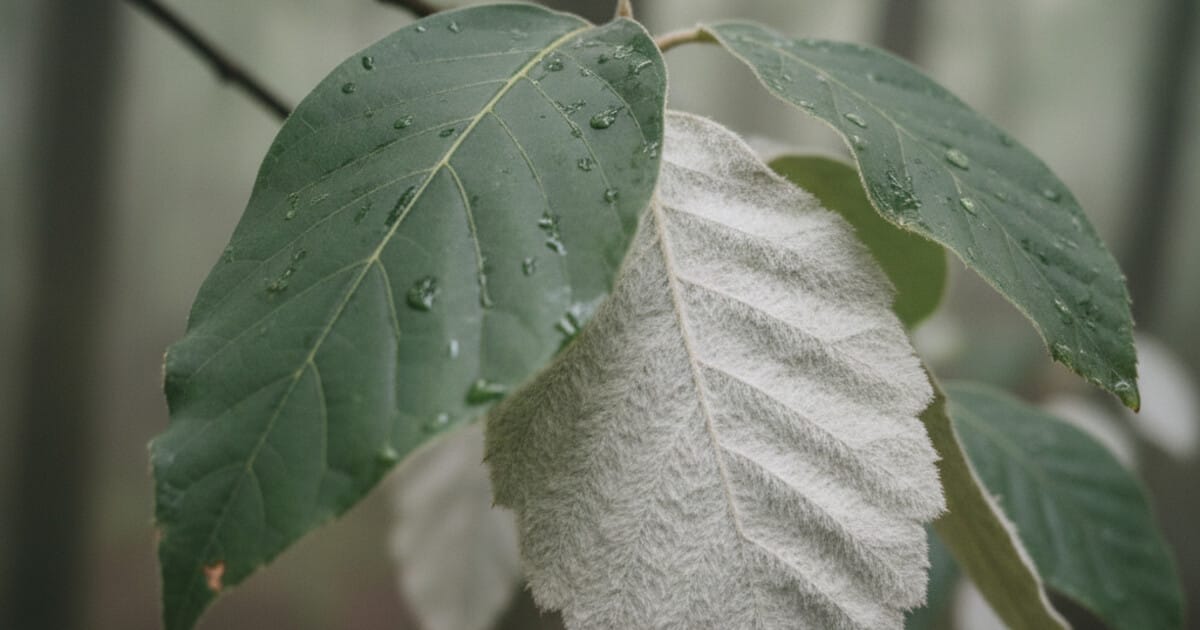
Run your finger along a leaf and it feels like sandpaper, fine wool, or velvet. That texture isn’t random. Leaf fuzziness (called pubescence in botany) is a survival trait, and it’s one of the more reliable ID clues you can use in summer when flowers are gone and seed pods haven’t formed yet. Trees with fuzzy leaves show up across every climate zone in North America, from slippery elm on floodplains to velvet ash along desert streams. Once you know what to look for, a quick touch can narrow your ID considerably. This guide covers 8 North American trees with notably fuzzy or hairy leaves, what the texture tells you about each species, and how to pair it with other features for a confident identification.
Common trees with fuzzy or hairy leaves include slippery elm, hackberry, red mulberry, bigleaf magnolia, silver poplar, downy hawthorn, American basswood, and velvet ash. The fuzziness comes from tiny hair-like structures called trichomes on the leaf surface. These hairs reduce moisture loss, reflect intense sunlight, and deter some insects. Most fuzzy-leaved trees have hairy undersides; a few are rough or hairy on both surfaces.
What Makes Tree Leaves Fuzzy?
Leaf fuzziness is caused by trichomes: microscopic hair-like growths on the leaf surface. Botanists categorize them by density and feel: pubescent (soft, fine hairs), tomentose (dense, matted felt), scabrous (stiff, sandpapery), and hirsute (coarse, bristly). Each category points to a different group of trees and a different evolutionary reason for the texture.
Pubescence evolved primarily as a moisture-management tool. Leaves covered in fine hairs trap a thin layer of still air near the surface, which slows water evaporation through the leaf, a process called transpiration. In species like silver poplar and velvet ash, this adaptation is particularly visible: velvet ash grows along hot desert streams in the Southwest and can lose significantly less water than a smooth-leaved species would under the same conditions. The hairs also scatter incoming sunlight before it reaches the leaf cells, reducing heat buildup during peak afternoon hours. In some species, trichomes deter insect feeding by making it physically harder for small insects to grip and move across the surface. Hackberry and slippery elm use this strategy; their sandpapery textures discourage aphids and scale insects even without chemical defenses. The texture each species evolved tells you something about where it grows and the stresses it’s adapted to handle.
One key identification tip: check both surfaces separately. The upper side and underside of a leaf can have completely different textures. Bigleaf magnolia has a smooth, shiny upper surface but a dense velvety white underside. American basswood feels mostly smooth on top but has small tufts of hairs tucked into the vein axils below. This distinction can help you narrow down species quickly in the field.
8 Trees With Fuzzy Leaves
1. Slippery Elm (Ulmus rubra)
Slippery elm is one of the roughest-leaved trees in eastern North America. Both the upper and lower surfaces feel like fine-grit sandpaper, a scabrous texture caused by stiff, coarse hairs that don’t soften as the leaf matures. The leaves are oval, strongly asymmetric at the base, and doubly serrated along the edges.
This roughness separates slippery elm from American elm, whose leaves are softer and mostly smooth above. The quick test: drag your finger from tip to base across the upper surface. If it feels scratchy in both directions, you’re almost certainly looking at slippery elm. Trees with serrated leaves walks through the leaf edge distinctions across elm, hackberry, and other common species in the same family.
2. Hackberry (Celtis occidentalis)
Hackberry leaves are sandpapery on the upper surface and slightly hairy below, particularly along the veins. The roughness feels like coarse-woven burlap: stiff, not soft. Combined with three prominent veins at the base and a strongly asymmetric leaf shape, this texture is a reliable field clue.
Hackberry grows in urban environments, along rivers, and in disturbed soils across a huge range. Its leaves are oblong-lanceolate, sharply toothed, and typically 2-4 inches long. The rough texture stays consistent through summer as the leaf matures, which makes it useful all season. For a full breakdown of bark, fruit, and range, hackberry tree identification covers everything you need.
3. Red Mulberry (Morus rubra)
Red mulberry leaves vary a lot: some are simple ovals, others are deeply lobed with 2-3 rounded lobes, sometimes on the same branch. What they share is a rough, hairy upper surface and a softly hairy underside. The upper surface feels scratchy; the underside feels more downy and pliable.
This roughness is more pronounced in red mulberry than in white mulberry (Morus alba), whose leaves are smoother. If you’re feeling fuzzy mulberry leaves on a tree with dark purple-red fruit ripening in summer, you’re almost certainly looking at the native species. Trees with lobed leaves covers the lobing variation in mulberry and other species where leaf shape is inconsistent.
4. Bigleaf Magnolia (Magnolia macrophylla)
Bigleaf magnolia has the largest leaves of any native North American tree, often 20-30 inches long and 10 inches wide. The upper surface is smooth and pale green. Flip the leaf over and you find a dense, white, velvety coating that feels like soft felt. This woolly underside (tomentose texture) is one of the most striking leaf features in eastern North American forests.
The sheer size makes bigleaf magnolia hard to confuse with much else. It grows in sheltered coves and ravines in the Appalachians and along the Gulf Coastal Plain. In summer it produces enormous white flowers, sometimes 12 inches across. The velvety underside helps manage heat reflection across such a large leaf surface, which would otherwise overheat in direct sun.
5. Silver Poplar (Populus alba)
Silver poplar leaves have a white, woolly underside that’s cottony to the touch. The upper surface is dark green and smooth, but the underside is densely covered in white, felt-like hairs that cling to your finger when you press gently. When the wind blows, the leaves flip and show their white undersides, giving the tree a shimmering, two-toned appearance.
Silver poplar is European in origin but widely naturalized across North America as an ornamental and escaped tree. The leaves vary in shape: maple-like with 3-5 lobes on long shoots, more rounded on short shoots. The woolly white underside is consistent across both leaf types and is the most reliable way to confirm the species without fruit or bark.
6. Downy Hawthorn (Crataegus mollis)
Downy hawthorn gets its name from the dense, woolly hairs on its young leaves and shoots. “Mollis” is Latin for soft, and the spring leaves genuinely feel like they’re covered in fine down. By late summer, the upper surface sheds some hairs and becomes less fuzzy, though the underside stays hairy along the veins throughout the season.
Leaves are broadly oval with pointed lobes and toothed edges. Downy hawthorn grows as a large shrub or small tree (up to 35 feet) in open woodlands, roadsides, and pasture edges across the eastern half of North America. White flowers in spring and red haws in fall help confirm the ID when you’re not sure between hawthorn species.
7. American Basswood (Tilia americana)
Basswood leaves aren’t heavily fuzzy across the whole surface, but they have a distinctive feature on the underside: small tufts of light brown hairs tucked into the axils where the major veins meet. This axillary tufting is one of the quickest basswood checks once you know to look for it, especially with a hand lens.
The leaves are large (3-6 inches), heart-shaped with an asymmetric base, and coarsely toothed. The upper surface is dark green and mostly smooth. Basswood produces clusters of small, fragrant yellow-white flowers in June and July, hanging from a distinctive wing-like bract attached to the stalk. Linden tree identification covers both American basswood and its European relatives.
8. Velvet Ash (Fraxinus velutina)
Velvet ash grows across the desert Southwest and has compound leaves with 3-5 leaflets, each covered in fine, velvety hairs on both surfaces. The texture is soft rather than scratchy, giving the leaflets an almost dusty feel in dry summer conditions. “Velutina” is Latin for velvety, and the name fits.
The leaflets are 1-2 inches long, lance-shaped to elliptic, and finely toothed. The compound leaves are 4-8 inches long overall and arranged opposite on the twig, which is consistent across all ash species. Velvet ash is one of the few deciduous trees in low-elevation desert riparian areas of Arizona, New Mexico, and adjacent states, making habitat a strong confirming clue.
How to Use Leaf Texture in Tree ID
Texture narrows the field but rarely closes the ID on its own. When you feel a fuzzy or rough leaf, pair that observation with two or three other features before committing to a species:
- Leaf arrangement: Are the leaves opposite or alternate on the twig? Velvet ash and basswood have opposite arrangements. Elm, hackberry, and mulberry are all alternate.
- Leaf shape and edges: Serrated? Lobed? Compound? Each fuzzy species has a distinct shape profile.
- Habitat and range: Slippery elm grows in moist, fertile soils; velvet ash grows along desert streams. Range rules out plenty of candidates quickly.
- Fruit and bark: Hackberry has small purple drupes; basswood has round nutlets hanging from a wing bract; silver poplar has whitish, furrowed bark on older trunks.
Trees with alternate leaves is a useful companion for working through leaf arrangement while you’re in the field.
Touch is an underused sense in tree identification. Many beginners go straight to shape and color, but running a finger across a leaf surface takes two seconds and can separate species that look nearly identical in a photo. Get into the habit of touching leaves, not just looking at them.
How Tree Identifier Helps With Fuzzy-Leaved Trees
Photographing fuzzy leaves can be tricky because texture doesn’t always show up clearly in photos. The Tree Identifier app handles this by analyzing multiple features from a single photo: leaf shape, color, proportions, and visible surface patterns. You get accurate results even when the fuzziness itself doesn’t photograph well.
You can also photograph leaves from both surfaces, the bark, or the whole tree shape to build a stronger ID. The app gives a confidence score for each result so you know how certain the match is. It works offline, which matters when you’re on a remote trail and you’ve just found an unfamiliar tree with woolly undersides or sandpapery leaves and no cell signal to spare. Start with 2 free identifications per day; no subscription required to get going.
Frequently Asked Questions
Why do some trees have fuzzy leaves?
Fuzzy leaves have tiny hair-like structures called trichomes that help the tree manage water and heat. The hairs slow moisture evaporation by trapping still air near the leaf surface, and they scatter intense sunlight to reduce heat damage. Some trees also use coarse leaf hairs to make it physically harder for insects to grip and feed. It’s a survival adaptation that evolved independently across many unrelated tree families.
What is the fuzziest common tree in North America?
Slippery elm is among the roughest-leaved trees in eastern North America, with both surfaces feeling like sandpaper. American basswood is softer, with downy tufts in the vein axils. Bigleaf magnolia has the most dramatic velvety texture: a dense white felt on the underside. For sheer softness, bigleaf magnolia wins, though it’s less widespread than elm or basswood.
Can you tell fuzzy-leaved trees apart by touch alone?
Touch can narrow it down significantly but rarely gives a final answer on its own. Slippery elm’s sandpapery roughness on both surfaces is quite distinct from anything else in its range. Bigleaf magnolia’s white velvety underside is almost unmistakable once you’ve felt it. For most other species, you’ll want to also check leaf shape, size, arrangement, and habitat before committing to an ID.
Do leaves get less fuzzy as the season progresses?
On some species, yes. Downy hawthorn sheds surface hairs as the leaves mature through summer, so late-season leaves are less fluffy than spring growth. On slippery elm and hackberry, the roughness stays consistent all season. Young leaves on almost any tree can feel downier than mid-summer foliage, which is a normal part of leaf development rather than a defining trait.
Is leaf fuzziness visible in photos?
Sometimes, but not reliably. Coarse, sandpapery textures (slippery elm, hackberry) can show up in close-up photos when the light hits the surface at an angle. Soft, downy hairs on undersides often don’t photograph clearly enough to be diagnostic. Leaf texture is best identified by touch in person rather than from a photo, which is one reason a field ID check is worth doing alongside any app-based identification.
Wrapping Up
Fuzzy leaves give you one more tool for summer field identification, when flowers and seed pods aren’t always available. Sandpapery elm and hackberry, velvety magnolia, woolly-bottomed basswood and silver poplar, soft velvet ash. Each texture has a distinct feel that pairs with shape, size, and habitat to close out a confident ID.
If you’ve found a fuzzy-leaved tree you can’t place, the Tree Identifier app can help you work through it. Take a photo of the leaf (both sides if you can), the bark, or the whole tree, and the app cross-references thousands of species to give you a result with a confidence score. Free to try, offline-capable, and no subscription required to get started.
Identify a tree from your photo — free
Upload a leaf, bark, or whole-tree photo and get the species in seconds. No signup.
Confidence:
Unlock the full species profile
Free in the app — with unlimited identifications.


AI result for guidance — the app gives full species details and works offline.
Want unlimited identifications?
Get the full species profile, photos and details — free in the app, with unlimited scans.
- Unlimited identifications
- Full species profiles & details
- Works offline, anywhere
- Save and revisit your finds
Elena Torres
Tree Identifier Team