Trees With Orange Flowers: 9 Species Identified
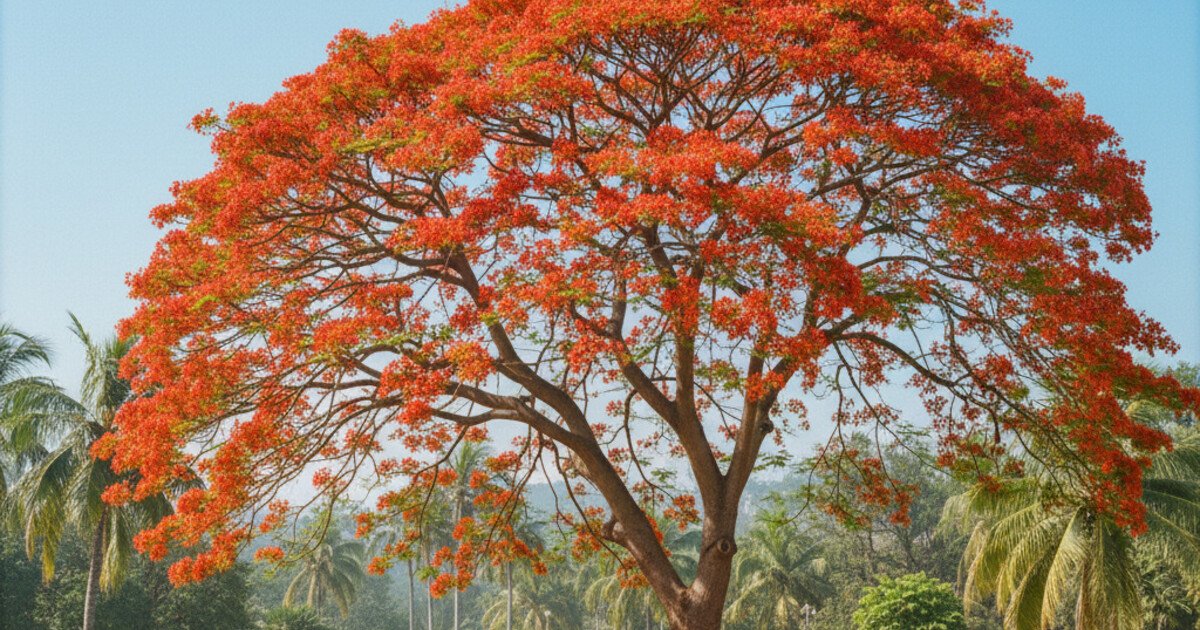
You’re out walking when you see it: a tree blazing with orange blooms, canopy lit up like a fire. Or maybe something smaller at the forest edge, tubular orange-red flowers hanging in tight clusters. Either way, you want to know what it is.
Trees with orange flowers are rarer than white- or pink-flowering trees, which can make them harder to pin down. This guide covers 9 of the most commonly encountered orange-flowering trees in the US, from a tall native of eastern forests to tropical showpieces in Florida and California.
Trees with orange flowers include the tulip tree, royal poinciana, and red buckeye. The tulip tree is the most widespread in eastern North America, producing orange-yellow cup-shaped blooms in late spring. In warm climates, the royal poinciana and African tulip tree both produce vivid orange canopies visible from a distance.
9 Trees With Orange Flowers
Orange-flowering trees are among the most visually dramatic trees in cultivation, yet surprisingly few species produce this color. In eastern North America, the tulip tree (Liriodendron tulipifera) is the primary native species with orange flowers. It blooms from May to June, producing cup-shaped flowers with orange at the base of each petal and yellow-green outer tips. The flowers often go unnoticed because they appear near the tops of 80-120 foot canopies.
In tropical and subtropical climates, the royal poinciana (Delonix regia) produces the most vivid orange display: its canopy turns nearly orange-red during peak bloom from June through August. The red buckeye (Aesculus pavia) offers a better option for gardens in the southeastern US, staying under 20 feet tall. It blooms in April with tubular orange-red flower spikes, making it one of the earliest orange-flowering trees to bloom in the eastern US.
1. Tulip Tree (Liriodendron tulipifera)
The tulip tree is the most widespread orange-flowering tree in eastern North America. It grows from Florida to southern Ontario, reaching 80-120 feet tall, one of the tallest deciduous trees on the continent.
The flowers appear in May and June, shaped like tulips: 6 petals, yellow-green on the outside, with a distinct orange blotch at the base of each. They sit high in the canopy, so fallen petals on the pavement are often the first sign a tulip tree is blooming nearby.
Leaves are one of the most recognizable in North American forests: 4-lobed with a flat or slightly notched tip, like someone snipped the point off. Bark on mature trees shows deep, interlocking gray-brown ridges.
For a detailed look at all the identification features, see the full tulip tree identification guide.
2. Royal Poinciana (Delonix regia)
In full bloom, the royal poinciana’s canopy is almost entirely replaced by flowers. The effect is overwhelming: the whole tree turns orange-red, visible from blocks away. It’s one of the most photographed flowering trees in the world, and for good reason.
Flowers are large, up to 4 inches across, with 5 petals: 4 orange-red and 1 white-streaked with red. Peak bloom runs from June through August in South Florida, Hawaii, and coastal Southern California where it’s commonly planted.
After the flowers drop, long seed pods (up to 2 feet) hang on through fall and winter. The feathery, fern-like compound leaves are distinctive even without the blooms. Royal poinciana needs frost-free winters, so it stays limited to USDA zones 10-12 in the US.
3. Red Buckeye (Aesculus pavia)
The red buckeye is a native understory tree of the southeastern US, usually 10-20 feet tall. Its flowers are tubular and orange-red, packed into upright candle-like clusters (panicles) 4-8 inches tall. They bloom in April and May, some of the earliest orange flowers to appear in the eastern US.
Hummingbirds track red buckeyes closely. The tubular shape and red-orange color are almost purpose-built for hummingbird pollination, so finding one in bloom often means a visit is coming.
Leaves have 5-7 leaflets arranged like an open hand (palmate compound). The fruit is a leathery round capsule with 1-3 glossy brown seeds inside. For a full breakdown of buckeye species, see the buckeye tree identification guide.
4. African Tulip Tree (Spathodea campanulata)
The African tulip tree produces some of the most intense orange flowers of any tree: large, waxy, cup-shaped blooms that range from deep orange to scarlet. Individual flowers reach 4 inches across, and the clusters are dense enough to cover entire branch ends.
Native to tropical Africa, it’s planted widely in Hawaii and South Florida. In Hawaii, it’s classified as invasive, spreading quickly and outcompeting native species. Check local regulations before planting; it’s banned in some counties.
Leaves are large (up to 18 inches) and pinnately compound with 7-17 leaflets. The tree grows 50-80 feet at maturity in ideal conditions.
5. Geiger Tree (Cordia sebestena)
The Geiger tree is native to South Florida and the Caribbean, one of the few orange-flowering trees adapted to salt spray and sandy coastal soil. It’s a common sight in coastal landscapes from the Florida Keys through Miami.
Flowers are bright orange and funnel-shaped, clustered at the tips of branches. They appear year-round in frost-free areas, with the heaviest bloom in spring and summer. The tree stays compact, typically 15-25 feet, with large rough-textured oval leaves.
6. Silky Oak (Grevillea robusta)
Despite the name, silky oak isn’t related to true oaks. It’s an Australian native widely planted as a street tree and garden specimen in California, Hawaii, and parts of Florida.
In spring and early summer, it produces dense clusters of orange, spider-like flowers: each cluster 3-5 inches long, shaped like a bottle brush crossed with a comb. The fern-like leaves (silvery-white on the underside) are distinctive year-round.
At maturity, silky oak reaches 60-100 feet, one of the larger orange-flowering trees in California parks. Like the African tulip tree, it’s invasive in Hawaii.
7. Flame Tree (Brachychiton acerifolius)
Australia’s flame tree puts on one of the more unusual flower shows: in late spring, it drops most of its leaves before the flowers open, so the vivid scarlet-orange blooms appear on nearly bare branches. The contrast is striking.
It’s planted in Southern California, the Gulf Coast, and Hawaii. Most landscape specimens grow 40-60 feet, though the species can reach 120 feet in ideal conditions.
The 5-7 lobed leaves resemble maple leaves, which can create confusion before or after flowering. When the tree is in full bloom with bare branches, nothing else looks quite like it.
8. Coral Tree (Erythrina species)
Coral trees are a large group with over 100 species, several commonly planted in warm US climates. The Cockspur Coral Tree (Erythrina crista-galli) shows up in Gulf Coast gardens; the Kafir Bloom Coral Tree (Erythrina caffra) lines streets across Southern California.
Flowers are pea-shaped and carried in dense clusters at branch tips. They appear in late winter through spring, often before the leaves emerge fully. Color ranges from deep red-orange to orange-yellow depending on the species.
Most coral trees have stout thorns on the trunk and branches, a reliable ID feature. Leaves are compound with 3 leaflets.
9. Orange Champak (Magnolia champaca)
Orange champak is a magnolia relative from Southeast Asia, planted in Florida, Hawaii, and Southern California. The flowers are small (about 2 inches), but the scent is extraordinary: it carries for hundreds of feet and is one of the plants used historically in perfumery.
Color ranges from deep amber to pale apricot depending on the cultivar. The tree grows 30-50 feet with large glossy oval leaves and blooms on and off year-round in frost-free climates.
How to Tell Orange-Flowering Trees Apart
Three things narrow down an orange-flowering tree fast.
Climate zone: Tulip tree and red buckeye grow anywhere in eastern North America. Royal poinciana, African tulip tree, Geiger tree, and champak need frost-free winters (zones 10-12). Flame tree and silky oak do well in Southern California and the Gulf Coast.
Size: Red buckeye stays small (10-20 feet). Geiger tree is mid-sized (15-25 feet). Royal poinciana spreads wide but stays under 40 feet tall.
Big trees: Tulip tree and silky oak both top out at 60-120 feet.
Flower shape: Tubular, hummingbird-friendly flowers in upright clusters = red buckeye or coral tree. Large, waxy cup-shaped blooms = royal poinciana, African tulip tree, or champak. Spider-like or bottlebrush clusters = silky oak.
If you’re working through a flowering tree you can’t place, the flowering tree identification guide covers the full range of bloom types across species.
When Do Trees With Orange Flowers Bloom?
Bloom timing varies widely by species and climate:
- Red buckeye: April-May (one of the earliest)
- Tulip tree: May-June across eastern North America
- Royal poinciana: June-August, peak in June-July
- African tulip tree: Year-round in tropical climates, heaviest in dry season
- Geiger tree: Year-round in South Florida, peaks in spring-summer
- Flame tree: October-November in Australia, May-June in the Northern Hemisphere
- Silky oak: Spring to early summer
- Coral tree: Late winter to spring, before leaves fully emerge
- Orange champak: Year-round in warm climates, on and off
In temperate climates, May and June are peak months for orange-flowering trees.
How Tree Identifier Helps
Most orange-flowering trees are identifiable from a good photo. The Tree Identifier app analyzes leaves, bark, and flowers, so you can submit whichever part is easiest to photograph. Take a photo of the bloom cluster, a single leaf, or the bark, and you’ll get a species match with a confidence score.
Offline mode works without cell service, useful for coastal hikes and remote parks where you’re likely to encounter less common species like coral trees or flame trees. You get 2 free identifications per day to try it out.
Frequently Asked Questions
What tree has orange flowers in spring? In eastern North America, the red buckeye blooms earliest (April-May) with tubular orange-red flower spikes. The tulip tree follows in May-June with large orange-yellow cup-shaped flowers. In Florida and Southern California, royal poinciana peaks in June-July.
What is the most common orange-flowering tree in the US? The tulip tree (Liriodendron tulipifera) is the most widespread, growing across eastern North America from the Deep South up to southern Ontario. Its orange-yellow flowers appear in late spring, high in the canopy.
Are any orange-flowering trees native to North America? Two common orange-flowering trees are native to eastern North America: the tulip tree and the red buckeye. Most others (royal poinciana, African tulip tree, silky oak) are introduced species planted in warm-climate states.
How do I identify an orange-flowering tree by its leaves? Leaf shape is a strong secondary clue. Tulip tree leaves are 4-lobed with a flat top edge. Red buckeye has 5-7 finger-like leaflets fanned from a central point.
Royal poinciana has fine, fern-like compound leaves. Flame tree leaves are 5-7 lobed, similar to a maple. The Tree Identifier app can ID from a leaf photo alone if you’re not sure.
Can orange-flowering trees grow in cold climates? The tulip tree and red buckeye both handle cold winters well (zones 4-9). Most other orange-flowering trees (royal poinciana, African tulip, champak) need frost-free conditions and won’t survive north of zone 9-10.
Conclusion
Orange-flowering trees span a wide range of climates and sizes. The tulip tree and red buckeye are the native eastern options; the tropical species cluster in Florida, Hawaii, and coastal California. Climate is usually the first filter when you’re trying to identify one.
If you spot an orange-flowering tree and can’t place it, take a photo of the flowers, leaves, or bark. Tree Identifier handles all three and works in the field without a signal.
Identify a tree from your photo — free
Upload a leaf, bark, or whole-tree photo and get the species in seconds. No signup.
Confidence:
Unlock the full species profile
Free in the app — with unlimited identifications.


AI result for guidance — the app gives full species details and works offline.
Want unlimited identifications?
Get the full species profile, photos and details — free in the app, with unlimited scans.
- Unlimited identifications
- Full species profiles & details
- Works offline, anywhere
- Save and revisit your finds
Elena Torres
Tree Identifier Team