Trees With Round Leaves: 8 Species Identified
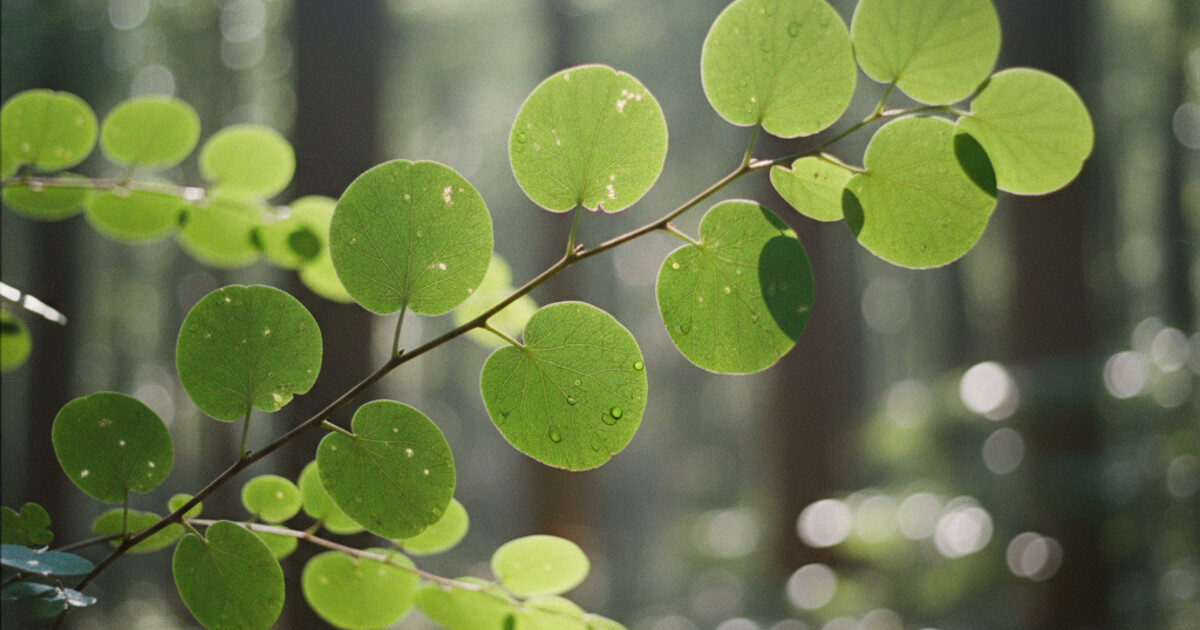
You’re out on a walk and spot a tree with perfectly round leaves. Maybe they’re spinning in the breeze, or maybe they’re broad and waxy. Either way, you want to know what it is.
Round-leafed trees are more diverse than you’d expect. They grow in mountain forests, suburban yards, wetlands, and subtropical coastlines. The shape alone narrows your identification down considerably before you even check anything else.
This guide covers 8 trees with round or nearly round leaves, what makes each one distinct, and how to separate them when more than one grows in your area.
Trees with round leaves include quaking aspen, katsura, alder, American basswood, serviceberry, Eastern redbud, American hazel, and sea grape. Most are deciduous. The fastest way to tell them apart is size: aspen leaves are coin-sized at 1-2 inches, basswood leaves span your palm at 4-6 inches, and sea grape leaves can reach 8 inches across.
Standing in front of one? Identify it from a photo in seconds — free, no sign-up needed.
What “Round” Actually Means on a Leaf
Botanists use the term “orbicular” for leaves that are essentially circular. In practice, you’ll see everything from near-perfect circles to egg shapes, kidney shapes, and heart shapes all grouped together as “round.”
Four things to check once you’ve got a round leaf in hand:
- Leaf margins: Smooth, toothed, or lobed? Aspen has fine serrations. Alder has wavy double teeth. Sea grape edges are smooth and slightly wavy.
- Leaf size: Aspen and katsura leaves run 1-2 inches. Basswood can hit 6 inches across.
- Petiole: The stem connecting the leaf to the branch. Aspen petioles are flattened sideways, which is why the leaves tremble in any breeze.
- Underside texture: Smooth or fuzzy? Hazel leaves are downy below. Alder leaves often have tufted veins.
With these four checks, you can narrow most round-leafed trees to 2 or 3 candidates before looking at bark or habit.
8 Trees With Round Leaves
1. Quaking Aspen (Populus tremuloides)
The most recognizable round-leafed tree in North America. Aspen leaves are roughly circular, 1-2 inches across, with fine serrated edges. The defining feature is that flattened petiole: it’s laterally compressed, so even a light breeze makes the whole leaf spin and shimmer. That’s the “quaking” in the name.
Aspen grows in clonal colonies connected by a shared root system. You’ll find it in the Rockies and Sierra Nevada at elevations above 6,000 feet, and at lower elevations across the boreal East. Bark is smooth and whitish-green on young trees, turning dark and furrowed at the base as the tree ages.
Quaking aspen is actually the most widely distributed tree in North America, covering more ground than any other single tree species on the continent.
2. Katsura Tree (Cercidiphyllum japonicum)
Katsura is a landscaping staple you’ll find in parks and older neighborhoods across the country. Leaves are nearly circular, 2-4 inches across, with a slight heart-shaped notch at the base and a pointed tip. In fall, they turn yellow to apricot and release a faint sweet scent often described as burnt caramel or brown sugar.
The leaf looks nearly identical to redbud at a glance. What separates them: katsura leaves grow opposite on the branch. Redbud leaves grow alternately. Flip a branch over and check the pattern before guessing.
Katsura also produces small, inconspicuous flowers in early spring before the leaves emerge. Redbud’s flowers are the opposite: bright magenta-pink and impossible to miss.
3. Alder (Alnus spp.)
Red alder (Alnus rubra) and speckled alder (Alnus incana) both carry oval to broadly rounded leaves with wavy, double-toothed margins. They’re among the few trees that fix nitrogen in the soil, so they cluster along streambanks, wetland edges, and disturbed ground.
The easiest alder tell: small woody cones that stay on the branches through winter. They look like tiny pine cones and persist after the seeds drop. Bark is grayish to brownish with pale speckles on younger trees.
If you’ve read our alder tree identification guide, you’ll already know the cones are the fastest ID shortcut in the field.
4. American Basswood / Linden (Tilia americana)
Basswood leaves are heart-shaped to round and noticeably larger than most others on this list. A mature leaf spans 4-6 inches across. Look at the base: it’s lopsided, with one side attaching slightly higher than the other. That asymmetry is a reliable basswood tell and separates it from similarly shaped leaves.
In early summer, basswood produces creamy white flowers on a stalk attached to a distinctive wing-shaped bract (a pale, oblong leaf-like structure). If you see that bract, the ID is done.
Bark is dark gray and deeply furrowed on mature trees. Young twigs are reddish-green and slightly zigzag.
5. Serviceberry (Amelanchier spp.)
Serviceberry leaves are oval to round, typically 1-2 inches, with fine serrated margins. These are relatively small trees or multi-stemmed shrubs that grow in woodland edges, slopes, and yards across most of the eastern and western US.
In spring, serviceberry is among the first trees to flower: small white blossoms that open before or just as the leaves emerge. The round leaves turn orange-red in fall. Fruit is dark red to purple, edible, and ripe in June across most of its range. (Birds find it first.)
Full breakdown in our serviceberry tree identification guide.
6. Eastern Redbud (Cercis canadensis)
Redbud leaves are broadly heart-shaped, which puts them solidly in the round-leaf category for visual ID. They run 3-5 inches wide, smooth on both surfaces, with a pointed tip and a notched base.
Redbud’s clearest identifier is its flower: small magenta-pink blossoms that appear directly on the branches and trunk in early spring before any leaves open. Hard to miss, and hard to confuse with anything else in bloom at the same time.
Outside of flowering season, check for alternate branching (vs. katsura’s opposite) and the slightly deeper heart-shaped notch at the leaf base.
7. American Hazel (Corylus americana)
Hazel grows as a large shrub to small tree and shows up along woodland edges, roadsides, and hedgerows across the eastern US. Leaves are round to broadly oval, 3-5 inches, with a heart-shaped base and coarsely double-toothed margins. The underside is soft and downy, which separates it from similarly sized leaves.
In fall and early winter, look for edible hazelnuts wrapped in ragged, leafy husks. Squirrels locate them faster than most humans do, but the husks often stay on the branch after the nuts are gone.
Hazel is also one of the earliest trees to produce catkins in late winter, before most other trees show any sign of life.
8. Sea Grape (Coccoloba uvifera)
Sea grape carries some of the most distinctive round leaves in North America. The leaves are stiff and leathery, nearly circular, and can reach 8 inches across. Veins are prominent and often reddish or pink, particularly on young leaves.
Sea grape grows in coastal zones of Florida, the Caribbean, and Gulf states, where it tolerates salt spray, sandy soil, and full sun. The fruit grows in grape-like clusters that ripen to dark purple and are edible, sometimes made into jelly.
If you’re in coastal Florida and see a low, spreading tree with huge round leaves, sea grape is almost certainly what you’re looking at.
How to Tell Round-Leafed Trees Apart
When you’re in the field, here’s the fastest path to an ID.
Start with leaf size. Small leaves (1-2 inches): likely aspen, katsura, serviceberry, or alder. Medium (3-5 inches): redbud, hazel, or basswood. Large (6-8 inches): basswood or sea grape.
Then check habitat. Aspen grows in mountain forests and boreal regions. Alder clusters along water. Sea grape stays near the coast. Basswood favors moist, rich lowlands. Redbud is common in woodland edges and suburban yards.
Confirm with one extra feature. Aspen: white bark with dark knots. Alder: small woody cones on branches year-round. Basswood: lopsided leaf base. Katsura: opposite branching and fall caramel scent. Hazel: fuzzy leaf underside and nut husks in fall.
Two features together beat one feature alone. Checking size plus habitat will get you to the right species the large majority of the time.
Our tree identification by leaf shape guide covers the full leaf shape system if you want a broader framework for any tree you encounter.
How Tree Identifier Can Help
When you’re in the field and want a faster answer, Tree Identifier can ID most of these species from a single photo.
Take a clear shot of the leaf (a single leaf against a neutral background works best), or snap the bark if leaves are out of reach. The app works offline, so it’s useful on remote trails without cell service. Each identification comes with species details, habitat info, and key characteristics.
Tree Identifier offers 2 free identifications per day, so the next round-leafed tree that stumps you is a quick photo away from an answer. Download it free on iOS and Android.
Frequently Asked Questions
What are the small round-leafed trees that shake in the wind?
That’s almost certainly quaking aspen (Populus tremuloides). The flattened petiole causes the leaves to spin and flutter in even light wind. Aspen grows in clonal colonies, so you’ll often see dozens of trees with identical round leaves all moving together.
Are round leaves a sign of a specific tree family?
No single family has round leaves exclusively. Aspens (family Salicaceae), alders (Betulaceae), basswoods (Malvaceae), redbuds (Fabaceae), and katsura (Cercidiphyllaceae) all carry round to broadly rounded leaves. Leaf shape narrows the ID but won’t confirm it on its own.
How do I tell aspen from cottonwood?
Both are in the poplar family and have broadly rounded leaves. Aspen leaves are typically smaller (1-2 inches) and more circular. Cottonwood leaves run larger (2-4 inches) and are more triangular or delta-shaped, with a longer petiole. Cottonwood also releases cottony seeds that fill the air in late spring. See our cottonwood tree identification guide for more.
Can a tree identification app ID a tree from just a leaf?
Yes. Tree Identifier can ID most species from a leaf photo alone. A single leaf shot with clear margins and veins gives the AI enough detail to identify the species in seconds, even offline.
Conclusion
Round leaves cover more variety than most people expect, from the trembling 1-inch coins of aspen to the stiff 8-inch platters of sea grape. Leaf size, habitat, and one confirming feature will get you to the right answer most of the time.
If you’d rather skip the guesswork, Tree Identifier confirms your ID from a single leaf photo and works without cell service. It’s free to try on iOS and Android.
Identify a tree from your photo — free
Upload a leaf, bark, or whole-tree photo and get the species in seconds. No signup.
Confidence:
Unlock the full species profile
Free in the app — with unlimited identifications.


AI result for guidance — the app gives full species details and works offline.
Want unlimited identifications?
Get the full species profile, photos and details — free in the app, with unlimited scans.
- Unlimited identifications
- Full species profiles & details
- Works offline, anywhere
- Save and revisit your finds
Elena Torres
Tree Identifier Team