Trees With Yellow Flowers: 9 Species Identified
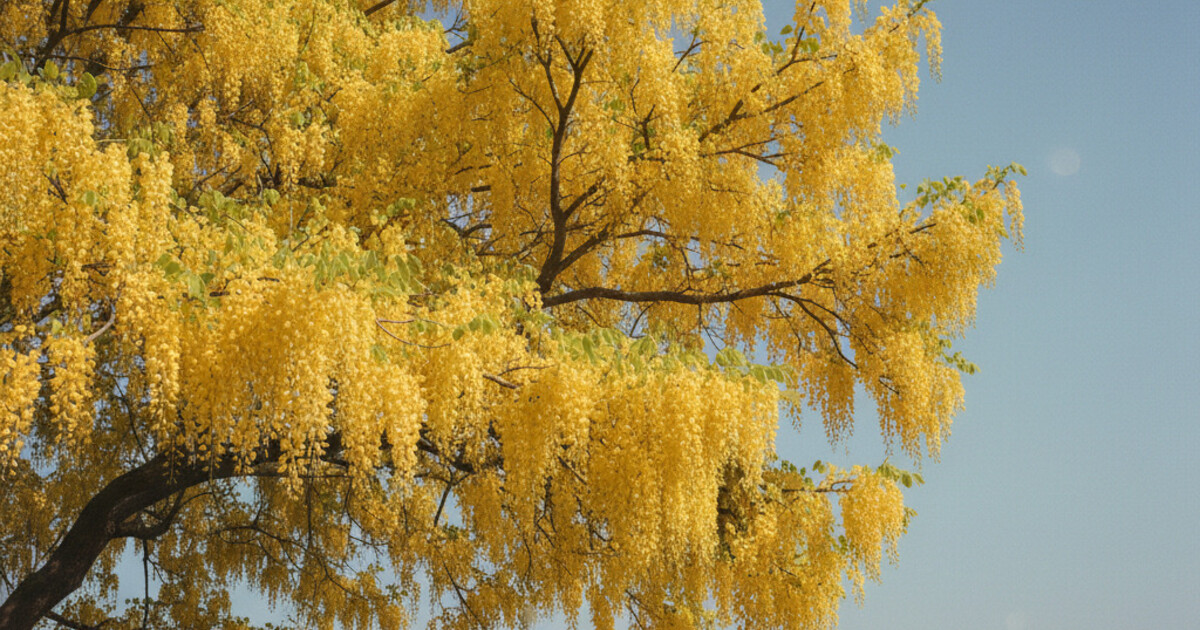
You’re out for a walk and spot a tree covered in yellow blooms. It could be a dozen different species. Yellow flowers appear on trees from January through July in North America, which is a wide range to narrow down.
The good news: most yellow-flowering trees have distinct bloom shapes and timing. Once you know what to look for, you can usually ID the species quickly. This guide covers 9 of the most common trees with yellow flowers in North America, organized by when they bloom.
Trees with yellow flowers in North America bloom across nearly 6 months, from witch hazel in late winter through golden rain tree in midsummer. The fastest way to narrow down a species is by bloom time: early-spring bloomers tend to flower before their leaves open, while late-season species bloom against a backdrop of full foliage.
Standing in front of one? Identify it from a photo in seconds — free, no sign-up needed.
Yellow Flowering Trees: Why Season Matters for ID
Bloom time cuts your list of candidates in half before you look at anything else.
A tree covered in yellow flowers with bare branches is almost certainly a winter or early spring species. Witch hazel, Cornelian cherry dogwood, and spicebush all follow this pattern. If the tree is already leafed out when the yellow flowers appear, you’re looking at a mid to late spring or summer species.
Yellow-flowering trees in North America bloom across 5 distinct season windows. Witch hazel blooms from December through March, often while snow is still on the ground, producing spidery yellow petals that curl in cold temperatures. Cornelian cherry dogwood follows in February and March, with tight clusters of small yellow flowers directly on the bare branches. Golden chain tree peaks in April and May with hanging flower chains called racemes, reaching 8 to 20 inches long. Tulip tree blooms in late May and June, producing large cup-shaped flowers with yellow-green petals and an orange band at the base. Golden rain tree is the outlier: it blooms in late June and July, with upright clusters of small yellow flowers well after most flowering trees have finished. Knowing which window you’re in narrows down the species dramatically before you even look at leaves or bark.
Flower shape is the second key clue. Yellow tree flowers come in a few distinct forms:
- Spidery, ribbon-like petals: witch hazel, spicebush
- Long drooping cluster chains: golden chain tree
- Small tight clusters: Cornelian cherry dogwood, sassafras
- Large cup-shaped blooms: tulip tree
- Upright spike candles: yellow buckeye
- Flat-topped spray clusters: golden rain tree
Early Spring: Yellow Flowers on Bare Branches
Three species commonly bloom in late winter and early spring before any leaves appear.
Witch Hazel (Hamamelis)
Witch hazel is probably the most unusual winter-bloomer in North America. It flowers from December through March, producing narrow, ribbon-like yellow petals that spiral outward directly from the bare branch.
Two species show up most often. American witch hazel (Hamamelis virginiana) actually blooms in fall, which surprises people. Hybrid witch hazel (Hamamelis x intermedia) blooms in late winter and is the one you’re more likely to see in gardens and parks. Both have oval leaves with wavy margins that look similar to hazel.
Bark is smooth and gray on young trees, developing shallow flat ridges with age.
Cornelian Cherry Dogwood (Cornus mas)
Don’t confuse this with flowering dogwood, the species everyone knows for its white bracts. Cornelian cherry dogwood blooms in late February to early March with small, tight clusters of bright yellow flowers, each about ¼ inch across.
From a distance it looks a lot like forsythia. The difference: Cornelian cherry can grow into a small tree reaching 25 feet, while forsythia stays shrub-sized. In late summer it produces small red fruits that resemble cherries.
Spicebush (Lindera benzoin)
Spicebush is more often a large shrub than a true tree, but it can reach 12 feet and takes on a tree-like form in good conditions. It blooms in early March with clusters of tiny yellow flowers along bare stems.
The easiest confirmation: crush a leaf or small branch. Spicebush smells strongly of spice and citrus, unlike anything else in the forest.
Mid-Spring: The Most Dramatic Yellow Blooms
Golden Chain Tree (Laburnum anagyroides)
Golden chain trees produce one of the most striking flower displays of any ornamental tree. They bloom in April and May with long, drooping flower chains (racemes) hanging 8 to 20 inches from the branches, similar to yellow wisteria.
Leaves are trifoliate, with 3 oval leaflets resembling clover. The tree typically tops out at 20 to 25 feet.
One thing worth knowing: golden chain tree is highly toxic throughout, especially the seeds and seed pods. Every part of the plant can cause harm if ingested.
Sassafras (Sassafras albidum)
Sassafras blooms in April with small, inconspicuous yellow-green flower clusters on bare branches. The flowers aren’t showy, but they appear early enough to be visible before the leaves open.
If you want to confirm the species, wait for the leaves. Sassafras is the only common eastern tree with 3 different leaf shapes on the same branch: an unlobed oval, a 2-lobed mitten shape, and a 3-lobed shape. Our sassafras tree identification guide has more detail on how to tell it apart from similar species.
Forsythia (Forsythia spp.)
Forsythia is technically a large shrub, but it’s widely grown as a multi-stemmed small tree and is one of the most recognizable yellow-flowering plants in North American landscapes. It blooms in March to April with 4-petaled yellow flowers covering every branch before any leaves open.
After flowering, it leafs out and looks like an ordinary green shrub until the following spring.
Late Spring and Summer: Yellow Blooms With Full Foliage
Tulip Tree (Liriodendron tulipifera)
Tulip trees bloom in May and June. The flowers are large (about 2 inches across), cup-shaped, with yellow-green petals and a bright orange band at the base. They look like a cross between a tulip and a magnolia blossom.
The catch: tulip trees are tall. Mature specimens can reach 100 feet or more, which puts the flowers well out of easy view. You’re often more likely to spot fallen flowers on the ground in late May than to see them on the tree. Look for the distinctive 4-lobed leaf with a flat or notched top edge to confirm the species.
Yellow Buckeye (Aesculus flava)
Yellow buckeye blooms in April and May with upright spikes of pale yellow flowers, 4 to 6 inches tall. The spikes stand above the foliage and are visible from a distance.
Leaves are compound palmate with 5 leaflets, similar to Ohio buckeye but typically larger. Yellow buckeye is concentrated in the Appalachian Mountains and surrounding areas.
The nuts are smooth-husked, round, and dark brown with a pale scar. Unlike horse chestnut, the husk has no spines.
Golden Rain Tree (Koelreuteria paniculata)
Golden rain tree is the only common yellow-flowering tree that blooms in summer, typically late June through July. It produces large, upright clusters of small bright yellow flowers at the branch tips.
After flowering, the seed pods are papery and lantern-shaped, turning from green to bronze-pink by late summer. Those pods often make the tree easier to spot than the flowers themselves.
It’s a medium ornamental tree (30 to 40 feet tall) and common in parks and street plantings across much of the US. If you want a broader look at how to approach ID by bloom type, check out our flowering tree identification guide.
How Tree Identifier Can Help
If you’ve spotted a yellow-flowering tree and aren’t sure which species it is, a photo gets you the answer in seconds.
The Tree Identifier app lets you photograph the flowers, leaves, or bark and get an instant AI-powered ID with the species name and detailed information. For flowering trees, a photo of the flower clusters typically gives the clearest result.
The app also works offline, so you can use it on a trail or in a park without cell service. Each identification includes the species’ typical range, habitat, and characteristics.
It’s free to start with 2 identifications per day, available on iOS and Android at treeidentifier.app.
Frequently Asked Questions
What tree has yellow flowers in early spring? Several trees bloom yellow in early spring. Witch hazel flowers from January to March, Cornelian cherry dogwood from February to March, and golden chain tree in April and May. Forsythia, while technically a large shrub, is probably the most common yellow-flowering plant you’ll see in yards and parks each spring.
What tree has long hanging clusters of yellow flowers? That’s almost certainly a golden chain tree (Laburnum anagyroides). It’s the only common ornamental tree in North America that produces long, drooping chains of yellow flowers similar to wisteria. It blooms in April and May and can reach 20 to 25 feet tall.
Is there a yellow-flowering tree that blooms in summer? Golden rain tree (Koelreuteria paniculata) blooms in late June and July, which is unusual for a flowering tree. You’ll recognize it by its upright yellow flower clusters and the papery, lantern-shaped seed pods that follow in late summer.
What’s the difference between witch hazel and forsythia? Both produce yellow flowers on bare branches in late winter or early spring. Witch hazel has narrow, ribbon-like petals that curl and twist, while forsythia has clean 4-petaled flowers with an open shape. Witch hazel also grows taller and more tree-like. Forsythia flowers tend to be a brighter, more saturated yellow.
Conclusion
Yellow-flowering trees span nearly the entire growing season. Check bloom time first: bare-branch bloomers narrow the field to winter and early spring species, while trees that flower with full foliage point to late spring or summer.
Pair that with flower shape and any other details (leaf form, bark texture, seed pods), and most species come into focus quickly. If you want a faster answer, take a photo and run it through Tree Identifier.
For more flowering tree guides by color, check out trees with white flowers and trees with pink flowers.
Identify a tree from your photo — free
Upload a leaf, bark, or whole-tree photo and get the species in seconds. No signup.
Confidence:
Unlock the full species profile
Free in the app — with unlimited identifications.


AI result for guidance — the app gives full species details and works offline.
Want unlimited identifications?
Get the full species profile, photos and details — free in the app, with unlimited scans.
- Unlimited identifications
- Full species profiles & details
- Works offline, anywhere
- Save and revisit your finds
Elena Torres
Tree Identifier Team