Water Hickory Tree Identification: 7 Reliable Signs
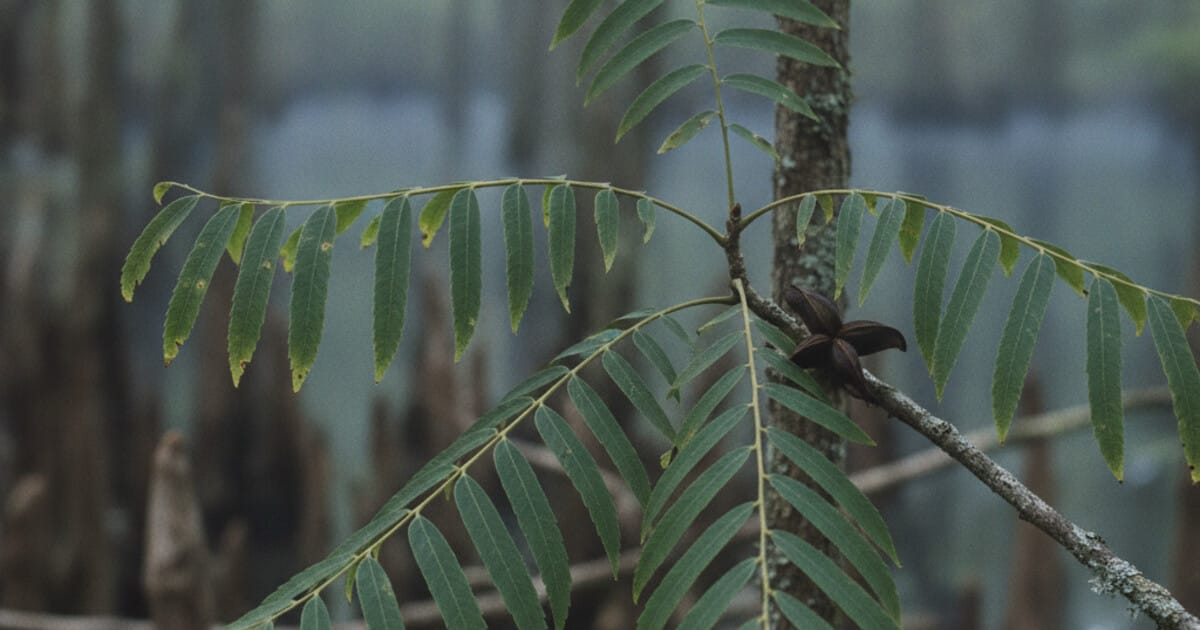
Most hickories favor dry ridges and upland forests. Water hickory (Carya aquatica) does the opposite. It spends its life in bottomland swamps, river margins, and seasonally flooded flats where standing water would kill most other Carya species. That habitat preference is a useful field clue, but the most reliable sign is the nut: small, dark, flattened, and wrapped in a thin husk with 4 narrow wings that run nearly the full length of the fruit. No other hickory shares that combination.
Water hickory is also called bitter pecan, a name that gives away two things at once. The nuts are relatives of pecan (they share the same botanical subgenus), and they’re inedible. The bitterness comes from tannins concentrated enough that squirrels often pass them over when better hickory nuts are nearby. This guide covers 7 signs to confirm a water hickory identification in the field.
Water hickory (Carya aquatica) is identified by its 4-winged nut husk extending nearly to the base of the small, flattened, bitter nut; falcate (sickle-curved) compound leaves with 7-13 leaflets; yellow-brown valvate buds; and strict bottomland habitat across the southeastern United States from Virginia to Texas. It’s also known as bitter pecan.
What Is Water Hickory?
Water hickory (Carya aquatica) belongs to the pecan group within the hickory genus Carya, sharing its subgenus with pecan (Carya illinoinensis). It’s native to the southeastern United States, ranging from southeastern Virginia and Maryland south through Florida and west to eastern Texas, with the highest concentrations on the Gulf Coastal Plain and along the lower Mississippi River valley from Louisiana north to southern Illinois. The species grows exclusively in lowland settings: bottomland hardwood forests, swamp margins, river floodplain terraces, and seasonally flooded depressions where water stands for weeks after heavy rains. Mature trees reach 60-80 feet with trunks 1-1.5 feet in diameter. In forest composition, water hickory grows alongside water tupelo, bald cypress, sweetgum, overcup oak, and water elm. It’s the most flood-tolerant member of the hickory family, tolerating inundation periods that would eliminate most other Carya species. Outside wetland sites, it’s essentially absent.
Water hickory is uncommon enough that many naturalists in the Southeast go years without seeing one, even in good bottomland habitat. The key is knowing where to look: low flats that stay wet most of the year, not just after storms. Once you find the habitat, the distinctive nut gives the species away immediately.
For a broader introduction to the hickory family, see our hickory tree identification guide.
Signs #1 and #2: The Winged Husk and Bitter Nuts
The nut is the clearest identifier for water hickory, and the husk is the most distinctive part.
Water hickory’s husk is thin, dark brown to brownish-black, and has 4 narrow wings (ridges) that run from near the tip down nearly to the very base of the fruit. In most other hickories, the husk wings either stop partway down or are only present near the top. In water hickory, the wings extend almost the full length. This is visible even in dried husks on the ground under the tree.
Under the husk, the nut itself is:
- Small, typically under 1 inch long
- Flattened or slightly compressed (more oval in cross-section than round)
- Dark brown to nearly black when ripe
- Extremely bitter due to high tannin concentrations
The bitterness is intense enough that most wildlife prefers mockernut, shagbark, or pecan nuts when available. Deer and squirrels do consume water hickory nuts in lean mast years, but they’re a backup food source rather than a preferred one.
Nuts ripen in September through November and fall still enclosed in the husk. The husk splits only partially at maturity, often staying partially closed longer than other hickories.
Water Hickory Leaf Identification
Water hickory has pinnately compound leaves, like all hickories. Two features separate them from other species in the family.
First, the leaflet count: water hickory typically carries 9-11 leaflets per leaf, ranging from 7-13. That puts it closer to pecan (9-17 leaflets) than to mockernut (7-9) or shagbark (5).
Second, and more diagnostic, is the leaflet shape. Water hickory leaflets are falcate: lance-shaped and curved in a gentle sickle shape from base to tip. Hold a leaflet at arm’s length and you can see the curve along the blade. Most hickory leaflets are straight or only gently tapered without any sickle curve.
Other consistent leaf characteristics:
- Terminal leaflet is roughly equal to or slightly smaller than the adjacent lateral leaflets (in most hickories, the terminal is noticeably the largest)
- Leaflet surface is dark yellow-green above, paler and slightly hairy below
- Leaf edges carry fine, sharp serrations along the full margin
- The leaf rachis (central stalk) is slender and often lightly hairy when young
In fall, water hickory turns yellow before dropping. The color change is less dramatic than shagbark or mockernut, partly because the tree lives in low-light bottomland settings where fall color tends to be muted.
Buds, Twigs, and Bark
Buds: Water hickory buds are small, yellow to yellow-brown, and covered in 4-6 valvate scales. Valvate means the scales meet edge-to-edge like clamshell halves rather than overlapping like roof shingles. This contrasts with bitternut hickory, where the buds are a vivid sulfur-yellow (almost neon) and more elongated. Water hickory buds are subtler in color and rounder in shape.
Twigs: Slender, reddish-brown to dark brown, slightly hairy when young and smooth with age. Thinner in diameter than mockernut or shagbark twigs.
Bark: On young trees under 8 inches in diameter, bark is smooth and grayish-brown. On mature trees, it develops thin, irregular plates or flat scales separated by shallow furrows. Unlike shagbark hickory, which has dramatically exfoliating strips visible from 50 yards away, water hickory bark stays close to the trunk and doesn’t shag or curl outward. It’s plated rather than shaggy.
That distinction is a useful field pair: if you’re in wet bottomland and the hickory has loose peeling strips, look at shagbark. If the bark is tighter and plated, water hickory is the stronger candidate.
Water Hickory vs. Pecan and Bitternut Hickory
Water hickory is most often confused with pecan and bitternut hickory. Here’s how to separate them.
Water hickory vs. pecan (Carya illinoinensis):
Both belong to the pecan subgenus and share general structure. The differences come down to size and site:
- Nut size: pecan nuts run 1-2.5 inches long, elongated, and cylindrical. Water hickory nuts are under 1 inch and flattened.
- Leaflets: pecan carries more leaflets (9-17 is typical) with leaflets that are also slightly curved but less dramatically so than water hickory’s falcate form.
- Habitat: pecan grows on fertile, moist to well-drained bottomlands. Water hickory occupies the wettest, most flood-prone spots that pecan avoids.
- Nut taste: pecan is sweet and edible. Water hickory is bitter.
Our pecan tree identification guide covers pecan’s full set of field marks.
Water hickory vs. bitternut hickory (Carya cordiformis):
Both are bitter and have 4-winged husks. The key differences:
- Buds: bitternut’s vivid sulfur-yellow buds are visible from several feet away. Water hickory buds are dull yellow-brown.
- Husk wings: bitternut husk wings are present mainly in the upper half of the fruit. Water hickory wings extend nearly to the base.
- Habitat: bitternut grows across a wide range of sites including upland forests, river valleys, and mixed hardwood slopes. Water hickory is a strict wetland specialist. A tree on a dry or well-drained slope is almost certainly bitternut.
- Range: bitternut extends north to Minnesota, Quebec, and New England. Water hickory is confined to the Southeast.
See our bitternut hickory identification guide for full coverage of that species.
How Tree Identifier Helps with Water Hickory
Water hickory is one of the harder hickories to confirm from a single leaf photo. The falcate leaflet shape is subtle, and compound leaves can look similar to several other Carya species at a glance.
The nut husk is much more diagnostic. If you can photograph a nut or husk showing the 4 wings extending nearly to the base, Tree Identifier’s AI gives a confident match. Photograph the compound leaf alongside it, showing the full structure with all leaflets visible and the slight sickle curve of the blades.
The app works offline, which matters in remote bottomland sites without cell service. You get 2 free identifications per day, and each result includes species habitat data and characteristics you can cross-check against this guide. Download Tree Identifier at treeidentifier.app and test it on the next hickory you find in a swamp.
Frequently Asked Questions
What makes water hickory different from other hickories?
The clearest difference is the nut husk: water hickory has 4 narrow wings running from near the tip nearly to the base of the small, flattened, bitter nut. No other hickory has wings extending that far down. The species also grows strictly in bottomland swamps and flooded flats, where most other hickories won’t survive long-term.
Can you eat water hickory nuts?
No. Water hickory nuts are extremely bitter due to high tannin concentrations and aren’t edible for humans. They’re distinct from pecan (a close relative) and from shagbark or shellbark hickory nuts, which are sweet. Wildlife consumes them in lean mast years, but typically prefers other hickory species when available.
How do you tell water hickory from bitternut hickory?
Look at the buds first: bitternut has vivid sulfur-yellow buds visible from several feet away. Water hickory buds are dull yellow-brown and far less conspicuous. Also check habitat: bitternut grows in varied sites including upland forests, while water hickory is strictly a wetland species. A hickory on a dry slope is bitternut; one in a swamp could be either.
What does water hickory bark look like?
On mature trees, water hickory bark is grayish-brown with thin, irregular plates or flat scales. It doesn’t shag or exfoliate like shagbark hickory. On young trees, the bark is smooth and gray. The plated texture on mature trees is less dramatic than most other hickory species.
Where does water hickory grow?
Water hickory grows in the southeastern United States from Virginia and Maryland south through Florida and west to eastern Texas. It’s a strict bottomland species found in swamps, river floodplains, seasonally flooded depressions, and low wet forest floors. It commonly grows alongside bald cypress, water tupelo, sweetgum, and overcup oak.
Identify a tree from your photo — free
Upload a leaf, bark, or whole-tree photo and get the species in seconds. No signup.
Confidence:
Unlock the full species profile
Free in the app — with unlimited identifications.


AI result for guidance — the app gives full species details and works offline.
Want unlimited identifications?
Get the full species profile, photos and details — free in the app, with unlimited scans.
- Unlimited identifications
- Full species profiles & details
- Works offline, anywhere
- Save and revisit your finds
Elena Torres
Tree Identifier Team