Black Ash Tree Identification: 7 Reliable Signs
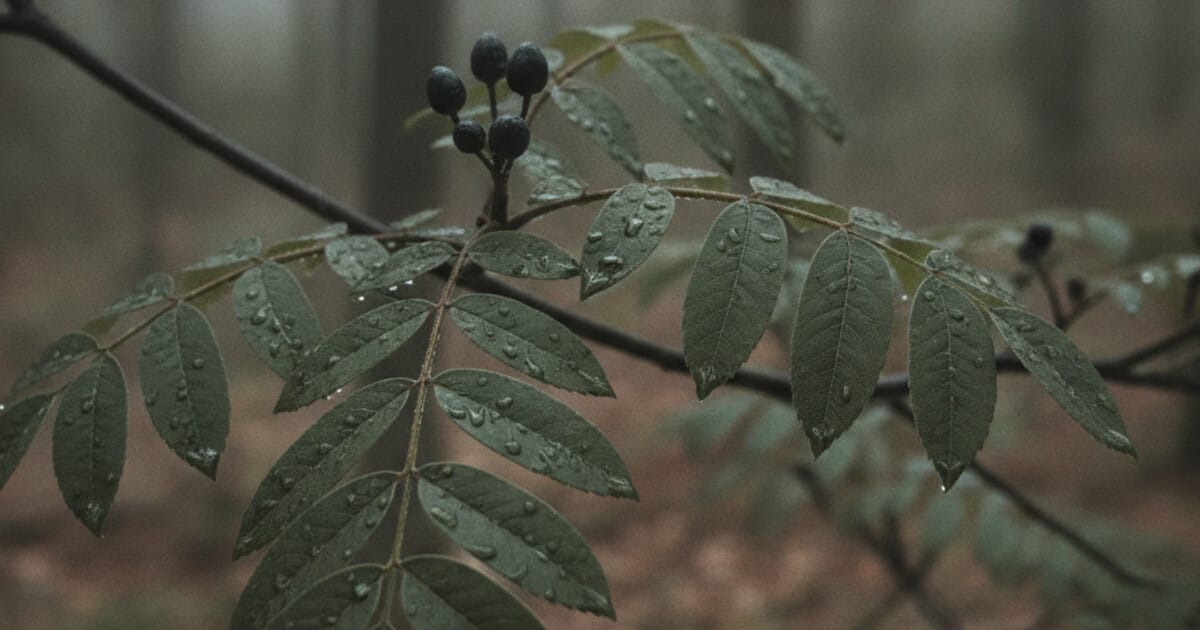
Black ash tree identification has a shorter checklist than most eastern ash species. Fraxinus nigra has 3 features no close relative shares: soft corky bark that crumbles when scraped with a fingernail, winter buds so dark they’re nearly black, and compound leaves where each leaflet attaches directly to the central stem with no individual stalk. Botanists call that last feature sessile attachment. White ash, green ash, and blue ash all have stalked leaflets. Once you know these 3 features, black ash is one of the more confident calls you can make in a northern forest.
The challenge is finding one. Populations across the Northeast and Great Lakes have declined sharply from emerald ash borer, and a living, mature black ash today is worth noting. This guide covers all 7 reliable signs for black ash identification, plus habitat, range, and the species’ cultural significance in Indigenous basketry traditions.
Black ash identification relies on 3 primary features: sessile leaflets (no individual stalks where leaflets meet the central stem), near-black winter buds, and soft corky bark that crumbles when scraped. Black ash grows almost exclusively in northern swamps and wet forests, ruling it out in most upland settings before you examine a leaf.
Sessile Leaflets: Black Ash’s Most Reliable Feature
The clearest separator in the eastern ash genus is how each leaflet attaches to the main leaf stem. White ash, green ash, and blue ash all have leaflets sitting on short individual stalks called petiolules. Black ash leaflets attach directly to the central rachis with no stalks at all.
Pick up a leaf and examine where each leaflet meets the central stem. A direct connection, base of leaflet sitting flat against the rachis, means black ash. Short elevated stalks, even very short ones, point to a different species. This check works on fresh green leaves, dried fall leaves, and pressed specimens.
Black ash leaves carry 7-11 leaflets, most commonly 9. The leaflets are oblong to lance-shaped, 3-5 inches long, with finely serrated margins and a slightly elongated tip. Upper surfaces are dark green and slightly rough. Undersides are paler with small tufts of rusty-brown hair at the base of each midrib, a subtle but consistent detail once you know to look for it.
Range and Conservation Status
Black ash (Fraxinus nigra) is a northern wetland specialist native to a broad arc from Newfoundland and Nova Scotia across New England, the Great Lakes states, and into Manitoba and Saskatchewan. Its U.S. core range covers Maine, Vermont, New Hampshire, New York, Wisconsin, Minnesota, and Michigan, with outliers reaching Pennsylvania and New Jersey. The species grows almost entirely in swamps, fens, and poorly drained lowland forests where soil stays saturated for weeks. Unlike white ash and green ash, which both tolerate upland sites, black ash is rarely found more than a few meters above the water table. COSEWIC assessed black ash as Endangered in 2018, citing emerald ash borer as an imminent existential threat to the species. Black ash’s range in productive northern wetlands means beetle spread moves quickly through populations. Ontario and Quebec hold hundreds of thousands of black ash, many now dead or in serious decline.
The U.S. Forest Service tracks black ash as a vulnerable resource requiring active monitoring in the Lake States and Northeast. Because the species grows in isolated wetland pockets rather than continuous forest blocks, natural recolonization after beetle kill is slow. Finding a healthy, living black ash today is genuinely notable.
Bark: Soft, Corky, and Distinct
Black ash bark has one feature no other eastern ash shares: it’s soft. On ridge surfaces, the outer bark is corky and slightly spongy, compressing when pressed firmly and crumbling slightly when scraped with a thumbnail. This quality is most obvious on medium-sized trees, roughly 4-10 inches in diameter.
Mature bark color is gray to light gray-brown, with irregular interlaced ridges that create a rough, somewhat braided texture. The ridges are narrower and less deeply furrowed than white ash bark, and don’t form the clean diamond pattern that mature white ash trunks show.
On very young black ash, the bark is thin and smooth with little distinctive texture. As the tree grows, the corky softness develops and becomes increasingly useful in the field. Gray color, interlaced ridges, and soft crumbling texture together are enough to make a confident call on most mature trees even before you examine a leaf.
Buds: Near-Black and Unmistakable
Black ash winter buds are among the darkest of any eastern hardwood. The terminal bud is broadly oval to rounded, roughly 0.2-0.3 inches long, and dark brown to near-black. Lateral buds are smaller, sitting opposite each other at roughly 90 degrees from the twig in the typical ash arrangement.
The bud color is noticeably darker than white ash (which has gray-brown to gray buds) and green ash (brown buds with paler scales). On bare winter branches, these dark buds against gray bark give black ash a somber appearance that matches its name.
Bud checks work best from late October through early April, when leaves are absent. It’s a reliable cross-check when bark softness alone doesn’t feel conclusive, or when you’re working from photos taken in winter.
Samaras: Full-Length Winged Seeds
Black ash produces winged seeds called samaras, typically 1-1.5 inches long. The wing runs the full length of the seed body and rounds at both ends, giving the fruit an oval to spatula shape. The tip is often slightly notched.
This is similar in shape to blue ash samaras, which also encircle the seed body, but black ash fruit is generally smaller and narrower. White ash and green ash samaras have wings that extend mainly from the seed tip rather than wrapping around the full body.
Samaras hang in drooping clusters and persist into early winter. On bare or partially leafless trees in fall, these clusters are visible from a distance on intact trees, but heavy beetle mortality means many black ash you encounter may have already dropped their canopy.
Habitat: Swamps, Fens, and Wet Forests
Black ash is one of the most wetland-dependent eastern forest trees. It grows in swamps, bogs, fens, alder thickets, floodplain forests, and along stream edges where water sits for weeks or months in spring. Finding it on well-drained upland soil is unusual enough to be a red flag.
Within northern forest communities, black ash often grows alongside red maple, silver maple, tamarack, white cedar, speckled alder, and yellow birch. In richer Great Lakes swamp forests it occurs with green ash, though bark texture and leaflet stalks usually separate them quickly.
One practical field note: if you’re looking at an ash in a dry upland or hillside setting in the Northeast or Great Lakes, it’s almost certainly not black ash. Habitat eliminates it in many cases before you examine the leaves.
Indigenous Basketry and Cultural Significance
Black ash has cultural significance that extends well beyond ecology. The wood splits naturally along growth rings into thin, flexible strips when pounded, a property that comes from the absence of latewood cross-grain fibers connecting annual rings. No other North American hardwood splits this cleanly in this way.
Indigenous communities across the Northeast and Great Lakes, including the Mi’kmaq, Maliseet (Wolastoqiyik), Abenaki, Ojibwe, and Haudenosaunee, have used black ash splints to weave baskets for centuries. Woven black ash baskets remain an active art form and economic practice in many of these communities today.
The decline of black ash from emerald ash borer carries direct cultural consequence. Several tribal nations and Indigenous craft organizations in the Northeast have begun seed banking and seedling cultivation programs specifically to preserve black ash for future basket making.
Black Ash vs. White Ash and Green Ash
Three features sort these species quickly. For a full overview of the eastern ash genus, the ash tree identification guide covers shared traits and the key separators across all North American species.
Leaflet stalks. Black ash leaflets are sessile (no stalks). White ash and green ash leaflets sit on short petiolules. This is the fastest separator when you have a leaf in hand.
Habitat. Black ash grows in swamps and boggy ground. White ash prefers rich, moderately moist upland soils. Green ash is the most adaptable, tolerating bottomlands to somewhat dry sites, but favors stream banks and moist floodplains.
Bark texture. Black ash bark is noticeably soft and corky. White ash and green ash bark is firm and doesn’t crumble when scratched.
For side-by-side comparisons with close relatives, the white ash tree identification and green ash tree identification articles cover their distinguishing features. For the recently covered ash with square twigs, see blue ash tree identification.
How Tree Identifier Helps
Black ash identification often means checking multiple features: leaf stalks, bud color, bark texture, and habitat. A single photo doesn’t always capture all of them. Tree Identifier accepts multiple photos per identification session, so submitting a leaf shot alongside a bark close-up lets the AI cross-reference both features for a more accurate result.
The app works offline, which matters in swampy terrain where cell coverage is unreliable. Download species data before heading out and you’re covered even in low spots and remote bogs. You get 2 free identifications daily with no subscription required to start.
Because black ash is declining rapidly across its range, any documented sighting of a living, healthy specimen is valuable conservation data. After identifying a tree, consider logging it in iNaturalist or reporting it to your state or provincial natural heritage program.
Frequently Asked Questions
How do you identify a black ash tree?
Look for sessile leaflets (no individual stalks where leaflets meet the central stem), near-black winter buds, and soft corky bark that crumbles when pressed. Black ash also grows almost exclusively in northern swamps and boggy forests. These 3 features together are reliable across its range, and habitat alone rules it out in most upland settings.
What makes black ash bark different from other ash species?
Black ash bark is noticeably softer than other ash species. On the ridge surfaces, it’s corky and slightly spongy, compressing when pressed and crumbling slightly when scraped with a fingernail. White ash and green ash bark is firm and doesn’t show this behavior. The softness is most obvious on trees 4-10 inches in diameter and useful as a quick field check.
Is black ash endangered?
In Canada, yes. COSEWIC assessed black ash as Endangered in 2018, citing emerald ash borer as an imminent existential threat. In the U.S., it’s not federally listed but the Forest Service considers it vulnerable and monitors it as a species of concern in several states. Populations across the Great Lakes and Northeast have declined significantly since emerald ash borer arrived.
What is black ash used for?
Black ash wood splits along growth rings into thin, flexible strips when pounded, a property no other North American hardwood shares to the same degree. Indigenous communities across the Northeast and Great Lakes have used these splints for basket weaving for centuries. Woven black ash baskets remain an active cultural practice among the Mi’kmaq, Maliseet, Abenaki, Ojibwe, and Haudenosaunee nations today.
Where does black ash grow?
Black ash is a northern species, native to a range from Newfoundland and Nova Scotia west through New England, the Great Lakes states, and into Manitoba and Saskatchewan. It grows in swamps, fens, and poorly drained forests where soil stays wet for extended periods. White ash and green ash tolerate upland sites; black ash almost never does, making habitat a fast pre-check before you examine any leaf features.
If you’re in the northern Great Lakes or Northeast and want to confirm what ash species you’re looking at, Tree Identifier can help. Take a photo of a compound leaf, get a close shot of the bark surface, and let the AI cross-reference both. You get 2 free identifications daily with no subscription required to start.
Identify a tree from your photo — free
Upload a leaf, bark, or whole-tree photo and get the species in seconds. No signup.
Confidence:
Unlock the full species profile
Free in the app — with unlimited identifications.


AI result for guidance — the app gives full species details and works offline.
Want unlimited identifications?
Get the full species profile, photos and details — free in the app, with unlimited scans.
- Unlimited identifications
- Full species profiles & details
- Works offline, anywhere
- Save and revisit your finds
Elena Torres
Tree Identifier Team