Black Hickory Tree Identification: 7 Reliable Signs
Black hickory trees can stop even experienced naturalists. The bark is so dark it looks scorched, the nuts are smaller than most other hickories, and the range overlaps with several lookalike species. Without knowing the key field marks, black hickory (Carya texana) blends right into the surrounding woodland.
Reliable black hickory tree identification comes down to 7 features you can check in any season: the near-black furrowed bark, compound leaves with 7 leaflets, rusty glandular dots on leaflet undersides, small pear-shaped nuts, thin husks that split to the base, dry upland habitat, and distinctive dark winter buds. This guide covers each one and shows how to separate black hickory from the most common lookalike species in its range.
Black hickory (Carya texana) is a small to medium hickory native to Texas, Oklahoma, and Arkansas. Identify it by its near-black, deeply furrowed bark, compound leaves with 7 leaflets that carry rusty glands on the underside, and small pear-shaped nuts with thin husks that split to the base. It grows on dry, rocky upland sites across the south-central United States.
How to Identify Black Hickory at a Glance
Black hickory is one of about 18 native hickory species in North America, and it’s the most closely tied to dry, rocky terrain in the south-central states. Most field guides give it less coverage than shagbark or pecan, but its field marks are consistent and reliable once you know what to look for.
Black hickory is a slow-growing hardwood reaching 30 to 50 feet, though trees on dry, rocky sites often stay shorter. It belongs to the true hickory group in Carya alongside shagbark, pignut, and mockernut. Mature trunks are dark gray to near-black with deep vertical furrows and tight, interlocking ridges. Leaves are pinnately compound, typically with 7 leaflets, each lanceolate to ovate with finely serrated margins. Rusty glands dot the entire lower surface of each leaflet, visible with a hand lens and one of the most reliable field marks on the tree. Nuts ripen September through October, measuring 1 to 1.5 inches long, pear-shaped, with a thin husk that splits to or near the base. The kernel is sweet and edible, though small. Black hickory grows in the Cross Timbers of Texas and Oklahoma, the Ozark Plateau, and scattered south-central US sites, always on dry, rocky uplands rather than moist bottomland.
Black Hickory Bark: The Darkest in the Genus
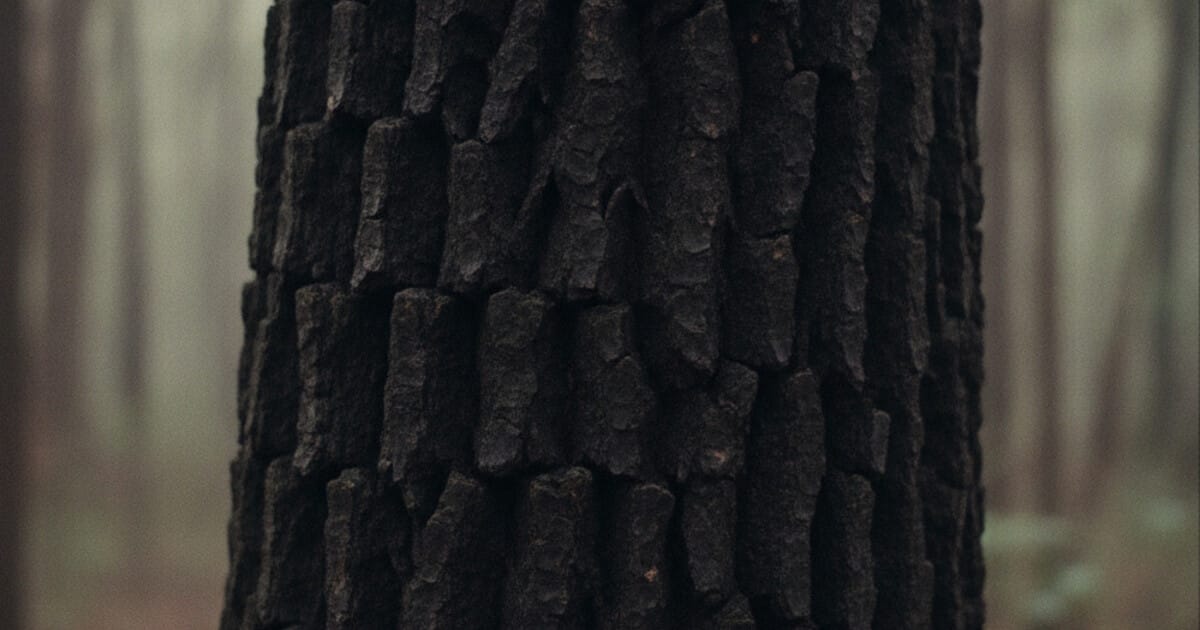
The bark is the first thing that separates black hickory from every other hickory in its range. Mature trunks develop deep vertical furrows with tight, interlocking ridges that form a rough, blocky surface. The color runs from dark gray to near-black, noticeably darker than the gray-brown tones of most other hickories.
Young trees under 4 inches in diameter show smoother, lighter gray bark. The dark, ridged pattern builds steadily as the trunk thickens, and by the time a tree reaches 6 to 8 inches across, the near-black color is well established. The ridges are hard and fixed, without loose plates or peeling strips.
Compare this to shagbark hickory, which has long plates that curl away from the trunk, or to bitternut hickory, which stays lighter gray with shallower furrows. On old black hickory trunks, the furrows deepen further and the dark color can look almost carbon-stained in low light. The bark texture alone is often enough to separate this species in the field without checking leaves or nuts.
Run your hand along the trunk: the ridges feel coarse and unyielding. On a dry ridge in central Oklahoma where several hickory species grow side by side, black hickory stands out by bark color before you’re close enough to examine a leaflet.
Black Hickory Leaves: 7 Leaflets and Rusty Glands
Black hickory leaves are alternate and pinnately compound, most often with 7 leaflets, though the count occasionally runs 5 to 9. Each leaflet is 3 to 5 inches long, narrowly lanceolate to ovate, with finely serrated margins. Terminal leaflets are typically larger than the lateral ones.
The underside of the leaflets carries the most useful field mark: scattered rusty or yellowish glands across the entire surface. These are visible with a 10x hand lens and feel slightly waxy. They remain present throughout the growing season and persist into fall before leaf drop.
The rachis (the central stem of the compound leaf) also carries scattered reddish-brown hairs, especially on new growth. Upper surfaces are deep green and smooth by midsummer. Fall color turns yellow, consistent with other members of the hickory genus.
In spring, young leaflets emerge with a reddish tint and more visible hair before settling into the full-season look by May or June. The 7-leaflet count combined with the rusty underside glands is the most reliable combination for leaf-based identification.
Black Hickory Nuts and Husks
Black hickory produces nuts that are small by hickory standards, measuring 1 to 1.5 inches long. They’re pear-shaped to nearly round, with a thin husk that splits all the way or nearly to the base when ripe. The four husk sections pull apart cleanly.
The shell is thin to moderately thick. The kernel is small but edible and sweet, though noticeably smaller than what you’d get from a shagbark hickory nut or a pecan. Squirrels, wild turkeys, and white-tailed deer take the nuts heavily before many hit the ground.
Nuts ripen from September through October. On the ground, look for pear-shaped husk sections and small dark shells scattered under the canopy. The base-splitting husk helps distinguish black hickory from pignut hickory, whose husk splits only in the upper half to two-thirds.
Where Black Hickory Trees Grow
Black hickory’s core range covers Texas, Oklahoma, and Arkansas, with extensions into Missouri, Kansas, and scattered counties in surrounding states. Within that range, it’s most common in 3 landscapes: the Cross Timbers region of north-central Texas and Oklahoma, the Ozark Plateau in Arkansas and Missouri, and the Ouachita Mountains in Arkansas and southeastern Oklahoma.
Also called Texas hickory in some references, black hickory is a species that rewards knowing your local geography. In the Cross Timbers specifically, it grows alongside post oak, blackjack oak, and other dry-site species on shallow, rocky soils underlain by Pennsylvanian sandstone. It’s a common component of that vegetation type across north-central Texas and central Oklahoma.
Habitat preference is nearly as diagnostic as the bark. Black hickory grows on dry, rocky uplands, sandy ridges, and thin, nutrient-poor soils where other hickories struggle to establish themselves. It tolerates drought conditions better than most Carya species.
On a rocky, south-facing slope in dry woodland in central Texas or the Oklahoma hills, a hickory you find there is most likely black hickory. The species doesn’t appear in moist bottomlands or river floodplains, where you’d expect water hickory (Carya aquatica) instead.
Black Hickory vs. Similar Hickory Species
Three species cause the most confusion with black hickory: sand hickory (Carya pallida), bitternut hickory (Carya cordiformis), and pignut hickory (Carya glabra).
Sand hickory shares part of the range but has lighter brownish-gray bark and silvery-white leaflet undersides covered in dense stellate hairs, rather than the rusty gland dots of black hickory. Sand hickory also favors sandy coastal plain soils more than the rocky upland sites where black hickory is most at home.
Bitternut hickory is the easiest to separate in winter. Its buds are bright sulfur-yellow, elongated, and naked (without protective bud scales). Black hickory buds are darker, with rusty-brown scales. Bitternut hickory also has lighter gray bark and strongly prefers moist bottomlands and stream edges, the opposite habitat from black hickory.
Pignut hickory has lighter gray bark that may develop irregular furrows with age but doesn’t reach the near-black color of Carya texana. Pignut husks split only partway at maturity, while black hickory husks split to or near the base. Pignut also grows on a much wider range of sites across the eastern US, while black hickory is concentrated in the south-central states.
When three features line up together (near-black bark, rusty leaflet glands, and dry upland habitat in the south-central US), you have a confident black hickory identification.
How to Identify Black Hickory with Tree Identifier
Photo identification works well for black hickory when you photograph the right features. A clear close-up of the bark texture, one compound leaf showing both upper and lower surfaces, and a nut or husk (if available) give the AI enough detail to work with.
Tree Identifier handles this species across its range. Photograph the bark first, since the near-black color and tight ridging are the most distinctive features. If you’re on an upland site in Texas or Oklahoma and the bark returns a match, confirm with a leaflet underside check using a hand lens.
The app works offline, which helps when you’re on a remote rocky ridge without cell coverage. Free users get 2 identifications per day, enough to verify a hickory sighting in the field. Download Tree Identifier at treeidentifier.app and bring it on your next walk through Cross Timbers country.
Frequently Asked Questions
What does black hickory bark look like?
Black hickory bark is dark gray to near-black on mature trees, with deep vertical furrows and tight, interlocking ridges. The ridges don’t shed in plates or curl away from the trunk. The near-black color is the most distinctive feature and separates it from most other hickories, which run lighter gray or gray-brown.
Where does black hickory grow?
Black hickory grows primarily in Texas, Oklahoma, and Arkansas, with smaller populations in Missouri, Kansas, and surrounding states. It favors dry, rocky uplands, sandy ridges, and thin soils in the Cross Timbers region, the Ozark Plateau, and the Ouachita Mountains. You won’t find it in moist bottomlands or river floodplains.
How do I tell black hickory from sand hickory?
Look at the leaflet undersides. Sand hickory leaflets have silvery-white undersides covered in dense stellate hairs. Black hickory leaflets carry rusty or yellowish glands on the underside, visible with a hand lens, without the silvery coating. Bark color also differs: sand hickory runs brownish-gray while black hickory reaches near-black.
Are black hickory nuts edible?
Black hickory nuts are edible. The kernel is small but sweet and nutritious. Squirrels, wild turkeys, and white-tailed deer take them heavily in fall. The husks split to or near the base at maturity, which makes extraction reasonably straightforward compared to thick-shelled species like mockernut hickory.
What are the 3 most reliable signs for black hickory identification?
The 3 most reliable signs in combination are: near-black, deeply furrowed bark on mature trunks; compound leaves with 7 leaflets that carry rusty glandular dots on the underside; and dry, rocky upland habitat in the south-central US. Any single sign alone can be ambiguous, but all 3 together give a confident identification.
Identify a tree from your photo — free
Upload a leaf, bark, or whole-tree photo and get the species in seconds. No signup.
Confidence:
Unlock the full species profile
Free in the app — with unlimited identifications.


AI result for guidance — the app gives full species details and works offline.
Want unlimited identifications?
Get the full species profile, photos and details — free in the app, with unlimited scans.
- Unlimited identifications
- Full species profiles & details
- Works offline, anywhere
- Save and revisit your finds
Elena Torres
Tree Identifier Team