Black Willow vs White Willow: How to Tell Them Apart
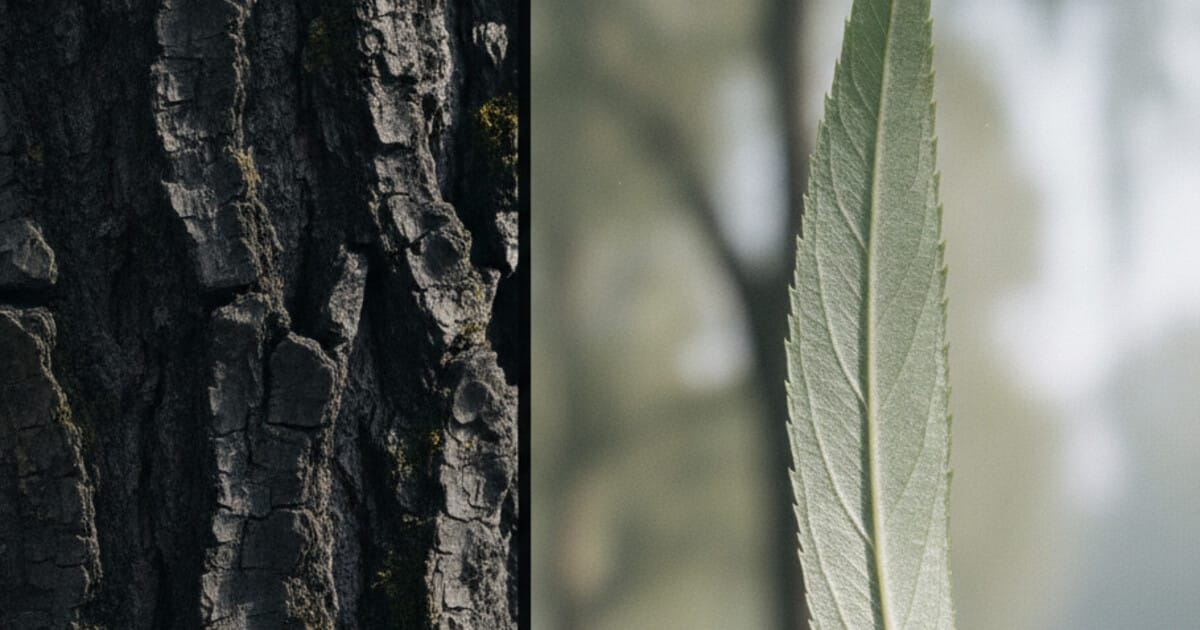
Black willow and white willow share the same upright growth form, nearly identical narrow leaves, and a preference for wet soils. Both handle cold winters down to USDA zone 2. People commonly confuse them in the northern U.S. and southern Canada where both turn up along rivers and stream banks. The two species evolved on opposite sides of the planet: one on North American flood plains, the other on European and Asian riverbeds before being introduced centuries ago. A single field test separates them instantly. Flip a leaf over. White willow leaf undersides look like brushed silver, coated in fine silky hairs. Black willow leaves are glossy green on both sides. That one character is faster and more reliable than any bark or branch comparison.
Black willow (Salix nigra) and white willow (Salix alba) look nearly identical from a distance but have one reliable separator: the leaf underside. White willow leaves have distinctive silvery-white silky hairs on the underside; black willow leaves are glossy green on both surfaces. Black willow’s near-black furrowed bark versus white willow’s gray-brown bark adds a second confirmation.
How Black Willow and White Willow Compare
A side-by-side summary before the full species breakdowns.
| Feature | Black Willow | White Willow |
|---|---|---|
| Scientific name | Salix nigra | Salix alba |
| Leaf underside | Glossy green | Silvery-white, silky hairs |
| Bark | Near-black, deeply furrowed | Gray-brown, shallowly furrowed |
| Typical form | Multi-stemmed | Single trunk |
| Height | 30–80 ft | 65–80 ft (20–25 m) |
| USDA Zones | 2–8 | 2–8 |
| Native origin | Eastern North America | Europe and western Asia |
| Typical habitat | Wild flood plains, river banks | Planted along waterways; naturalized |
| Twig color | Orange-brown to yellowish | Olive to golden-yellow |
The leaf underside test works reliably whenever a leaf is reachable. When you’re looking at a tall tree from the ground, bark pattern and stem form become your field tools.
Black willow (Salix nigra) is the largest willow native to North America, growing 30 to 80 feet along flood plains and river bottomlands from Maine and Ontario south to the Gulf Coast and west to Nebraska. White willow (Salix alba) is the European counterpart, native across central Europe, western Asia, and into North Africa, reaching 65 to 80 feet on moist riverside soils. Both species produce the same salicin compound in their bark. Hippocrates prescribed willow bark tea for fever and pain around 400 BC, and the isolation of salicin from Salix alba bark in 1828 directly led to the chemical synthesis of aspirin in 1897. White willow bark contains between 0.5% and 2% salicin by dry weight. Black willow bark also contains salicin but was never the commercial source. Both species can grow side by side in USDA zones 2 through 8, making them a genuinely instructive pair to study in the same riparian corridor.
For the full range of willow species, including pussy willow, corkscrew willow, dappled willow, and weeping willow, see the willow tree identification guide.
Black Willow (Salix nigra): Identification Features
Black willow is the largest willow native to North America. Mature trees reach 30 to 80 feet, with exceptional specimens on lowland flood plains occasionally pushing past 100 feet. The bark is the fastest identifier on tall trees: it starts reddish-brown and scaly on young stems, then develops into near-black, deeply interlocking ridges and rough plate-like scales by middle age. That near-black color at any age above 10 to 15 years is uncommon among willows and sets it apart from every other species in its eastern range.
Leaves run 3 to 6 inches long, lance-shaped with finely serrated edges. Both the upper and lower surfaces are glossy green, a clear contrast with white willow’s silver undersides. Twigs trend orange-brown to yellowish-brown and are brittle at the joints: older branches snap cleanly in wind storms rather than bending.
Black willow often grows multi-stemmed, with 2 to 4 trunks forking near the base. Combined with the dark bark and a wild flood-plain setting, that structure makes field ID reliable even from across a river. Catkins appear in April and May alongside the emerging leaves, not before them as they do in pussy willow.
The species grows across USDA zones 2 through 8, following river systems from southern Maine and Ontario through the Gulf Coast and west to Nebraska. It’s a native anchor for flood-plain forests, growing alongside sycamore, silver maple, and cottonwood where periodic flooding keeps competition thin. Historically, black willow charcoal was a key ingredient in black powder manufacture. The bark contains salicin, though the species wasn’t used commercially for that purpose the way European white willow was.
White Willow (Salix alba): Identification Features
White willow came to North America with European settlers, first documented in colonial plantings and now naturalized along waterways from the northeastern U.S. through the Midwest and into southern Canada. The silvery-white leaf underside is the definitive identifier and the source of its common name. Hold any leaf at eye level: the fine silky hairs catch light and give the whole canopy a glistening silver shimmer on a breezy day. No other common North American willow has that underside texture.
Leaves run 2 to 4 inches long, narrower than black willow’s, and taper to a fine point. The upper surface is dull green, the underside distinctly paler and silky. Twigs are olive to yellowish-brown on most trees. The cultivar ‘Vitellina’ (golden willow) carries bright golden-yellow twigs visible through winter, similar in color to weeping willow’s twigs and sometimes confused with them at a distance.
Bark on young white willows is olive-gray and relatively smooth. Mature trunks develop gray-brown bark with shallowly furrowed ridges. The color stays in the gray-brown range regardless of age, lighter and less dramatic than black willow’s near-black interlocking plates. On trees of similar size, the bark color contrast is a reliable secondary check after the leaf underside.
White willow typically grows as a single trunk with an upright to broadly spreading crown. The silhouette from a distance looks close to black willow’s, which is one reason people conflate them. The multi-stemmed, forked-base habit of black willow is the clearest crown-level distinction when leaves aren’t reachable.
One cultivar creates a common confusion. ‘Tristis’ is sold in many nurseries as “weeping willow” because its branches arch and droop. A ‘Tristis’ tree can be mistaken for true weeping willow (Salix babylonica) or for the widely planted hybrid S. × sepulcralis ‘Chrysocoma.’ The silvery leaf underside immediately separates it from both: neither Salix babylonica nor the common hybrid has silvery-white silky hairs on the leaf underside. For the full comparison, see White Willow vs Weeping Willow.
Where Each Species Grows
Black willow is a native, wild-growing tree tied to river systems. You’ll find it in flood plains, wet meadows, and the margins of rivers and streams across the eastern and central U.S. It grows where flooding is frequent and most other trees can’t handle saturated soils for extended periods. It shows up alongside cottonwood, silver maple, and box elder in bottom-land forest mixes, rarely planted as a landscape tree.
White willow was introduced to North America from Europe and has naturalized along stream banks, road ditches, and moist lowlands across the northeastern and midwestern U.S. into Canada. In some regions, naturalized white willows are common enough along waterways to look native on a casual walk, which adds to the confusion with black willow.
Both species have aggressive root systems. Neither should go near septic tanks, sewer lines, or building foundations. Their roots follow any water source and will crack clay pipes.
For a compact ornamental willow without the root aggression of these larger species, dappled willow (Salix integra ‘Hakuro-nishiki’) is a far better garden choice. It tops out at 4 to 6 feet as a shrub or 6 to 10 feet as a standard, with pink-flushed spring foliage that fades to white-green by summer.
If you need to compare black willow against weeping willow specifically, see Black Willow vs Weeping Willow. The crown habit is the fastest separator there: weeping willow branches cascade to near ground level while black willow grows upright to spreading.
How Tree Identifier Helps With Willow ID
When a tree is tall and the leaves aren’t within reach, the leaf-flip test isn’t available. Bark and crown habit become the only tools, and the gray-brown versus near-black bark distinction can be subtle on some trees or in low light.
Tree Identifier’s AI works from photos of bark, twigs, or whole-tree silhouettes. Photograph the bark pattern close up, capture the branch architecture from a distance, or snap a leaf if you can reach one. The app analyzes the image and returns a species identification with habitat, native range, and size information alongside the result.
The app runs on iOS and Android with 2 free identifications per day. No subscription needed to start. For quick lookups from a desktop or tablet, the web tool at treeidentifier.app/tools/tree-identifier handles lookups without downloading anything.
Frequently Asked Questions
What’s the fastest way to tell black willow from white willow?
Flip any reachable leaf and look at the underside. White willow leaves are coated in fine silky hairs that give them a distinctive silvery-white color. Black willow leaves are glossy green on both surfaces. This test takes about 5 seconds and works reliably regardless of tree age or season whenever a leaf is available. On tall trees, the near-black deeply furrowed bark of black willow versus white willow’s gray-brown bark is the best secondary check.
Do black willow and white willow grow in the same areas?
Their ranges overlap across the northeastern and midwestern U.S. and into southern Canada. Black willow grows wild on flood plains; white willow was introduced from Europe and appears both in planted settings and naturalized along waterways. In some river corridors, the two species grow within a few hundred yards of each other.
Is white willow native to North America?
White willow (Salix alba) is native to Europe, western Asia, and North Africa. European settlers brought it to North America and it has naturalized widely across the northeastern and midwestern U.S. and Canada. Black willow (Salix nigra) is the large native willow across those same regions.
Which willow is better for medicinal bark?
White willow (Salix alba) is the species historically used in European herbal medicine. Its bark contains 0.5% to 2% salicin by dry weight, the compound isolated in 1828 that led directly to aspirin’s synthesis in 1897. Black willow bark also contains salicin but wasn’t the commercial source. Both species were used in traditional medicine in their respective regions.
Can a white willow cultivar look like a weeping willow?
Yes. The cultivar ‘Tristis’ has arching, drooping branches and is sold in some nurseries under the name “weeping willow.” To separate it from true weeping willow (Salix babylonica), flip any leaf: ‘Tristis’ has the characteristic silvery-white silky underside of all white willows. True weeping willow and the common hybrid S. × sepulcralis ‘Chrysocoma’ have plain green leaf undersides.
Next time you’re standing near a river willow and want a quick ID, try Tree Identifier. Photograph the bark close up or grab a leaf for the underside test, and the app returns a species match with range and habitat details in seconds. It works offline, useful on remote stream hikes without cell service.
Identify a tree from your photo — free
Upload a leaf, bark, or whole-tree photo and get the species in seconds. No signup.
Confidence:
Unlock the full species profile
Free in the app — with unlimited identifications.


AI result for guidance — the app gives full species details and works offline.
Want unlimited identifications?
Get the full species profile, photos and details — free in the app, with unlimited scans.
- Unlimited identifications
- Full species profiles & details
- Works offline, anywhere
- Save and revisit your finds
Elena Torres
Tree Identifier Team