Carolina Ash Tree Identification: 7 Reliable Signs
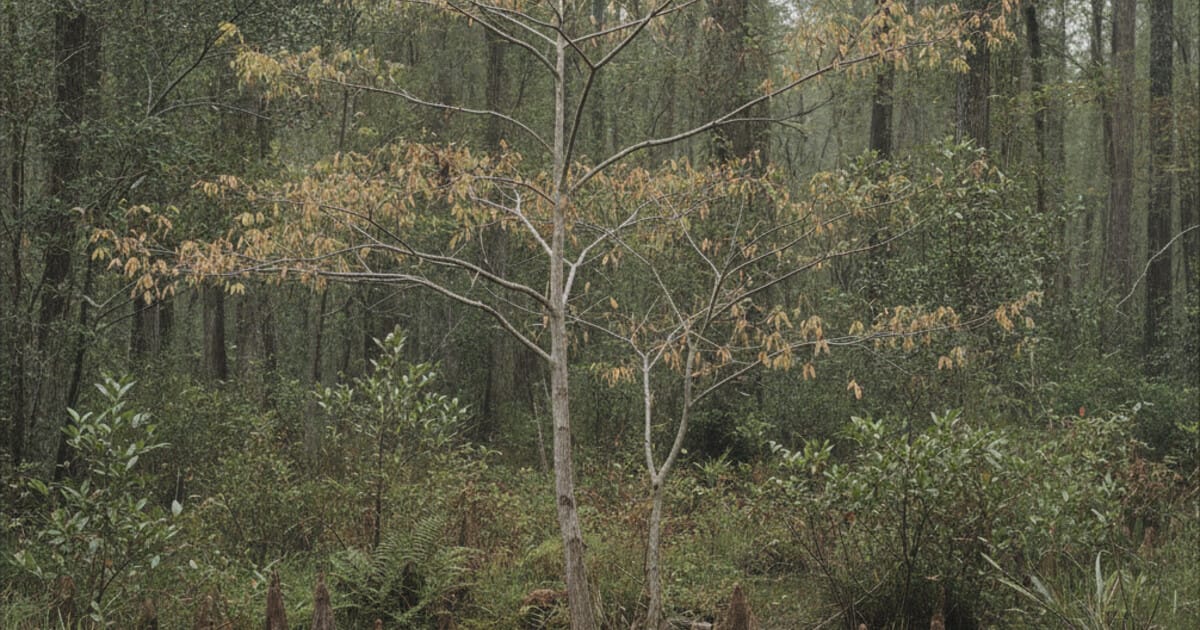
Carolina ash (Fraxinus caroliniana) is one of the least-recognized trees in the eastern United States, and that’s mostly because it grows in places most people don’t linger: coastal swamps, wooded floodplains, and saturated bottomlands where the ground stays wet for most of the year. If you’re picking your way through a swampy stretch of the southeastern coastal plain and spot a small ash-like tree with its roots in standing water, there’s a good chance you’ve found one.
The species rarely tops 30 feet. It grows as an understory tree beneath taller bottomland hardwoods like bald cypress and swamp tupelo, staying small and scraggly where other ashes would spread into a full canopy. Its modest stature and affinity for wet ground set it apart from its larger relatives, but confirming the ID takes more than noting “small ash in a swamp.” Here are 7 signs that make carolina ash tree identification reliable in the field.
Carolina ash (Fraxinus caroliniana) is identified by its small stature (typically 15-30 feet tall), compound leaves with 5-7 leaflets that have individual stalks (petiolules), and samaras with wings extending nearly to the seed base. It grows exclusively in wet swamps and bottomlands across the southeastern coastal plain, from Virginia south through Florida and west to eastern Texas.
What Is Carolina Ash? Range and Conservation Status
Carolina ash (Fraxinus caroliniana) is native to the southeastern coastal plain of the United States, from Delaware and Virginia south through all of Florida and west to eastern Texas. The species occupies coastal swamps, bottomland forests, and cypress-tupelo wetland communities where soils stay wet or seasonally flooded. Like all North American Fraxinus, it’s susceptible to the emerald ash borer (Agrilus planipennis), an invasive beetle from northeastern Asia first detected in the US in Michigan in 2002 and confirmed in Florida by 2020. The USDA Forest Service projects that EAB will kill virtually all untreated ash trees in North America over the coming decades. Carolina ash populations face compounded pressure: the species already occupies fragmented, isolated swamp habitats, and EAB attacks are accelerating die-off across the Southeast. State forestry agencies in Florida, Georgia, and South Carolina are actively monitoring Carolina ash stands in priority wetlands.
The tree goes by several common names. Water ash and pop ash are the most widespread, with pop ash being the regional Florida term. All names point to the same species and the same place: standing water.
Carolina Ash Leaves: Compound with Stalked Leaflets
Like all ash trees, Carolina ash has opposite, pinnately compound leaves. Each leaf holds 5-7 leaflets (most commonly 5) arranged along a central stalk. What matters for ID is that each leaflet has its own individual stalk, called a petiolule.
This one trait separates Carolina ash from black ash, which has sessile leaflets that attach directly to the rachis with no petiolule at all. If you’re in wet ground and you can see a gap of stalk between each leaflet and the central midrib, you’re looking at Carolina ash rather than black ash.
Carolina ash leaflets are oval to broadly lance-shaped, 2-4 inches long. The margins are variable: finely serrate on some specimens, nearly smooth on others. This smooth-to-nearly-smooth margin is unusual among eastern ashes, where serrated edges are more consistent. When leaflets look almost entire on an ash growing in a southeastern swamp, Carolina ash climbs the probability list fast.
Leaflets are medium green on top, paler below, with a slight sheen when fresh. The terminal leaflet is often noticeably larger than the lateral pairs.
Carolina Ash Samaras: The Wing Nearly Reaches the Base
The fruiting structure is the single most diagnostic feature for distinguishing Carolina ash from its relatives. Ash trees produce samaras: single seeds attached to a papery wing that helps with wind dispersal.
In most eastern ashes (white ash, green ash), the wing extends from roughly the middle of the seed body to its tip. The seed end is thick and wingless for its lower half.
In Carolina ash, the wing starts much lower. It extends nearly to the very base of the seed, sometimes wrapping partway around it. The overall samara looks uniformly winged along most of its length rather than being seed-heavy at one end.
The samaras are produced in dense hanging clusters and mature in late summer through fall. They’re smaller than white ash samaras, typically 1 to 1.5 inches long. When you see small ash samaras with the wing running nearly to the seed base, on a small tree standing in water in the Southeast, the ID is solid.
Bark: Gray and Finely Furrowed
Carolina ash bark is gray to pale gray-brown with shallow furrows and flat-topped ridges. The texture is finer and less deeply grooved than white ash or green ash, which develop pronounced interlocking diamond patterns on mature trunks.
On young trees and branches, the bark is smooth to slightly scaly. As the tree ages, the ridges sharpen, but the overall texture stays relatively fine-grained. Older trunks often have a grayish, almost powdery look to the surface.
Bark alone won’t close the ID on Carolina ash. Combined with habitat, leaf structure, and seed form, it confirms you’re in the right species.
Twigs: Round, Not 4-Angled
Twig cross-section is a fast field check among ash species. Blue ash is unique among eastern ashes for having distinctly 4-angled (square in cross-section) twigs. All other eastern ashes, including Carolina ash, have round twigs.
Carolina ash twigs are gray to pale gray, slender, and round in cross-section. The buds are dark gray to blackish, small, and somewhat flattened against the twig. The leaf scars are U-shaped or C-shaped, with 5-7 bundle scars visible, consistent with other ashes.
If you’re distinguishing Carolina ash from black ash in overlapping range, the petiolules settle it. Carolina ash leaflets have individual stalks. Black ash leaflets sit directly on the rachis. Check that one trait and the ID is done.
Habitat: A Strict Swamp Associate
More than any other single trait, habitat places Carolina ash with near-certainty in the right region. This species is an obligate wetland plant. It doesn’t tolerate dry ground. It grows in areas with seasonal to semi-permanent standing water: coastal swamps, floodplain forests, cypress-tupelo swamps, and wet bottomlands where the soil stays saturated.
The ecological company tells you what you need to know. If you’re seeing Carolina ash, you’re probably also seeing bald cypress, swamp tupelo (Nyssa biflora), buttonbush, water oak, and swamp red maple. The ground is soft and often inundated. Carolina ash roots can handle periods of full submersion.
It doesn’t grow on ridges, in dry uplands, or in disturbed urban areas. Spotting an ash-like small tree in a southeastern swamp, rather than on dry ground, is the single most useful heuristic before you examine any leaf or fruit.
How Carolina Ash Compares to Related Ash Species
A few quick comparisons help lock the ID when you’re uncertain.
Carolina ash vs. green ash: Green ash grows in a wide range of conditions, including wet areas, but also tolerates dry uplands and reaches 50-60 feet. Carolina ash stays under 30 feet and only grows in saturated swamp conditions. The samaras differ: green ash wings don’t reach the seed base, while Carolina ash wings extend nearly all the way down. Green ash also covers the entire eastern US; Carolina ash is limited to the coastal plain.
Carolina ash vs. white ash: White ash is a large upland tree, typically 50-80 feet, growing in mesic forests rather than swamps. Its samaras have wings covering only the upper portion of the seed. Size, habitat, and fruit structure all point away from Carolina ash when you’re looking at a white ash.
Carolina ash vs. black ash: Black ash also grows in wet conditions, but its range is strictly northern: New England, the Great Lakes, and into Canada. Carolina ash is southeastern. In the rare case of geographic overlap at the range margins, the sessile leaflets on black ash versus the stalked leaflets on Carolina ash close the debate immediately.
Frequently Asked Questions
Is Carolina ash the same as water ash?
Yes. Carolina ash (Fraxinus caroliniana) goes by several common names including water ash, pop ash, and swamp ash. Water ash refers to its strict wetland habitat; pop ash is the regional Florida term. All names refer to the same species.
How does Carolina ash differ from green ash in wet areas?
Green ash can grow in wet conditions but also tolerates dry upland soils and reaches 50-60 feet tall. Carolina ash stays under 30 feet and only grows in saturated swamp conditions. The samaras also differ: green ash wings don’t extend to the seed base, while Carolina ash wings reach nearly to the base. Green ash is found throughout the eastern US; Carolina ash is limited to the southeastern coastal plain.
Is Carolina ash threatened by emerald ash borer?
Yes. All North American ash species are susceptible to EAB. The beetle has spread throughout the southeastern coastal plain, including Florida, where Carolina ash is most abundant. Treatment options exist for high-value specimen trees, but most wild populations are unprotected. The combination of EAB pressure and the species’ already-fragmented swamp habitat makes population monitoring a priority.
Can you identify Carolina ash without seeds?
The combination of small stature (under 30 feet), wet swamp habitat, southeastern coastal plain location, compound leaves with stalked leaflets, and round twigs is enough for confident field identification without fruit. Seeds add certainty, but vegetative traits align well enough to make a reliable call on their own when all signs match.
Where is Carolina ash most common?
Florida has the most abundant Carolina ash populations, particularly in the central Florida swamps, coastal plain river systems, and the Big Bend region. The species is also common in Georgia, South Carolina, and Louisiana bottomlands. Virginia and Delaware populations sit at the northern edge of its range and tend to be smaller and more scattered.
If you’re moving through a southeastern swamp and want to confirm a Carolina ash ID on the spot, Tree Identifier can help. Photograph the compound leaves (show a full leaf with leaflets and the rachis), the bark, and any seeds if the tree is fruiting. The app processes multiple photo inputs and returns a species match with a confidence score. It works offline, so you don’t need a signal in remote swamp habitat. Two free identifications are available every day.
Identify a tree from your photo — free
Upload a leaf, bark, or whole-tree photo and get the species in seconds. No signup.
Confidence:
Unlock the full species profile
Free in the app — with unlimited identifications.


AI result for guidance — the app gives full species details and works offline.
Want unlimited identifications?
Get the full species profile, photos and details — free in the app, with unlimited scans.
- Unlimited identifications
- Full species profiles & details
- Works offline, anywhere
- Save and revisit your finds
Elena Torres
Tree Identifier Team