Evergreen Tree Identification: Beyond Pines and Spruces
What Makes a Tree Evergreen?
Evergreen tree identification starts with a basic question: does this tree hold its leaves year-round? If the answer is yes, it’s an evergreen. But that’s where the simplicity ends.
Most people hear “evergreen” and picture a Christmas tree. Pointed crown, green needles, pinecones on the ground. That covers pines, spruces, and firs, which we break down in detail in our pine vs spruce vs fir guide. But the evergreen category is far wider than the conifer aisle at a tree farm.
Broadleaf evergreens like Southern Magnolia, Live Oak, and Holly keep their flat, wide leaves through winter. Semi-evergreen species hold leaves in mild climates but drop them when temperatures plunge. And some needle-bearing evergreens, like yew and hemlock, look nothing like a typical pine.
This guide covers the evergreen species that most identification resources skip over.
Evergreen vs Deciduous: The Key Distinction
Deciduous trees drop all their leaves each fall, survive winter bare, and leaf out again in spring. Evergreens keep their foliage through every season. But “keep” doesn’t mean “forever.” Most evergreens shed and replace leaves on a rolling cycle, dropping older needles or leaves while retaining newer ones. A white pine holds its needles for about two years before they yellow and fall. A Southern Magnolia replaces its leaves gradually throughout the year.
The advantage for the tree is year-round photosynthesis. Evergreens can produce energy even in winter, though at reduced rates. The trade-off is that they need leaves tough enough to handle frost, snow load, and winter desiccation. That’s why evergreen leaves tend to be thick, waxy, or needle-shaped.
For identification purposes, the evergreen vs deciduous split is the first filter. If you’re looking at a tree with full foliage in January in a northern climate, you’ve already narrowed your options significantly.
Broadleaf Evergreens Most People Overlook
When people struggle with evergreen tree identification, it’s usually because they’re staring at a broadleaf species and don’t realize it qualifies. These trees have wide, flat leaves and keep them year-round.
Southern Magnolia (Magnolia grandiflora)
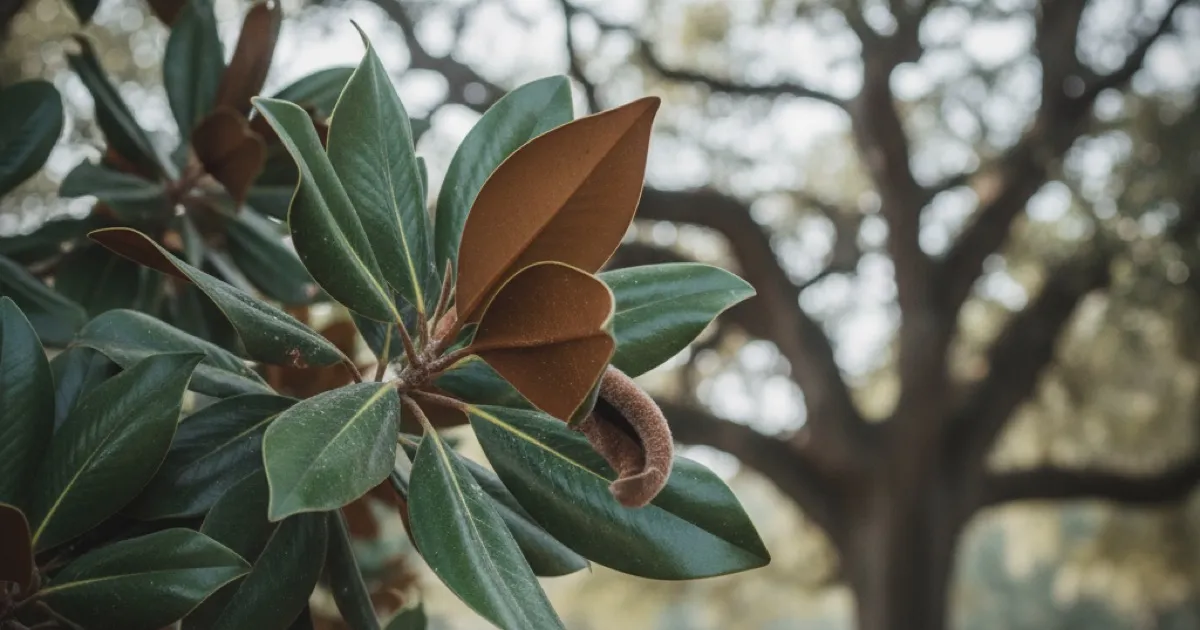
The Southern Magnolia is one of the most recognizable broadleaf evergreens in North America. Native from Virginia to eastern Texas, it reaches 60 to 80 feet tall with a dense pyramidal shape.
The identification giveaway: flip a leaf over. The upper surface is thick, glossy, and dark green. The underside is covered in rusty-brown felt. No other common landscape tree has that combination. Leaves measure 5 to 10 inches long.
In late spring and summer, Southern Magnolias produce massive white flowers up to 12 inches across with a strong lemon-citrus fragrance. For a deeper dive into all six common magnolia species, see our magnolia tree identification guide.
Live Oak (Quercus virginiana)
Live oaks are the wide-spreading, moss-draped trees that define the landscapes of the Deep South. They’re evergreen oaks, holding their small, leathery leaves through winter. The leaves are simple, oval-shaped, 2 to 5 inches long, dark green on top and grayish-green below. Edges are smooth, with no lobes or teeth.
Live oaks rarely top 50 feet in height but can spread 80 feet or more across. That horizontal branching habit is a strong field mark. If you see an oak with a crown wider than the tree is tall and leaves present in February, you’re almost certainly looking at a live oak.
Our oak tree identification guide covers the broader oak family, including red oaks and white oaks that lose their leaves seasonally.
Holly (Ilex opaca and Ilex aquifolium)
American Holly (Ilex opaca) is native to the eastern United States, while English Holly (Ilex aquifolium) is common in the Pacific Northwest and as an ornamental across the country.
Both are broadleaf evergreens with stiff, spiny leaves. American Holly has matte, olive-green leaves with scattered spines along the margins. English Holly leaves are darker, glossier, and more heavily armed with sharp teeth.
The red berries that appear on female trees in fall and persist into winter are the fastest identification shortcut. But be aware: male holly trees produce no berries at all, and they’re just as common.
Holly trees grow slowly and typically reach 20 to 50 feet. Look for the pyramidal shape, the alternating leaf pattern, and those characteristic spiny margins.
Rhododendron (Rhododendron maximum and others)
Wild rhododendrons form dense understory thickets in Appalachian forests and are planted as landscape shrubs across the country. While technically large shrubs or small trees, they’re important broadleaf evergreens that people often want to identify.
Rhododendron leaves are large (4 to 10 inches), leathery, dark green, and oblong with smooth edges. In cold weather, the leaves curl downward and inward, which is a defense against water loss. If you see a shrub in a winter forest with tightly curled, drooping leaves, it’s likely a rhododendron.
Spring brings large clusters of white, pink, or purple flowers. The native Rosebay Rhododendron (R. maximum) produces white to pale pink blooms in early summer, while the Catawba Rhododendron (R. catawbiense) flowers in purple and pink during late spring.
Needle-Leaf Evergreens Beyond Pine, Spruce, and Fir
The big three conifers get most of the attention, but several other needle-bearing evergreens are common across North America. These species have distinct characteristics that set them apart from the pine-spruce-fir group.
Arborvitae (Thuja)
Arborvitae, also called northern white cedar, has flat, scale-like foliage arranged in fan-shaped sprays. The leaves aren’t needles at all; they’re tiny overlapping scales pressed tightly against the twig. Crush a sprig and you’ll notice a strong, pleasant scent.
Eastern Arborvitae (Thuja occidentalis) grows wild from southeastern Canada through the Great Lakes region and into the Appalachians. Western Red Cedar (Thuja plicata) dominates moist forests in the Pacific Northwest. Both are commonly planted as hedge trees and privacy screens.
Arborvitae bark is thin, reddish-brown, and shreds in long vertical strips. The small, elongated cones (about half an inch long) stand upright on the branches. Our cedar tree identification guide explains how arborvitae fits into the confusing world of “cedar” names.
Eastern Hemlock (Tsuga canadensis)
Hemlocks are graceful, shade-tolerant evergreens found in cool ravines and north-facing slopes across the eastern United States. Their needles are short (about half an inch), flat, and attached to the twig by a tiny stem. Two white stripes run along the underside of each needle.
The easiest identification feature: hemlock branches droop. The overall silhouette is softer and more relaxed than a spruce or fir. The top of the tree, called the leader, bends over in a distinctive nod.
Small, oval cones hang from branch tips and measure about three-quarters of an inch long. These cones persist on the tree through winter.
Eastern hemlocks face a serious threat from the hemlock woolly adelgid, an invasive insect that appears as white, cotton-like tufts on the undersides of branches. If you spot those woolly masses, you’ve confirmed hemlock and identified a pest problem at the same time.
Yew (Taxus)
Yews are unusual evergreens. They produce fleshy red berry-like structures (technically arils) instead of cones. The flat, dark green needles are soft, about an inch long, and arranged in two rows along the twig, giving branches a feathery look.
Yew bark is thin, reddish-brown, and peels off in papery flakes. The overall growth habit depends on the species: English Yew (Taxus baccata) can become a full-sized tree reaching 40 feet, while Japanese Yew (Taxus cuspidata) and Canadian Yew (Taxus canadensis) stay shrubby.
Yews tolerate deep shade better than almost any other evergreen, so they’re common under forest canopies and as foundation plantings. If you see a low-growing evergreen with flat needles and red berries growing in heavy shade, yew is your top candidate.
Juniper (Juniperus)
Junipers range from sprawling ground covers to 40-foot trees. Most species have two types of foliage: juvenile leaves that look like short, prickly needles, and mature leaves that are tiny, overlapping scales similar to arborvitae.
The bluish, berry-like cones are the quickest identification mark. These are actually modified cones with fleshy scales that fuse together, and they take two to three years to mature. Eastern Red Cedar (Juniperus virginiana), one of the most common junipers, is found from the Atlantic coast to the Great Plains.
Juniper bark is reddish-brown and peels in thin, shreddy strips. The wood inside is aromatic, which is why cedar closets and cedar chests are usually made from juniper, not true cedar.
Identifying Evergreens in Winter
Evergreens have an identification advantage in cold months. While deciduous trees stand bare, evergreens keep their leaves and needles, giving you more to work with. But winter also presents unique challenges.
Snow and ice can obscure leaf details. Broadleaf evergreens like rhododendron curl their leaves tightly in freezing temperatures, making shape assessment harder. And lighting in winter forests is flat, which reduces the color contrast between species.
Focus on these features during winter tree identification:
- Silhouette: Hemlocks droop; spruces stand rigid; arborvitae stays flat and fan-shaped
- Bark: Yew bark peels in papery flakes; juniper bark shreds in strips; holly bark is smooth and gray
- Persistent fruit: Holly berries, juniper cones, and yew arils all remain visible through winter
- Leaf retention pattern: Live oaks hold all their leaves; some hollies drop a portion in harsh winters
A Quick Evergreen Tree Identification Key
Use this simplified key when you’re standing in front of an unknown evergreen:
-
Does it have broad, flat leaves (not needles or scales)?
- Glossy with rusty-brown underside: Southern Magnolia
- Small, leathery, oval with smooth edges: Live Oak
- Stiff with spiny margins: Holly
- Large, oblong, curling in cold weather: Rhododendron
-
Does it have needles?
- Bundled in groups of 2, 3, or 5: Pine (detailed guide here)
- Square, sharp, on pegs: Spruce
- Flat, soft, smooth scar when pulled: Fir
- Short, flat, with white stripes underneath and drooping branches: Hemlock
- Flat, dark green, soft, in two rows with red arils: Yew
-
Does it have tiny, overlapping scales instead of needles?
- Flat, fan-shaped sprays, aromatic: Arborvitae
- Berry-like blue cones, shreddy bark: Juniper
How Tree Identifier Can Help
Sorting through all these categories takes practice, and field guides can be slow when you’re staring at a tree you’ve never seen before. Tree Identifier speeds up the process.
Snap a photo of a leaf, a section of bark, a branch tip, or the whole tree, and the app’s AI returns a species identification with a confidence score. It works with all the evergreen types covered here, from broadleaf species like Southern Magnolia and Holly to needle-bearing conifers and scale-leaf junipers.
Tree Identifier runs on both iOS and Android. You get 2 free identifications per day with no subscription required. If you’re heading somewhere without cell service, download species data ahead of time and use the app’s offline mode on the trail.
The app identifies from multiple inputs: leaves, bark, flowers, fruit, and overall tree shape. So even in winter, when broadleaf evergreens have curled their leaves and conifers are covered in snow, a close-up of bark or a branch tip is enough for an accurate match.
Frequently Asked Questions
What is the difference between evergreen and deciduous trees?
Deciduous trees shed all their leaves in fall and grow new ones in spring. Evergreens keep their foliage year-round, though they do replace leaves gradually over months or years. The distinction matters for identification because any tree holding full foliage in mid-winter is either evergreen or dead. In northern climates during January, a tree with green leaves immediately narrows your options to evergreen species.
Are all evergreen trees conifers?
No. Many evergreens are broadleaf species with wide, flat leaves. Southern Magnolia, Live Oak, Holly, and Rhododendron all keep their leaves through winter without a needle in sight. Conifers (cone-bearing trees) are a subset of evergreens, and even that overlap isn’t complete. Larches and bald cypresses are conifers that drop their needles every fall, making them deciduous conifers.
How do I identify an evergreen tree in my yard?
Start with leaf type. If the tree has broad, flat leaves, check for spiny margins (holly), glossy leaves with brown undersides (magnolia), or small leathery ovals (live oak). If it has needles, check whether they come in bundles (pine), attach to pegs (spruce), or lie flat with white stripes underneath (fir or hemlock). Scale-like foliage points to arborvitae or juniper. For a quick answer, take a photo with a tree identification app and compare the result against the features described here.
Do evergreen trees lose any leaves at all?
Yes. Evergreens shed older leaves on a continuous cycle. Pines drop interior needles every 2 to 5 years, which is why you see brown needles on the ground beneath healthy pines each fall. Southern Magnolias drop older leaves year-round as new ones grow. The key difference from deciduous trees is that evergreens never stand bare; they always retain enough foliage to stay green.
Identify a tree from your photo — free
Upload a leaf, bark, or whole-tree photo and get the species in seconds. No signup.
Confidence:
Unlock the full species profile
Free in the app — with unlimited identifications.


AI result for guidance — the app gives full species details and works offline.
Want unlimited identifications?
Get the full species profile, photos and details — free in the app, with unlimited scans.
- Unlimited identifications
- Full species profiles & details
- Works offline, anywhere
- Save and revisit your finds
Elena Torres
Tree Identifier Team