Is My Furniture Real Wood or Veneer? 5 Quick Tests
You’re at an estate sale and you spot a dresser with rich, dark grain. The tag says “walnut.” The price feels almost reasonable. Before you load it into the car, one question matters: is this solid walnut, a thin veneer glued over plywood, or a photo-printed foil on particleboard? Knowing whether furniture is real wood or veneer matters for repairs, resale value, and identifying the wood species. Solid wood, veneer, and laminate each need completely different approaches when it’s time to refinish, patch, or restore a piece.
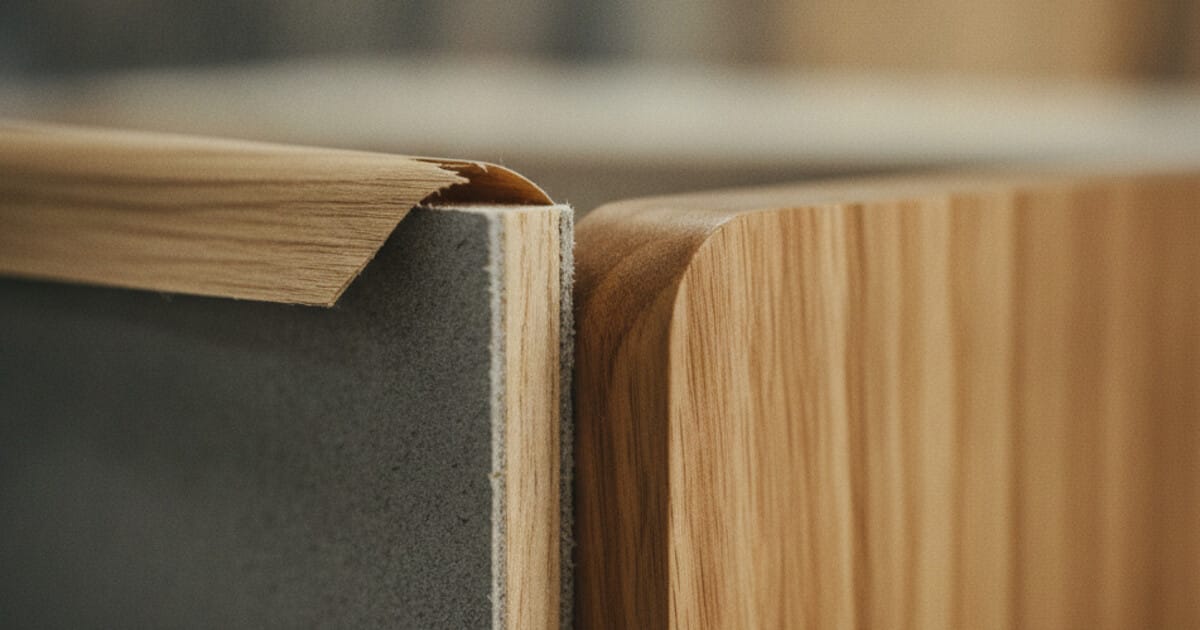
To tell if furniture is real wood or veneer, check exposed edges first. Solid wood shows continuous grain on all faces and edges. Veneer over MDF shows gray compressed particles at the cut edge. Veneer over plywood shows stacked plies. Laminate has no real grain depth. Confirm with the tap test, sand test, and grain symmetry check.
Check the Edges: The Fastest Real Wood vs Veneer Test
Pull open a drawer and flip it over. Look at the edges and the back panel.
On solid wood, the grain wraps continuously from face to edge to back. Same wood, same ring structure, same irregularities on all six faces. A solid oak drawer shows oak grain on every surface, including the cut edges, with no material change at the corner.
On veneer over MDF, the edge looks completely different from the face. MDF is compressed wood fiber and resin. Cut it and the edge shows gray or tan compressed material, sometimes covered with iron-on edge banding in a slightly different color than the face veneer. Perfect grain on the face, gray fiber at the edge: that’s veneer over MDF.
On veneer over plywood, the edge shows alternating light and dark layers: the cross-banded plies. Better quality than MDF-core, but the face and edge still don’t match.
Laminate and foil wrap are easiest to spot once you know the tell. The “grain” is a printed image with no actual depth. Scratch a corner with your fingernail: solid wood and real veneer show lighter wood underneath. Foil and laminate show white paper or plastic substrate.
Veneer has been used in furniture since ancient Egypt, when craftsmen applied thin wood slices to cedar and sycamore carcasses around 1450 BCE. In modern furniture production, veneer sheets run 0.5mm to 6mm thick depending on quality tier. Commercial flat-pack furniture typically uses 0.5mm to 0.8mm paper-thin veneer or PVC foil glued to particleboard (600–650 kg/m³). Mid-range production furniture uses 1.5mm to 3mm real-wood veneer over MDF (approximately 700 kg/m³). High-end and antique pieces built before 1900 used 3mm to 6mm hand-cut veneer over solid secondary wood such as pine or poplar. That thickness is why genuine antique veneers can be carefully sanded and refinished once or twice: there’s enough wood fiber to survive light abrasion. Modern commercial veneer averages 0.6mm, thin enough that a single refinish pass with 120-grit sandpaper removes it entirely. Knowing which category you’re dealing with determines every repair option available.
Grain Pattern and Symmetry: The Visual Test
Real solid wood has irregular grain. Trees grow around knots, respond to wind, and shift their ring spacing from year to year. A solid wood tabletop shows grain that wanders, varies in width, and changes character from one end to the other.
Veneer is sliced from a log and book-matched: two consecutive sheets are opened like a book to create a mirrored grain pattern. The result looks intentional and beautiful, but no natural solid wood panel ever produces perfect bilateral symmetry. If you see grain that mirrors itself across a center seam, that’s a book-matched veneer face.
Rotary-cut veneer (common in plywood and mid-range furniture) produces cathedral arch patterns that repeat with suspicious regularity. Solid wood can produce similar cathedral arches, but the spacing and width vary. Rotary-cut veneer looks almost mathematically consistent from one arch to the next.
Check pore depth under raking light. Hold a flashlight at a low angle across the surface. On real wood or thick veneer, you’ll see shadow inside the pores: actual depth. On thin veneer over MDF, the pores are shallower. On laminate, the “pores” are printed dots with no shadow at all.
For a detailed breakdown of grain patterns by species and how to read pore structure, see how to identify wood by grain.
The Tap Test and Sand Test
Tap the surface with your knuckle.
Solid wood resonates with a slightly warm note, a short ring. MDF and particleboard return a dull, dead thud: flat, heavy, no resonance. The difference is easy to hear once you’ve tapped a solid oak panel next to an IKEA particleboard shelf.
The sand test is definitive but mildly destructive. Use it on an inconspicuous spot: inside a drawer corner, the back of a leg, or anywhere hidden from view. Take a small piece of 100-grit sandpaper and sand a 1cm area.
Real solid wood produces tan or brown wood dust matching the surface color. MDF produces white or gray powder, the compressed fiber releasing as dust. Particleboard is similar. Stop the moment you see white. Thin veneer over MDF will go through the wood layer quickly, and the white substrate appears within a few passes.
If you can scratch a corner with your thumbnail, you’ll often see the same thing without sandpaper. Solid wood and real veneer scratch to a lighter wood tone. Foil and melamine laminate scratch to white plastic.
Weight: Useful Clue, Not a Definitive One
Weight comes up often in these conversations, but it’s a trickier test than people assume.
Solid hardwoods are dense: red oak runs around 800 kg/m³, hard maple around 705 kg/m³, and black walnut around 600 kg/m³. MDF is approximately 700 kg/m³. That puts MDF squarely between walnut and maple in terms of density. A large MDF-veneered dresser can feel just as heavy as a comparable solid walnut piece.
What weight does tell you: particleboard (600–650 kg/m³) feels noticeably lighter per volume than solid oak or MDF. If a piece feels surprisingly light for its size, particleboard is likely underneath. If it feels extremely dense and heavy, it could be MDF-core or solid hardwood, and the edge test tells you which.
Feel matters independently from weight. Run your hand across the surface. Real wood has subtle texture variation even under finish: the earlywood (softer, lighter spring growth) sits slightly lower than the latewood (denser summer growth). Under raking light, you can see this topography. A perfectly flat, glassy surface with no texture variation at all is usually laminate or foil.
Real Wood vs Veneer vs Laminate: Repair Options
The practical reason to run these tests before you buy or refinish is knowing what you can actually do with a piece.
Solid wood can be sanded, patched with wood filler, stripped, and refinished as many times as the thickness allows. A 2-inch solid oak tabletop could theoretically be refinished dozens of times across its lifetime. Repairs are forgiving.
Quality veneer (3mm to 6mm, typical of pre-1900 antique pieces) can be carefully sanded once with 220-grit and refinished. Lifted edges can be re-glued with hide glue and clamped flat. For help identifying the species in antique furniture before refinishing, see how to identify antique furniture wood.
Commercial veneer (0.5mm to 1.5mm, common in most furniture produced after 1960) can’t survive sanding. The wood layer is thinner than a credit card. Refinishing means chemical stripping and re-coating without any abrasion at all. Chipped or cracked thin veneer is a cosmetic patch job with a matching veneer piece, not a structural repair.
Laminate and foil wrap can’t be sanded, stripped, or refinished. The options are peel-and-stick veneer replacement, paint designed for laminate surfaces, or accepting the damage.
Identifying the Wood Species Once You Know It’s Real
If the edge test confirms solid wood or thick veneer, the next question is which species you’re dealing with.
Photograph the face grain in good natural light, then submit it to the Tree Identifier wood tool at treeidentifier.app/tools/wood-identifier. The tool reads grain pattern, pore structure, and color to identify the species from the photo.
Oak is the easiest to spot: wide medullary rays (silver flecks running perpendicular to the grain) are oak’s signature, especially on quartersawn faces where the rays appear as lustrous streaks up to 2mm wide. Walnut is dark chocolate-brown with straight tight grain and almost no visible pore banding. Maple is pale, close-grained, and nearly featureless. Cherry starts pale pink-orange and oxidizes to deep amber over decades.
If you photograph a piece and the grain looks suspiciously uniform, perfectly repeating, with no real pore depth under raking light, you’re likely looking at laminate or very thin veneer where there’s nothing structural for the AI to read. Real wood grain has texture, variation, and pore shadows that a camera picks up. If the surface cleans up with mineral spirits and shows distinct pores or rays, it’s real wood worth identifying.
Frequently Asked Questions
Is IKEA furniture real wood?
Most IKEA pieces use particleboard or MDF with a thin wood veneer or paper foil finish. A few product lines (such as MÖRBYLÅNGA) use solid wood for specific components, but most IKEA surfaces are veneered particleboard. Check the IKEA website’s materials section for each product: it will say “veneer,” “foil finish,” or “solid wood” directly.
Can veneer furniture be refinished?
It depends on thickness. Antique veneers (pre-1900 pieces) typically run 3mm to 6mm thick and can be lightly sanded and refinished with careful technique. Modern commercial veneer (0.5mm to 1.5mm) generally can’t survive sanding. Strip the old finish with a chemical stripper and re-coat without abrading the surface.
How do I fix bubbling or lifting veneer?
If the veneer is lifting but still intact, inject wood glue (or hide glue on antiques) under the lifted section, press flat with a clamped block or weighted board, and let it cure 24 hours. If the veneer has cracked, chipped, or gone brittle, it needs a cosmetic patch with a matching veneer piece cut to fit the damaged area.
What’s the difference between veneer and laminate?
Veneer is a thin slice of real wood glued to a substrate. The grain has actual depth, natural variation, and visible pore structure. Laminate (also called melamine or high-pressure laminate) is a printed paper or plastic layer with no real wood. Sand a corner: veneer produces wood-colored dust, laminate produces white powder.
Is quarter-sawn furniture always solid wood?
Quarter-sawn refers to a cut angle (logs sawn radially rather than plain-sawn), not necessarily solid construction. Veneer can be cut in a quarter-sawn pattern to display the ray figure. The grain pattern and medullary rays in quartersawn oak are real regardless of whether the piece is solid or veneered. Use the edge test to determine which.
Before you buy, refinish, or repair a piece of furniture, the edge test takes 30 seconds. Flip a drawer, inspect a cut corner, or look at any exposed cross-section. The substrate tells you exactly what you’re working with. If it’s solid wood or thick veneer, photograph the grain and run it through the Tree Identifier wood identifier to nail the species, or open the Tree Identifier app on iOS or Android to identify from grain pattern and color on the spot.
Identify a tree from your photo — free
Upload a leaf, bark, or whole-tree photo and get the species in seconds. No signup.
Confidence:
Unlock the full species profile
Free in the app — with unlimited identifications.


AI result for guidance — the app gives full species details and works offline.
Want unlimited identifications?
Get the full species profile, photos and details — free in the app, with unlimited scans.
- Unlimited identifications
- Full species profiles & details
- Works offline, anywhere
- Save and revisit your finds
Elena Torres
Tree Identifier Team