How to Identify Wood by Grain: A Visual Field Guide
Color is the first thing most people notice when they’re holding a mystery piece of wood. But color shifts with age, sunlight exposure, and finish, so it’s unreliable on its own. Learning how to identify wood by grain is far more dependable. Grain pattern is fixed at the time the tree grows, so you can narrow most pieces down to a handful of candidates, often to a single species, without any special equipment.
This guide covers how to identify wood by grain using three surfaces (end grain, face grain, edge grain), the two main pore patterns in hardwoods, and the key markers in softwoods. Whether you’re a woodworker sourcing reclaimed lumber, an antique buyer trying to verify what you’re looking at, or just curious about a tree that came down in your yard, the approach is the same.
To identify wood by grain, check the end grain first. Ring-porous hardwoods (oak, ash, elm) show a band of large pores in the earlywood and tiny pores in the latewood. Diffuse-porous hardwoods (maple, cherry, birch) distribute pores evenly throughout. Softwoods (pine, fir, cedar) show no pores, just alternating pale and dark growth bands. Each pattern points to a different group of species.
What Wood Grain Reveals About Species
Wood grain forms as a tree adds one ring each growing season. Each ring has two parts: earlywood (spring growth, faster, lighter, larger cells) and latewood (summer growth, slower, denser, darker). The structure of those cells, specifically whether they contain large vessel openings called pores and how those pores are distributed, is what grain reading is really about.
Ring-porous hardwoods form large vessel cells in spring, then switch to much smaller vessels in summer. This creates a clear visual boundary: a band of open pores in the earlywood, then tight dense latewood. Oak, ash, elm, hickory, and chestnut all fall in this group. Their earlywood pores are large enough to see without magnification, typically 0.3 to 0.5mm in diameter for white oak, while latewood pores shrink to under 0.1mm.
Diffuse-porous hardwoods distribute vessels evenly across the entire growth ring. There’s no pore band, just a uniform field of small openings roughly 0.05 to 0.15mm wide. Maple, cherry, birch, poplar, and walnut (technically semi-ring-porous, but it reads as diffuse) belong here. Growth ring boundaries are subtle, sometimes only visible as a faint color shift.
Softwoods carry no vessels at all. Conifers move water through tracheids instead, which are too small to see. What you see in softwood end grain is alternating pale earlywood and darker latewood bands, plus small white or tan dots in pine, fir, and spruce (resin canals). Cedar and redwood have no resin canals, so their end grain reads as clean alternating bands without any dots.
North America has roughly 170 native wood-producing tree species, split about 60% hardwood and 40% softwood by genera count. Ring-porous genera number around 30; oak alone accounts for about 90 species in North America. Diffuse-porous genera concentrate in maple (13 species), cherry (several dozen Prunus), birch (around 18 species), and walnut (Juglans, 3 native species). Among softwoods, pine leads with 36 native species, followed by fir (11) and spruce (8). Annual ring width provides a secondary cue: temperate oak typically grows 2 to 4mm per year, while pine averages 4 to 10mm under similar conditions. Hardness adds another layer: white oak tests at 1,360 lbf on the Janka scale, hard maple at 1,450 lbf, black walnut at 1,010 lbf, and Eastern white pine at 380 lbf. Combining pore pattern with ring width and hardness pins down species faster than any single cue alone.
How to Identify Wood by Grain on End Grain
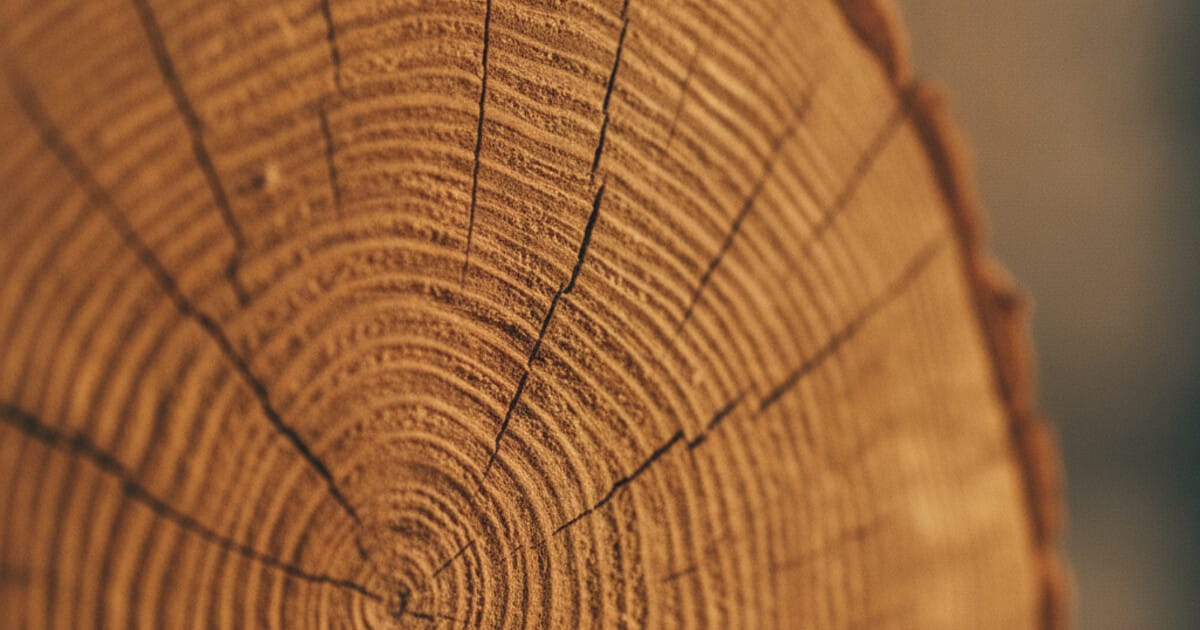
End grain, the cross-section you see when you cut across a log or board, is the most diagnostic surface. It shows the pore pattern, ring spacing, ray structure, and any resin canals directly. For how to identify wood purposes, it’s the first cut to make when you have access to it.
To read end grain clearly, get a clean surface. Sand to 220 grit if you can. Angle a light source low across the cut. Pores appear as tiny holes or dots; rays appear as thin lines radiating outward from the center.
For ring-porous wood, you’ll see a band of large open pores in the inner earlywood zone, surrounded by tight dense latewood. In white oak, the rays are also prominent, often 1 to 4cm long, visible without a loupe. No other common North American ring-porous species has rays anywhere near this width. Red oak has similar rays, but unlike white oak, its pores lack tyloses, the foam-like outgrowths that plug white oak’s pores and make it waterproof.
For diffuse-porous wood, pores spread evenly across the ring with no visible jump in size. Cherry shows fine, uniformly spaced pores with a reddish-pink tint in freshly cut end grain. Hard maple’s pores are so small that the end grain surface looks almost smooth, closer to ivory than wood.
For softwood, look for the alternating pale/dark band pattern of growth rings, plus resin canals in pine, spruce, and fir. Eastern white pine has wide pale earlywood bands and fine latewood. Southern yellow pine compresses those rings tight, with a very dark, resinous latewood band.
Reading Face Grain and Edge Grain
Face grain, the wide flat surface of flat-sawn lumber, shows the annual ring arches in a cathedral pattern. In ring-porous woods, you’ll see open pore lines running lengthwise, more pronounced in the earlywood zones. The understanding wood grain patterns on face grain are less definitive than end grain, but several species reveal distinctive figure here.
Edge grain (the quartersawn surface) is where some species show their most telling feature: ray fleck. White oak quartersawn produces a broad, silvery ray pattern across the surface, sometimes called silver grain or tiger grain, because the medullary rays cut at 90 degrees to the face and reflect light. No other common North American wood produces ray fleck at this scale. Red oak has similar but slightly narrower rays.
Interlocked grain creates a ribbon stripe on quartersawn surfaces, where alternating sections appear lighter and darker. You’ll see this in mahogany and teak, and sometimes in black walnut. Curly or wavy grain, often called fiddleback figure, appears as a rippled three-dimensional wave across the face surface. Bird’s-eye figure in hard maple shows scattered circular indentations, each one where a dormant bud was absorbed into the wood.
Species-Level Identification by Grain
Once you’ve placed the wood as ring-porous, diffuse-porous, or softwood, a few secondary cues separate the species.
Ring-porous hardwoods:
- Oak: wide medullary rays, visible without magnification; tyloses plug pores in white oak (pores appear filled and closed) vs open pores in red oak
- Ash: straight parallel grain; rays narrow and hard to see; pale cream to light brown; heavier than it looks
- Elm: interlocked grain producing a wavy, irregular ring pattern; rays fine; sometimes shows a distinctive “feathered” figure
- Hickory: extremely tight growth rings; very dense and heavy (shagbark hickory Janka 1,820 lbf); narrow rays
Diffuse-porous hardwoods:
- Hard maple: very fine pores, pale white to cream, straight grain; dense and heavy
- Black walnut: chocolate-brown heartwood, semi-ring-porous pores, often wavy grain creating light/dark contrast
- Cherry: reddish-pink when freshly cut, darkens to rich red-brown over months; fine straight grain; subtle rays
- Yellow birch: fine diffuse pores, pale yellowish-white heartwood, faint growth ring boundaries
Softwoods:
- Eastern white pine: pale yellow to white, wide earlywood, fine latewood, sparse resin canals
- Douglas fir: strong earlywood/latewood contrast with an orange-red tint in heartwood; prominent resin canals
- Western red cedar: no resin canals, reddish-brown with a sharp aromatic scent, very lightweight, distinct grain lines
- Sitka spruce: nearly white, fine straight grain, resin canals present, exceptionally uniform texture
For a fuller breakdown of how hardness and structure separate species, the hardwood vs softwood guide covers the cellular differences in more depth.
Common Mistakes When Reading Grain
Finish is the most common obstacle. A heavy polyurethane or lacquer film obscures fine pore details, but the overall ring pattern usually reads through it. For a cleaner look, sand through the finish on an inconspicuous corner, or wet the surface with mineral spirits, which temporarily reduces glare and shows pore structure more clearly.
Stain throws off color cues but has almost no effect on grain pattern. A piece stained to look like walnut still shows oak’s ring-porous pore band and wide rays. Grain doesn’t dye the same way wood fiber does, so the structural pattern survives most surface treatments.
Aged and weathered wood loses surface color and sometimes surface texture, but end grain structure stays intact. A 100-year-old oak beam still shows the same ray fleck and pore pattern as freshly milled oak.
Veneer is the trickiest case. Veneer slices can be as thin as 0.5mm, and end grain may not be visible at all. Face grain cues (ray fleck, pore lines, figure) are your main tools. Knocking on the surface and listening for the hollow sound of particle board underneath is a practical first check before reading grain at all.
How the Tree Identifier App Helps
The Tree Identifier app includes wood type recognition as a built-in feature, not an add-on. Photograph the end grain or face grain under natural light, upload it in the app, and it returns species matches with confidence scores based on grain texture, color, and visible pore pattern.
You get 2 free identifications per day without a subscription. The dedicated wood identifier tool on the website works for quick checks without opening the app.
For the clearest results, photograph end grain rather than face grain when you can get a fresh cut. Crop tight so pores and growth rings fill most of the frame. Heavy finish on the surface reduces accuracy, so a light sand on one corner before photographing makes a measurable difference.
The app identifies both living trees and harvested wood, which means you can use the same tool whether you’re standing in front of a tree or holding a board in a workshop. For identification by leaf, bark, or flower on living trees, the how to identify wood type guide has a step-by-step breakdown of the full workflow.
Frequently Asked Questions
Can you identify wood species from face grain alone?
Sometimes, but end grain is more reliable. Face grain shows ring pattern, figure, and some pore lines, but species with similar color and texture can look nearly identical on the flat surface. White oak and American chestnut, for example, are hard to separate on face grain alone. End grain adds the pore pattern data that resolves most ambiguous cases.
What’s the difference between ray fleck and regular grain lines?
Regular grain lines run lengthwise along the wood, following the growth rings. Medullary rays run radially, from the center of the tree outward. On a quartersawn surface, rays cut at 90 degrees and appear as broad, lustrous flecks or streaks, often called silver grain. White oak’s rays are wide enough (up to 4cm) to be obvious. On flat-sawn surfaces, rays show as thin lines running across the grain, which are easy to overlook.
How do I separate oak from ash by grain?
Both are ring-porous with visible earlywood pore bands. Oak has wide medullary rays visible without magnification; ash rays are narrow and hard to spot. Oak’s latewood is very tight and dense; ash’s is slightly more open. On quartersawn surfaces, oak produces ray fleck while ash doesn’t. If you’re still unsure, ash is almost always straighter-grained and somewhat lighter in color than oak.
Does wood grain change as the wood ages?
The underlying pore structure doesn’t change. Annual rings, ray width, and pore pattern are fixed at the time the wood forms. What changes with age is surface color (oak and cherry both darken significantly) and sometimes surface texture as fibers compress or raise. A clean fresh cut always restores the original grain pattern for identification purposes.
How reliable is photo-based wood grain identification?
Reasonably accurate for common domestic species, especially with a clear end grain photo. Uncommon tropical species or heavily figured wood can produce ambiguous results since the figure masks the underlying pore pattern. The Tree Identifier app performs best with end grain photos taken in natural light, with fresh cuts rather than finished surfaces. For antique furniture identification, grain reading narrows the field but often needs corroboration from hardware, construction method, and finish type.
Wood grain doesn’t lie. A fresh end grain cut tells you more about a species in under a minute than most other identification methods combined. Start with pore pattern (ring-porous, diffuse-porous, or no pores), add ray width and ring spacing, and most pieces resolve to at least a genus quickly. When the grain is obscured by finish or age, the Tree Identifier app’s wood recognition feature gives you a fast second check. Try photographing the next board you can’t place.
Identify a tree from your photo — free
Upload a leaf, bark, or whole-tree photo and get the species in seconds. No signup.
Confidence:
Unlock the full species profile
Free in the app — with unlimited identifications.


AI result for guidance — the app gives full species details and works offline.
Want unlimited identifications?
Get the full species profile, photos and details — free in the app, with unlimited scans.
- Unlimited identifications
- Full species profiles & details
- Works offline, anywhere
- Save and revisit your finds
Elena Torres
Tree Identifier Team