How to Identify Antique Wood Furniture: Visual Field Guide
You find a chest of drawers at an estate sale. The wood is dark, rich, and old. The tag says “antique walnut,” but is it? Or is it stained cherry? Maybe dark-finished mahogany? Knowing how to identify antique furniture wood matters for three reasons: accurate valuation, selecting the right finish for repairs, and knowing whether you’re looking at solid wood or a later laminate. Old wood looks different from new lumber. Patina, oxidation, and decades of wax change the surface color significantly. The underlying grain structure stays the same. With a few visual tests and a close look at exposed end grain, you can narrow most pieces down to species without any lab equipment.
To identify antique furniture wood, start with the grain pattern: ring-porous species like oak and ash show distinct earlywood and latewood bands; diffuse-porous species like walnut, cherry, and maple show finer, more even grain. Check base color by scraping a hidden area, inspect end grain, and compare weight. Most pre-1900 American furniture used walnut, oak, cherry, maple, or mahogany.
Why Wood Species Matters in Antique Furniture
Species places a piece in its era and likely region of origin. American furniture styles tracked closely with available timber: Chippendale makers (1750-1780) favored Cuban mahogany imported from the Caribbean; the Federal period (1780-1820) leaned on cherry and hard maple from New England forests; Victorian workshops (1840-1900) used black walnut heavily before over-harvesting made it scarce by 1890; Arts & Crafts makers (1880-1920) specified quartersawn white oak for its cathedral ray-fleck figure.
Pre-1900 furniture is nearly always solid wood. Plywood wasn’t commercially practical until the early 1900s, and furniture-grade particleboard didn’t exist until the 1960s. If a piece looks pre-1900 but something seems thin or layered, it’s either veneer over solid wood (common in high-end case pieces after 1800) or a later repair.
Species also drives repair decisions. Walnut is a cool chocolate-brown. Cherry starts pinkish-red and darkens to deep amber over 20-30 years. Staining a cherry repair to match walnut fails within a few years as the cherry’s natural tannins resurface through the colorant.
How to Identify Antique Furniture Wood by Grain Pattern
Grain pattern is the most reliable visual starting point when you’re trying to identify antique furniture wood. Two structural categories cover most pieces you’ll encounter.
Ring-porous woods (oak, ash, chestnut, hickory) have large pores concentrated in the earlywood, the fast-growing spring wood, and smaller, denser cells in the latewood. On a flat-sawn surface you see clear alternating bands: broad, open-grained rows followed by tighter, darker rows. Oak’s medullary rays (silver-gray flecks running perpendicular to the grain) are distinctive enough to spot at a glance, especially on quartersawn pieces where rays appear as wide, lustrous streaks up to 2mm wide.
Diffuse-porous woods (walnut, cherry, maple, birch, beech) distribute pores more evenly across the growth ring. The surface reads smoother and more uniform without the stark banding. Walnut shows a wavy, irregular figure. Cherry has clean, straight grain with subtle rays. Maple often shows tight, almost featureless grain, or in figured pieces, curly or bird’s-eye patterns from localized grain distortion.
The 5 species that dominate American antique furniture are American black walnut (Juglans nigra), white oak (Quercus alba), American black cherry (Prunus serotina), hard maple (Acer saccharum), and Cuban mahogany (Swietenia mahagoni). Each has measurable visual characteristics. Walnut has a Janka hardness of 1,010 lbf and a chocolate-brown heartwood that contrasts sharply with its pale sapwood. White oak reads 1,360 lbf and displays silver-gray medullary rays spanning 1-2mm wide in quartersawn boards. Cherry measures 950 lbf and oxidizes from pinkish-red to deep amber over roughly 20-30 years of light exposure. Hard maple reaches 1,450 lbf with fine, closed grain and a pale cream to honey color. Cuban mahogany, now CITES-protected and unavailable as new stock, shows an interlocked grain that produces a distinctive ribbon figure on quartersawn surfaces, with a Janka rating around 900 lbf. Knowing these 5 covers roughly 80% of American antique case furniture.
For a breakdown of ring-porous and diffuse-porous patterns with visual examples, see how to identify wood by grain.
Color Under Patina: What Antique Wood Actually Looks Like
Old wood doesn’t look like new wood. Decades of wax, shellac, and light oxidation layer over the base color. You need to read under the patina to identify the species correctly.
Scrape a small hidden area with your fingernail or a pen knife: the inside face of a drawer side, under a corner block, or the back of a cabinet panel. Even a 2mm scratch reveals the base color. What you’re typically looking at under the surface:
- Walnut: chocolate-brown heartwood, sometimes with a purple-grey cast; pale cream sapwood visible at edges
- Cherry: deep amber-red under patina; freshly cut areas show lighter pinkish-red
- White oak: tan to light brown with silver rays; slightly more olive-grey than red oak
- Maple: pale cream to honey-yellow; almost no warmth compared to cherry or walnut
- Mahogany: reddish-brown with an orange tint; figure depends heavily on cut angle
- American chestnut: similar in color to oak but without prominent rays; nearly all chestnut furniture predates 1930, when the blight eliminated the species from North American forests
One note on finishes: shellac, the standard pre-1900 finish, darkens wood considerably more than modern polyurethane. A stripped piece typically looks several shades lighter than you’d expect.
Softwoods show up in secondary wood: drawer bottoms, cabinet backs, internal framing. Pine, poplar, and cedar are common. They’re lighter in weight, show visible resin lines or canals, and have pronounced growth rings without visible pores.
End Grain and Weight: The Confirming Tests
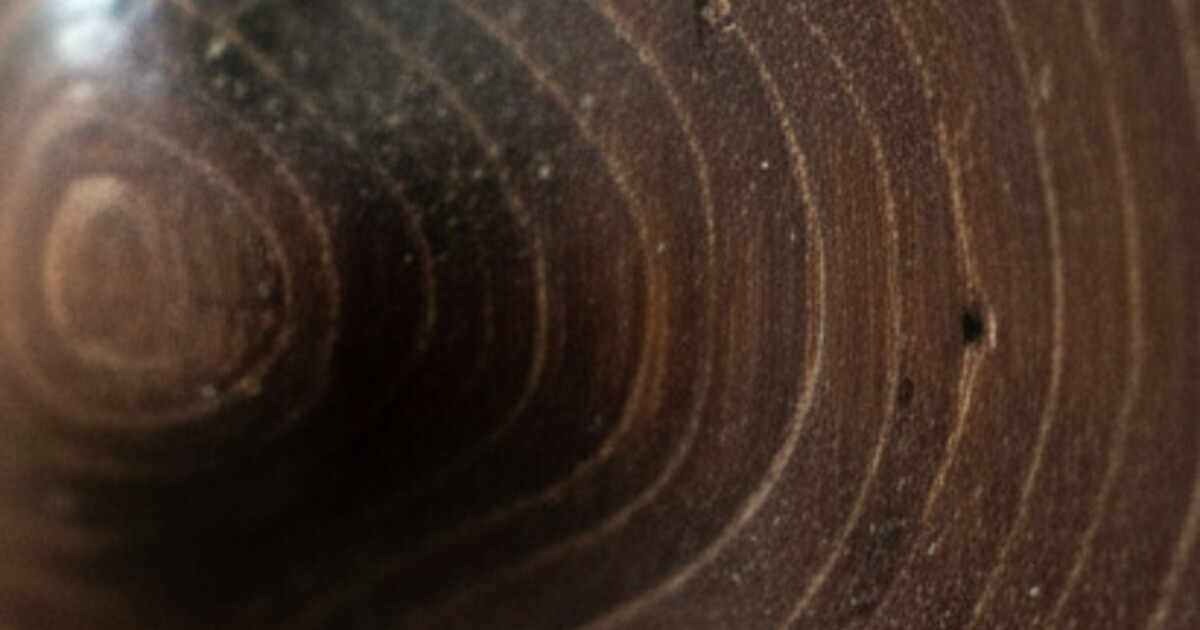
If you can access end grain, use it. End grain shows the ring structure and pore pattern directly, without the smoothed and finished surface you see on faces and edges. Look at drawer sides, the bottom of legs, or any exposed cross-section.
For ring-porous species, you’ll see large pores clustered in the earlywood rings and smaller, tighter pores in the latewood. Oak’s rings are visible without magnification. A 10x loupe (about $8 at any hardware store) makes the distinction between ring-porous and diffuse-porous unmistakable. For diffuse-porous species, pores distribute evenly across the growth ring at roughly similar sizes, giving a fine, uniform texture at the end.
Weight tells you a lot too. Pull a drawer from the case and hold it. Walnut is moderately heavy. Oak is heavier, noticeably denser per cubic inch. Maple feels solid even in thin sections. Cherry is lighter than walnut despite similar hardness numbers. Pine and poplar drawer bottoms feel almost hollow compared to hardwood sides.
A useful pattern in American case furniture: if drawer bottoms are soft and light with visible resin lines, they’re softwood (likely pine in Northern pieces, yellow pine in Southern ones). Pale cream drawer sides with tight, even grain are typically maple. Warm tan-brown sides with open grain usually mean oak or chestnut.
Common Antique Furniture Wood Pairings to Know
Period American furniture rarely used just one wood throughout a piece. Case furniture often combined a primary wood for visible surfaces with a secondary wood for interior parts. Learning the common pairings speeds up identification.
Federal-period pieces (1780-1820) frequently show cherry or maple on exterior surfaces with pine drawer bottoms. Chippendale furniture uses Cuban or Honduras mahogany on exterior surfaces with secondary poplar or pine. Victorian walnut pieces often have poplar or soft maple for drawer sides, and yellow pine for back panels. Arts & Crafts case furniture (1880-1920) is typically quartersawn white oak throughout, even for interior parts, distinguishing it from Victorian work.
Primary versus secondary wood is a clue to authenticity too. If a claimed period piece shows plywood or particleboard anywhere inside, it’s either a later reproduction or has been significantly rebuilt.
Identifying Antique Furniture Wood with the Tree Identifier App
The Tree Identifier app includes wood identification from photos, one of its core features alongside tree ID. Point your phone at a flat, clean wood surface, take a close photo of the grain, and submit it through the /tools/wood-identifier. The app reads grain texture, pore pattern, color, and ray structure from the photo and matches against species in its database.
For antique furniture, clean a small hidden area first. Old shellac and built-up wax absorb light and shift color readings. A quick wipe with mineral spirits on a hidden spot is enough to reveal the base wood. Shoot the grain at a slight angle so raking light picks out the texture.
End grain photos work particularly well. If you can photograph a drawer end or the bottom of a removed leg, that cross-section gives the app the clearest possible read on pore pattern and ring structure. For a step-by-step approach to narrowing down wood type from first principles, how to identify wood type walks through the full decision tree.
Frequently Asked Questions
How do I tell walnut from mahogany in antique furniture?
Walnut is a cool chocolate-brown with a wavy grain and clear contrast between dark heartwood and pale sapwood at edges. Mahogany runs warmer, reddish-brown with an orange cast, and often shows a ribbon or interlocked figure on quartersawn surfaces. Under a loupe, mahogany’s end grain shows larger, more evenly distributed pores than walnut’s more variable pattern.
Can I identify antique furniture wood without damaging the piece?
Mostly yes. Grain pattern, ray visibility, color, and weight give you enough to narrow most pieces to 2-3 candidates without touching the surface. A fingernail scrape on a hidden area (inside a drawer face, under a rear rail) reveals base color without visible damage. End grain inspection requires no surface contact at all.
Is American chestnut still found in antique furniture?
Yes, fairly often in northeastern US pieces made before 1930. American chestnut (Castanea dentata) was a dominant hardwood before the chestnut blight arrived in 1904 and eliminated the species by the 1940s. It resembles oak in color but lacks oak’s prominent medullary rays. Drawer sides and secondary wood in New England furniture sometimes show chestnut even when the primary wood is something else.
What wood did Shaker furniture makers typically use?
Shaker craftsmen used whatever grew locally near each community. New England communities (Canterbury, Hancock) favored cherry and hard maple. Midwestern communities (Pleasant Hill, Union Village) leaned on walnut and poplar. Shaker pieces rarely used mahogany, which they considered too ornate. The spare, undecorated designs mean the grain itself carries most of the visual interest.
How accurate is photo-based wood identification on antique surfaces?
Accuracy depends heavily on surface condition and photo quality. Clean grain under good natural light gives the best results. On heavily patinated antique surfaces with built-up shellac, accuracy drops. Clean a small hidden area first with mineral spirits, shoot in diffuse natural light without flash, and photograph the grain at a slight angle to bring out texture. End grain shots are more accurate than face grain on finished pieces.
Next time you’re at an estate sale, flip a drawer out and look at the end grain. That single cross-section, combined with weight and base color, will place most pieces within a species or two. The Tree Identifier app handles wood identification from photos on both iOS and Android: point the camera at clean grain or end grain, submit the photo, and get a species match in seconds. Two free daily identifications means you can check a piece on the spot before you buy.
Identify a tree from your photo — free
Upload a leaf, bark, or whole-tree photo and get the species in seconds. No signup.
Confidence:
Unlock the full species profile
Free in the app — with unlimited identifications.


AI result for guidance — the app gives full species details and works offline.
Want unlimited identifications?
Get the full species profile, photos and details — free in the app, with unlimited scans.
- Unlimited identifications
- Full species profiles & details
- Works offline, anywhere
- Save and revisit your finds
Elena Torres
Tree Identifier Team